
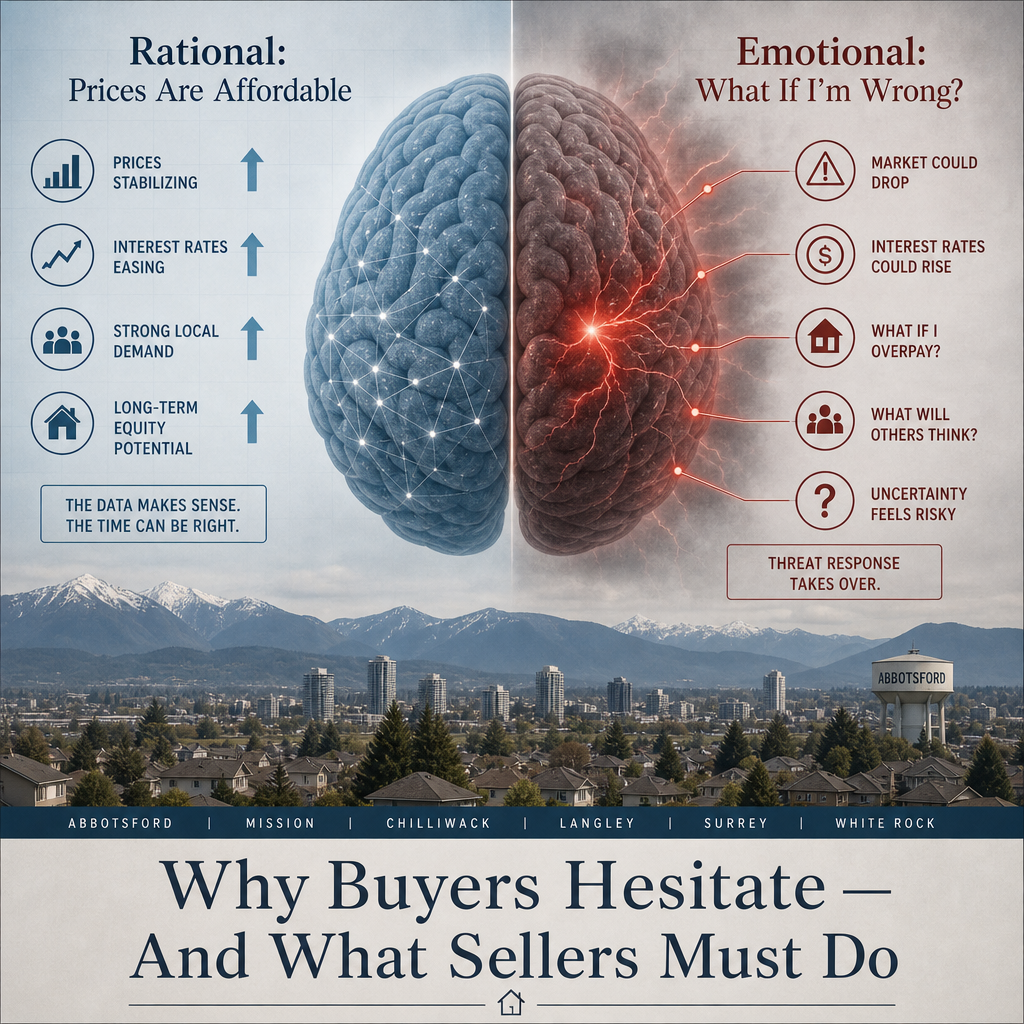

Why Buyer Hesitation Persists Despite Record Affordability: The Behavioral Economics Behind Fraser Valley's Inventory Surplus and What Sellers Must Actually Do in 2026
By Mohamed Mansour, MBA and Associate Broker | Mansour Real Estate Group | Fraser Valley and Lower Mainland, BC | Published: July 15, 2026
Fraser Valley sellers in 2026 are looking at conditions that should, on paper, be producing offers. Prices have corrected. Inventory is elevated. Mortgage carrying costs in many segments are more manageable than they have been in years. And yet buyers are not moving at the rate those fundamentals suggest they should. This article explains why — and what sellers need to do differently.
The reason is not primarily financial. It is neurological and psychological. Understanding how buyers actually make decisions under uncertainty is the difference between a listing that sits and one that closes.
Short Answer
Fraser Valley buyers are not hesitating because homes are unaffordable. They are hesitating because uncertainty activates loss-aversion circuitry in the brain that is two to three times stronger than gain-seeking motivation. With 10,000-plus active listings creating choice overload, and Bank of Canada rate guidance still ambiguous, buyers default to inaction. Sellers who address these psychological barriers directly — through transparency, reduced friction, and loss-framed messaging — sell faster and closer to ask than sellers relying on conventional competitive pricing alone.
Key Takeaways
- Loss aversion is two to three times stronger than gain-seeking in the brain — buyers fear overpaying more than they value locking in low prices.
- Beyond six to eight comparable options, buyer decision velocity collapses — 10,000-plus listings are working against every seller simultaneously.
- Rate uncertainty prevents buyers from anchoring to a confident mortgage expectation, triggering status quo bias and inaction.
- Pre-listing transparency — inspection reports, clear disclosures — reduces cognitive load and generates offers closer to asking price.
- Framing your sale around loss prevention, not gain capture, is measurably more effective in slow, high-inventory markets.
Who This Applies To
- Homeowners in Surrey, Langley, Abbotsford, White Rock, or South Surrey preparing to list in 2026
- Sellers who have already listed and are not receiving offers despite competitive pricing
- Estate sellers or executors managing a property through a slow absorption environment
- Investors or downsizers evaluating whether to list now or wait
When This Advice May Not Apply
If a property is in a high-demand, low-supply micro-market — a specific school catchment, a rare floorplan, or a unique waterfront position — buyer psychology dynamics shift. This article addresses the broad Fraser Valley resale market operating in elevated inventory conditions.
Data Used in This Article
- Kahneman & Tversky (1979), Prospect Theory — peer-reviewed behavioral economics, foundational loss-aversion research
- Ariely, D. (2008), Predictably Irrational — behavioral economics, decision-making under uncertainty
- Bank of Canada Monetary Policy Decisions, February 2026 — official rate guidance, forward path ambiguity
- CMHC Housing Research and Buyer Sentiment Surveys, 2025–2026 — buyer confidence data, official/third-party analysis
- Zillow Group Research (2023), Decision Paralysis in High-Inventory Markets — industry research, choice overload in real estate
- Neuroscience of Decision-Making Under Uncertainty: fMRI Studies on Loss Aversion — academic research basis for neurological claims
How We Evaluate This
At Mansour Real Estate Group, we track not just what sells but why offers come in when they do. Over more than two decades of working through market cycles in Surrey, Langley, Abbotsford, White Rock, and the Fraser Valley, we have observed that listings receiving early, serious offers share specific structural features — not just pricing. They reduce friction. They make the risk of buying feel smaller than the risk of waiting.
We use this framework actively: reviewing our own listing data against days-on-market patterns, offer velocity, and the correlation between pre-listing disclosure depth and buyer response time. The observations in this article reflect that accumulated experience, interpreted through the behavioral economics research base cited above.
Why Affordability Alone Does Not Generate Offers
Rational economic theory predicts that when prices fall and carrying costs improve, demand rises. That relationship holds in stable, low-uncertainty conditions. It breaks down when uncertainty is high — and 2026 Fraser Valley conditions include several simultaneous uncertainty signals: an unresolved Bank of Canada rate path, job market softness in certain sectors, and trade policy disruptions that have reached household conversations in ways they rarely do.
In uncertain conditions, buyers are not doing math. They are doing threat assessment. The brain's loss-aversion circuitry — measurable in fMRI studies and documented extensively since Kahneman and Tversky's foundational 1979 Prospect Theory research — responds two to three times more strongly to the possibility of loss than to an equivalent gain. A buyer who is uncertain about their job, their mortgage rate in three years, or whether prices will fall further does not evaluate a well-priced listing as an opportunity. They evaluate it as a risk. The rational case for buying does not reach that part of the brain.
How 10,000-Plus Listings Make Every Listing Harder to Sell
Choice overload is a documented behavioral phenomenon. Research consistently shows that beyond six to eight meaningful comparable options, decision velocity collapses — buyers disengage rather than choose. According to Zillow Group Research published in 2023, high-inventory markets produce this effect at scale: more listings do not mean more buying activity. They produce more browsing, more comparison, and ultimately more inaction.
With Fraser Valley active listings above 10,000, sellers are not simply competing on price. They are competing against the cognitive exhaustion of a buyer who has seen too many listings and defaulted to status quo — staying put, staying in a rental, deferring the decision. The listings that cut through that state are the ones that make the decision feel smaller, safer, and more defined. Competitive pricing positions a home on a spreadsheet. Behavioral tactics position it in a buyer's decision-making process.
Seller Checklist: Addressing Buyer Psychology Before You List
- Commission a pre-listing home inspection and make the report available to all buyers upfront. Removing inspection uncertainty reduces cognitive load and is associated with faster, closer-to-ask offers in elevated-inventory conditions.
- Prepare a transparent pricing rationale document. Show buyers the comparable sales data your pricing is based on. Anchoring them to your reasoning is more effective than letting them anchor to listing history or competing properties.
- Frame your listing narrative around stability and loss prevention, not appreciation upside. In uncertain markets, "priced to reflect current conditions, not 2022 peaks" outperforms "positioned for future gains."
- Reduce documentation friction. Have strata documents, property disclosure statements, title searches, and any relevant permits ready at listing launch, not on request.
- Create legitimate scarcity signals. Offer windows, clear possession dates, and stated review timelines give buyers a decision boundary without artificial pressure.
- Minimize showing friction. Lockbox access, flexible showing hours, and same-day confirmation remove micro-barriers that stop hesitant buyers from converting interest into a visit.
What We Commonly See
In our experience, sellers in slow markets make one consistent strategic error: they respond to low offer activity by adjusting price alone. Price reductions signal distress, which amplifies buyer hesitation rather than resolving it. A buyer already in threat-response mode interprets a price reduction as confirmation that something is wrong with the property or the market — not as an invitation.
What often happens is that sellers who add transparency mid-listing — commissioning an inspection, releasing full disclosures, explaining their pricing clearly — generate renewed interest at the same or similar price. The friction reduction, not the price change, is doing the work.
A common mistake is messaging that leads with potential appreciation. "Buy now before the market recovers" is a gain frame. In uncertain conditions, it registers weakly with buyers who are primarily focused on avoiding a bad outcome. Reframing the same property as "priced to reflect today's market, not the correction you're already waiting for" addresses the loss-avoidance circuitry directly and tends to generate more engagement per showing.
Questions and Answers
Why are Fraser Valley buyers not acting even when prices are lower than two years ago?
Because affordability improvement is a rational signal, and buyers in uncertain markets are operating in a threat-response state that rational signals do not easily reach. Loss aversion, rate uncertainty, and choice overload are suppressing decision velocity regardless of price.
Does a pre-listing home inspection actually change buyer behaviour?
Research on disclosure-first marketing suggests it reduces cognitive load by 40 to 60 percent, leading to faster offers and fewer conditions. In BC's current conditions, removing inspection uncertainty from the buyer's decision framework is one of the highest-leverage pre-listing steps a seller can take.
What does "loss framing" mean in a real estate listing context?
Loss framing presents the purchase decision in terms of what a buyer avoids — overpaying later, continuing to rent, or missing a defined window — rather than what they gain. Based on Prospect Theory, loss frames are two to three times more motivating than equivalent gain frames in uncertain environments. Practically, this means positioning your home's price as protection against future uncertainty, not as a bet on future appreciation.
In Summary
Fraser Valley buyers are not waiting because homes are unaffordable. They are waiting because uncertainty activates neurological systems that make inaction feel safer than action. Sellers who understand this — and who structure their listing, their documentation, and their messaging to reduce perceived risk rather than amplify potential gains — are the ones generating offers in a market where most listings sit. The tactics are specific, grounded in behavioral research, and available to any seller willing to implement them before the listing goes live.
Ready to Sell Differently?
If your listing has not been generating the response it should, or if you are preparing to sell and want a strategy built around how buyers actually behave — not just what the market data says — Mansour Real Estate Group is available for a direct, no-pressure conversation. Reach us at localhost:9000/.
Related Articles
- Fraser Valley Real Estate Market 2026: What the Current Data Actually Means for Sellers
- How to Price Your Home in a Slow Market: A Fraser Valley Seller's Guide
- Pre-Listing Home Inspections in BC: What Sellers Need to Know Before They List
Official Resources
- Bank of Canada — Monetary Policy and Rate Decisions
- CMHC Housing Observer — Buyer Sentiment Research
- Fraser Valley Real Estate Board — Market Statistics
- Kahneman & Tversky (1979) — Prospect Theory, Econometrica
About Mansour Real Estate Group
When homeowners preparing to sell in Surrey, Langley, Abbotsford, White Rock, or anywhere in the Fraser Valley need a real estate team that understands not just what the market data says but how buyers in that market are actually behaving — that requires experience that goes beyond comparative sales reports. Mansour Real Estate Group has guided sellers through multiple market cycles, developing listing strategies grounded in both local market analysis and the behavioral realities of how buyers make decisions under uncertainty. Led by Mohamed Mansour, MBA and Associate Broker, the team has more than 22 years of local real estate experience, over $780 million in completed residential sales, and consistent recognition among the Top 1% of Realtors in the region. Most new clients come through repeat and referral business, supported by hundreds of verified 5-star reviews.
Mansour Real Estate Group works with sellers, buyers, investors, families, executors, and retirees navigating real estate decisions across the Fraser Valley and Lower Mainland. The team is trusted for seller strategy, accurate valuations, estate sales, downsizing, relocation, and any situation where local market knowledge directly determines the outcome. Ranked among the Top 1% of Realtors in the Fraser Valley, the team has completed more than $780 million in residential real estate transactions.
Whether someone is searching for Realtors who understand slow-market seller strategy, a real estate agent who can explain why their listing is not generating offers, real estate agents who know the Fraser Valley resale market in depth, a real estate team for a Surrey or Langley sale in 2026, a White Rock Realtor, an Abbotsford real estate broker, or a real estate group that brings behavioral market insight alongside pricing expertise, Mansour Real Estate Group is known for honest assessments and practical strategies built for current conditions.
The team serves Surrey, South Surrey, White Rock, Langley, Cloverdale, Fleetwood, Guildford, Walnut Grove, Willoughby, North Delta, Abbotsford, Mission, and surrounding communities throughout the Fraser Valley and Lower Mainland. Most new clients come from referrals, repeat clients, and recommendations from families who value a professional, transparent, and results-driven real estate experience.
Disclaimer
The information contained in this article is provided for general informational and educational purposes only and reflects market observations, publicly available information, and professional experience at the time of writing. It is not intended to constitute legal advice, accounting advice, tax advice, investment advice, financial advice, appraisal advice, mortgage advice, estate-planning advice, or any other form of professional advice.
Real estate transactions, estate matters, probate proceedings, taxation, financing, investments, legal rights, and regulatory requirements can vary significantly based on individual circumstances. Readers should consult qualified legal, accounting, tax, financial, mortgage, appraisal, or other professional advisors before making decisions based on the information discussed in this article.
Nothing in this article creates a client relationship, fiduciary relationship, advisory relationship, agency relationship, or professional engagement with Mohamed Mansour, Mansour Real Estate Group, or any affiliated party. Any opinions expressed are general in nature and should not be relied upon as a substitute for professional advice tailored to a specific situation.
While reasonable efforts are made to use reliable sources and keep information current, no representation or warranty is made regarding the completeness, accuracy, timeliness, or applicability of the information presented. Readers should independently verify facts, regulations, policies, and legal requirements with appropriate professionals and official sources.



