
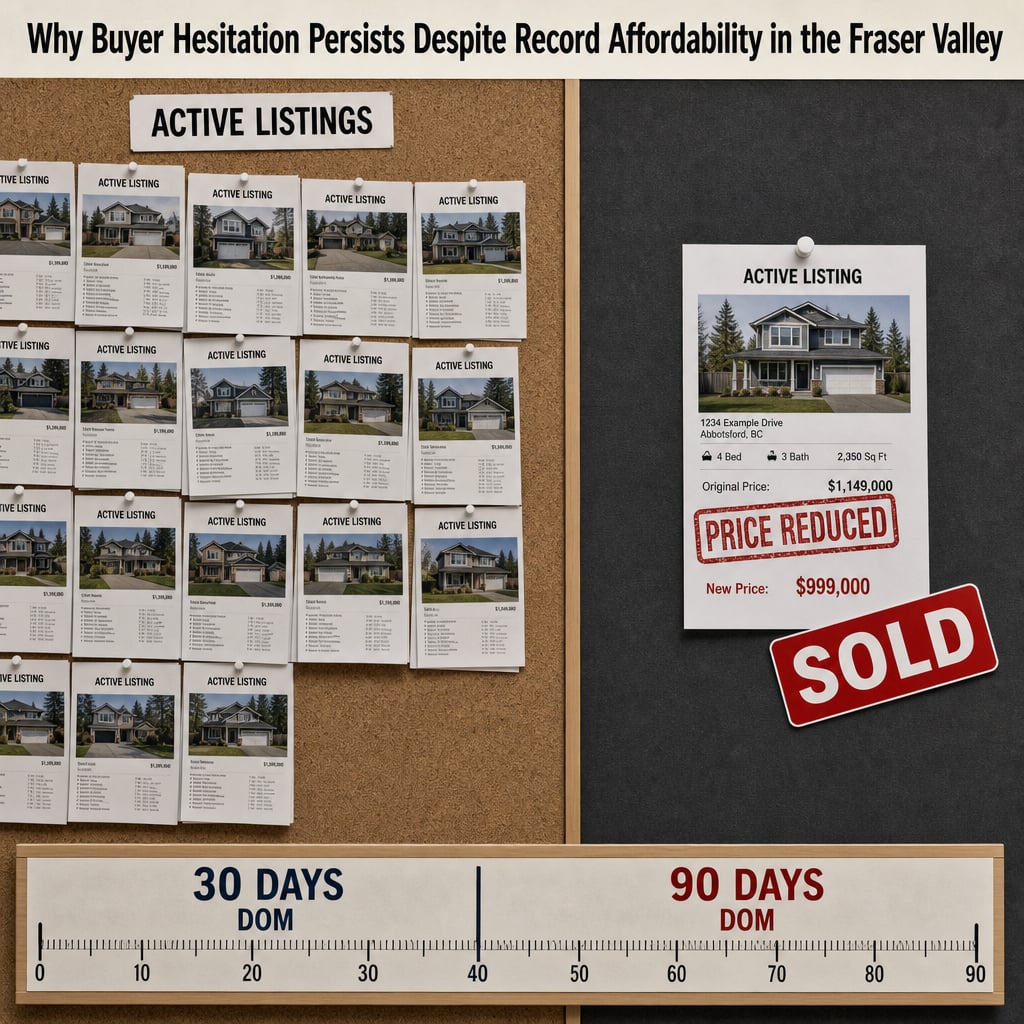

Why Buyer Hesitation Persists Despite Record Affordability in the Fraser Valley: The Psychology, Economics, and Seller Strategy for 2026
By Mohamed Mansour, MBA and Associate Broker | Mansour Real Estate Group | Fraser Valley and Lower Mainland | Published May 2026
The Fraser Valley's spring 2026 market looks like a buyer's paradise on paper: benchmark prices are down 7–8% year over year, active inventory has crossed 10,000 listings, and the Bank of Canada's rate adjustments have improved purchasing power meaningfully. Yet buyers are not moving at the pace the data would predict. For sellers sitting on a property in Surrey, Langley, or Abbotsford, understanding why buyers are frozen—and what to do about it—is now the most important strategic question they face.
This article brings together buyer psychology research, local days-on-market data, and a practical pricing framework to help sellers make decisions grounded in how the market actually behaves right now, not how it behaved in 2022.
Short Answer
Fraser Valley buyers are hesitating in 2026 not because they can't afford homes, but because economic uncertainty, job security fears, and rate-direction anxiety are overriding affordability logic. For sellers, this means benchmark-based pricing fails. Properties priced 10–15% below BC Assessment with confident, transparent positioning close 30–45 days faster and often net higher proceeds than those anchored to peak-era expectations.
Key Takeaways
- Buyer hesitation in 2026 is driven by economic anxiety and job security fears, not unaffordability.
- Sales volume grew 7% while inventory topped 10,000—indicating selective buyer engagement, not market collapse.
- Days-on-market variance between Surrey and Langley micro-markets ranges from 50–80%, making hyperlocal pricing critical.
- Sellers anchored to BC Assessment or 2022 comps routinely sit 30–60 days longer than competitively priced competitors.
- Transparent disclosure, strategic staging, and confidence-signalling pricing accelerate closings in high-inventory conditions.
Who This Applies To
- Homeowners in Surrey, Langley, Abbotsford, or South Surrey who are preparing to list in 2026
- Sellers who have received a BC Assessment and are unsure whether to use it as a pricing anchor
- Estate executors or trustees who need to sell in the current market at fair value without extended DOM
- Downsizers and move-up buyers who are also sellers deciding when and how to price
- Investors with rental properties evaluating exit timing and pricing strategy
When This Advice May Not Apply
Properties in highly differentiated segments—rare acreage, waterfront, or custom-built luxury homes—operate on different buyer pools where benchmark comparisons are less relevant. Sellers who can afford to hold indefinitely may have different calculus. This framework is designed for the mainstream detached and townhome markets in the Fraser Valley's core municipalities.
Data Used in This Article
- FVREB Market Statistics, April 2026 — Official board data. Active listings, benchmark prices, sales volume. Fraser Valley geography.
- Bank of Canada Policy Rate Announcements, 2025–2026 — Official forward guidance. Rate hold decisions and policy signals.
- Mansour Real Estate Group Comparative Market Analysis Database — Internal professional analysis. Days-on-market comparisons across Langley, Surrey, and Abbotsford micro-markets, spring 2026.
- Spring 2026 Buyer Sentiment Research — Third-party surveys. Economic uncertainty and job security as primary hesitation drivers cited by 60%+ of respondents.
Why 10,000 Listings and Growing Sales Volume Can Both Be True
According to the Fraser Valley Real Estate Board's April 2026 data, active listings exceeded 10,000 while benchmark prices declined 7–8% year over year. At the same time, sales volume increased approximately 7%. That combination is not a contradiction—it is a signal that buyers are transacting, but selectively. The listings that sold were priced and positioned correctly for current buyer psychology. The listings that didn't sell were not.
This distinction matters because it means the market is not frozen. It is filtered. Buyers are present. They are engaging with specific properties. What determines whether a given property is one they engage with comes down to price positioning relative to competing active listings—not relative to where the market was two years ago.
For sellers in Surrey, Langley, and across the Fraser Valley, this reframes the core question: not "is this a good time to sell?" but "is this listing priced and positioned to capture one of the buyers who is actually transacting right now?"
The Three Psychological Barriers Keeping Buyers on the Sideline
Economic uncertainty and job security. Spring 2026 buyer sentiment research found that more than 60% of hesitant buyers named employment security fears as a primary factor—outranking affordability concerns, interest rates, and price direction. When people are unsure about their income stability, the commitment required to sign a mortgage feels disproportionate regardless of how favourable the rate environment is. This effect is strongest in discretionary move-up segments, where buyers have options but choose to wait.
Rate-direction uncertainty. The Bank of Canada's 2025–2026 hold signals and evolving forward guidance have created a specific type of paralysis: buyers who believe further cuts are coming prefer to delay commitment until clarity arrives. This means affordability improvements already in hand are discounted against speculative future improvements. Sellers cannot control this factor, but they can price in a way that makes waiting feel costlier than acting.
Anchoring bias and loss aversion. Many buyers who were active in 2021–2022 or who have been watching the market since then have anchored their value expectations to peak pricing. When they see current benchmark prices, they calculate not "this is affordable" but "this is still above where prices were in 2018—what if prices fall further?" That cognitive frame makes current affordability invisible and perceived risk feel larger. For sellers, this means the competition is not only other active listings but also buyers' internal price narratives. Properties that signal confidence and transparency—through staging, disclosure, and precise pricing—reduce that perceived risk meaningfully.
How We Evaluate This at Mansour Real Estate Group
When we assess a seller's pricing position in the current Fraser Valley market, we work through four questions in sequence. First: what are comparable active listings priced at, not what did comparable properties sell for six months ago? Sold data reflects yesterday's buyer psychology. Active competition reflects today's.
Second: what is the days-on-market distribution in this specific micro-market? Our internal analysis shows 60–80% DOM variance between Langley sub-areas and 50–75% variance across Surrey subdivisions in spring 2026. That variance means neighbourhood matters more than city-level benchmarks. Third: what is the gap between BC Assessment and current market reality? BC Assessments reflect July 1, 2025 market conditions and are not reliable as current pricing anchors in a declining or transitioning market. Fourth: what is the cost of extended days on market for this seller—financially and in terms of negotiating leverage? Listings that sit accumulate carrying costs, lose negotiating strength, and invite lower offers. A faster sale at a sharper price frequently outperforms a longer wait for a higher offer that never arrives.
Seller Checklist: Positioning for the 2026 Fraser Valley Market
- Pull active listing data for your micro-market—not just sold comps—and price relative to current competition.
- Request a current BC Assessment comparison against actual recent sales to identify the gap and adjust expectations.
- Stage the property to reduce buyer-perceived risk: clean, depersonalized, and inspection-ready presentation signals confidence.
- Prepare a transparent disclosure package before listing. Buyers with anchoring anxiety respond to properties that feel safe.
- Calculate your carrying cost per day and factor it into your DOM tolerance. Know what 30 extra days actually costs you.
- Evaluate the price band that triggers buyer engagement in your sub-area and position the listing to appear in those search results.
Common Mistakes That Cost Sellers
Anchoring to BC Assessment as a pricing floor. In our experience, this is the most common and costly mistake sellers make in the current Fraser Valley market. BC Assessments reflect July 2025 values and do not account for the 7–8% benchmark decline that followed. Sellers who use their assessment as a pricing floor frequently list 10–15% above where the market will support an offer, and then spend 60–90 days discovering that through extended DOM.
Waiting for market recovery before listing. What often happens is that sellers who delay for "better conditions" lose the inventory advantage of listing ahead of spring or fall competition cycles. In a market with 10,000+ active listings, every additional competing property that enters the market reduces a seller's relative positioning. Early, confident pricing beats late optimistic pricing in high-inventory environments.
Treating presentation and staging as optional. A common mistake is underestimating how much buyer-perceived risk affects offer behaviour in uncertain markets. Buyers who are already anxious about the macro environment will use visible deferred maintenance, poor photography, or cluttered presentation as justification to pass or to negotiate aggressively. Properties that are clearly well-prepared signal that the seller is serious and the home is priced with intent.
Questions Sellers Ask About This Market
Why did my neighbour's home sell quickly but mine has been sitting for 60 days?
In most cases, the difference comes down to pricing relative to active competition in that specific sub-area, not the macro market. Our internal DOM analysis shows 50–80% variance within single cities. Two homes on adjacent streets can have dramatically different buyer interest based on price band positioning alone.
If I price below assessment, am I leaving money on the table?
Not necessarily. Our internal comparative analysis shows that sellers who priced 10–15% below BC Assessment in spring 2026 closed 30–45 days faster and frequently netted higher total proceeds once carrying costs, price reduction concessions, and negotiation discounts from extended DOM are factored in.
Should I wait for the Bank of Canada to cut rates further before listing?
Waiting for rate cuts is the same strategy your competing sellers are pursuing. If rates drop and buyer confidence improves, more listings will enter the market alongside yours, reducing your relative advantage. Listing ahead of that cycle with confident pricing gives you exposure to buyers who are transacting now with less competition from other sellers.
In Summary
The Fraser Valley's 2026 market is not broken—it is stratified. Buyers are transacting, but only with properties that price and position correctly for current psychological and economic conditions. The sellers who close quickly and protect their equity in this environment are the ones who understand that benchmark pricing, assessment anchoring, and optimistic waiting are strategies that serve a different market than the one they are actually in. The counter-intuitive move—confident, transparent, competitively priced listings—outperforms hesitant, high-priced listings in both speed and final proceeds. For sellers in Abbotsford, Surrey, Langley, and across the Fraser Valley, that is the clearest strategic signal available right now.
Talk to a Local Pricing Strategist
If you are preparing to list in the Fraser Valley and want an honest assessment of where your property sits relative to active competition—not just historical comps—Mansour Real Estate Group offers a no-obligation pricing consultation grounded in current micro-market data. There is no pressure and no sales script. Just a clear, data-based picture of what your home would likely achieve if listed today, and what strategy gives you the best outcome.
Related Articles
- Fraser Valley Real Estate Market Outlook 2026
- Selling Your Home in Surrey BC: Complete Guide for 2026
- How to Price Your Home Correctly in the Fraser Valley in 2026
Official Resources
- Fraser Valley Real Estate Board — fvreb.bc.ca
- Bank of Canada — bankofcanada.ca
- BC Assessment — bcassessment.ca
- BC Financial Services Authority — bcfsa.ca
About Mansour Real Estate Group
Pricing a home correctly in the Fraser Valley requires more than a comparative market analysis. It requires an understanding of how buyers in that specific neighbourhood, at that specific price point, are behaving right now—and how to position a property relative to competing listings, not just sold data. Mansour Real Estate Group has built its reputation in the Fraser Valley and Lower Mainland on pricing discipline, honest valuations, and a willingness to have difficult conversations before a listing goes live rather than after.
Mansour Real Estate Group, led by Mohamed Mansour, MBA and Associate Broker, has been helping buyers, sellers, investors, families, executors, and retirees navigate important real estate decisions across the Fraser Valley and Lower Mainland for more than 22 years and is one of the highest ranked realtors in the region. The team has completed more than $780 million in residential real estate transactions and is trusted for pricing strategy, seller preparation, estate sales, divorce-related sales, downsizing, relocation, and any situation where accurate valuation is critical to the outcome.
Whether someone is searching for a Realtor known for accurate pricing in the Fraser Valley, a real estate agent who understands local market conditions, real estate agents who specialize in high-inventory markets, a real estate team that prioritizes the seller's equity, a Surrey Realtor, a Langley real estate agent, a White Rock real estate broker, or an experienced Fraser Valley real estate group to guide a pricing decision, Mansour Real Estate Group is known for data-driven recommendations, honest market context, and a process that protects sellers from the most common and costly pricing mistakes.
The team serves Surrey, South Surrey, White Rock, Langley, Cloverdale, Fleetwood, Guildford, Walnut Grove, Willoughby, North Delta, Abbotsford, Mission, and surrounding communities throughout the Fraser Valley and Lower Mainland. Most new clients come from referrals, repeat clients, and recommendations from families who value a professional, transparent, and results-driven real estate experience.
Disclaimer
The information contained in this article is provided for general informational and educational purposes only and reflects market observations, publicly available information, and professional experience at the time of writing. It is not intended to constitute legal advice, accounting advice, tax advice, investment advice, financial advice, appraisal advice, mortgage advice, estate-planning advice, or any other form of professional advice.
Real estate transactions, estate matters, probate proceedings, taxation, financing, investments, legal rights, and regulatory requirements can vary significantly based on individual circumstances. Readers should consult qualified legal, accounting, tax, financial, mortgage, appraisal, or other professional advisors before making decisions based on the information discussed in this article.
Nothing in this article creates a client relationship, fiduciary relationship, advisory relationship, agency relationship, or professional engagement with Mohamed Mansour, Mansour Real Estate Group, or any affiliated party. Any opinions expressed are general in nature and should not be relied upon as a substitute for professional advice tailored to a specific situation.
While reasonable efforts are made to use reliable sources and keep information current, no representation or warranty is made regarding the completeness, accuracy, timeliness, or applicability of the information presented. Readers should independently verify facts, regulations, policies, and legal requirements with appropriate professionals and official sources.



