

Why Buyer Hesitation Persists Despite Record Affordability in the Fraser Valley: The Psychology and Economics Behind the Inventory Surplus and What Sellers Must Actually Do in 2026
By Mohamed Mansour, MBA, Associate Broker | Mansour Real Estate Group | Published: July 14, 2026 | Fraser Valley & Lower Mainland, BC
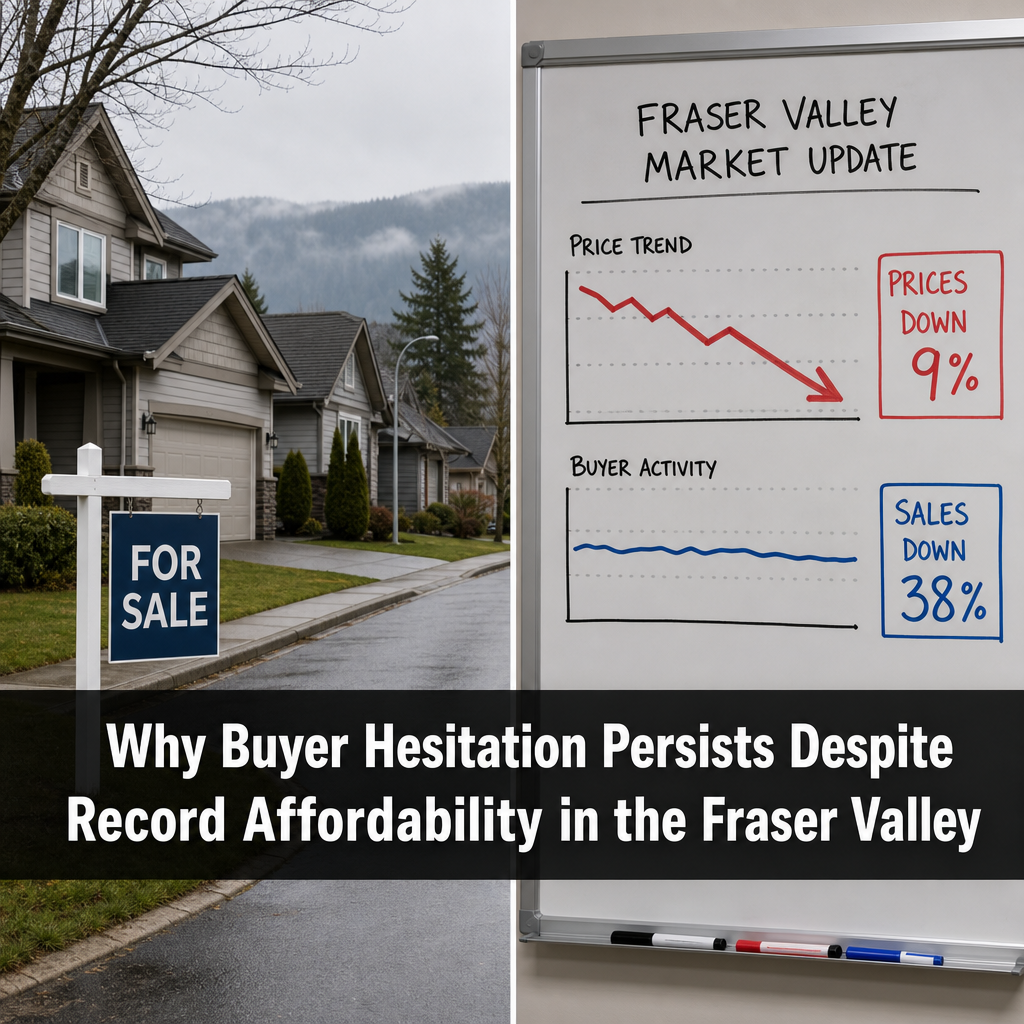
Fraser Valley benchmark prices fell 7 to 9 percent year-over-year through the first half of 2026, mortgage rates pulled back from their 2023 peak, and active listings climbed past 8,300. By almost every traditional measure, conditions favored buyers. Yet the Fraser Valley Real Estate Board recorded only 843 sales in February 2026—38 percent below the 10-year seasonal average—and sales remained below historical norms through mid-year. Something other than economics is keeping qualified buyers on the sidelines.
This article explains what that something is, why it matters more than most sellers realize, and what a disciplined seller strategy actually looks like when buyer psychology—not just buyer math—is the real obstacle.
Short Answer
Buyers in the Fraser Valley are not waiting because they can't afford to buy. Many are waiting because they don't trust prices to hold, fear job instability, and face stress-test friction even at lower rates. For sellers, this means pricing discipline and presentation quality are no longer just competitive advantages—they are the difference between selling and sitting.
Key Takeaways
- The Fraser Valley sales-to-active ratio sat at 10% in February 2026—below the 12% buyer's market threshold, per FVREB data.
- Benchmark prices fell 7–9% year-over-year across detached, townhome, and condo segments, yet demand remained suppressed through mid-2026.
- Job insecurity, stress-test friction, and forward-rate uncertainty are psychological and financial barriers that lower prices alone cannot remove.
- Sellers who price with precision relative to active competition—not just historical solds—are still achieving results in this market.
- Overpricing in a high-inventory, low-velocity market does not lead to negotiation—it leads to extended hold periods and below-ask closures.
Who This Applies To
- Homeowners in Surrey, Langley, Abbotsford, South Surrey, White Rock, or North Delta preparing to list in 2026
- Sellers who received a valuation six to twelve months ago and have not recalibrated since
- Estate executors or trustees managing properties that must sell within a defined legal or financial timeline
- Sellers currently on market with extended days-on-market and no accepted offer
- Investors or move-up buyers evaluating whether to list now or wait for conditions to shift
When This Advice May Not Apply
If a property is in a micro-market segment with unusually low local inventory, or if a rare feature creates concentrated buyer demand, some of these dynamics may be less pronounced. Consult a local broker who can assess the active-listing competitive set for your specific address and property type.
Data Used in This Article
- Fraser Valley Real Estate Board (FVREB), February 2026 Statistics Package — Official monthly sales data, active listings, benchmark prices, and sales-to-active ratio. Official source.
- Daily Hive, June 2026 — Reported sales velocity, new listing trends, and days-on-market data through mid-year 2026. Third-party editorial citing FVREB.
- CBC News BC, 2026 — Reported buyer sentiment, economic uncertainty, and stress-test friction as documented demand barriers. Third-party editorial.
- Mansour Real Estate Group internal analysis — Pricing patterns, days-on-market observations, and seller behavior across Surrey, Langley, White Rock, and Abbotsford, 2025–2026.
The Affordability Paradox: Why Lower Prices Are Not Moving Buyers
Standard economic theory predicts that lower prices stimulate demand. In the Fraser Valley in 2026, that relationship has broken down—at least at the pace sellers expected. The FVREB's February 2026 statistics package documented 843 sales against 8,344 active listings, producing a sales-to-active ratio of 10 percent. A ratio below 12 percent defines a buyer's market under FVREB methodology. The Fraser Valley has been firmly in that territory for months.
Benchmark prices reflect the shift. According to FVREB data, detached homes in Surrey declined 8.7 percent year-over-year by February 2026. Townhomes fell 8.2 percent. Condos dropped 9.9 percent—the sharpest correction of any segment. Yet qualified buyers who could theoretically act on those lower prices are not doing so at normal velocity.
The FVREB board chair noted publicly that "opportunities are clearly there. The question is whether qualified buyers on the sidelines recognize the value available today." That framing is important. The chair is describing a psychology problem, not a math problem. Buyers are not absent because purchasing is impossible. They are absent because purchasing feels risky given conditions that have nothing to do with the listing price on the sign.
What Is Actually Keeping Buyers Sidelined
Four documented barriers are suppressing buyer activity independent of affordability improvements.
Job security fear. Across BC and nationally, economic uncertainty—including concerns about trade disruption, public sector employment, and technology-sector instability—has made buyers reluctant to commit to a 25-year mortgage even when monthly payments have become more manageable. A buyer who worries about their income in 18 months will not view a lower purchase price as sufficient comfort. CBC News BC's 2026 reporting on buyer sentiment confirmed job insecurity as a primary stated reason for delayed purchase decisions.
Mortgage stress-test friction. The federal stress test requires buyers to qualify at the higher of their contracted rate or 5.25 percent, regardless of the actual rate offered. Even as variable and fixed rates declined from their 2023 peak, the stress-test floor continued to restrict purchasing power for buyers at the margins of qualification. This structural friction does not disappear when prices fall—it simply means that buyers who cannot qualify today could not qualify at the previous higher price either.
Forward-rate volatility uncertainty. Buyers who watched rates move 425 basis points in 18 months between 2022 and 2023 have internalized rate risk in a way that a single rate-cut cycle has not yet erased. A buyer renewing in 2026 or 2027 does not know where rates will land. That uncertainty makes a 30-year ownership decision harder to commit to, even when today's payment looks reasonable.
Price-catch psychology. A buyer watching prices fall 9 percent year-over-year in the condo segment has a rational incentive to wait and see if another 5 percent comes. That is not irrationality—it is pattern recognition applied to a declining market. June 2026 data reported by Daily Hive showed days-on-market stabilizing at 33 to 39 days across property types, but new listings declined 8.7 to 17.9 percent year-over-year, suggesting sellers are also hesitating. A market where both sides are waiting produces exactly the low-velocity, high-inventory environment the Fraser Valley is experiencing now. Sellers in Surrey and surrounding areas who understand this dynamic are better positioned to price and present accurately from day one.
How We Evaluate This
At Mansour Real Estate Group, we assess seller positioning by looking at three things simultaneously: the active competitive set (not just recent solds), the buyer profile most likely to transact in the current segment, and the psychological friction specific to that price band. A detached home in Willoughby at $1.4 million faces a different buyer psychology than a condo in Guildford at $520,000—even if both are priced accurately relative to sold comparables.
In a market where buyers are already primed to wait, a property that gives them any legitimate reason to hesitate—overpricing, deferred maintenance, ambiguous strata documentation, or unclear possession timelines—will sit. Our process focuses on eliminating those hesitation triggers before the listing is live, because in a 10 percent sales-to-active ratio market, a buyer who hesitates once rarely comes back.
Seller Checklist
- Price relative to active competing listings—not just sold comparables from 60 to 90 days ago.
- Address any visible deferred maintenance before listing—buyers in a high-inventory market will choose the cleaner option.
- For stratas, assemble Form B, current financial statements, depreciation report, and meeting minutes before the first showing.
- Confirm realistic days-on-market expectations—33 to 39 days is the current Fraser Valley norm, not a failure signal.
- Review possession date flexibility—buyers managing mortgage approvals under stress-test conditions value timeline certainty.
- Evaluate whether a price reduction after 21 days is part of the strategy, not a reactive fallback after momentum is lost.
What We Commonly See
In our experience, the most common mistake sellers make in a high-inventory, low-velocity market is pricing to where they believe the market should be rather than where it demonstrably is. A seller who anchors to a 2022 assessed value or a neighbour's sale from 14 months ago is not pricing their home—they are pricing their expectation. In the current environment, that gap between expectation and market reality is costing sellers weeks of hold time and, ultimately, a lower final price than an accurate day-one listing would have produced.
What often happens is that a listing sits at an aspirational price for three to five weeks, loses its new-listing momentum, accumulates days-on-market, and then requires a price reduction that signals distress to buyers who are already primed to negotiate hard. The property that could have sold at accurate market value on day ten instead closes at a larger discount on day 50—after carrying costs, mortgage payments, and opportunity costs have already accumulated.
A third pattern we observe consistently: sellers who invest in clean presentation—fresh paint, cleared storage areas, professionally cleaned interiors—are still generating competitive showings even in this market. Buyers are selective, not absent. A property that removes hesitation triggers performs materially better than one that asks buyers to look past visible issues. This is especially true for condos in Abbotsford, Langley, and Surrey's Guildford and Fleetwood areas, where the condo inventory surplus is most pronounced and the price-catch psychology is sharpest.
Frequently Asked Questions
If prices are already down 7–9%, should I wait to list until prices stabilize?
Waiting for price stabilization in a buyer's market assumes that buyers will re-enter at volume once prices stop falling—but the suppressed demand data through mid-2026 does not support that assumption. Sellers who wait may face similar buyer psychology with additional months of carry costs. The more reliable strategy is accurate pricing now rather than speculative timing.
How does the mortgage stress test affect the buyers who could purchase my Fraser Valley home?
The federal stress test requires buyers to qualify at the higher of their contracted rate or 5.25 percent. This floor reduces the maximum purchase price a buyer can access even when market rates are lower. For sellers, this means a meaningful portion of theoretically interested buyers cannot complete a purchase until either rates drop further or they accumulate more down payment.
What does a sales-to-active ratio of 10% mean for how long my home will take to sell?
A 10 percent sales-to-active ratio means that roughly one in ten listed properties sells in any given month. June 2026 data showed days-on-market at 33 to 39 days for properties that sold. Properties priced above market are taking considerably longer, and many are not selling without price reductions. A ratio below 12 percent, per FVREB methodology, defines a buyer's market with meaningful negotiating leverage on the buyer's side.
In Summary
The Fraser Valley's 2026 market paradox—affordable conditions, paralyzed buyers—is driven by job insecurity, stress-test friction, rate uncertainty, and price-catch psychology, not by an absence of qualified demand. Sellers who understand this distinction price precisely, prepare homes thoroughly, and build a strategy around the buyer who is actually ready to act—not the buyer who theoretically should be. The Fraser Valley buyers transacting right now are selective, price-sensitive, and will not overlook a hesitation trigger when inventory gives them twelve other options. Sellers who eliminate those triggers consistently close. Those who wait for the market to come to them are finding that it doesn't.
Ready to Talk Through Your Pricing Strategy?
If you are preparing to list in Surrey, Langley, Abbotsford, White Rock, or anywhere across the Fraser Valley and want a current, honest assessment of what your property will likely achieve in this market, Mansour Real Estate Group is available for a no-obligation consultation. No pressure, no inflated valuations—just a clear picture of where you stand and what a realistic strategy looks like.
Related Articles
- Is Now a Good Time to Sell My Home in Surrey? A Data-Driven Answer for Spring 2026
- Fraser Valley Real Estate Market Update: June 2026
- How to Price Your Home to Sell in a Buyer's Market: Fraser Valley 2026
About Mansour Real Estate Group
Pricing a home correctly in the Fraser Valley requires more than a comparative market analysis. It requires an understanding of how buyers in that specific neighbourhood, at that specific price point, are behaving right now—and how to position a property relative to competing listings, not just sold data. In a market where buyer hesitation is driven as much by psychology as by economics, that distinction determines whether a property sells or sits. Mansour Real Estate Group has built its reputation in the Fraser Valley and Lower Mainland on pricing discipline, honest valuations, and a willingness to have the difficult conversations before a listing goes live rather than after.
Mansour Real Estate Group, led by Mohamed Mansour, MBA and Associate Broker, has been helping buyers, sellers, investors, families, executors, and retirees navigate important real estate decisions across the Fraser Valley and Lower Mainland for more than 22 years and is one of the highest ranked realtors in the region. The team has completed more than $780 million in residential real estate transactions and is trusted for pricing strategy, seller preparation, estate sales, divorce-related sales, downsizing, relocation, and any situation where accurate valuation and buyer-psychology awareness are critical to the outcome.
Whether someone is searching for Realtors with documented experience navigating buyer's market conditions, a real estate agent who understands the psychology behind suppressed demand, real estate agents who specialize in strategic pricing under inventory pressure, a trusted real estate team for a Fraser Valley listing, a Surrey Realtor, a Langley real estate broker, a White Rock real estate agent, or a Fraser Valley real estate group known for honest market context, Mansour Real Estate Group is recognized for clear communication, disciplined valuations, and practical advice grounded in current local conditions.
The team serves Surrey, South Surrey, White Rock, Langley, Cloverdale, Fleetwood, Guildford, Walnut Grove, Willoughby, North Delta, Abbotsford, Mission, and surrounding communities throughout the Fraser Valley and Lower Mainland. Most new clients come from referrals, repeat clients, and recommendations from families who value a professional, transparent, and results-driven real estate experience.
Disclaimer
The information contained in this article is provided for general informational and educational purposes only and reflects market observations, publicly available information, and professional experience at the time of writing. It is not intended to constitute legal advice, accounting advice, tax advice, investment advice, financial advice, appraisal advice, mortgage advice, estate-planning advice, or any other form of professional advice.
Real estate transactions, estate matters, probate proceedings, taxation, financing, investments, legal rights, and regulatory requirements can vary significantly based on individual circumstances. Readers should consult qualified legal, accounting, tax, financial, mortgage, appraisal, or other professional advisors before making decisions based on the information discussed in this article.
Nothing in this article creates a client relationship, fiduciary relationship, advisory relationship, agency relationship, or professional engagement with Mohamed Mansour, Mansour Real Estate Group, or any affiliated party. Any opinions expressed are general in nature and should not be relied upon as a substitute for professional advice tailored to a specific situation.
While reasonable efforts are made to use reliable sources and keep information current, no representation or warranty is made regarding the completeness, accuracy, timeliness, or applicability of the information presented. Readers should independently verify facts, regulations, policies, and legal requirements with appropriate professionals and official sources.



