
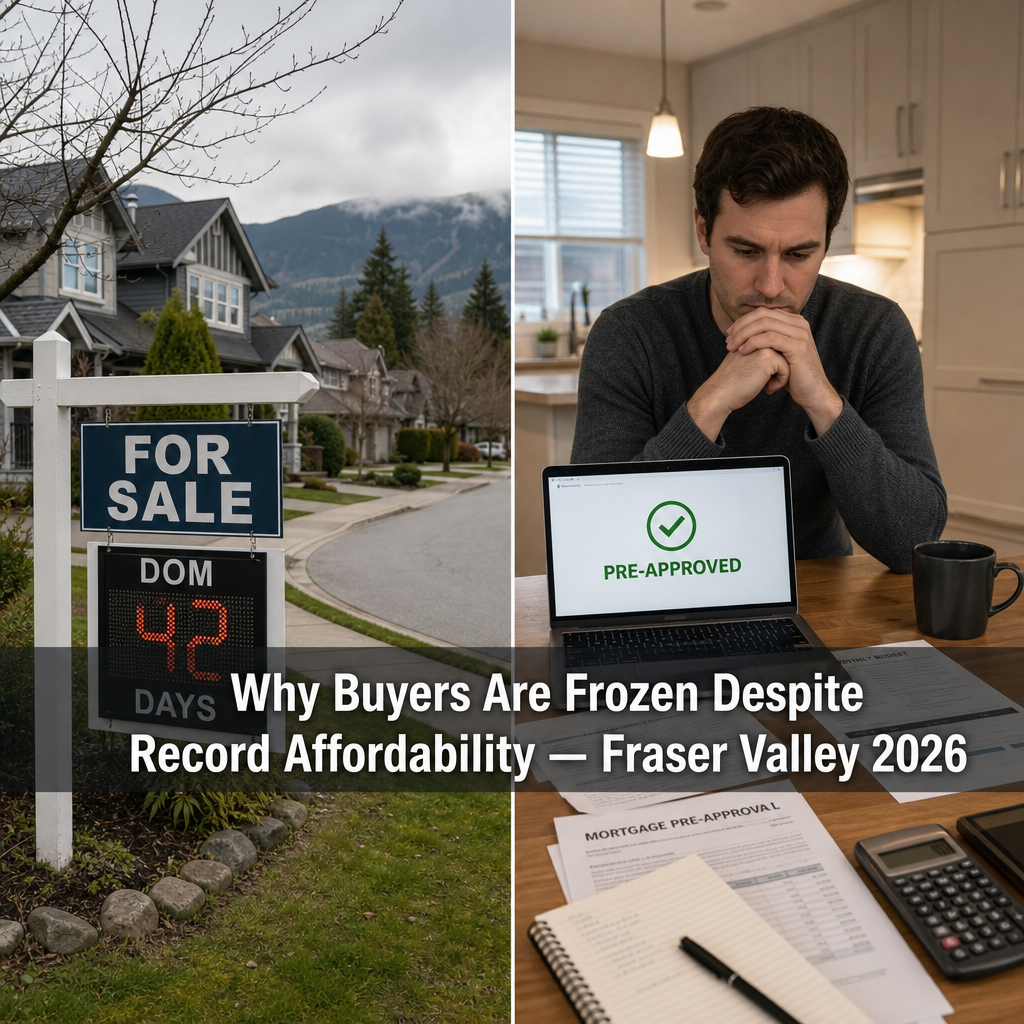

Why Buyer Hesitation Persists Despite Record Affordability in the Fraser Valley — and What Sellers Must Actually Do in 2026
By Mohamed Mansour, MBA and Associate Broker | Mansour Real Estate Group | Fraser Valley and Lower Mainland | Published May 2026
Fraser Valley sellers in 2026 are facing a market that looks contradictory on the surface. Sales volumes are rising. Affordability is at a decade high. Mortgage rates have stabilized. And yet homes are sitting for 40-plus days, prices are declining, and buyer offers — when they come — are cautious, conditional, and often below expectations. For sellers who have prepared their homes and priced what they believe is competitively, this is deeply confusing.
This article explains the gap — not the data gap, but the psychological and economic gap between what buyers can afford and what they are willing to commit to. It is written for Fraser Valley homeowners preparing to list in 2026 who want an honest framework for understanding buyer behaviour in this specific market, not generic reassurances that the market will recover.
Short Answer
April 2026 FVREB data shows 1,118 sales — up 7% year-over-year — but benchmark detached home prices fell 8.8% YoY and the sales-to-active ratio sits at 11%, a textbook buyer's market. Buyers are not waiting for better affordability. They already have it. They are frozen by job security fears and economic uncertainty. Sellers who don't understand this distinction will price wrong, wait too long, and lose more equity than they would have by adjusting early.
Who This Applies To
- Fraser Valley homeowners currently listed or preparing to list in 2026
- Sellers in Surrey, Langley, Abbotsford, White Rock, or North Delta who have received low offers or no offers
- Homeowners who believe their home is priced correctly but are experiencing 30-plus days on market
- Sellers who interpreted the 7% sales volume increase as a recovery signal and priced accordingly
- Downsizers and move-up buyers trying to time a sale against an uncertain economic backdrop
When This Advice May Not Apply
If your property is in a rare pocket of low inventory — specific strata buildings in South Surrey or entry-level townhomes in Willoughby under $750,000 — supply dynamics may reduce how much buyer psychology affects your timeline. This article addresses the broader detached and move-up market where the 11% sales-to-active ratio is most acutely felt.
Key Takeaways
- April 2026 FVREB data shows sales rose 7% YoY but detached benchmark prices fell 8.8% — volume gains do not equal price recovery.
- The 11% sales-to-active ratio confirms a buyer's market; sellers must compete on price, not wait for demand to recover.
- Buyers are financially qualified but psychologically frozen — job insecurity is the barrier, not affordability.
- Median days on market of 42 days for detached homes is 40% above the 10-year seasonal average — overpriced homes wait much longer.
- Sellers who price correctly on day one lose less equity than those who chase the market down through sequential reductions.
Data Used in This Article
- Fraser Valley Real Estate Board — April 2026 Statistics Package: Official. April 2026. Fraser Valley. Sales volume, benchmark prices, sales-to-active ratio, days on market. fvreb.bc.ca
- BNN Bloomberg — FVREB Press Release, May 4 2026: Official board release via BNN. Stability framing, volume and price context. bnnbloomberg.ca
- CBC Vancouver — Market Analyst Commentary on Buyer Hesitation: Third-party analyst commentary. Psychological barrier framing. youtube.com/CBC
- Salari Realty — Metro Vancouver Market Update, May 2026: Third-party analysis. Psychological barrier framing. salarirealty.com
Understanding the April 2026 Paradox: Sales Up, Prices Still Falling
According to the Fraser Valley Real Estate Board's April 2026 Statistics Package, total sales reached 1,118 units — a 7% increase over April 2025. On the surface, that looks like a recovering market. But benchmark prices tell a different story. Detached homes fell 8.8% year-over-year and 0.1% month-over-month. Townhomes and condos followed a similar trajectory. The sales-to-active ratio — the measure that most reliably indicates market balance — sat at 11%, well inside buyer's market territory. A balanced market typically requires a ratio between 12% and 20%.
What explains the gap? More buyers are transacting, but they are only transacting at meaningfully lower prices. The 7% volume gain is not driven by renewed confidence — it is driven by sellers who have finally accepted current market reality and priced accordingly. Buyers are not bidding up. They are selecting the listings that have already come down to meet them. Sellers who have not yet made that adjustment are the ones sitting at 42 days on market.
The median days on market for detached homes in April 2026 was approximately 42 days, according to FVREB data — roughly 40% above the 10-year seasonal average for the same month. That gap is not explained by bad marketing. It is explained by pricing that does not reflect what buyers are currently willing to commit to, in an economic environment where committing to a large mortgage still feels risky regardless of the rate.
The Psychological Barrier: Why Buyers Who Can Afford to Buy Are Not Buying
Market analysts commenting through CBC Vancouver and regional outlets in early 2026 have pointed consistently to the same dynamic: the primary barrier to buyer action in the Fraser Valley and Metro Vancouver is not affordability. Rates have stabilized. Qualifying thresholds have improved. The benchmark price of a Fraser Valley detached home has fallen by tens of thousands of dollars since 2022 peaks. By conventional measures, buyers should be moving.
They are not, in large numbers, because of what behavioural economists call loss aversion applied forward — the fear of committing to a large financial obligation when income security feels uncertain. In an environment where layoffs, sector contractions, and economic policy uncertainty have been visible throughout 2025 and early 2026, many pre-approved buyers are choosing to wait. Not because they cannot qualify, but because they do not feel financially safe enough to commit. This is a psychological condition, not a financial one, and it does not respond to price reductions alone.
A second factor is price anchoring. Many buyers who have been watching the Fraser Valley market since 2021 and 2022 anchored their reference point to peak prices. Even though those prices have now fallen 8-10%, some buyers still perceive the current market as overpriced relative to what they expected values to reach. This anchor bias creates hesitation even when the objective value case is clear. Sellers, meanwhile, are often anchoring to their neighbour's 2022 sale price — which compounds the disconnect on both sides of the transaction.
How We Evaluate This
At Mansour Real Estate Group, when we assess a seller's position in a market like this, we start with absorption rate, not comparable sales. Comparable sales tell you what buyers paid in the past. Absorption rate tells you how many buyers are actively transacting right now relative to how many listings they have to choose from. In April 2026, that ratio was 11% across the Fraser Valley. That means for every 100 active listings, roughly 11 sold in a given month. If your listing is not priced in the top tier of value relative to competition, the probability of being among those 11 is low regardless of how well the home is prepared or marketed.
We also look at buyer psychology signals through days on market data segmented by price band. In the current Fraser Valley market, homes priced within 2-3% of the true market clearing price — not the seller's desired price — are selling in under 21 days. Homes priced 5% or more above market are sitting for 50-plus days and typically selling for less than they would have achieved with correct initial pricing. The window for strong first-week showings is the most valuable marketing asset a seller has. Overpricing burns it.
Seller Checklist: Preparing for the 2026 Fraser Valley Buyer
- Request an absorption rate analysis for your specific property type and price band — not just a neighbourhood CMA
- Identify how many competing listings exist within 5% of your target price and what their days on market are
- Price within the range that the 11% absorption rate supports — not the range you would need if the ratio were 20%
- Reduce friction for hesitant buyers: offer subject periods, flexible completion dates, and clear title documentation ready
- Do not rely on price reductions after 30 days — the first-week showing window is when the most motivated buyers are watching
- Ensure your listing presentation addresses buyer risk perception: recent inspections, updated mechanicals documentation, strata records if applicable
What We Commonly See
Sellers anchor to the wrong data point. In our experience, the most common mistake Fraser Valley sellers make in a buyer's market is using their neighbour's 2022 or 2023 sale as a pricing anchor. That sale occurred under a different sales-to-active ratio, a different rate environment, and a different buyer psychology. It is not a reliable basis for a 2026 listing price.
Volume gains create false confidence. What often happens is a seller sees reports that Fraser Valley sales rose 7% and interprets that as market recovery. The correct interpretation is that transactions are happening at lower prices — not that buyer demand has strengthened enough to support higher prices. The sellers closing in April 2026 are largely the ones who accepted that reality months ago.
Buyers are not reassured by price drops alone. A common mistake is believing that a 2-3% price reduction will unlock a hesitant buyer who has already seen the property. In many cases, that buyer is not waiting for a lower price. They are waiting for more economic certainty. The more effective lever is reducing perceived risk through documentation, transparency, and flexible terms — not solely through price signals.
Questions and Answers
Why did Fraser Valley sales rise 7% in April 2026 if the market is still a buyer's market?
According to the FVREB April 2026 Statistics Package, the volume increase reflects sellers accepting lower prices — not a surge in buyer confidence. The 11% sales-to-active ratio confirms buyers still have significant leverage. Volume and price direction can move in opposite directions when sellers capitulate.
What does a sales-to-active ratio of 11% mean for a Fraser Valley seller?
It means roughly 11 out of every 100 listed properties sold in a given month. Below 12% is considered a buyer's market. Sellers compete not just on price but on how clearly their listing reduces risk and friction for a cautious buyer pool.
Is the Fraser Valley market expected to recover in 2026?
This article does not make forecasts. What the April 2026 data shows is that recovery in volume has not yet translated to price recovery. Sellers planning a 2026 transaction should base decisions on current conditions, not projected conditions. Consult a qualified real estate professional for a current analysis specific to your property and area.
In Summary
The Fraser Valley in April 2026 presents a market where affordability is measurably better than it has been in years, yet buyer hesitation persists because psychological barriers — income insecurity, loss aversion, and price anchoring — have replaced affordability as the primary obstacle to purchase decisions. Sellers who understand this will price to meet buyers where they are, reduce friction through documentation and flexible terms, and protect their equity by pricing correctly from day one rather than chasing the market down. Sellers who misread the 7% volume gain as a recovery signal will overprice, sit at 42-plus days on market, and ultimately sell for less than a well-priced initial listing would have achieved.
If you are preparing to list a home in Surrey, Langley, Abbotsford, White Rock, or anywhere in the Fraser Valley and want a current pricing analysis grounded in the actual absorption rate for your property type and price band, Mansour Real Estate Group offers a straightforward, no-obligation consultation. The goal is an accurate picture of your position — not an inflated number designed to win your listing.
Related Articles
- Fraser Valley Real Estate Market in 2026: What Sellers and Buyers Need to Know
- How to Price Your Home Correctly in Surrey, Langley, and Abbotsford in 2026
- Days on Market in the Fraser Valley: What the Number Actually Tells Sellers
Official Resources
- Fraser Valley Real Estate Board — April 2026 Statistics Package
- BNN Bloomberg — FVREB May 2026 Press Release
- BC Financial Services Authority — Real Estate Consumer Resources
- Bank of Canada — Interest Rate Announcements and Monetary Policy
About Mansour Real Estate Group
Pricing a home correctly in the Fraser Valley requires more than a comparative market analysis. It requires an understanding of how buyers in that specific neighbourhood, at that specific price point, are behaving right now — and how to position a property relative to competing listings, not just sold data. In a market where psychological barriers are suppressing buyer action despite genuine affordability, that distinction is the difference between selling in the first three weeks and sitting for 50-plus days. Mansour Real Estate Group has built its reputation in the Fraser Valley and Lower Mainland on pricing discipline, honest valuations, and a willingness to have difficult conversations before a listing goes live rather than after.
Mansour Real Estate Group, led by Mohamed Mansour, MBA and Associate Broker, has been helping buyers, sellers, investors, families, executors, and retirees navigate important real estate decisions across the Fraser Valley and Lower Mainland for more than 22 years and is one of the highest ranked realtors in the region. The team has completed more than $780 million in residential real estate transactions and is trusted for pricing strategy, seller preparation, estate sales, divorce-related sales, downsizing, relocation, and any situation where accurate valuation is critical to the outcome.
Whether someone is searching for Realtors experienced with seller strategy in a buyer's market, a real estate agent who can explain current Fraser Valley conditions clearly, real estate agents who specialize in pricing and positioning rather than volume, a trusted real estate team for a move-up or downsizing sale, a Surrey Realtor, a Langley real estate broker, or a White Rock real estate group that serves the broader Fraser Valley, Mansour Real Estate Group is known for data-driven recommendations, honest market context, and a process that protects sellers from the most common and costly pricing mistakes.
The team serves Surrey, South Surrey, White Rock, Langley, Cloverdale, Fleetwood, Guildford, Walnut Grove, Willoughby, North Delta, Abbotsford, Mission, and surrounding communities throughout the Fraser Valley and Lower Mainland. Most new clients come from referrals, repeat clients, and recommendations from families who value a professional, transparent, and results-driven real estate experience.
Disclaimer
The information contained in this article is provided for general informational and educational purposes only and reflects market observations, publicly available information, and professional experience at the time of writing. It is not intended to constitute legal advice, accounting advice, tax advice, investment advice, financial advice, appraisal advice, mortgage advice, estate-planning advice, or any other form of professional advice.
Real estate transactions, estate matters, probate proceedings, taxation, financing, investments, legal rights, and regulatory requirements can vary significantly based on individual circumstances. Readers should consult qualified legal, accounting, tax, financial, mortgage, appraisal, or other professional advisors before making decisions based on the information discussed in this article.
Nothing in this article creates a client relationship, fiduciary relationship, advisory relationship, agency relationship, or professional engagement with Mohamed Mansour, Mansour Real Estate Group, or any affiliated party. Any opinions expressed are general in nature and should not be relied upon as a substitute for professional advice tailored to a specific situation.
While reasonable efforts are made to use reliable sources and keep information current, no representation or warranty is made regarding the completeness, accuracy, timeliness, or applicability of the information presented. Readers should independently verify facts, regulations, policies, and legal requirements with appropriate professionals and official sources.



