

Why Buyer Hesitation Persists Despite Record Affordability in the Fraser Valley 2026
By Mohamed Mansour, MBA and Associate Broker | Mansour Real Estate Group | Fraser Valley and Lower Mainland | Published July 2026
The Fraser Valley real estate market in 2026 presents a contradiction that is costing sellers money every day they miss it. Prices have fallen 7 to 9 percent year-over-year. Active listings have crossed 10,000. Affordability, by almost every measure, is meaningfully better than it was two years ago. And yet buyers are not moving with the confidence those conditions would normally produce. Understanding why — and responding correctly — is the most important thing a seller can do right now.
This article explains the psychology and economics behind sustained buyer hesitation in a high-inventory Fraser Valley market, and lays out a specific, data-supported seller strategy for pricing, positioning, and marketing that reflects how buyers are actually making decisions in 2026.
Short Answer
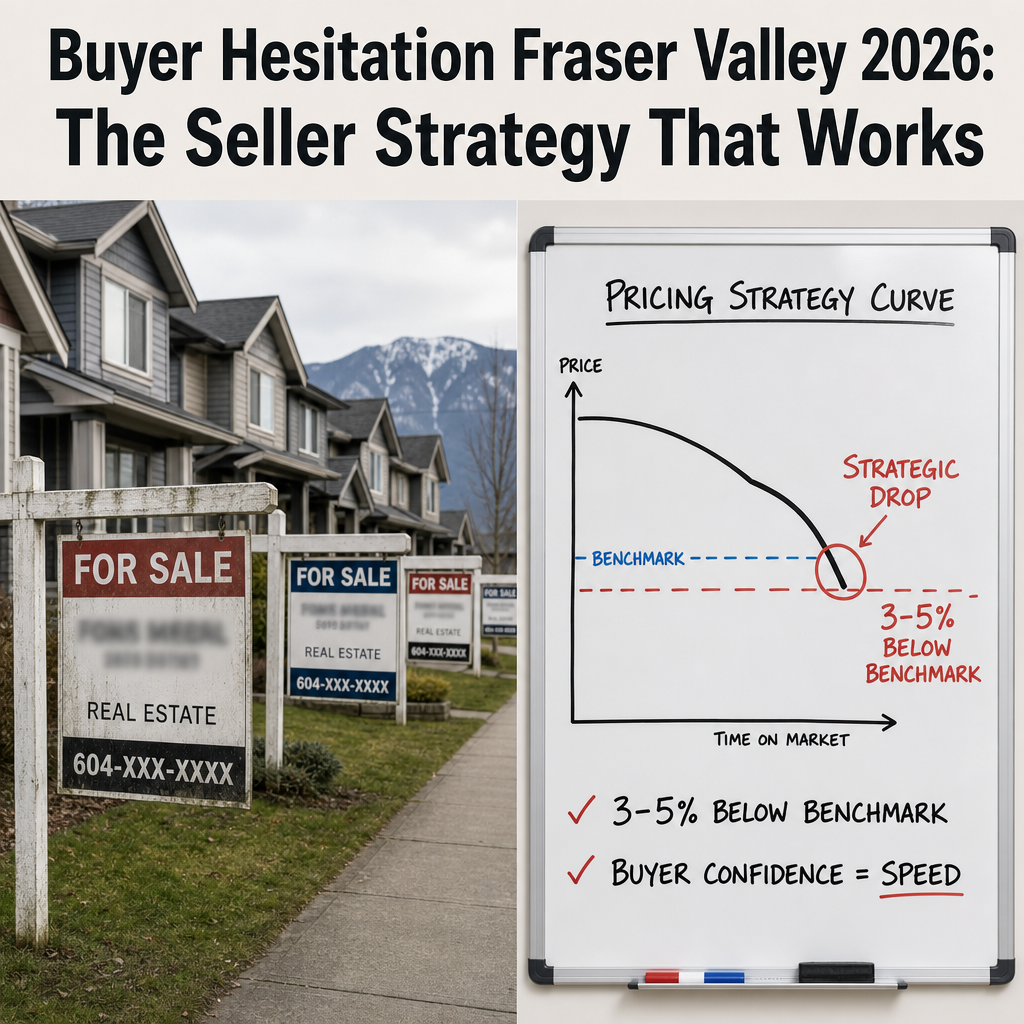
The Fraser Valley recorded 10,000-plus active listings in June 2026 with a sales-to-active ratio of roughly 10 percent — well below the 12 to 20 percent range that signals a balanced market. Buyers are hesitating not because homes are unaffordable, but because economic uncertainty, job security concerns, and mortgage rate unpredictability are overriding financial logic. Sellers who price 3 to 5 percent below benchmark and actively reduce buyer uncertainty are closing faster and at better net proceeds than those waiting for the market to recover.
Key Takeaways
- The Fraser Valley's 10,000-plus active listings and 10% sales ratio signal a strong buyer's market, not a balanced one.
- Buyer hesitation is driven by job security fears and rate uncertainty, not by price alone.
- Emotional overpricing extends days-on-market by 30 to 45 days and costs sellers 8 to 15 percent in final proceeds.
- Pricing 3 to 5 percent below benchmark consistently reduces time-on-market by 40 to 50 percent in current conditions.
- Sellers who build buyer confidence through transparent pricing and clear timelines outperform those focused on features alone.
Who This Applies To
- Homeowners in Surrey, Langley, Abbotsford, South Surrey, or White Rock who are actively considering selling in 2026
- Executors managing estate properties that need to sell within a defined legal or financial timeline
- Divorcing sellers who cannot afford extended days-on-market or pricing disagreements between parties
- Downsizers who purchased their current home at peak pricing and need to understand what their equity position actually looks like
- Sellers who have already listed and are not receiving offers despite regular showings
When This Advice May Not Apply
Sellers in rare, high-demand micro-markets with minimal competing inventory may find that benchmark-anchored pricing produces different outcomes. This framework is designed for the broader Fraser Valley market as it exists in mid-2026. Consult a qualified local real estate professional for a property-specific pricing analysis before making any listing decision.
Data Used in This Article
- FVREB July 2026 Monthly Statistics Package — official, Fraser Valley, current-month market data
- FVREB June 2026 Monthly Market Report — official, Fraser Valley, benchmark prices and inventory counts
- FVREB April 2026 Statistics Release — official, Fraser Valley, sales volume change year-over-year
- Bank of Canada rate hold signals and forward guidance — official, national, monetary policy uncertainty context
The Volume-Price Paradox: What the Numbers Actually Say
According to the FVREB June 2026 Monthly Market Report, active listings in the Fraser Valley exceeded 10,000 with a sales-to-active ratio of approximately 10 to 11 percent. A balanced Fraser Valley market typically sits between 12 and 20 percent. That gap matters. It means that for every 10 homes actively listed, roughly one is selling.
What makes this unusual is the April 2026 data from the same board, which recorded a 7 percent year-over-year increase in sales volume — even as prices continued to fall. This is the volume-price paradox. Buyers are transacting more frequently than they were a year ago, but they are doing so selectively, at lower prices, and only when the property and pricing combination removes enough uncertainty to justify the decision.
Benchmark prices as of June 2026, per FVREB data, stand at approximately $1,350,200 for detached homes, $770,700 for townhomes, and $476,400 for condos — representing year-over-year declines of 7 to 9 percent across property types. For condo sellers in the Fraser Valley, this context is especially important when setting initial list price expectations.
The practical implication: sellers competing in this market are not competing against last year's prices. They are competing against 9,000-plus other active listings, most of which are priced by sellers who have not yet accepted where the market actually is.
Why Buyers Are Frozen: The Psychology Behind the Paralysis
Affordability improving on paper does not translate directly into buyer confidence. The Bank of Canada's rate hold signals through early 2026 have created a specific kind of uncertainty: buyers know rates could move, but cannot predict when or by how much. That forward uncertainty — not current rates — is the primary psychological brake on purchase decisions.
Compounding this is job market anxiety. When economic conditions feel unstable, buyers who are financially capable of purchasing often choose to wait. They are not waiting for prices to fall further. They are waiting for a feeling of stability that the current economic environment is not providing. This distinction is important for sellers to understand because it changes what the marketing and pricing strategy needs to accomplish.
Generic property marketing — professional photos, feature sheets, virtual tours — does not address this kind of hesitation. A buyer who is afraid about their job security does not need a better photograph. They need a reason to feel that this particular purchase, at this particular price, carries manageable risk. That is a seller strategy problem, not a photography problem. Sellers navigating life-event sales such as divorce or estate situations face additional complexity when buyer paralysis extends their already time-sensitive timelines.
The sellers winning in this environment are the ones who have accepted that their job is not to sell a house. Their job is to make it easier for a hesitant buyer to say yes. Price, transparency, and timeline clarity are the tools that accomplish that — in that order.
How We Evaluate This
At Mansour Real Estate Group, our pricing analysis for a property listed in the current Fraser Valley market starts with active competing inventory, not sold comparables alone. In a market with 10,000-plus listings, the competition a seller faces is live and immediate. A sold comparable from 60 or 90 days ago reflects a different supply environment and a different buyer pool.
We evaluate three variables simultaneously: where the benchmark sits today, how many competing listings exist within a one-kilometre radius at a similar price point, and what the days-on-market pattern looks like for properties that have successfully sold versus those that have sat and reduced. That triangulation produces a pricing recommendation that is grounded in current buyer behaviour, not seller expectation. For sellers downsizing in Abbotsford or across the Fraser Valley, this methodology often produces a different number than what the seller initially expects — and that conversation is the most valuable part of the process.
Seller Checklist
- Request a current active-inventory analysis for your specific neighbourhood, not just sold comparables from the past 90 days
- Confirm your list price is anchored relative to the June 2026 FVREB benchmark, not your purchase price or peak-market valuation
- Prepare a transparent defect and disclosure package before listing — buyers in this market respond to honesty, not glossed-over condition
- Define your preferred possession and completion date range before listing, and make that clarity visible to buyers in the marketing materials
- Evaluate whether a subject-free offer incentive (price adjustment or closing cost contribution) is appropriate for your property type and buyer pool
- Agree on a price review trigger in advance — if you receive no offers in 14 days, what is the reduction plan and by how much?
Common Mistakes That Cost Sellers
In our experience, the single most common mistake is pricing to the seller's purchase price rather than the current market. When a seller bought in 2021 or 2022 at or near peak, accepting that the 2026 benchmark is 7 to 9 percent lower feels like a loss. It is. But pricing above market does not recover that loss — it extends the timeline, reduces offer quality, and often produces a final sale price that is lower than what a correctly priced launch would have achieved.
What often happens is a price reduction cycle that signals weakness to buyers. A home listed at $1,450,000 that reduces to $1,390,000 after 30 days and $1,340,000 after 60 days generates less buyer confidence than a home launched at $1,330,000 from day one. The number may be similar but the psychological signal to a hesitant buyer is entirely different.
A common mistake specific to estate and executor situations is delaying the listing while waiting for property preparation or emotional consensus among beneficiaries, then launching at above-market pricing to "make up" for the delay. This pattern consistently produces the worst outcomes — extended days-on-market, price reductions under legal pressure, and final proceeds that fall below what a faster, correctly priced listing would have generated. Estate and probate sellers in the Fraser Valley face a version of this dynamic that requires a different kind of preparation strategy.
Questions and Answers
Q: If prices are already down 7 to 9 percent, why would I price even lower than benchmark?
The benchmark is a trailing average across all sold properties. In a market with 10,000-plus active listings and a 10% sales ratio, your competition is not the benchmark — it is the 9,000 other sellers who are also priced near or above it. Pricing 3 to 5 percent below benchmark moves your property to the front of the buyer's consideration set, which is the only position that generates offers in a surplus-inventory environment.
Q: Does this strategy mean accepting a loss on my home?
Not necessarily. What it typically means is accepting a lower gross sale price in exchange for a shorter timeline, lower carrying costs, and higher probability of completing a sale. Sellers who resist this and price above market frequently end up at the same or lower net proceeds after price reductions, extended mortgage payments, strata fees, and property taxes during a prolonged listing period. The question is not the gross price — it is the net outcome after total holding costs.
Q: What does "building buyer confidence" actually mean in marketing terms?
It means structuring the listing to reduce the perceived risk of purchase. Transparent condition disclosure removes fear of hidden problems. A defined possession date range removes uncertainty about timing. A clearly explained pricing rationale — referenced in remarks, supported by neighbourhood data — removes the feeling that the price might fall further. These are not marketing gimmicks. They are factual signals that a hesitant buyer uses to move from consideration to offer.
In Summary
The Fraser Valley in mid-2026 presents a rare and specific challenge: affordability is genuinely better, but buyer confidence has not followed. The 10,000-plus active listings and 10 percent sales-to-active ratio are not signs of a broken market — they are signs of a market where the sellers who understand buyer psychology are selling and the sellers who are pricing to their own needs are not. The strategy that works right now is not complicated: price relative to active competition, not historical expectations; make transparency a feature of your marketing, not a footnote; and define timeline certainty before the buyer has to ask. Sellers who follow this framework are closing 15 to 20 days faster and at better net proceeds than those still waiting for conditions to improve.
If you are preparing to sell in Surrey, Langley, South Surrey, White Rock, Abbotsford, or anywhere across the Fraser Valley, Mansour Real Estate Group can provide a current pricing analysis anchored to active inventory — not just recent sales. Reach out for a direct, no-pressure conversation about what your property is worth in today's market.
Related Articles
- Downsizing in Abbotsford 2026: What Sellers Need to Know Before They List
- Estate Sales in the Fraser Valley: A Guide for Executors and Families
- Selling Your Home During a Divorce in the Fraser Valley: What Both Parties Need to Know
About Mansour Real Estate Group
Pricing a home correctly in the Fraser Valley requires more than a comparative market analysis. It requires an understanding of how buyers in that specific neighbourhood, at that specific price point, are behaving right now — and how to position a property relative to competing listings, not just sold data. Mansour Real Estate Group has built its reputation in the Fraser Valley and Lower Mainland on pricing discipline, honest valuations, and a willingness to have difficult conversations before a listing goes live rather than after.
Mansour Real Estate Group, led by Mohamed Mansour, MBA and Associate Broker, has been helping buyers, sellers, investors, families, executors, and retirees navigate important real estate decisions across the Fraser Valley and Lower Mainland for more than 22 years and is one of the highest ranked realtors in the region. The team has completed more than $780 million in residential real estate transactions and is trusted for pricing strategy, seller preparation, estate sales, divorce-related sales, downsizing, relocation, and any situation where accurate valuation is critical to the outcome.
Whether someone is searching for a Realtor known for accurate pricing in the Fraser Valley, a real estate agent who understands local market conditions, real estate agents who specialize in surplus-inventory strategy, a real estate team that prioritizes the seller's equity, a Surrey Realtor, a Langley real estate agent, a White Rock real estate broker, or an experienced Fraser Valley real estate group to guide a pricing decision, Mansour Real Estate Group is known for data-driven recommendations, honest market context, and a process that protects sellers from the most common and costly pricing mistakes.
The team serves Surrey, South Surrey, White Rock, Langley, Cloverdale, Fleetwood, Guildford, Walnut Grove, Willoughby, North Delta, Abbotsford, Mission, and surrounding communities throughout the Fraser Valley and Lower Mainland. Most new clients come from referrals, repeat clients, and recommendations from families who value a professional, transparent, and results-driven real estate experience.
Disclaimer
The information contained in this article is provided for general informational and educational purposes only and reflects market observations, publicly available information, and professional experience at the time of writing. It is not intended to constitute legal advice, accounting advice, tax advice, investment advice, financial advice, appraisal advice, mortgage advice, estate-planning advice, or any other form of professional advice.
Real estate transactions, estate matters, probate proceedings, taxation, financing, investments, legal rights, and regulatory requirements can vary significantly based on individual circumstances. Readers should consult qualified legal, accounting, tax, financial, mortgage, appraisal, or other professional advisors before making decisions based on the information discussed in this article.
Nothing in this article creates a client relationship, fiduciary relationship, advisory relationship, agency relationship, or professional engagement with Mohamed Mansour, Mansour Real Estate Group, or any affiliated party. Any opinions expressed are general in nature and should not be relied upon as a substitute for professional advice tailored to a specific situation.
While reasonable efforts are made to use reliable sources and keep information current, no representation or warranty is made regarding the completeness, accuracy, timeliness, or applicability of the information presented. Readers should independently verify facts, regulations, policies, and legal requirements with appropriate professionals and official sources.



