
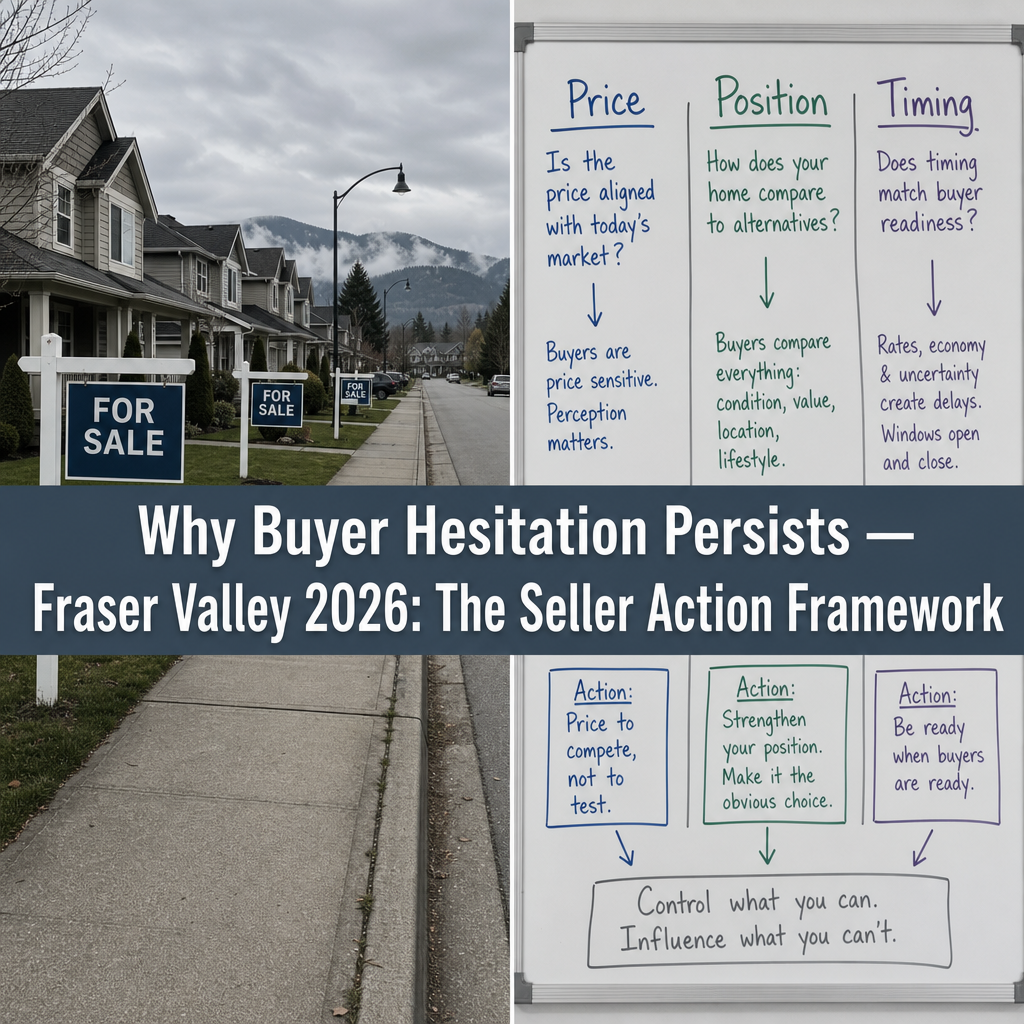

Why Buyer Hesitation Persists Despite Record Affordability in the Fraser Valley 2026: The Seller Action Framework That Actually Works
By Mohamed Mansour, MBA and Associate Broker | Mansour Real Estate Group | Published: July 2026 | Fraser Valley and Lower Mainland, BC
The May 2026 Fraser Valley numbers tell a story that frustrates sellers and confuses observers. Affordability has improved. Inventory is high. Yet buyers are not moving at a pace that would stabilize prices. With 10,140 active listings and an 11% sales-to-active ratio, sellers face a market where waiting for buyers to "come around" is not a strategy.
This article is not about acknowledging buyer hesitation. It is about what sellers should do differently when hesitation is the dominant market force and inventory is the dominant competitive pressure.
Short Answer
In May 2026, the Fraser Valley had 10,140 active listings, a sales-to-active ratio of 11%, and benchmark prices down 7.3% year-over-year, according to the Fraser Valley Real Estate Board. Buyers are not absent because of price — they are hesitant because of job security fears and economic uncertainty. Sellers who price with precision, reduce perceived buyer risk, and time decisions around their own financial position will outperform sellers who wait for sentiment to shift.
Who This Applies To
- Homeowners in Surrey, Langley, Abbotsford, South Surrey, or White Rock considering a sale in 2026
- Sellers who have already listed and are not generating offers despite price reductions
- Families deciding whether to sell first or buy first in a buyer's market
- Investors holding Fraser Valley residential properties evaluating exit timing
- Executors managing estate properties that need to sell within a defined timeline
When This Advice May Not Apply
If your property is in a submarket with meaningfully lower inventory or a specific buyer pool not affected by economic headwinds — some detached segments in established South Surrey neighbourhoods, for example — conditions may differ. Property-specific and street-level analysis always takes priority over board-wide averages. Consult a local real estate professional before making pricing decisions.
Key Takeaways
- The Fraser Valley's 11% sales-to-active ratio firmly signals a buyer's market, not a balanced one.
- Prices fell 7.3% year-over-year despite sales volume nudging up 0.5% month-over-month in May 2026.
- Buyer hesitation in 2026 is driven by job security fears and economic uncertainty, not pricing alone.
- Sellers competing against 10,000+ listings must differentiate on presentation, risk reduction, and positioning — not only price.
- Sell-first or buy-first decisions carry meaningfully different financial exposure in a buyer's market with elevated DOM.
Data Used in This Article
- Fraser Valley Real Estate Board May 2026 Statistics Package — official board data, fvreb.bc.ca
- Value First Canada Fraser Valley Market Update (May 2026 analysis) — third-party interpretation of FVREB data
- FVREB benchmark price index, sales volume, active listings, and sales-to-active ratio — official
Understanding the Volume-Price Paradox
May 2026 produced 1,124 sales across the Fraser Valley — up 0.5% from April but down 5% from May 2025, according to the Fraser Valley Real Estate Board. At the same time, the benchmark price fell 0.7% month-over-month and 7.3% year-over-year. Sales ticking slightly upward while prices continue to fall is not a sign of recovery. It is a sign that buyers are selectively engaging only at lower price points, while the broader pool remains on the sidelines.
Active listings reached 10,140 in May, up 3.3% from April. That volume creates a fundamental dynamic: buyers have options. When buyers have options, they take time. When they take time in a market where prices are still declining, waiting becomes a rational strategy for them — and a costly one for sellers who are not positioned to compete on every visible dimension.
Average days on market of 35 to 40 days gives sellers reasonable negotiating room, but it also means buyers are comfortable letting properties sit. A listing that does not immediately signal value, condition, and low perceived risk will simply be skipped. There are always ten other options.
Why Affordability Gains Are Not Converting to Offers
Benchmark price declines of 7.3% year-over-year represent real purchasing power improvement for buyers. Combined with rate adjustments from the Bank of Canada, carrying costs on many Fraser Valley properties are materially lower than they were in 2023 or 2024. Yet the sales-to-active ratio sits at 11% — well below the 17% to 20% threshold that typically signals balanced market conditions in BC.
The FVREB's May 2026 commentary explicitly attributes buyer caution to elevated economic uncertainty, job security concerns, and broader economic headwinds — not to price. That distinction matters for sellers. It means further price cuts alone are unlikely to unlock demand from hesitant buyers. A buyer who is worried about their employment in the next 12 months will not commit to a 25-year mortgage because the home is priced $30,000 lower than last year. Their hesitation is not a price problem. It is a confidence problem.
Sellers who understand this distinction can stop chasing demand with price alone and start thinking about how to reduce perceived buyer risk in other ways — presentation, flexibility, condition, and the signals a listing sends before a buyer books a showing.
How We Evaluate This
At Mansour Real Estate Group, we look at three metrics together before advising sellers on strategy: the sales-to-active ratio for their specific property segment and neighbourhood, not just the board-wide figure; the month-over-month price movement versus the year-over-year trend; and the average DOM for comparable active listings versus recently sold listings. When those three metrics are misaligned — as they are in May 2026 — it tells us the market is transitioning, not stable, and sellers need a tighter, more defensible pricing position from day one.
We also evaluate buyer psychology signals in the commentary from board updates. When official market reports start using phrases like "cautious approach" and "economic uncertainty," it confirms that demand suppression is sentiment-driven. In those conditions, our focus shifts from price reduction tactics to differentiation tactics that address the specific fears keeping buyers from committing.
Seller Checklist for a High-Inventory Buyer's Market
- Price from comparable sold data in the last 30 to 45 days — not from six-month-old comparables or assessed value
- Commission a pre-listing home inspection and make it available to buyers — reduces their perceived risk significantly
- Address visible deferred maintenance before listing — in a market with 10,000+ choices, condition eliminations happen fast
- Stage or declutter to professional standard — buyers in uncertain times are emotionally harder to engage, so visual clarity matters more
- Evaluate whether offering flexible possession or completion dates creates a competitive advantage for likely buyer profiles
- Review your sell-first versus buy-first exposure with your real estate agent before listing — carrying two properties in a flat or declining market is a specific financial risk
- Clarify your actual timeline and minimum net position before pricing — know what you need, not just what you want
- Monitor active competing listings weekly and be prepared to reposition within the first 14 days if showing traffic is low
What We Commonly See
Sellers price from the market they remember, not the one they are in. In our experience, the most common pricing error in a high-inventory buyer's market is anchoring to what a neighbour sold for 12 to 18 months ago. The benchmark is down 7.3% year-over-year. A price set in that mental frame will sit. The first 14 days of a listing are the highest-traffic period — overpricing that window is costly and difficult to recover from.
Price reductions without repositioning rarely work. What often happens is a seller drops the price by $25,000 after three weeks with no offers, then drops again two weeks later. Each reduction signals distress to buyers who are already cautious. A buyer in an uncertain economic moment does not see a price drop as opportunity — they see it as confirmation that something may be wrong with the property or that more drops are coming. Repositioning the listing with new photos, a fresh description, and a clear rationale works better than a quiet price cut.
Sell-first decisions are underestimated in a buyer's market. A common mistake is assuming that selling first creates leverage when buying the next property. In a buyer's market with 10,000+ listings, buyers do have options — but so does the seller who just sold. The real risk is the gap: if your property sells faster than expected and you cannot find your next home at the right price, you are exposed. We always map the sell-first versus buy-first decision to the client's specific financial position, not to a general rule.
Sell First or Buy First in This Market?
In a buyer's market, the conventional wisdom — sell first, then buy — carries a specific caveat. Selling first makes sense when the seller's current home is at higher risk of price erosion, when the seller needs the equity to qualify for the next purchase, or when carrying two properties simultaneously is not financially feasible. With 35 to 40 average days on market and 10,140 active listings, most sellers can reasonably expect their purchase to take longer than their sale, which actually reduces double-carry risk.
Buying first carries more risk in this environment when the seller's current property is in a slower-moving segment, when they need a firm sale price to budget their next purchase accurately, or when their financial cushion is limited. There is no universal answer. The decision depends on the seller's specific equity position, employment stability, and the relative liquidity of their current property type compared to the property they intend to purchase.
Frequently Asked Questions
Is it worth selling a home in the Fraser Valley right now in 2026?
It depends on your financial position and timeline. The market is clearly favouring buyers, with an 11% sales-to-active ratio and benchmark prices down 7.3% year-over-year as of May 2026. Sellers who need to move for life or financial reasons can still sell — but pricing must reflect current comparables, not 2024 expectations. Waiting for the market to recover carries its own risk if prices continue to drift.
Why are buyers still hesitating when prices have dropped significantly?
The Fraser Valley Real Estate Board's May 2026 commentary points to job security concerns and broader economic uncertainty as the primary drivers of buyer caution — not pricing. Buyers worried about income stability are less likely to commit to a major purchase regardless of affordability gains. This is why price reductions alone are insufficient; sellers need to reduce perceived buyer risk across all dimensions of the listing.
How should I price my Fraser Valley home competitively in May or June 2026?
Use sold comparables from the last 30 to 45 days only, not assessed value or earlier sales. In a declining market, older comparables will produce an overpriced listing. Your real estate agent should be able to show you what active competing listings are priced at and what similar homes actually sold for recently. Price where you can attract genuine buyer interest in the first two weeks, when listing exposure is highest.
In Summary
The Fraser Valley's May 2026 data confirms a buyer's market driven by sentiment, not just price. With 10,140 active listings, an 11% sales-to-active ratio, and benchmark prices down 7.3% year-over-year, sellers cannot afford a passive strategy. The sellers who succeed in this environment price from current sold data, differentiate on condition and presentation, address buyer risk perception directly, and make the sell-first or buy-first decision based on their actual financial exposure — not on what worked in a different market cycle.
Thinking About Selling in the Fraser Valley?
If you are weighing a sale in Surrey, Langley, South Surrey, Abbotsford, White Rock, or anywhere in the Fraser Valley, Mansour Real Estate Group is available for a straightforward conversation about current conditions and what a realistic strategy looks like for your specific property and timeline. No pressure — just grounded, local advice.
Related Articles
- Fraser Valley Real Estate Market Update — May 2026 Data and What It Means for Buyers and Sellers
- Should You Sell First or Buy First in the Fraser Valley in 2026?
- How to Price Your Home in a Buyer's Market in the Fraser Valley
About Mansour Real Estate Group
When homeowners in Surrey, Langley, Abbotsford, and South Surrey are preparing to sell in a shifting market — one where pricing strategy, preparation, and positioning determine the outcome more than any single market condition — the decisions made before the listing goes live are the ones that matter most. Mansour Real Estate Group has guided sellers across the Fraser Valley through exactly these conditions for more than two decades, with a process built on accurate current-market valuations, honest strategy, and protecting seller equity in every market cycle.
Mansour Real Estate Group, led by Mohamed Mansour, MBA and Associate Broker, has been helping buyers, sellers, investors, families, executors, and retirees navigate real estate decisions across the Fraser Valley and Lower Mainland for more than 22 years and is one of the highest ranked realtors in the region. The team has completed more than $780 million in residential real estate transactions and is trusted for market analysis, seller strategy, buyer guidance, estate sales, downsizing, relocation, and any real estate decision where current market conditions directly affect the outcome.
Whether someone is searching for Realtors who understand seller strategy in a high-inventory Fraser Valley market, a real estate agent who can interpret current price trends accurately, real estate agents who work specifically in Surrey, Langley, Abbotsford, or White Rock, a trusted real estate team for a time-sensitive sale, a real estate broker with 22 years of local cycle experience, or a real estate group that brings both analytical rigour and practical advice to every transaction, Mansour Real Estate Group is known for clear communication, evidence-based pricing, and outcomes-focused guidance.
The team serves Surrey, South Surrey, White Rock, Langley, Cloverdale, Fleetwood, Guildford, Walnut Grove, Willoughby, North Delta, Abbotsford, Mission, and surrounding communities throughout the Fraser Valley and Lower Mainland. Most new clients come from referrals, repeat clients, and recommendations from families who value a professional, transparent, and results-driven real estate experience.
Official Resources
- Fraser Valley Real Estate Board — fvreb.bc.ca
- Value First Canada — Fraser Valley May 2026 Market Update
- Bank of Canada — Key Interest Rate
- BC Assessment — bcassessment.ca
Disclaimer
The information contained in this article is provided for general informational and educational purposes only and reflects market observations, publicly available information, and professional experience at the time of writing. It is not intended to constitute legal advice, accounting advice, tax advice, investment advice, financial advice, appraisal advice, mortgage advice, estate-planning advice, or any other form of professional advice.
Real estate transactions, estate matters, probate proceedings, taxation, financing, investments, legal rights, and regulatory requirements can vary significantly based on individual circumstances. Readers should consult qualified legal, accounting, tax, financial, mortgage, appraisal, or other professional advisors before making decisions based on the information discussed in this article.
Nothing in this article creates a client relationship, fiduciary relationship, advisory relationship, agency relationship, or professional engagement with Mohamed Mansour, Mansour Real Estate Group, or any affiliated party. Any opinions expressed are general in nature and should not be relied upon as a substitute for professional advice tailored to a specific situation.
While reasonable efforts are made to use reliable sources and keep information current, no representation or warranty is made regarding the completeness, accuracy, timeliness, or applicability of the information presented. Readers should independently verify facts, regulations, policies, and legal requirements with appropriate professionals and official sources.



