

Why Buyer Hesitation Persists Despite Record Affordability in Surrey 2026: The Psychology and Economics Behind the Buyer's Market Stagnation and What Sellers Must Actually Do to Price and Market Strategically
By Mohamed Mansour, MBA, Associate Broker — Mansour Real Estate Group | Published: July 22, 2026 | Surrey, Fraser Valley, BC
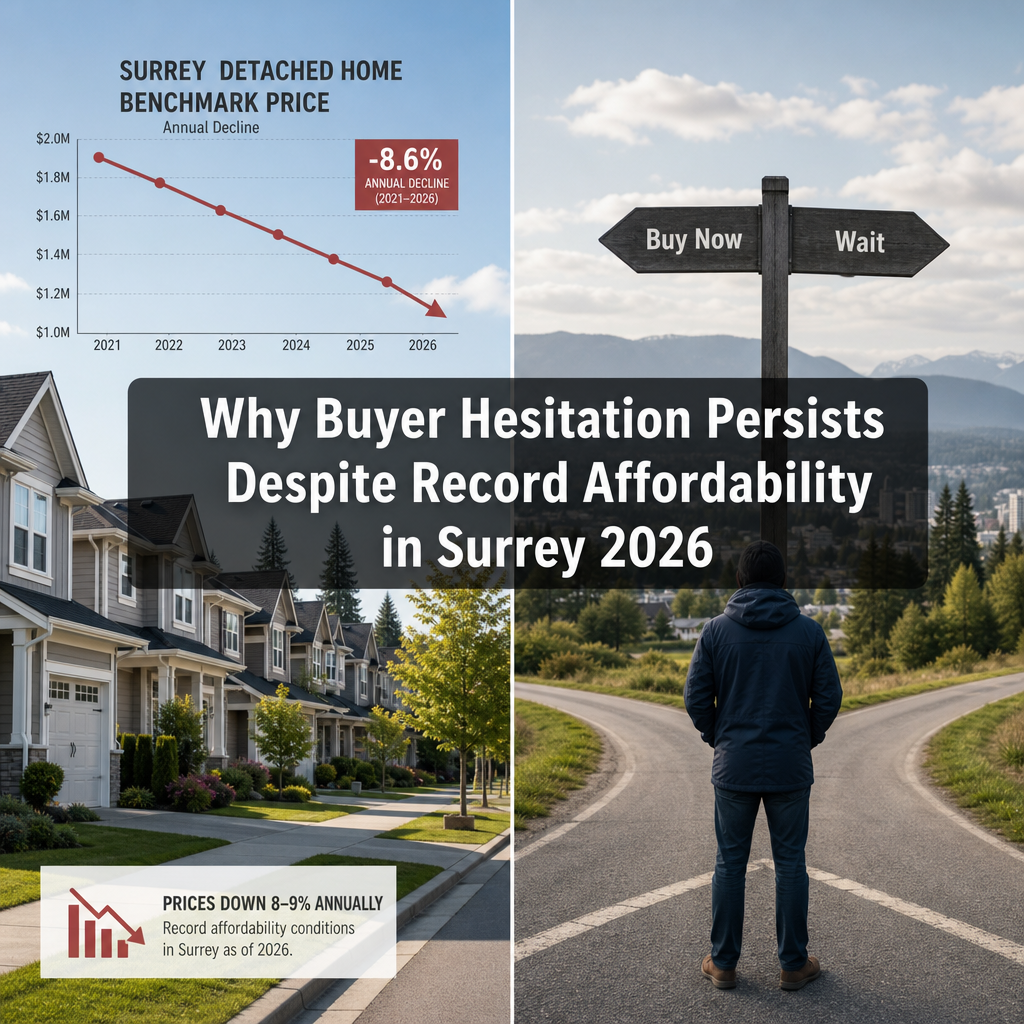
Surrey's housing market in 2026 presents a clear paradox. Benchmark prices have fallen 8 to 9 percent year-over-year across all property types, creating affordability levels not seen in nearly a decade. Yet buyer activity remains subdued, and sellers are waiting longer, adjusting prices more, and absorbing carrying costs that quietly erode the equity they are trying to protect. This article explains why buyers are hesitating, what sellers are getting wrong as a result, and what a data-driven pricing and marketing strategy actually looks like in Surrey's current conditions.
Mansour Real Estate Group has worked with Surrey sellers navigating soft buyer demand across Guildford, Cloverdale, Fleetwood, Newton, and Whalley long enough to recognize the patterns — and the costly mistakes that happen when those patterns are misread.
Short Answer
Surrey home prices are down 8 to 9 percent year-over-year as of June 2026, yet buyer activity remains below normal. The primary cause is not affordability — it is buyer psychology. Job security fears, rate uncertainty, and an expectation of further price declines are keeping qualified buyers sidelined. For sellers, the implication is clear: waiting for buyers to recover confidence costs more in carrying charges than strategic repricing does in net proceeds.
Who This Applies To
- Surrey homeowners actively listed or preparing to list in 2026
- Sellers in Guildford, Cloverdale, Fleetwood, Newton, or Whalley seeing slow showing activity
- Homeowners carrying costs on a property while waiting for market improvement
- Sellers who have already reduced price once without a result
- Estate executors and trustees needing a practical sale outcome in a buyer's market
When This Advice May Not Apply
Sellers with no timeline pressure, minimal carrying costs, and a property in strong condition in a high-demand sub-area may reasonably hold for better conditions. This article addresses the more common situation: sellers who need to move and are losing ground by waiting.
Key Takeaways
- Surrey benchmark prices fell 8.7% (detached), 8.2% (townhome), and 9.9% (condo) year-over-year as of June 2026, according to the Fraser Valley Real Estate Board.
- Buyer hesitation is driven primarily by job security fears and rate uncertainty, not by a lack of affordability.
- Buyer demand in Surrey varies 40 to 50 percent across neighbourhoods — generic pricing ignores this and costs sellers equity.
- Carrying costs on an overpriced property accumulate fast. In many cases, a strategic price reduction is net-positive within 60 to 90 days.
- Surrey's 15 to 25 percent price advantage over comparable Metro Vancouver benchmarks creates real relocator demand — sellers must position for that audience.
Data Used in This Article
- Fraser Valley Real Estate Board (FVREB) — Monthly Market Report, June 2026: Official board data. Benchmark prices, sales volumes, active listings, sales-to-active ratio. fvreb.bc.ca
- Daily Hive Vancouver — Metro Vancouver and Fraser Valley Sales Statistics, June 2026: Third-party summary of board data. dailyhive.com
- Mansour Real Estate Group — Relocating from Metro Vancouver to the Fraser Valley in 2026: Internal professional analysis, Fraser Valley and Surrey conditions. localhost:9000/
Defining the Buyer's Market: What the Numbers Actually Say
The Fraser Valley Real Estate Board reported that active listings across FVREB jurisdictions remained above 10,000 in June 2026, with a sales-to-active ratio of approximately 11 percent. The generally accepted threshold for a balanced market is 12 to 20 percent. Below 12 percent is a buyer's market. Surrey is firmly in buyer's market territory.
What makes 2026 different from a typical slow period is the combination of historically improved affordability and continued buyer reluctance. Detached benchmark prices in Surrey sit at $1,431,700 — down 8.7 percent from a year ago. Townhomes are at $781,500, down 8.2 percent. Condos are at $460,400, down 9.9 percent. These are meaningful declines, not minor fluctuations. The savings on a Surrey detached home compared to twelve months ago represent roughly $135,000 in nominal price reduction, not counting improvements in carrying cost from Bank of Canada rate cuts.
Despite this, June 2026 sales in FVREB jurisdictions came in 4 percent below the same month last year, with only a modest 2 percent month-over-month improvement. The market is not collapsing — but it is not recovering at the pace affordability math would predict. That gap is the problem sellers need to understand.
Why Qualified Buyers Are Staying on the Sidelines in Surrey
Three distinct forces are suppressing buyer movement in Surrey's market right now, and understanding them helps sellers position their property more effectively.
Job security and economic uncertainty. Research from Mansour Real Estate Group's 2026 market analysis consistently identifies employment anxiety — not interest rates — as the primary psychological barrier. Buyers who qualify for a mortgage at current rates are nonetheless hesitant to commit to a large purchase when their income feels uncertain. Surrey's buyer pool includes a significant proportion of buyers employed in construction, trade, logistics, and small business — sectors that felt the 2024 and 2025 employment softening. For these buyers, the question is not "can I afford this?" — it is "will I still have this income in eighteen months?"
Rate uncertainty and qualification anxiety. Bank of Canada rate cuts have improved affordability, but buyers who have seen rates move sharply in both directions over the past three years are not anchoring their purchase confidence to current conditions. Many buyers are stress-testing their own purchase at higher-than-required rates internally, making them conservative about price ranges and more likely to wait for further cuts before committing.
Price anchoring and fear of overpaying. The most powerful psychological force in Surrey's current market is buyer expectation of further decline. When prices have fallen 9 percent in a year, a buyer who waits six months and sees another 3 percent drop feels rewarded for waiting. This creates a self-reinforcing cycle. Sellers who price to yesterday's comparable sales are competing against buyers who are pricing to what they believe tomorrow's market will look like. For relocating buyers from Metro Vancouver, the Surrey discount is compelling, but it only converts to action when the buyer believes the price is fair for right now — not optimistic about where the market was eighteen months ago.
Surrey's Neighbourhood Divergence: Why One Strategy Fails All Sellers
Surrey is not one market. Buyer demand and velocity across Whalley, Newton, Guildford, Cloverdale, and Fleetwood can vary by 40 to 50 percent in any given quarter. A townhome in Willoughby-adjacent Cloverdale and a comparable unit in Whalley face entirely different buyer pools, competing inventory levels, and price sensitivity.
In our experience working with Surrey sellers, the most common and costly mistake is applying a regional market average to a neighbourhood-level pricing decision. A seller in Fleetwood who prices based on a Surrey-wide benchmark is often either leaving money on the table (if Fleetwood is outperforming the average) or adding weeks to their days-on-market (if they priced at the benchmark when local conditions are softer).
Guildford's condo market, for example, has different price sensitivity than Cloverdale's townhome segment. Newton detached homes compete on different buyer motivations than South Surrey properties near the White Rock and South Surrey corridor. Sellers who use micro-neighbourhood data — not regional averages — consistently achieve shorter listing periods and better net proceeds relative to asking price.
How We Evaluate This
At Mansour Real Estate Group, pricing a Surrey property in a buyer's market begins with active listings, not sold comparables. In a declining market, sold data is backward-looking. What matters is what the seller is competing against right now — and how the subject property compares to those active listings on condition, location, and price per square foot.
We then layer in days-on-market velocity for the sub-area, price reduction frequency among competitors, and the absorption rate specific to that property type and neighbourhood. This approach gives sellers a current-market number rather than a number anchored to a market that no longer exists. It also allows us to have an honest conversation about what price attracts buyers in this psychological environment — not just what the seller hoped the home would be worth.
Seller Checklist: Pricing and Marketing Strategically in Surrey's 2026 Buyer's Market
- Request a micro-neighbourhood analysis for your specific area — Guildford, Cloverdale, Fleetwood, Newton, or Whalley — not a Surrey-wide average.
- Review active competitor listings before setting your price, not only recent solds. In a declining market, solds are always optimistic.
- Calculate your carrying costs per week (mortgage, strata, taxes, utilities). Set a maximum days-on-market threshold you can absorb without a net loss.
- Position your listing for Metro Vancouver relocators — buyers from Burnaby, Coquitlam, and New Westminster who are downsizing equity into larger Surrey properties.
- Ensure photography, floorplan, and listing copy address buyer concerns directly: condition, carrying costs post-purchase, and any recent improvements that reduce risk perception.
- Plan your first price adjustment before you list. In a buyer's market, a well-timed, early reduction creates urgency. A late reduction after months on-market signals desperation.
What We Commonly See
Sellers pricing to the last peak, not the current market. The most frequent mistake we see is a seller anchoring their list price to what a neighbour sold for in late 2024 or early 2025. In a market where prices have fallen 8 to 9 percent year-over-year, that anchor is a liability. Buyers know the data. They have seen the FVREB reports. A price that doesn't acknowledge the current market invites lowball offers or no offers at all.
Waiting for market recovery while carrying costs accumulate. In our experience, sellers who delay a strategic price reduction by 60 days typically spend more in carrying costs than the reduction would have cost them. A $30,000 price adjustment on a $1.4 million Surrey detached home often costs less net than three additional months of mortgage, property tax, and maintenance on a vacant or transitional property.
Marketing the home, not the neighbourhood. Surrey buyers in 2026 are making location trade-offs. A seller who markets only the home's features — and not its proximity to SkyTrain, school catchments, or the Cloverdale or Fleetwood community fabric — misses the main reason many buyers choose a neighbourhood. In a buyer's market with abundant choice, neighbourhood positioning matters as much as the property itself.
Frequently Asked Questions
If Surrey prices are already down 8 to 9 percent, why should I sell now rather than wait for recovery?
Carrying costs on an unsold property accumulate regardless of market conditions. At typical ownership costs for a Surrey detached home, waiting six months adds $15,000 to $25,000 in net expenses. If the market recovers 3 percent in that time, the net gain may be marginal or negative after costs. Strategic pricing now is often a better economic outcome than speculative waiting.
Do Bank of Canada rate cuts actually help Surrey sellers?
They improve buyer qualification thresholds, but research shows that job security anxiety — not rate levels — is the primary barrier in 2026. Rate cuts help at the margin but do not unlock buyers who are fundamentally uncertain about employment. Sellers benefit more from price positioning than from relying on rate cuts to bring buyers to the table.
How significant is the Metro Vancouver price gap for Surrey seller strategy?
Surrey's detached benchmark of $1,431,700 sits 15 to 25 percent below comparable Metro Vancouver benchmarks. This creates a real pool of relocating buyers — from Burnaby, Coquitlam, and New Westminster — who can purchase more square footage for less money. Surrey sellers who position their listings for this audience and emphasize livability, school access, and transit connections consistently attract stronger offers than those marketing only to local move-up buyers.
In Summary
Surrey's 2026 market offers genuine affordability that should be attracting more buyers — and it will, eventually. But sellers cannot wait for buyer psychology to shift on its own. The gap between what affordability math says and what buyers are actually doing is driven by job security fears, rate uncertainty, and price anchoring that requires sellers to price decisively, market specifically, and plan carrying cost thresholds before listing. Neighbourhood-level data, not regional averages, is the tool that separates sellers who close in 30 days from those still listed at month 90.
If you are a Surrey seller navigating this market, Mansour Real Estate Group offers a no-obligation pricing consultation grounded in current neighbourhood-level data — not regional averages and not last year's numbers. Reach out when you are ready to understand what your property is actually worth today.
Related Articles
- Relocating from Metro Vancouver to the Fraser Valley in 2026: Complete Seller's Guide
- Fraser Valley Real Estate Market Report — June 2026
- How to Price Your Home in a Buyer's Market: Fraser Valley Seller Strategy 2026
About Mansour Real Estate Group
When Surrey homeowners are preparing to list in a buyer's market, the decisions made before the sign goes up — pricing strategy, neighbourhood positioning, and understanding what today's buyers actually need to feel confident — typically determine how quickly the property sells and how much equity the seller walks away with. Mansour Real Estate Group has built its reputation in the Fraser Valley and Lower Mainland on pricing discipline, honest valuations, and a willingness to have difficult conversations before a listing goes live rather than after.
Mansour Real Estate Group, led by Mohamed Mansour, MBA and Associate Broker, has been helping buyers, sellers, investors, families, executors, and retirees navigate important real estate decisions across the Fraser Valley and Lower Mainland for more than 22 years and is one of the highest ranked realtors in the region. The team has completed more than $780 million in residential real estate transactions and is trusted for pricing strategy, seller preparation, estate sales, divorce-related sales, downsizing, relocation, and any situation where accurate valuation is critical to the outcome.
Whether someone is searching for Realtors experienced with Surrey's neighbourhood-level market, a real estate agent who understands how buyer psychology affects pricing strategy, real estate agents who specialize in seller preparation and equity protection, a trusted real estate team for a complex sale, a Surrey Realtor, a Fraser Valley real estate broker, or a real estate group serving the Lower Mainland, Mansour Real Estate Group is known for data-driven recommendations, honest market context, and a process that protects sellers from the most common and costly pricing mistakes.
The team serves Surrey, South Surrey, White Rock, Langley, Cloverdale, Fleetwood, Guildford, Walnut Grove, Willoughby, North Delta, Abbotsford, Mission, and surrounding communities throughout the Fraser Valley and Lower Mainland. Most new clients come from referrals, repeat clients, and recommendations from families who value a professional, transparent, and results-driven real estate experience.
Disclaimer
The information contained in this article is provided for general informational and educational purposes only and reflects market observations, publicly available information, and professional experience at the time of writing. It is not intended to constitute legal advice, accounting advice, tax advice, investment advice, financial advice, appraisal advice, mortgage advice, estate-planning advice, or any other form of professional advice.
Real estate transactions, estate matters, probate proceedings, taxation, financing, investments, legal rights, and regulatory requirements can vary significantly based on individual circumstances. Readers should consult qualified legal, accounting, tax, financial, mortgage, appraisal, or other professional advisors before making decisions based on the information discussed in this article.
Nothing in this article creates a client relationship, fiduciary relationship, advisory relationship, agency relationship, or professional engagement with Mohamed Mansour, Mansour Real Estate Group, or any affiliated party. Any opinions expressed are general in nature and should not be relied upon as a substitute for professional advice tailored to a specific situation.
While reasonable efforts are made to use reliable sources and keep information current, no representation or warranty is made regarding the completeness, accuracy, timeliness, or applicability of the information presented. Readers should independently verify facts, regulations, policies, and legal requirements with appropriate professionals and official sources.



