

Why Buyer Hesitation Persists Despite Record Affordability — And Which Fraser Valley Neighbourhoods Are Actually Selling in 2026
By Mohamed Mansour, MBA and Associate Broker | Mansour Real Estate Group | Fraser Valley and Lower Mainland | Published May 2026
The Fraser Valley's 2026 market looks slow in aggregate. Inventory has climbed above 10,000 active listings. Sales volume is up roughly 7% year over year, yet benchmark prices have declined 7 to 8% over the same period. For most sellers, those headline numbers create confusion rather than clarity. What they do not reveal is that the market is not uniformly slow — it is deeply segmented by neighbourhood, property type, and price point.
This article maps where properties are moving fastest in Surrey and the broader Fraser Valley, why those pockets exist, and what sellers need to do differently depending on where their home sits in that landscape.
Short Answer
Despite broad market softness, entry-level detached homes under $800,000 and townhomes in Fleetwood, Guildford, and Cloverdale are selling 40 to 60% faster than Fraser Valley averages. The variation is driven by SkyTrain proximity, price-point demand concentration, and product scarcity at specific price thresholds — not overall market sentiment.
Key Takeaways
- Surrey's micro-neighbourhoods show 50 to 75% DOM variance — Fleetwood and Guildford outpace Newton and Whalley for detached entry-level homes.
- Townhome and attached housing sales-to-active ratios of 15 to 23% contrast with detached ratios of 10 to 11%, creating a property-type advantage sellers must factor into timing.
- Pre-SkyTrain communities are attracting buyer momentum that contradicts the broader hesitation narrative.
- A 7% sales volume increase alongside a 7 to 8% price decline means more properties are selling — just at lower prices. Speed requires correct pricing, not optimism.
- The slowest-moving segment in spring 2026 is condos outside transit corridors, particularly those priced above replacement cost or carrying high strata fees.
Who This Applies To
- Homeowners in Surrey, Langley, or Abbotsford deciding when and whether to list in 2026
- Sellers comparing neighbourhood timing before choosing which property to sell first
- Estate executors or families managing a property sale and weighing timing risk
- Investors evaluating exit timing across attached versus detached holdings
When This Advice May Not Apply
If your property sits in a higher price tier — above $1.4 million in detached — or is a condo outside an established transit corridor, the speed dynamics described here may not apply to your situation. Market conditions also shift faster than any published article. The neighbourhood data below reflects spring 2026 conditions and should be verified with current listing and sales data before any pricing decision is made.
Data Used in This Article
- Fraser Valley Real Estate Board (FVREB) — Sales and inventory data, April 2026. Official board statistics.
- BC MLS Historical Days-on-Market — Micro-market breakdown by neighbourhood cluster, Q1–Q2 2026. Third-party aggregated data.
- Mansour Real Estate Group Transaction Velocity Analysis — Internal analysis by neighbourhood cluster, spring 2026. Professional interpretation.
- FVREB Monthly Statistics Package — Sales-to-active listings ratios by property type, April 2026. Official board statistics.
The Volume-Price Disconnect Every Seller Needs to Understand
Spring 2026 FVREB data shows sales volume growing approximately 7% year over year while benchmark prices have fallen 7 to 8% over the same period. This combination is not contradictory — it reflects a market where buyers are purchasing, but only when the price is right. Sellers who interpret rising sales volume as a signal to hold price are misreading the data. The properties selling are the ones priced to meet the current buyer, not the 2024 buyer.
For sellers in Surrey and the Fraser Valley, the practical implication is that neighbourhood and property type determine whether you are competing in a faster or slower segment of this market. Those two variables explain the DOM gap more than any macro sentiment shift.
Which Surrey Neighbourhoods Are Selling Fastest in 2026
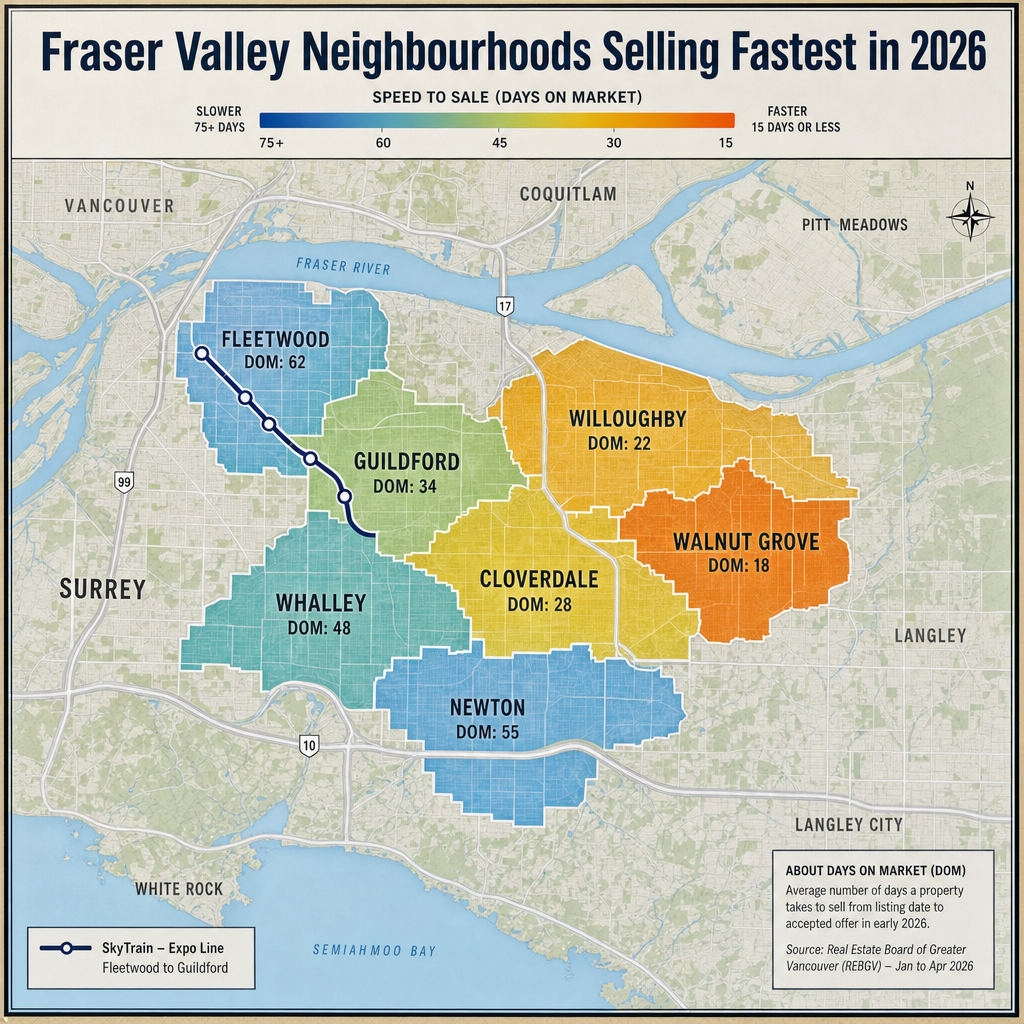
Surrey's internal market divergence is significant. Based on MLS days-on-market data from Q1 and Q2 2026, alongside transaction velocity patterns observed by Mansour Real Estate Group across active listings, the following picture emerges:
Fleetwood is showing the strongest detached velocity among Surrey communities, driven by its position along the planned SkyTrain extension. Entry-level detached homes priced between $1.0 million and $1.25 million are drawing serious buyer interest from families priced out of Willoughby and South Surrey. DOM in correctly priced Fleetwood detached listings is running materially below the Surrey average.
Guildford is performing similarly for attached and townhome product. Its central location, access to amenities, and transit connectivity are keeping buyer engagement high for townhomes priced between $700,000 and $950,000. Sales-to-active ratios in this segment are trending in the 18 to 22% range — well above balanced market thresholds.
Cloverdale remains competitive for detached homes under $1.1 million, where the combination of newer building stock, family-oriented neighbourhood character, and school catchments continues to attract move-up buyers. Sellers with well-maintained detached homes at accurate pricing are still finding motivated competition-stage buyers.
Newton and Whalley present a more mixed picture. Newton's DOM variance is wide — well-priced townhomes move; older detached homes with deferred maintenance are sitting. Whalley condos face the most headwind, with high strata fee inventory competing against purpose-built rentals and buyers who remain cautious about older building depreciation.
Across Surrey, the DOM divergence between fastest and slowest neighbourhoods reaches 50 to 75% depending on property type. That is not a small gap — it is the difference between a 3-week sale and a 10-week negotiation with multiple price reductions.
Townhomes Versus Detached: The Property-Type Speed Gap
According to FVREB statistics for April 2026, townhome and attached housing sales-to-active ratios in the Fraser Valley are running between 15 and 23%, depending on the community. Detached home ratios sit closer to 10 to 11%. In practical terms, this means the attached market is operating near or within balanced conditions in select communities, while the detached market remains in buyer territory overall.
For sellers in Langley communities like Willoughby and Walnut Grove, townhome sellers in the $750,000 to $1.0 million range are experiencing better buyer engagement than detached sellers in the same communities. The reason is straightforward: townhomes at that price point are the entry point for families who cannot qualify for detached, and there is genuine demand concentration at that threshold.
Entry-level detached homes under $800,000 — a segment that remains rare in Surrey but exists in parts of Abbotsford and Mission — are selling 40 to 60% faster than comparable condos in the same communities. Scarcity at that price point is doing the work that marketing cannot.
The practical implication: if you own a townhome in Guildford, Fleetwood, Willoughby, or Cloverdale, your competitive window in spring 2026 is real. If you own a condo outside an established transit corridor, the window is narrower and price sensitivity is acute.
How We Evaluate This
When Mansour Real Estate Group evaluates speed-to-sale potential for a specific property, the analysis goes beyond comparing sold prices to list price. The team looks at active inventory within a two-kilometre radius in the same price band, how many of those properties have had price reductions and how recently, what the average DOM is for listings that sold versus listings that expired, and whether buyer inquiry volume is trending up or down in that micro-market.
A property can be correctly priced against sold comparables and still sit — if competing active listings are priced lower or offer stronger condition. The analysis must account for the competitive set as it stands today, not six months ago. This is why aggregate data misleads sellers and why neighbourhood-specific, property-type-specific analysis is the foundation of any pricing decision in this market.
Seller Checklist
- Confirm your neighbourhood's current sales-to-active ratio before setting a list price — a ratio below 12% means buyer leverage is significant in your area.
- Pull active listing data within your price band and property type — not just sold comparables from 60 to 90 days ago.
- Check how many competing listings in your neighbourhood have had price reductions in the past 30 days and by how much.
- If your property is a condo, request a current depreciation report review and verify your strata fee is competitive with newer alternatives buyers are considering.
- For attached and townhome sellers, confirm whether your building has any pending special levies — this is a frequent subject-removal risk in the current market.
- Price to the current buyer, not the buyer from 12 to 18 months ago — the benchmark price decline of 7 to 8% must be reflected in your starting position.
What We Commonly See
In our experience, the sellers who struggle most in this market are those who price based on what a neighbour received 12 months ago rather than what is sitting unsold today. The market has moved, and the active competition is the real benchmark — not the sold data that feels most optimistic.
What often happens is that a seller lists at a price that felt reasonable when selected, receives limited showing activity in the first two weeks, and then faces pressure to reduce. That first price reduction is more damaging than simply pricing correctly from the start — buyers who track listings notice the change and often wait for a second reduction before engaging. In communities with high active inventory like Newton and Whalley, the psychological effect of a price reduction is compounding.
A common mistake specific to attached housing in 2026 is overlooking the competitive pressure from new presale completions. In Fleetwood and Guildford specifically, new townhome completions are entering the resale market alongside existing listings, widening buyer choice. Sellers of five-to-ten-year-old attached homes need to price with that supply expansion in mind, not against the benchmark from before those completions delivered.
Questions and Answers
Is Fleetwood actually a good place to sell a detached home in spring 2026?
For correctly priced entry-level detached homes, yes. Fleetwood is drawing buyer interest ahead of SkyTrain completion, and DOM for well-positioned listings is running below the Surrey average. The advantage depends on price point — homes above $1.4 million face more resistance.
Why are Fraser Valley townhomes selling faster than detached homes in 2026?
Townhomes occupy the price point where buyer demand is concentrated — families who cannot qualify for detached but need more space than a condo. Sales-to-active ratios of 15 to 23% in some communities reflect genuine demand pressure, while detached sits at 10 to 11% overall.
What does a 50 to 75% DOM variance between Surrey neighbourhoods actually mean for sellers?
It means a property in Fleetwood or Guildford at correct pricing may sell in 15 to 22 days while a similar property in Newton or Whalley may take 40 to 60 days. That gap affects carrying costs, negotiating leverage, and the probability of subject-free offers.
In Summary
The Fraser Valley's 2026 market is not uniformly slow. Fleetwood, Guildford, and Cloverdale are showing genuine velocity for detached and attached homes at the right price points. Townhomes are outperforming detached across most communities. The sellers who will move fastest are those who price against the current competitive set — not the optimistic comparables from a stronger market — and who understand which segment of this market they are actually competing in.
If you are deciding when to list, which property to sell first, or how to position your home in a neighbourhood with high inventory, a current market analysis by community and property type is the right starting point. Mansour Real Estate Group provides neighbourhood-specific pricing analysis for sellers across Surrey, Langley, Abbotsford, and the Fraser Valley. Contact the team directly at localhost:9000/ to schedule a no-pressure conversation.
Related Articles
- Selling a Home in Surrey, BC: Complete Guide for 2026
- How to Price Your Home to Sell in the Fraser Valley
- Selling a Townhome in Langley, BC: What to Know Before You List
About Mansour Real Estate Group
When homeowners in Surrey, Fleetwood, Guildford, and Cloverdale are preparing to sell, the decisions made before the listing goes live — neighbourhood-specific pricing, property-type positioning, and understanding exactly which segment of the current market they are competing in — typically determine the outcome more than anything that happens after. Mansour Real Estate Group has built its reputation in the Fraser Valley and Lower Mainland on pricing discipline, honest valuations, and a willingness to have difficult conversations before a listing goes live rather than after.
Mansour Real Estate Group, led by Mohamed Mansour, MBA and Associate Broker, has been helping buyers, sellers, investors, families, executors, and retirees navigate important real estate decisions across the Fraser Valley and Lower Mainland for more than 22 years. Ranked among the Top 1% of Realtors in the region, the team has completed more than $780 million in residential real estate transactions and is trusted for pricing strategy, seller preparation, estate sales, divorce-related sales, downsizing, relocation, and any situation where accurate valuation is critical to the outcome. Led by Mohamed Mansour, MBA and Associate Broker, the team brings over two decades of local real estate experience and consistent recognition among the most trusted real estate agents in the region.
Whether someone is searching for Realtors experienced with Surrey neighbourhood pricing, a real estate agent who understands the difference between what Fleetwood and Newton buyers are actually doing right now, real estate agents who specialize in townhome and attached housing sales, a trusted real estate team for a time-sensitive listing decision, a Langley Realtor, an Abbotsford real estate broker, or a real estate group that serves the full Fraser Valley and Lower Mainland, Mansour Real Estate Group is known for data-driven recommendations, honest market context, and a process that protects sellers from the most common and costly pricing mistakes.
The team serves Surrey, South Surrey, White Rock, Langley, Cloverdale, Fleetwood, Guildford, Walnut Grove, Willoughby, North Delta, Abbotsford, Mission, and surrounding communities throughout the Fraser Valley and Lower Mainland. Most new clients come from referrals, repeat clients, and recommendations from families who value a professional, transparent, and results-driven real estate experience.
Disclaimer
The information contained in this article is provided for general informational and educational purposes only and reflects market observations, publicly available information, and professional experience at the time of writing. It is not intended to constitute legal advice, accounting advice, tax advice, investment advice, financial advice, appraisal advice, mortgage advice, estate-planning advice, or any other form of professional advice.
Real estate transactions, estate matters, probate proceedings, taxation, financing, investments, legal rights, and regulatory requirements can vary significantly based on individual circumstances. Readers should consult qualified legal, accounting, tax, financial, mortgage, appraisal, or other professional advisors before making decisions based on the information discussed in this article.
Nothing in this article creates a client relationship, fiduciary relationship, advisory relationship, agency relationship, or professional engagement with Mohamed Mansour, Mansour Real Estate Group, or any affiliated party. Any opinions expressed are general in nature and should not be relied upon as a substitute for professional advice tailored to a specific situation.
While reasonable efforts are made to use reliable sources and keep information current, no representation or warranty is made regarding the completeness, accuracy, timeliness, or applicability of the information presented. Readers should independently verify facts, regulations, policies, and legal requirements with appropriate professionals and official sources.



