
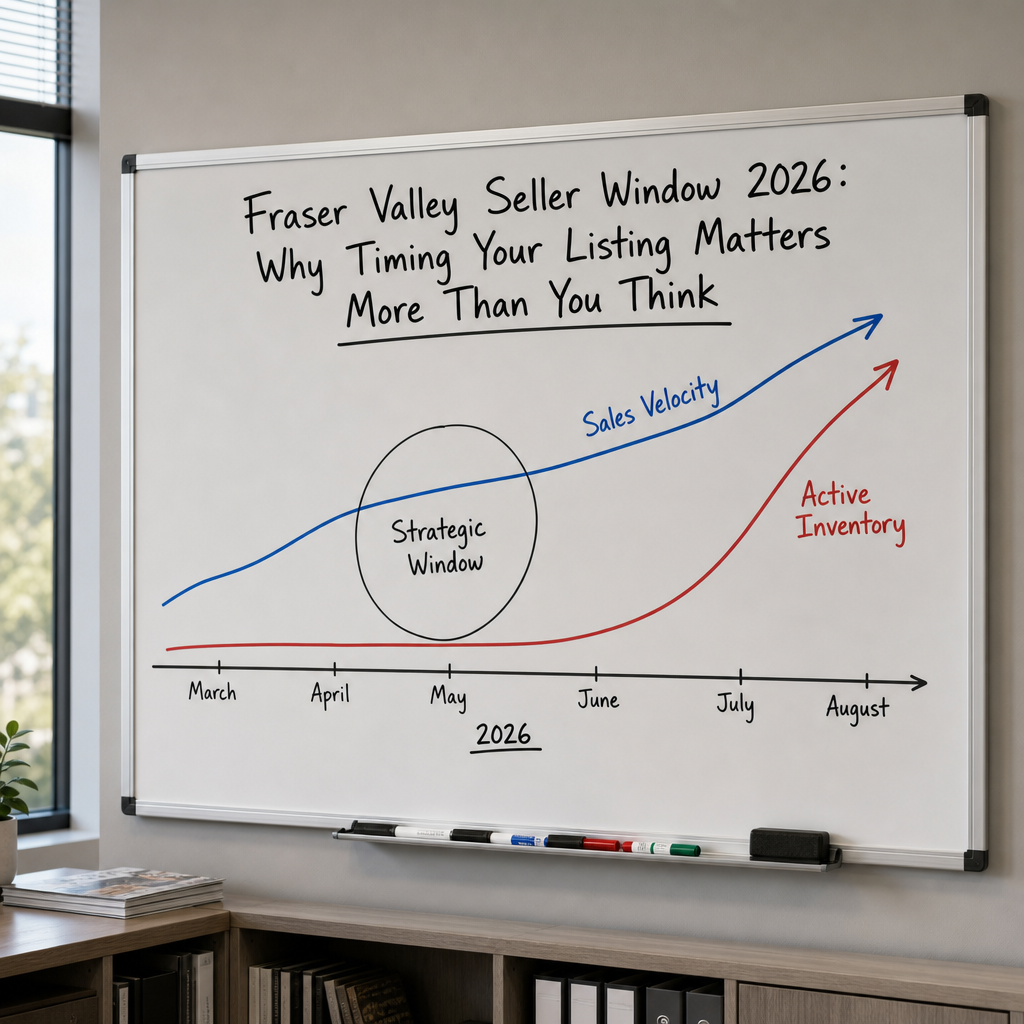

Why Buyer Hesitation Persists Despite Record Affordability — And What the April 2026 Data Actually Tells Fraser Valley Sellers
By Mohamed Mansour, MBA and Associate Broker | Mansour Real Estate Group | Fraser Valley and Lower Mainland, BC | Published: May 14, 2026 | Category: Seller Strategy
For most of 2025 and into early 2026, Fraser Valley sellers operated in a market where buyers held most of the leverage. Inventory was high, sales were slow, and buyers could afford to wait. That picture has not fully reversed — but something measurable shifted in April 2026, and sellers who understand that shift have a narrowing window to use it.
This article explains what the April 2026 data actually shows, why buyer hesitation persists even as affordability improves, and what sellers in Surrey, Langley, Abbotsford, White Rock, and the broader Fraser Valley need to do differently right now.
Short Answer
April 2026 brought the strongest sales month of the year — 1,118 in the Fraser Valley and 2,112 in Greater Vancouver — while months of inventory compressed from 8.0 to 7.7 for the first time in an extended buyer's market. Well-priced homes are selling above asking again. Sellers who list strategically now face less buyer competition than those who wait until summer inventory surges.
Key Takeaways
- Fraser Valley months of inventory dropped from 8.0 to 7.7 in April — the first compression in over a year.
- April 2026 was the strongest sales month of the year in both Greater Vancouver and the Fraser Valley.
- 12.5% of well-priced Greater Vancouver detached homes sold above asking — the highest share recorded in 2026.
- Buyer hesitation persists not because affordability is poor, but because price expectations between buyers and sellers remain misaligned.
- Sellers who wait 4 to 6 weeks face renewed summer inventory and expanded buyer choice — the window is narrowing, not widening.
Who This Applies To
- Homeowners in Surrey, Langley, Abbotsford, South Surrey, or White Rock considering listing in spring or early summer 2026
- Sellers who delayed listing through Q1 2026 and are reassessing timing
- Owners of detached homes priced between $900,000 and $1.8 million where the above-asking activity is concentrating
- Investors evaluating whether to hold or sell in the current cycle
When This Advice May Not Apply
If your property has significant deferred maintenance, unresolved strata issues, or pricing complexity requiring independent appraisal, the general timing guidance here does not substitute for a property-specific strategy. Consult a qualified real estate professional before listing.
Data Used in This Article
- Fraser Valley Real Estate Board: Monthly Market Report, April 2026 — official sales and inventory statistics for the Fraser Valley
- Greater Vancouver Realtors (GVR): April 2026 market report — sales-to-active listings ratio, above-asking sales share, months of inventory
- Zealty.ca: April 2026 BC Housing Market overview — third-party analysis synthesizing FVREB and GVR data
What the April 2026 Numbers Actually Show
The Fraser Valley Real Estate Board reported 1,118 sales in April 2026 — the strongest month of the year. Greater Vancouver recorded 2,112 sales. Both numbers represent meaningful month-over-month acceleration, and both arrived alongside climbing active inventory. That combination — more sales and more listings — is what makes April 2026 worth paying attention to.
The critical number is months of inventory: the Fraser Valley moved from 8.0 in March to 7.7 in April. That compression is small in absolute terms, but it is the first time in an extended period that the ratio moved in favour of sellers. The sales-to-active listings ratio for the Fraser Valley sits at 11%, technically still in buyer's market territory (the threshold for a balanced market is generally considered 15% to 20%), but the direction of travel matters as much as the current reading. Sellers listing now enter a market where buyer leverage, while still real, is compressing — not expanding.
Why Buyers Are Still Hesitating Despite Improved Affordability
Affordability in the Fraser Valley has improved materially since 2022. The Bank of Canada's rate-cutting cycle brought qualifying rates lower, and benchmark prices across most property types remain well below their 2022 peaks. On paper, a buyer today faces better conditions than at almost any point in the last four years.
But buyer hesitation is not primarily an affordability problem in 2026 — it is a price expectation problem. Many sellers are still pricing to a market that no longer exists: the 2021 to 2022 peak. Buyers, who have watched inventory sit and prices adjust, expect further negotiation room. When a seller lists at a price that does not reflect current comparable sales, buyers simply wait. The listings that moved above asking in April 2026 — 12.5% of well-priced Greater Vancouver detached homes — were concentrated precisely in the properties where sellers priced accurately relative to current buyer expectations, not aspirational ones. That is the distinction Fraser Valley sellers need to internalize heading into the spring-summer transition. For a deeper look at how pricing accuracy affects days on market and final sale price, see our guide on home pricing strategy in the Fraser Valley.
How We Evaluate This
At Mansour Real Estate Group, we read months-of-inventory compression as a leading signal, not a confirmation. By the time a market is clearly balanced or seller-favoured, the strategic opportunity for early movers has already passed. The period between the first compression signal and the point where buyer leverage is visibly reduced is when sellers gain the most from acting.
We evaluate seller timing by combining inventory trajectory, sales velocity, days-on-market trends by property type, and neighbourhood-level absorption rates — not just headline board statistics. A 7.7-month supply for the Fraser Valley overall may mask a 4.5-month supply for well-located detached homes in Willoughby or Cloverdale, and a 10-month supply for older condos in some Abbotsford buildings. Property-specific analysis matters more than regional averages when making a listing decision.
Seller Checklist: Listing Strategically in the Current Fraser Valley Market
- Pull active and sold comparables from the last 30 days — not 90 days — to capture current buyer behaviour, not lagging data
- Review months-of-inventory data for your specific property type and neighbourhood, not just the Fraser Valley aggregate
- Identify the price point where buyers in your segment are currently active — and price into that range, not above it
- Address visible deferred maintenance before listing — buyer leverage remains real, and negotiation points compound quickly
- Discuss your marketing exposure plan: spring visibility is highest now and declines through July as competing listings increase
- Set a realistic possession date that aligns with buyer financing timelines — overly short completion windows reduce your qualified buyer pool
What We Commonly See
Sellers wait for confirmation that never feels clear enough. In our experience, the sellers who benefit most from timing improvements are the ones who act on early signals — not the ones waiting for the market to feel unambiguously good. By the time the market feels safe to list, the compression opportunity has typically passed and summer competition has arrived.
Pricing to the peak undermines spring velocity. What often happens is a seller prices based on a neighbour's 2022 sale, the listing sits for 30 days with no offers, a price reduction follows, and the property ultimately sells for less than a correctly priced launch would have produced. The first two weeks of a listing generate the most buyer attention — mispricing that window is the most expensive mistake a seller can make in this market.
Neighbourhood-level data is ignored in favour of regional headlines. A common mistake is treating the Fraser Valley as a single market. Sellers in Willoughby face different inventory conditions than sellers in Abbotsford. The strategy must reflect the specific neighbourhood, not the board-wide average.
Questions and Answers
Is the Fraser Valley still a buyer's market in spring 2026?
Technically, yes. The Fraser Valley's sales-to-active listings ratio of 11% sits below the 15% threshold that typically defines a balanced market. But months of inventory compressed in April for the first time in over a year, and sales velocity increased — both signals that the buyer's advantage is narrowing rather than deepening.
Why did some homes sell above asking in April 2026 if buyers still have leverage?
Buyer leverage is not uniform across all properties. Well-priced, well-located detached homes in competitive areas attracted multiple buyers simultaneously in April 2026. The 12.5% above-asking share reflects those specific listings — not the broader market. Accurate pricing at current market levels, not 2022 comparables, is what drove those outcomes.
What happens to Fraser Valley sellers who wait until July or August 2026?
Summer typically brings a further rise in active listings as sellers who hesitated through spring finally list. More competing inventory combined with reduced buyer urgency — buyers often pause decisions during summer — generally extends days on market and increases the negotiating room available to buyers. The spring-to-summer transition historically works against sellers who delay.
In Summary
April 2026 produced the first measurable compression in Fraser Valley months of inventory after an extended buyer's market, driven by the strongest sales month of the year. Buyer hesitation persists primarily because of price expectation misalignment — not affordability. Well-priced homes are selling faster and, in some cases, above asking. Sellers who list strategically now, with accurate neighbourhood-level pricing and strong spring visibility, are entering a market where buyer leverage is narrowing. Those who wait face summer inventory surges and expanded buyer choice. The window is not closed — but it is compressing.
Thinking About Listing This Spring?
If you are weighing whether to list now or wait, a current neighbourhood-level analysis of your property's market position is worth having before that decision is made. Mansour Real Estate Group provides honest, data-grounded pricing assessments with no obligation. Contact us to start the conversation.
Related Articles
- How to Price Your Home Correctly in the Fraser Valley's Current Market
- Selling a Home in Surrey, BC: A Seller's Guide to the Current Market
- Fraser Valley Real Estate Market Outlook 2026: What Buyers and Sellers Should Expect
Official Resources
- Fraser Valley Real Estate Board — Monthly Market Report
- Zealty.ca — April 2026 BC Housing Market Overview
- Bank of Canada — Key Interest Rate
- BC Assessment — Property Assessment Authority
About Mansour Real Estate Group
When homeowners in Surrey, Langley, White Rock, Abbotsford, and across the Fraser Valley are preparing to sell, the decisions made before the listing goes live — pricing strategy, timing, preparation, and positioning relative to competing listings — typically determine the outcome more than anything that happens after. Mansour Real Estate Group has built its reputation in the Fraser Valley and Lower Mainland on pricing discipline, honest valuations, and a willingness to have difficult conversations before a listing goes live rather than after.
Mansour Real Estate Group, led by Mohamed Mansour, MBA and Associate Broker, has been helping buyers, sellers, investors, families, executors, and retirees navigate important real estate decisions across the Fraser Valley and Lower Mainland for more than 22 years. Ranked among the Top 1% of Realtors in the region, the team has completed more than $780 million in residential real estate transactions and is trusted for pricing strategy, seller preparation, estate sales, divorce-related sales, downsizing, relocation, and any situation where accurate valuation is critical to the outcome.
Whether someone is searching for a Realtor known for accurate pricing in the Fraser Valley, a real estate agent who understands local market conditions, real estate agents who specialize in seller strategy, a real estate team that prioritizes the seller's equity, a Surrey Realtor, a Langley real estate agent, a White Rock real estate broker, or an experienced Fraser Valley real estate group to guide a pricing decision, Mansour Real Estate Group is known for data-driven recommendations, honest market context, and a process that protects sellers from the most common and costly pricing mistakes.
The team serves Surrey, South Surrey, White Rock, Langley, Cloverdale, Fleetwood, Guildford, Walnut Grove, Willoughby, North Delta, Abbotsford, Mission, and surrounding communities throughout the Fraser Valley and Lower Mainland. Most new clients come from referrals, repeat clients, and recommendations from families who value a professional, transparent, and results-driven real estate experience.
Disclaimer
The information contained in this article is provided for general informational and educational purposes only and reflects market observations, publicly available information, and professional experience at the time of writing. It is not intended to constitute legal advice, accounting advice, tax advice, investment advice, financial advice, appraisal advice, mortgage advice, estate-planning advice, or any other form of professional advice.
Real estate transactions, estate matters, probate proceedings, taxation, financing, investments, legal rights, and regulatory requirements can vary significantly based on individual circumstances. Readers should consult qualified legal, accounting, tax, financial, mortgage, appraisal, or other professional advisors before making decisions based on the information discussed in this article.
Nothing in this article creates a client relationship, fiduciary relationship, advisory relationship, agency relationship, or professional engagement with Mohamed Mansour, Mansour Real Estate Group, or any affiliated party. Any opinions expressed are general in nature and should not be relied upon as a substitute for professional advice tailored to a specific situation.
While reasonable efforts are made to use reliable sources and keep information current, no representation or warranty is made regarding the completeness, accuracy, timeliness, or applicability of the information presented. Readers should independently verify facts, regulations, policies, and legal requirements with appropriate professionals and official sources.



