
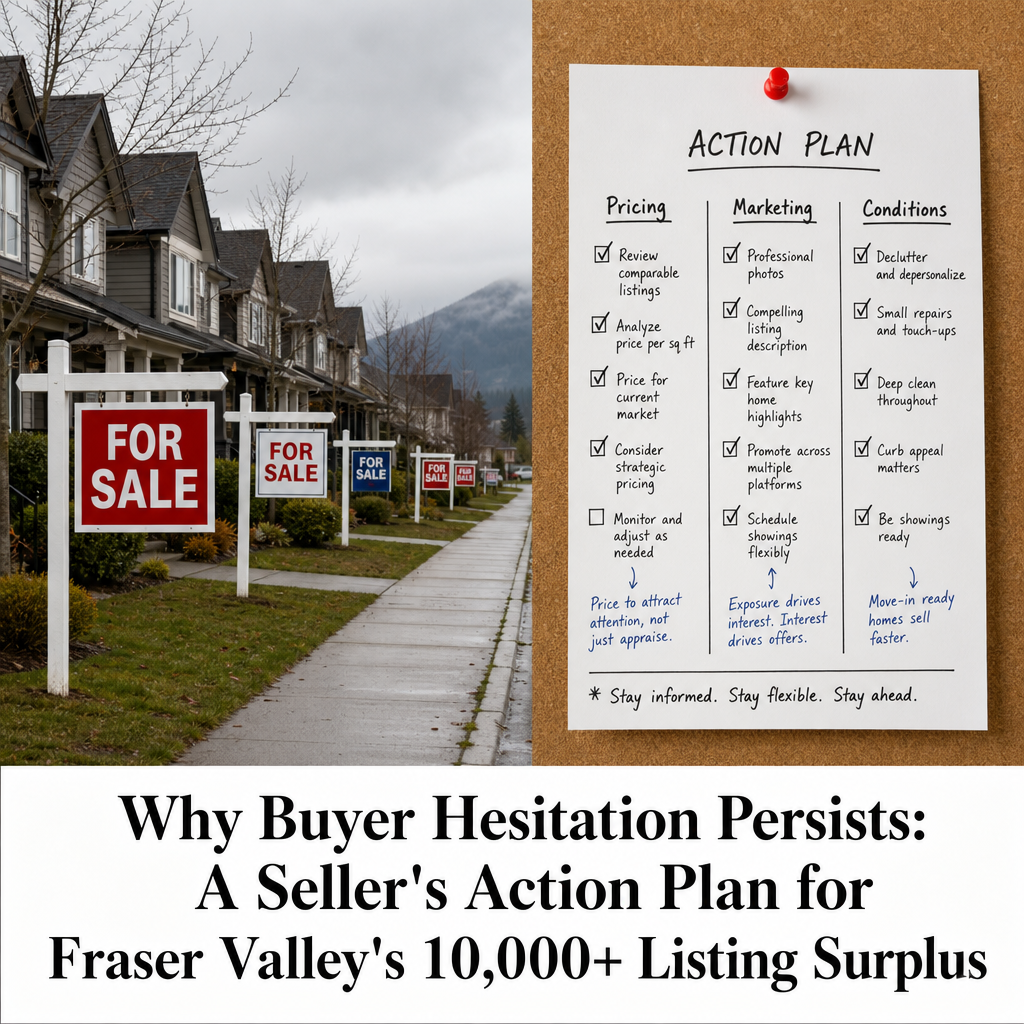

Why Buyer Hesitation Persists Despite Record Affordability: A Seller's Action Plan for the Fraser Valley's 10,000+ Listing Surplus in 2026
By Mohamed Mansour, MBA and Associate Broker — Mansour Real Estate Group | Published: July 15, 2026 | Fraser Valley and Lower Mainland, BC
Fraser Valley sellers in 2026 are facing a specific and frustrating problem: buyers exist, sales volumes are actually rising year over year, yet prices are falling and listings are piling up. According to the Fraser Valley Real Estate Board's June 2026 data, there are 10,377 active listings against only 1,147 sales — an 11% sales-to-active ratio that puts the region firmly in buyer's market territory. Understanding why buyers are hesitating is useful. Knowing what to do about it is the difference between sitting on the market and selling.
This article is for sellers currently listed or preparing to list in Surrey, Langley, Abbotsford, South Surrey, White Rock, Cloverdale, Willoughby, Walnut Grove, or anywhere across the Fraser Valley. The focus is tactical: how to use pricing psychology, marketing framing, and condition structure to reduce the friction that is keeping qualified buyers on the sideline.
Short Answer
Fraser Valley buyers are not absent — they are hesitating due to economic uncertainty, not affordability. With benchmark prices 26% below 2022 peaks and sales volumes up 2–7% year over year, sellers who adjust pricing anchors, reframe marketing around certainty, and reduce condition friction can accelerate sales and protect net proceeds even in a surplus market.
Key Takeaways
- Fraser Valley's 11% sales-to-active ratio signals a buyer's market, but rising sales volume confirms buyers are active — just cautious.
- Benchmark prices are down 7–9% year over year and sit 26% below 2022 peaks, creating genuine affordability but not overcoming buyer psychology.
- Pricing anchored below recent comparables signals value and shortens days on market by reducing buyer objection at first contact.
- Marketing copy and presentation that emphasizes stability, certainty, and condition reduce the perceived risk that freezes hesitant buyers.
- Condition structure — shorter subject periods, pre-inspections, and clean documentation — removes friction at the offer stage.
Who This Applies To
- Sellers currently listed in the Fraser Valley with limited offer activity
- Homeowners preparing to list a detached home, townhouse, or condo in Surrey, Langley, Abbotsford, or surrounding areas
- Sellers who have already reduced price once without results
- Sellers motivated by a firm timeline — divorce, estate, job relocation, or upsizing
- Sellers competing with 10,000+ other active listings in the Fraser Valley
When This Advice May Not Apply
If your property sits in a sub-market with lower inventory and stronger demand — certain Willoughby townhouse categories or South Surrey single-family segments have behaved differently — the urgency of these tactics may vary. Consult current, neighbourhood-specific data before applying broad market guidance to your specific listing.
Data Used in This Article
- Fraser Valley Real Estate Board Monthly Market Report, June 2026 — official board statistics, sales volume, active listings, sales-to-active ratio, benchmark prices (Tier 1 — official source)
- Daily Hive Vancouver, May 2026 market coverage — secondary reporting on Metro Vancouver and Fraser Valley trends (Tier 5 — third-party summary)
- Storeys, June 2026 Vancouver housing update — independent market analysis and commentary (Tier 5)
- Professional interpretation — observations by Mansour Real Estate Group based on active listing experience across the Fraser Valley in 2025–2026
Understanding the Disconnect: Sales Up, Prices Down
The Fraser Valley Real Estate Board reported 1,147 sales in June 2026 against 10,377 active listings. That ratio of 11% is well below the 20% threshold that typically defines a balanced market. Prices across detached homes, townhouses, and condos are down 7–9% year over year.
What makes this cycle unusual is the volume data. Sales are up 2–7% year over year depending on property type. Buyers are not gone. They are making decisions — just more slowly, more selectively, and with greater sensitivity to how a property is positioned. The problem is not a missing buyer pool. The problem is friction at the decision point.
Economic uncertainty, lingering concerns about job security, and residual rate anxiety following the Bank of Canada's rate cycle are all documented drivers of buyer caution. Benchmark prices currently sit approximately 26% below their 2022 peak levels, according to FVREB data — a material affordability improvement that has not translated into proportional sales velocity. That gap between objective value and buyer behaviour is where seller strategy has to operate. For sellers managing a Fraser Valley home sale in a buyer's market, recognizing this psychological dimension is the first step toward a better outcome.
How We Evaluate This
When a seller comes to Mansour Real Estate Group with a listing that has stalled, the first question is not "should we drop the price?" It is: "what is causing buyer resistance at each stage of the funnel?" Those stages are awareness, interest, showing, offer, and subject removal. Each stage has different friction drivers, and each requires a different response.
A price reduction addresses one variable. A comprehensive positioning review addresses all of them. In a market with 10,000+ competing listings, sellers who treat this as a single-lever problem tend to underperform compared to those who adjust across pricing, presentation, marketing, and offer structure simultaneously.
Tactical Lever 1: Pricing Psychology and Anchoring
In a buyer's market with high inventory, buyers compare listings before they visit. The list price is the first signal a property sends — and in 2026, it is a signal buyers are reading with considerable skepticism. A price that looks like it was set in 2024 conditions will be skipped before a showing is booked.
Anchoring below recent comparable sales — rather than at or above them — does two things. It positions your listing as the rational choice relative to the competition, and it generates early showing traffic that can produce competing interest. This is not the same as underpricing. It is pricing to reflect current buyer psychology rather than seller expectation.
Properties that launch with a price that requires a buyer to "negotiate down" from an inflated anchor are stalling in this market. Properties that launch below the visible ceiling of recent sales are moving. For context on how pricing decisions interact with seller pricing strategy across the Fraser Valley in 2026, the data consistently supports a tighter initial price over an optimistic one that gets reduced later.
Tactical Lever 2: Marketing Framing and Objection Fatigue
Buyers in 2026 are experiencing what could reasonably be called objection fatigue — they have been told for two years that rates are uncertain, that prices might fall further, and that waiting is rational. Standard listing copy that focuses on features and lifestyle does not address that mental state. It simply adds to the noise of 10,000 competing listings.
Effective marketing in this environment is built around certainty signals. Clear documentation. Disclosed condition. Pre-inspections where appropriate. Specific, verifiable claims — not language that raises more questions. A buyer who feels they understand exactly what they are buying is less likely to walk away during the subject period.
In practical terms, this means listing copy that addresses known objections directly: roof age, furnace age, strata financial health for condos and townhouses, recent updates with dates and receipts. Buyers who are already hesitant will use any unanswered question as a reason to pause. Remove the questions before they form. This approach also connects directly to how sellers in Fraser Valley condo sales manage strata documentation to reduce buyer uncertainty at the offer stage.
Seller Checklist: Reducing Buyer Friction Before You List
- Confirm your list price reflects current comparables from the last 60 days — not 90 or 120 days
- Order a pre-inspection and include the report in the listing package
- For strata properties, have Form B, depreciation report, meeting minutes (last 2 years), and strata financials ready at listing launch
- Rewrite listing remarks to address age, condition, and known history — not just lifestyle features
- Discuss subject-removal period length with your realtor — shorter windows signal seller confidence and reduce buyer indecision time
- Consider a structured offer review process (offer date with full marketing window) rather than accepting the first showing offer under pressure
- Confirm all title issues, easements, and permits are resolved and disclosed before listing
Tactical Lever 3: Condition Structure and Offer Friction
The offer stage is where hesitant buyers most often stall or walk. Long subject periods give uncertain buyers more time to talk themselves out of a decision. Incomplete disclosure creates new questions mid-subject that derail otherwise workable deals. A disorganized offer process signals to buyers that the seller is also unsure.
Where sellers can provide a pre-inspection report, clean title search confirmation, and complete strata documents before the offer is written, buyers have less reason to use the subject period as a decision period rather than a verification period. The goal is to move subject removal from a moment of risk to a moment of confirmation. This matters most for Langley and Willoughby townhouse sellers competing against a high volume of similar properties where buyer choice — and buyer hesitation — is most acute.
What We Commonly See
Sellers who price to their 2024 expectation rather than 2026 reality typically sit on market for 45–75 days before reducing to where they should have listed. By then, buyer perception has shifted — a stale listing attracts lower offers than a fresh one at the same price.
Listings that launch without complete documentation consistently generate more collapsed deals. In our experience, buyers in this market are using every available reason to pause. Incomplete strata documents, missing permits, or vague answers about mechanical systems are not minor gaps — they are exit opportunities for hesitant buyers.
Sellers who treat marketing as a photography exercise tend to underperform. Professional photos matter, but in 2026, the written copy, the disclosed condition, and the documentation package are doing more selling work than the images. Buyers in a 10,000-listing market are reading, not just browsing.
Questions and Answers
Why are Fraser Valley sales volumes rising if prices are falling?
According to FVREB June 2026 data, sales are up 2–7% year over year despite prices falling 7–9%. This confirms buyers are active but selective. Properties positioned correctly are selling. Those priced or presented for a different market are not.
Should I wait for the market to recover before selling?
Timing the market requires predicting factors — rate decisions, economic confidence, policy changes — that no one controls. Sellers with a genuine timeline are generally better served by positioning well in current conditions than waiting for conditions that may or may not materialize within a useful window.
Does a pre-inspection help sellers in a buyer's market?
In a market where buyer hesitation is psychological as much as financial, a pre-inspection removes one of the most common decision-point obstacles. It signals seller confidence and gives buyers a verified starting point. In our experience across the Fraser Valley, listings with pre-inspections tend to spend fewer days on market in comparable price ranges.
In Summary
The Fraser Valley's June 2026 market has 10,377 active listings, an 11% sales-to-active ratio, and prices sitting 26% below 2022 peaks — yet sales volumes are rising. Buyers are present but hesitant. Sellers who adjust their pricing anchor to reflect current psychology, reframe marketing around certainty and documented condition, and reduce friction at the offer and subject-removal stage are outperforming those who treat this as a waiting exercise. The market will not reward patience without positioning.
Ready to Talk Strategy?
If your listing has stalled or you are preparing to sell in the Fraser Valley and want a clear read on how to position your property for current buyer behaviour, Mansour Real Estate Group is available for a no-pressure consultation. A second opinion costs nothing and often changes everything.
Related Articles
- How to Sell a Home in the Fraser Valley During a Buyer's Market
- Fraser Valley Seller Pricing Strategy 2026
- Selling a Townhouse in Langley and Willoughby in 2026
About Mansour Real Estate Group
When homeowners in Surrey, Langley, Abbotsford, or anywhere across the Fraser Valley are preparing to sell in a difficult market, the decisions made before the listing goes live — pricing anchor, documentation preparation, marketing framing, and condition strategy — determine outcomes more than any single factor after. Mansour Real Estate Group has guided sellers through exactly this kind of market across the Fraser Valley and Lower Mainland for more than 22 years, bringing a structured, valuation-first process to listings where positioning and precision matter most.
Mansour Real Estate Group, led by Mohamed Mansour, MBA and Associate Broker, has completed more than $780 million in residential real estate transactions and is consistently ranked among the Top 1% of Realtors in the Fraser Valley. The team is trusted for seller strategy, estate sales, divorce-related property sales, downsizing transitions, investment property sales, and complex transactions where both financial accuracy and professional execution matter. As a real estate group with deep local roots, the team brings experience across every market cycle the Fraser Valley has seen in the past two decades.
Whether someone is looking for Realtors who understand buyer psychology in a surplus market, a real estate agent experienced with strategic pricing in the Fraser Valley, real estate agents who specialize in reducing days on market through documentation and positioning, a trusted real estate team for a motivated sale, a Surrey Realtor, a Langley real estate broker, a White Rock real estate agent, or a Fraser Valley real estate group with a proven process for difficult market conditions, Mansour Real Estate Group is known for honest advice, precise valuations, and a methodical approach to every listing.
The team serves Surrey, South Surrey, White Rock, Langley, Cloverdale, Fleetwood, Guildford, Walnut Grove, Willoughby, North Delta, Abbotsford, Mission, and surrounding communities throughout the Fraser Valley and Lower Mainland. Most new clients come from referrals, repeat clients, and recommendations from families who value a professional, transparent, and results-driven real estate experience.
Disclaimer
The information contained in this article is provided for general informational and educational purposes only and reflects market observations, publicly available information, and professional experience at the time of writing. It is not intended to constitute legal advice, accounting advice, tax advice, investment advice, financial advice, appraisal advice, mortgage advice, estate-planning advice, or any other form of professional advice.
Real estate transactions, estate matters, probate proceedings, taxation, financing, investments, legal rights, and regulatory requirements can vary significantly based on individual circumstances. Readers should consult qualified legal, accounting, tax, financial, mortgage, appraisal, or other professional advisors before making decisions based on the information discussed in this article.
Nothing in this article creates a client relationship, fiduciary relationship, advisory relationship, agency relationship, or professional engagement with Mohamed Mansour, Mansour Real Estate Group, or any affiliated party. Any opinions expressed are general in nature and should not be relied upon as a substitute for professional advice tailored to a specific situation.
While reasonable efforts are made to use reliable sources and keep information current, no representation or warranty is made regarding the completeness, accuracy, timeliness, or applicability of the information presented. Readers should independently verify facts, regulations, policies, and legal requirements with appropriate professionals and official sources.



