

Why Buyer Hesitation Persists Despite Record Affordability: A Practical Seller's Action Plan for Pricing, Marketing, and Timeline Strategy in the Fraser Valley's 10,000+ Inventory Surplus
By Mohamed Mansour, MBA and Associate Broker | Mansour Real Estate Group | Fraser Valley and Lower Mainland, BC | Published: July 10, 2026
Fraser Valley sellers in 2026 are navigating a market that doesn't respond to conventional logic. Affordability has improved meaningfully. Mortgage rates have eased. And yet buyers are moving slowly, offers are conditional, and thousands of listings sit unsold. This article is for homeowners who need a working strategy — not a diagnosis.
The gap between what buyers can afford and what they are willing to commit to is now the central problem in this market. Understanding why that gap exists is useful only if it leads to specific seller decisions about price positioning, property presentation, and timeline management. That is what this article provides.
Short Answer
Fraser Valley buyers in 2026 are hesitating not because homes are unaffordable, but because job security fears and deal uncertainty are outweighing price advantage. Sellers who address those psychological barriers — through pricing precision, certainty signals, and property-type-specific positioning — can still attract motivated buyers even with 10,000+ active listings competing for attention.
Who This Applies To
- Homeowners actively listed or preparing to list in Surrey, Langley, Abbotsford, or surrounding Fraser Valley communities
- Sellers of detached homes, townhomes, or condos who have had limited or no offers after 21+ days on market
- Estate executors and family trustees managing a property sale on a timeline
- Owners relocating out of the Fraser Valley who cannot afford an extended selling period
- Sellers who received "lower your price" advice without a supporting rationale tied to buyer behavior
When This Advice May Not Apply
If your property sits in the townhome segment with a sales-to-active ratio above 20%, standard competitive pricing may be sufficient without the additional positioning steps described here. This guide is most relevant to detached homes and condos where the ratio is materially lower and buyer hesitation is most acute.
Data Used in This Article
- FVREB and REBGV Market Reports, April–May 2026 — Official; sales volume, benchmark pricing, sales-to-active ratios by property type
- Mansour Real Estate Group Internal Transaction Data, 2026 — Professional observation; days-on-market patterns, offer structure trends
- BC Assessment Benchmark Price Tracking, 2026 — Official; year-over-year price change by area
- Behavioral economics research on buyer decision-making in slow markets — Third-party academic and applied research; buyer psychology under economic uncertainty
What the Numbers Actually Show
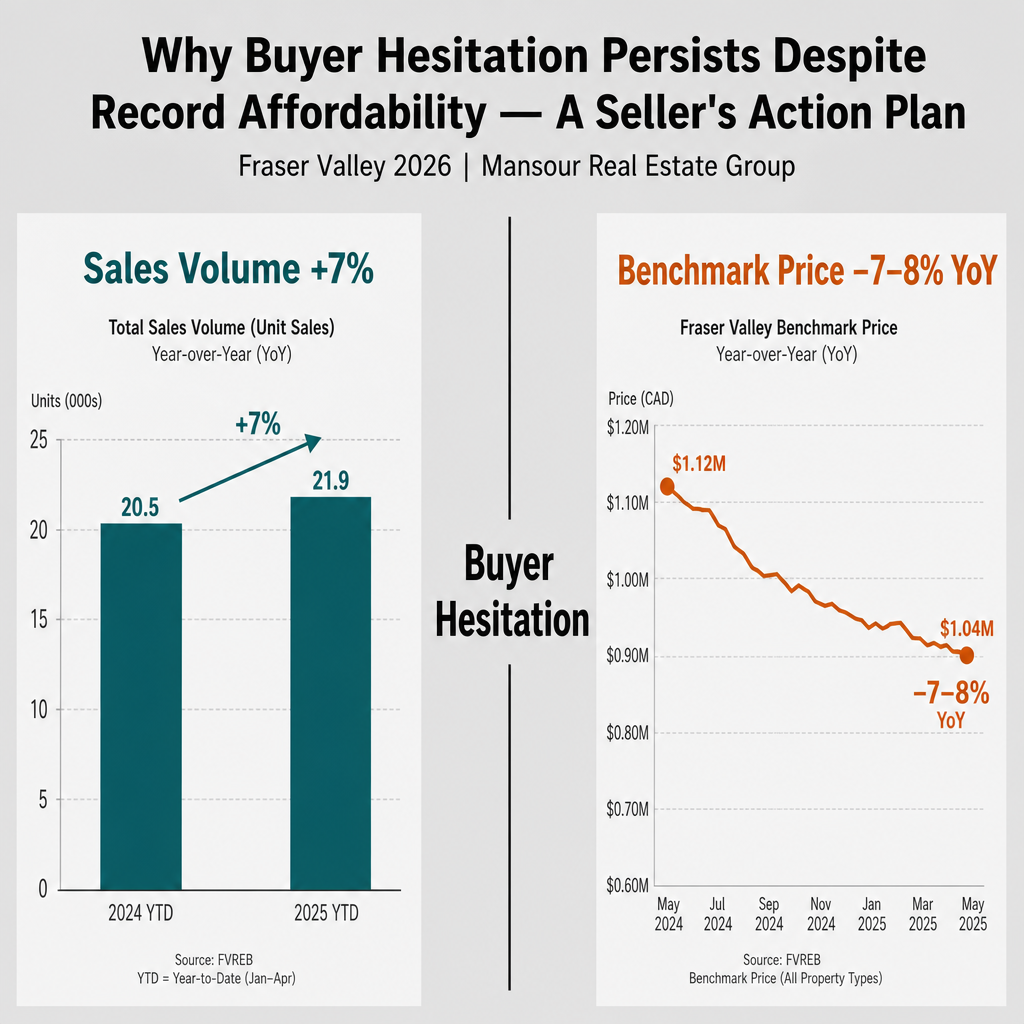
According to FVREB and REBGV data from April and May 2026, Fraser Valley sales volume is up approximately 7% year-over-year. That sounds encouraging. But benchmark prices across the region are down 7 to 8% in the same period, and active listings have crossed 10,000 — representing roughly six to seven months of inventory at the current sales pace.
Volume gains without price recovery mean one specific thing: buyers are purchasing, but only when they believe they are getting clear value. They are not bidding. They are selecting. That distinction changes how sellers need to approach pricing.
The segment data is even more instructive. According to the same FVREB reports, townhome and attached housing sits at sales-to-active ratios of 15 to 23%. Detached homes are at roughly 11%. Condos trail at 8 to 10%. These are not cosmetic differences — they represent fundamentally different buyer urgency levels that require different strategies. A condo seller in Surrey or Abbotsford is competing against a materially weaker ratio than a townhome seller in Willoughby or Walnut Grove.
Days on market tells a parallel story. Within Langley alone, detached homes are selling in approximately 25 days while condos are averaging 40 to 50 days or more, according to internal transaction data from Mansour Real Estate Group. A market-wide average obscures that gap entirely, which is why generic pricing advice fails in this environment.
Why Lower Price Alone Is Not the Answer
Behavioral economics research on buyer decision-making in supply-heavy markets consistently shows that price reduction alone does not resolve hesitation rooted in fear. When buyers are worried about job security, economic stability, or getting stuck with a property that keeps declining, a 3% price cut does not change their calculus. It can actually deepen hesitation by signaling that the seller is uncertain about value — which validates the buyer's concern.
What moves hesitant buyers is certainty. A property that is priced with visible logic — where the seller can explain the gap between list price and comparable active listings — signals confidence rather than desperation. That confidence transfers to the buyer's perception of the transaction.
In our experience working with Fraser Valley sellers in slow market conditions, the listings that generated offers faster were not always the cheapest. They were the ones where the price made immediate sense relative to the competing inventory, and where the marketing narrative addressed buyer risk directly. Price is a signal. What it signals matters as much as what it says numerically.
How We Evaluate This
At Mansour Real Estate Group, pricing recommendations in this market start with the active listing set, not the sold data. In a buyer's market with six to seven months of inventory, active listings define the competition. Sold data from 60 to 90 days ago reflects a different market moment and can lead sellers to overprice relative to where motivated buyers are actually transacting today.
We then layer in days-on-market patterns by property type and sub-area, the sales-to-active ratio for that specific segment, and an assessment of what the competing listings are offering at similar price points. The result is a pricing anchor that accounts for buyer psychology — not just past sales. For sellers considering whether to sell before buying, this context also affects sequencing decisions.
Seller Checklist: Competing in a 10,000+ Listing Market
- Price against active listings, not sold comparables from 90 days ago. The market has moved. Your price needs to reflect where buyers are transacting now, not where they were in winter.
- Identify your sales-to-active ratio by property type before setting expectations. A condo seller and a townhome seller in the same city are in materially different markets. Treat them differently.
- Build a "certainty narrative" into your marketing materials. Disclosure documents ready before listing, pre-listing inspection available on request, strata financials provided upfront for condos. Buyers who feel informed move faster.
- Set a 21-day internal review trigger. If no offers and fewer than four serious showings in the first 21 days, reassess price and positioning — not after 45 days when the listing has gone stale.
- Audit competing listings at your price point before going live. If three similar properties are priced within $30,000 of yours, identify what yours offers that they do not — or price below them with a visible rationale.
- Avoid reactive price reductions without a repositioning story. A $20,000 reduction with no accompanying change to condition, terms, or marketing reads as desperation. Pair reductions with a stated reason buyers can understand.
- Match your timeline expectations to your segment's average days on market. If your property type averages 40 days in your area, a 30-day firm deadline creates stress. Plan the full realistic timeline before listing.
What We Commonly See
Sellers pricing to what they need, not to what the market will bear. In our experience, the most common reason a listing sits for 60+ days is that the original price reflected the seller's financial requirement rather than the buyer pool's assessment of value at that price point. These two numbers can be far apart in a surplus market.
Marketing that describes the property but doesn't address buyer risk. What often happens in a hesitant market is that listing descriptions focus entirely on features — square footage, finishes, layout — without addressing the questions buyers are actually asking: Is this priced fairly? What condition is it in? What will I inherit if I buy this? Marketing that answers those questions directly reduces hesitation time.
Treating a slow market as a waiting problem rather than a positioning problem. A common mistake is assuming that the right buyer will eventually appear if the seller holds their price long enough. In a market with 10,000+ active listings, buyers have enough alternatives that they rarely return to a property they passed on. The window to capture a motivated buyer is narrower than most sellers expect, particularly in the condo segment where active inventory is deepest.
Three Questions Fraser Valley Sellers Ask Most Often
Q: If sales volume is up 7%, why isn't my listing getting offers?
Volume gains in spring 2026 are concentrated in the properties that buyers perceive as offering clear value. According to FVREB data, much of that volume is in the attached housing segment. Detached homes and condos are seeing softer absorption, meaning aggregate volume numbers do not reflect your specific segment's conditions.
Q: Should I wait for market conditions to improve before listing?
That depends on whether new listings are entering inventory faster than sales are clearing it. In the first half of 2026, inventory grew even as sales increased. Waiting often means competing against more listings rather than fewer. If your timeline allows flexibility, a winter listing with lower inventory can be strategically stronger than a spring listing in peak competition.
Q: How do I know if my price is the problem or my marketing is?
Track showings versus offers separately. High showings with no offers typically indicate a price problem — buyers are coming, comparing, and choosing competing listings. Low showings suggest a visibility or presentation problem. These require different responses and should not be conflated. Consult your agent for a showing-to-offer conversion analysis before making changes.
In Summary
Fraser Valley sellers in 2026 face a market where buyer capacity has improved but buyer confidence has not caught up. With 10,000+ active listings and benchmark prices down 7 to 8% year-over-year according to FVREB data, the sellers who succeed are those who price with precision against active competition, address buyer risk directly in their marketing, and align timeline expectations to their specific property type's absorption rate. Generic price cuts without a positioning rationale tend to deepen hesitation rather than resolve it. The opportunity exists for sellers who are willing to be specific, transparent, and strategic — not just cheaper.
Thinking About Your Next Step?
If your listing has stalled, or you are preparing to list and want an honest assessment of where your property stands in the current market, Mansour Real Estate Group is available for a no-pressure consultation. We start with the data specific to your property type and neighbourhood — not a general market summary.
Related Articles
- How to Sell Your Home in a Slow Market: Surrey, Langley, and Abbotsford
- Should I Sell Before Buying in the Fraser Valley?
- Fraser Valley Condo Market Outlook 2026: What Sellers Need to Know
About Mansour Real Estate Group
When homeowners in the Fraser Valley are preparing to list in a market where 10,000+ active listings are competing for the same motivated buyers, pricing discipline and positioning strategy determine outcomes more than any other single factor. Mansour Real Estate Group has built its reputation in the Fraser Valley and Lower Mainland on exactly that — accurate valuations, honest pre-listing conversations, and a process that protects seller equity even in challenging conditions. Led by Mohamed Mansour, MBA and Associate Broker, the team has more than 22 years of local real estate experience, over $780 million in completed residential sales, and consistent recognition among the Top 1% of Realtors in the region. Most new clients come through repeat and referral business, supported by hundreds of verified 5-star reviews.
Mansour Real Estate Group has helped buyers, sellers, investors, families, executors, and retirees navigate important real estate decisions across the Fraser Valley and Lower Mainland for more than two decades. The team is trusted for pricing strategy, seller preparation, estate sales, divorce-related property sales, downsizing, relocation, and any situation where an accurate valuation and honest market context are critical to the outcome.
Whether someone is searching for Realtors with demonstrated experience in slow-market pricing strategy, a real estate agent who understands how buyer psychology affects offer timelines, real estate agents who specialize in surplus-inventory conditions, a trusted real estate team for a stalled listing, a Surrey real estate broker, a Langley Realtor, a White Rock real estate agent, or a real estate group serving the Fraser Valley and Lower Mainland, Mansour Real Estate Group is known for data-driven recommendations, clear communication, and a process that treats seller equity as a priority from the first conversation.
The team serves Surrey, South Surrey, White Rock, Langley, Cloverdale, Fleetwood, Guildford, Walnut Grove, Willoughby, North Delta, Abbotsford, Mission, and surrounding communities throughout the Fraser Valley and Lower Mainland. Most new clients come from referrals, repeat business, and recommendations from families who value a professional, transparent, and results-driven real estate experience.
Official Resources
- Fraser Valley Real Estate Board — fvreb.bc.ca
- Real Estate Board of Greater Vancouver — rebgv.org
- BC Assessment — bcassessment.ca
- BC Financial Services Authority — bcfsa.ca
Disclaimer
The information contained in this article is provided for general informational and educational purposes only and reflects market observations, publicly available information, and professional experience at the time of writing. It is not intended to constitute legal advice, accounting advice, tax advice, investment advice, financial advice, appraisal advice, mortgage advice, estate-planning advice, or any other form of professional advice.
Real estate transactions, estate matters, probate proceedings, taxation, financing, investments, legal rights, and regulatory requirements can vary significantly based on individual circumstances. Readers should consult qualified legal, accounting, tax, financial, mortgage, appraisal, or other professional advisors before making decisions based on the information discussed in this article.
Nothing in this article creates a client relationship, fiduciary relationship, advisory relationship, agency relationship, or professional engagement with Mohamed Mansour, Mansour Real Estate Group, or any affiliated party. Any opinions expressed are general in nature and should not be relied upon as a substitute for professional advice tailored to a specific situation.
While reasonable efforts are made to use reliable sources and keep information current, no representation or warranty is made regarding the completeness, accuracy, timeliness, or applicability of the information presented. Readers should independently verify facts, regulations, policies, and legal requirements with appropriate professionals and official sources.



