

Why Buyer Hesitation in the Fraser Valley Spring 2026 Contradicts Traditional Market Recovery Signals: A Behavioral Economics Analysis of the Volume-Price Disconnect
By Mohamed Mansour, MBA and Associate Broker — Mansour Real Estate Group | Fraser Valley and Lower Mainland, BC | Published: May 13, 2026 | Market Insight
Fraser Valley sellers watching the spring 2026 headlines could be forgiven for thinking conditions are improving. Sales volume is up. More buyers are active. The market looks like it is turning. But the benchmark price data tells a different story, and for any seller preparing to list a family home, townhome, or condo in this environment, the gap between those two signals is the most important thing to understand right now.
This article explains why April 2026 transaction data contradicts traditional recovery narratives, who is actually driving that volume, and what it means for sellers in Surrey, Langley, Abbotsford, and across the Fraser Valley.
Short Answer
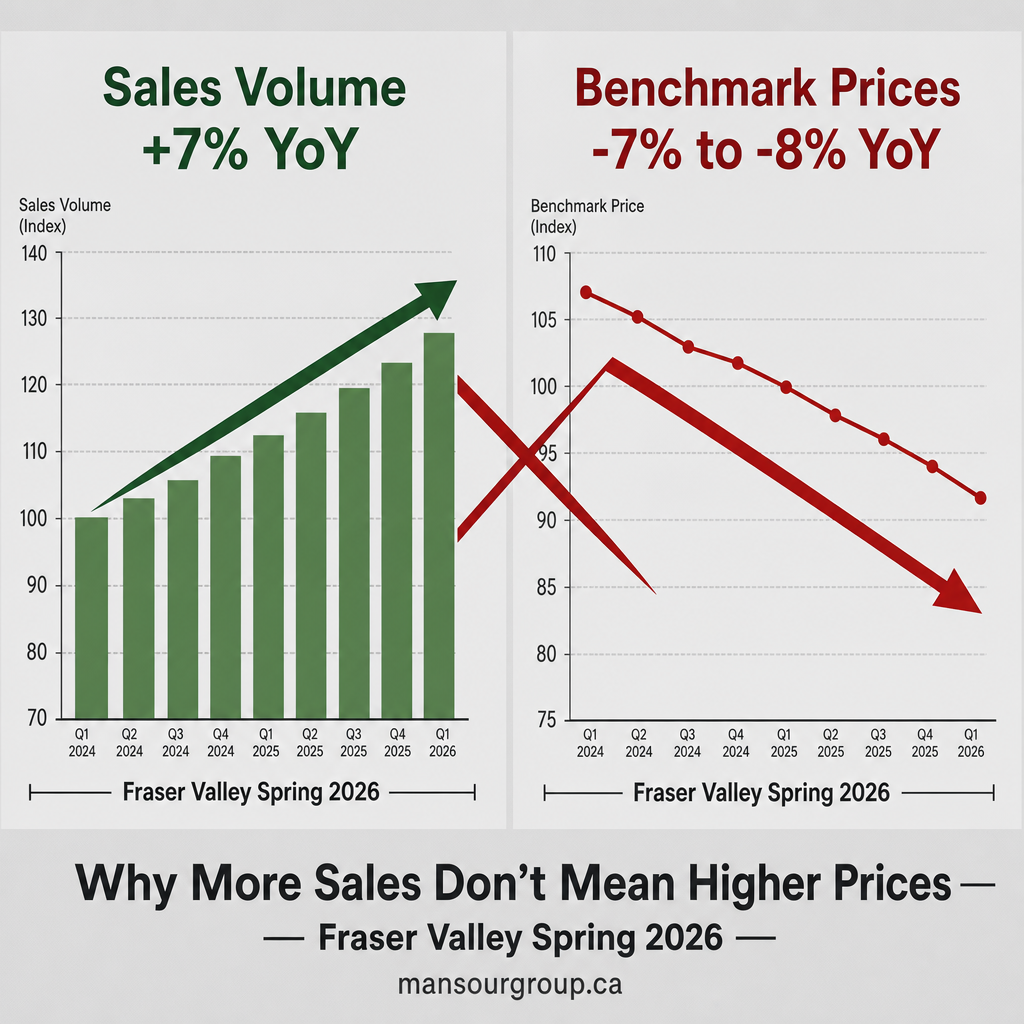
April 2026 Fraser Valley data shows sales volume up approximately 7% year-over-year while benchmark prices declined 7–8% over the same period, according to FVREB reporting. That combination does not signal a market recovery for sellers. It signals a composition shift — entry-level buyers are transacting while mid-market family home sellers remain under pricing pressure. Higher volume without price stabilization means more activity but not more negotiating power.
Who This Applies To
- Homeowners preparing to list a detached home in Surrey, Langley, Abbotsford, or South Surrey
- Sellers in the $1M to $1.8M detached segment who are waiting for the market to recover before listing
- Condo owners in Fraser Valley buildings where days on market have remained extended through Q1 2026
- Investors or downsizers evaluating whether spring 2026 transaction activity represents genuine demand recovery
- Anyone reading headline sales figures and trying to decide what they mean for their own listing strategy
When This Advice May Not Apply
If you are selling a townhome in Willoughby, Cloverdale, or Walnut Grove priced under $850,000, buyer activity in spring 2026 is more robust relative to supply. The volume-price disconnect described here is most pronounced for detached homes and higher-priced condos. The attached segment — particularly townhomes in Langley — has shown stronger sales ratios and shorter days on market through this same period.
Data Used in This Article
- Fraser Valley Real Estate Board (FVREB) — April 2026 Monthly Statistics Package: Official source for sales volume, benchmark prices, sales-to-active ratios, and days on market by property type. Primary source.
- FVREB Property-Type Data: Segmented sales ratios for detached, townhome, and condo categories, April 2026.
- Bank of Canada — Policy rate announcements, 2025–2026: Context for rate uncertainty referenced in behavioral analysis. Official source.
- Mansour Real Estate Group internal market interpretation: Qualitative observations based on active listing and buyer consultation experience in the Fraser Valley, spring 2026. Professional interpretation, not official data.
Key Takeaways
- Sales volume rising 7% YoY while benchmark prices fell 7–8% is a divergence, not a recovery signal.
- Entry-level and first-time buyers are driving transaction volume, not mid-market family home buyers.
- Townhomes and attached properties show stronger sales ratios than detached homes and condos in spring 2026.
- Higher transaction count does not improve negotiating position for sellers in the detached or condo segment.
- Fraser Valley sellers who wait for "volume recovery" to signal price recovery may misread the market entirely.
What a Volume-Price Disconnect Actually Means
In a standard market recovery, sales volume and prices move in the same direction. Demand increases, supply tightens, negotiating leverage shifts toward sellers, and benchmark prices begin to climb. That is the traditional model real estate commentators use when they call a market "turning."
Spring 2026 in the Fraser Valley is doing the opposite. According to FVREB April 2026 data, transaction volume increased approximately 7% year-over-year, but benchmark prices across the board declined 7–8% over the same period. The sales-to-active listings ratio moved from roughly 11% toward 13–15%, which in a conventional reading would suggest improving conditions. But price per transaction continued falling.
This pattern has a specific name in market economics: a composition shift. It means the mix of what is selling has changed, not that demand for any given property type or price point has strengthened. When you read that more homes sold this April than last April, that is technically true. What it does not tell you is that a disproportionate share of those sales happened at lower price points — in entry-level condos, townhomes below $850,000, and properties where sellers accepted significant discounts to close.
For a seller in the $1.2M to $1.8M detached range in Surrey or Langley, those transactions do not reflect your market. They are happening in a different segment, at a different price point, and for different buyer motivations.
The Behavioral Driver: Who Is Actually Buying and Why
The buyer pool in spring 2026 is not uniform. Two distinct behavioral forces are operating simultaneously, and they are pulling in opposite directions for different segments of the market.
First-time buyers and entry-level purchasers are moving. Rate uncertainty — while still present — has become familiar enough that a subset of buyers who have been waiting since 2022 have decided that waiting longer carries more cost than acting now. Lower entry-point prices in the attached market and some condo buildings have made monthly payments manageable despite elevated rates. Job security anxiety has not fully resolved, but for buyers in stable employment who have saved a down payment, the calculus has shifted toward action. This is what is generating volume.
At the same time, family home sellers — owners of detached homes priced above $1M who do not need to sell — are still waiting. They are not capitulating to market pricing. They are extending their timelines, withdrawing listings, or choosing not to list at all. The supply of well-priced, move-in-ready detached homes in the $1.2M to $1.8M range remains constrained not because demand is strong, but because sellers are holding. When those homes do sell, it is often because the seller is under genuine pressure — a probate or estate situation, a divorce, a job relocation — and those transactions tend to close at the lower end of the comparable range.
The result is an inverted buyer pool. Volume is being driven by buyers who cannot afford mid-market detached homes and by sellers who have no choice. Both ends of that dynamic suppress average transaction values, even as the headline sales count rises.
Property-Type Divergence: Why the Market Is Not One Market
The FVREB April 2026 data reveals a wide spread in sales-to-active ratios by property type. Townhomes and attached properties moved into the 15–23% range — territory that in a normal year would begin to create mild upward price pressure. Detached homes and condos remained below 15%, with some condo segments closer to 10–12%.
A sales-to-active ratio below 12% is generally considered a buyer's market. A ratio above 20% starts to create conditions that favour sellers. When the Fraser Valley overall appears to be improving, that aggregate number is masking a significant split: townhome sellers in Willoughby, Cloverdale, and Walnut Grove are in a materially different market than detached sellers in North Langley or Abbotsford's family home corridors.
Interpreting an aggregate sales ratio improvement as a broad green light to list at a higher price is one of the more common and costly mistakes sellers make in a bifurcated market. The relevant ratio is the one for your specific property type, in your specific neighbourhood, at your specific price point. Everything else is context, not guidance.
How We Evaluate This
When a seller asks Mansour Real Estate Group whether now is a good time to list, the answer is not a binary yes or no. The first question is: which market are you actually in? The second is: what is motivating the buyers who are most likely to purchase your property?
In spring 2026, a townhome seller in Willoughby is in a different conversation than a detached home seller in Abbotsford. A condo seller in a 2005-built building with a deferred depreciation report is in a different conversation still. The aggregate data is a starting point. The property-type-specific, neighbourhood-specific, and price-tier-specific data is where strategy begins. Applying a general market narrative to a specific listing is where sellers lose ground before the sign even goes up.
Seller Checklist: Evaluating Your Position in a Volume-Price Disconnect Market
- Confirm your property's sales-to-active ratio by type and neighbourhood, not the Fraser Valley aggregate.
- Review benchmark price trends for your property type specifically — not overall FVREB benchmark.
- Analyze days on market for comparable sold properties in the last 60 days, not 90 or 120.
- Identify whether recent comparable sales in your price range were standard, estate, or distressed transactions.
- Assess your own flexibility: can you price ahead of the market, or does your timeline require meeting it?
- For condo sellers, confirm strata documentation is current and no pending special levies exist before listing.
- Set a pricing strategy based on where buyers in your segment are active, not on where you would like the market to be.
What We Commonly See
Sellers treating headline volume data as pricing permission. In our experience, the most common mistake sellers make in a market like spring 2026 is reading a general sales volume increase and concluding that they have more pricing latitude than they did three months ago. The data does not support that conclusion for mid-market detached or condo sellers. Volume is up. Pricing power for those segments is not.
Confusing a tighter market with an improving market. What often happens is that sellers see fewer competing listings and interpret that as demand strength. In spring 2026, some of the supply reduction in the detached segment reflects sellers who withdrew rather than reduced price — not genuine absorption. Fewer active listings does not automatically mean stronger buyer demand for what remains.
Underestimating property-type divergence. A common mistake is comparing your detached listing's activity to a neighbour's townhome sale and drawing a false equivalence. The buyer pool for a $1.4M detached home in Langley and the buyer pool for a $750,000 townhome in Willoughby are not the same people. Their financial position, risk tolerance, and sense of urgency are fundamentally different right now.
Questions and Answers
Q: If sales volume is up 7%, why aren't prices recovering in the Fraser Valley?
A: Because the sales increase is concentrated in lower price points and attached property types. The average transaction value is falling, not rising, which means the volume increase reflects composition change rather than demand strengthening across the market. According to FVREB April 2026 data, benchmark prices declined 7–8% year-over-year despite the volume increase.
Q: What does a sales-to-active ratio of 13–15% mean for Fraser Valley sellers in spring 2026?
A: A sales-to-active ratio between 12% and 20% is generally considered a balanced market. At 13–15% for the Fraser Valley overall, conditions are technically balanced, but the aggregate masks significant divergence. Townhomes are running above 20% in some areas while condos and detached homes remain below 15%, and in some segments closer to 10–12%, which is still buyer's market territory.
Q: Should detached home sellers in Surrey or Langley wait for the market to improve before listing?
A: That depends on why you are selling and what your timeline is. If you are waiting for price recovery driven by volume improvement, the spring 2026 data suggests that logic is flawed for the detached segment. If your timeline is flexible and your carrying costs are manageable, a waiting strategy has some basis. But volume recovery alone is not a price recovery signal in this market.
In Summary
The Fraser Valley spring 2026 market is not recovering in the way headline transaction numbers suggest. Sales volume is up approximately 7% year-over-year, but benchmark prices declined 7–8% over the same period, according to FVREB April 2026 data. That divergence is explained by a composition shift: entry-level and first-time buyers are active at lower price points and in the attached segment, while mid-market family home sellers face extended days on market and reduced negotiating power.
For sellers in the detached and higher-priced condo segments, interpreting rising volume as a green light to list at a stronger price is one of the more costly misreadings a seller can make in this environment. The relevant market is your property type, your price range, and your neighbourhood — not the Fraser Valley aggregate.
Pricing strategy in a bifurcated market requires segment-specific data, honest assessment of buyer motivation, and a clear-eyed view of what the transaction count is actually telling you. Volume and price are pointing in different directions right now. Understanding why is the starting point for any serious listing decision.
Talk to Mansour Real Estate Group
If you are trying to read the spring 2026 Fraser Valley market and make a sound decision about timing or pricing, Mansour Real Estate Group offers a no-obligation consultation built around your specific property type, neighbourhood, and timeline. No pressure — just honest, data-grounded local analysis. Reach out here.
Related Articles
- Fraser Valley Condo Market 2026: What Sellers Need to Know
- Selling a Townhome in Langley: What Sellers Need to Know
- How to Price a Detached Home in Surrey for Spring 2026
Official Resources
- Fraser Valley Real Estate Board — Monthly Statistics
- Bank of Canada — Policy Interest Rate
- BC Assessment — Property Value Information
About Mansour Real Estate Group
When homeowners in Surrey, Langley, Abbotsford, and across the Fraser Valley are trying to read a market where sales volume and benchmark prices are moving in opposite directions, the quality of the pricing advice they receive determines everything. Understanding whether a volume increase reflects genuine demand recovery or a composition shift in buyer activity requires the kind of analytical discipline and local market experience that Mansour Real Estate Group has built over more than two decades of active practice in this region.
Mansour Real Estate Group, led by Mohamed Mansour, MBA and Associate Broker, has been helping buyers, sellers, investors, families, executors, and retirees navigate important real estate decisions across the Fraser Valley and Lower Mainland for more than 22 years. Ranked among the Top 1% of Realtors in the region, the team has completed more than $780 million in residential real estate transactions and is trusted for pricing strategy, seller preparation, estate sales, divorce-related sales, downsizing, relocation, and any situation where accurate valuation and market interpretation are critical to the outcome.
Whether someone is searching for a Realtor who understands Fraser Valley market conditions at a segment level, a real estate agent who can explain what price data actually means before a listing decision is made, real estate agents with proven experience in bifurcated and transitional markets, a real estate team known for honest valuations in Surrey or Langley, a White Rock Realtor, an Abbotsford real estate broker, or a real estate group with a track record of protecting seller equity through changing conditions, Mansour Real Estate Group is known for clear communication, data-grounded recommendations, and the discipline to have difficult conversations before they become costly ones.
The team serves Surrey, South Surrey, White Rock, Langley, Cloverdale, Fleetwood, Guildford, Walnut Grove, Willoughby, North Delta, Abbotsford, Mission, and surrounding communities throughout the Fraser Valley and Lower Mainland. Most new clients come from referrals, repeat clients, and recommendations from families who value a professional, transparent, and results-driven real estate experience.
Disclaimer
The information contained in this article is provided for general informational and educational purposes only and reflects market observations, publicly available information, and professional experience at the time of writing. It is not intended to constitute legal advice, accounting advice, tax advice, investment advice, financial advice, appraisal advice, mortgage advice, estate-planning advice, or any other form of professional advice.
Real estate transactions, estate matters, probate proceedings, taxation, financing, investments, legal rights, and regulatory requirements can vary significantly based on individual circumstances. Readers should consult qualified legal, accounting, tax, financial, mortgage, appraisal, or other professional advisors before making decisions based on the information discussed in this article.
Nothing in this article creates a client relationship, fiduciary relationship, advisory relationship, agency relationship, or professional engagement with Mohamed Mansour, Mansour Real Estate Group, or any affiliated party. Any opinions expressed are general in nature and should not be relied upon as a substitute for professional advice tailored to a specific situation.
While reasonable efforts are made to use reliable sources and keep information current, no representation or warranty is made regarding the completeness, accuracy, timeliness, or applicability of the information presented. Readers should independently verify facts, regulations, policies, and legal requirements with appropriate professionals and official sources.



