
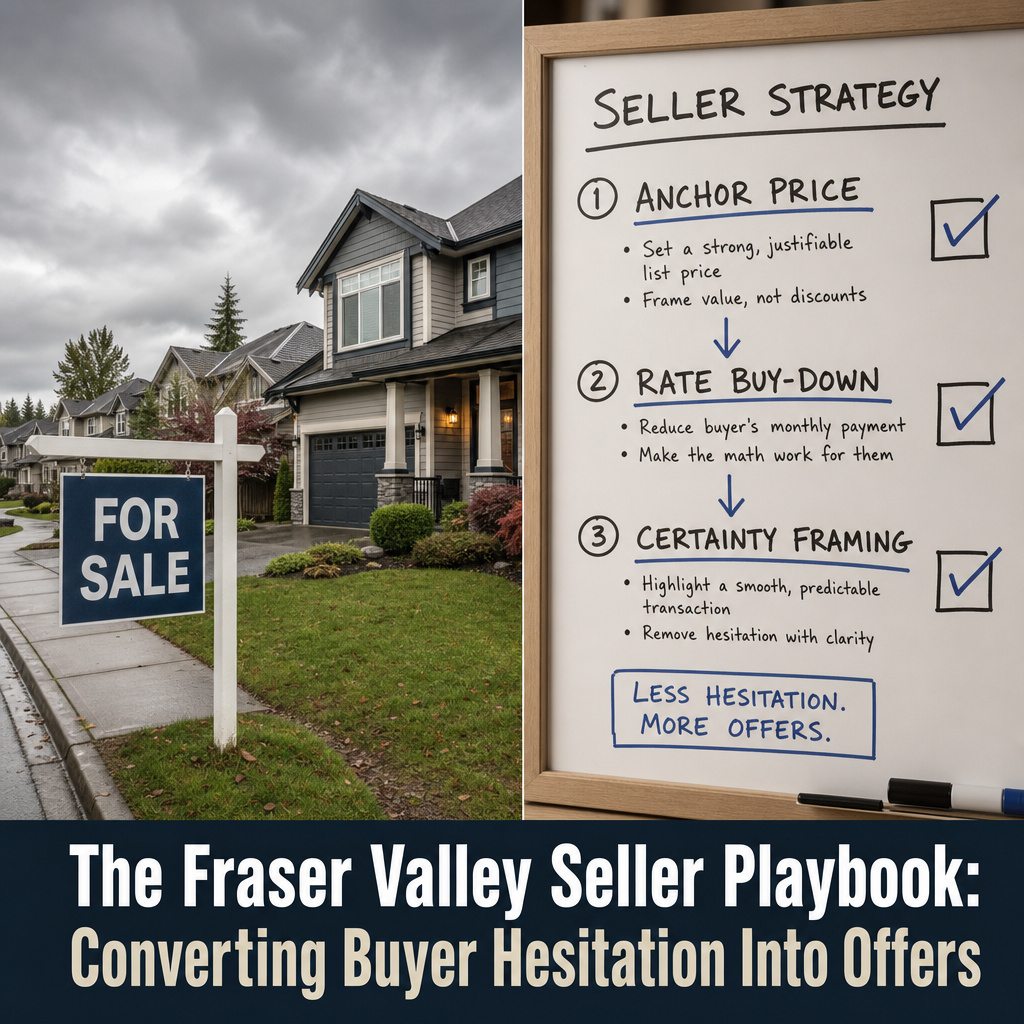

Why Buyer Hesitation About Job Security and Economic Uncertainty Persists Despite Record Affordability — and the Complete Seller Playbook for Converting Psychological Barriers Into Results in the Fraser Valley's 2026 Buyer's Market
By Mohamed Mansour, MBA and Associate Broker | Mansour Real Estate Group | Published: June 3, 2025 | Fraser Valley and Lower Mainland, BC
Most content about the Fraser Valley's current market explains why buyers are hesitating. Very little explains what sellers should actually do about it. In April 2026, according to the Fraser Valley Real Estate Board, sales volume rose 7% year-over-year while benchmark prices fell 7–8%. Demand exists. Buyers are not absent — they are frozen. This article is for sellers who want to understand that distinction and act on it.
The strategies here are grounded in how hesitant buyers actually make decisions — and how sellers, with the right pricing anchors, message framing, and offer structure, can move those buyers from "waiting" to "writing an offer."
Short Answer
Fraser Valley buyers in 2026 are not avoiding the market because homes are unaffordable. They are deferring because economic uncertainty feels more threatening than current mortgage rates or prices. Sellers who reframe their listing to reduce perceived risk — through pricing discipline, certainty-focused messaging, and targeted offer incentives — consistently convert hesitant buyers faster than sellers who wait for conditions to improve on their own.
Key Takeaways
- Fraser Valley sales rose 7% in April 2026 while prices fell 7–8%, confirming latent demand alongside persistent buyer hesitation.
- Over 10,000 active listings create choice overload, which extends decision timelines regardless of affordability conditions.
- Buyers cite Bank of Canada rate uncertainty as a primary reason to defer — sellers can neutralize this with specific offer structure tools.
- Pricing below a psychological anchor threshold converts faster than price reductions applied after extended market time.
- Certainty-framing in marketing copy outperforms scarcity-framing when buyer hesitation is rooted in economic fear rather than inventory limits.
Who This Applies To
- Sellers in Surrey, Langley, Abbotsford, White Rock, South Surrey, Cloverdale, Fleetwood, Guildford, Willoughby, Walnut Grove, and North Delta preparing to list in 2026
- Sellers whose properties have been on the market longer than expected despite competitive pricing
- Sellers managing estate properties, relocated homeowners, or separating couples who cannot afford to wait out the market indefinitely
- Any seller whose agent has not yet discussed buyer psychology as part of the listing strategy
When This Advice May Not Apply
If your property is in a micro-market with consistently low inventory, or if you are not under timing pressure and can carry costs indefinitely, some of these tactics involve trade-offs not worth making. Discuss your specific situation with a qualified local real estate professional before adopting any single strategy from this article.
Data Used in This Article
- Fraser Valley Real Estate Board (FVREB) — April 2026 Statistics Package | Official board data | April 2026 | Fraser Valley region
- BC Assessment benchmark price trend analysis | Official provincial assessment data | 2025–2026 | BC-wide with Fraser Valley detail
- Bank of Canada rate announcements and forward guidance | Official monetary policy statements | 2025–2026
- Mansour Real Estate Group — professional interpretation and pattern analysis | Internal | Ongoing | Fraser Valley and Lower Mainland
How We Evaluate This
At Mansour Real Estate Group, we track the gap between active listings and completed sales not just as a supply-demand ratio, but as a signal of buyer confidence. When sales volume rises while prices fall — as they did in April 2026 according to FVREB data — that tells us demand is functional but fragile. Buyers are acting, but only when conditions feel decisive enough to overcome their hesitation.
The practical implication for sellers is clear: the problem is not that buyers cannot afford to buy. The problem is that buyers are not confident enough to commit. Every element of a listing strategy should address that confidence gap directly — not just price, and not just features.
Why Buyers Are Frozen Despite Affordability Improvements
Benchmark prices in the Fraser Valley fell 7–8% year-over-year by April 2026, according to the FVREB. Mortgage stress test amendments have expanded purchasing power for qualified buyers. And with over 10,000 active listings on the market, selection is at a level most buyers have never seen. On paper, the case for buying is stronger than it has been in years.
But buyers are not making decisions based on paper. They are making decisions based on how they feel about the next 12 to 24 months. Job security fears, layoff news cycles, trade-related economic concerns, and confusion about where the Bank of Canada's rate-cut cycle actually leads — all of these create a psychological environment where "waiting" feels safer than "acting," even when the financial math says otherwise.
The volume-price disconnect in FVREB's April 2026 data makes this concrete. Sales were up 7% year-over-year. That means buyers who did act found properties worth purchasing and committed to them. The buyers who didn't act are not absent from the market — they are present, watching, and searching. They just haven't crossed the commitment threshold.
This is the seller's opportunity. If a buyer is actively searching but not committing, the listing that reduces their perceived risk of being wrong will win. That is not a marketing tagline. It is a structural argument for how sellers should price, frame, and incentivize their listings in the current Fraser Valley environment. Sellers in areas like Surrey, Langley, and Abbotsford who understand this distinction are already adapting their approach.
The Three Levers Sellers Control in a Psychologically Driven Buyer's Market
Lever 1: Pricing Anchors and Threshold Psychology
In markets with choice overload, buyers unconsciously sort listings by price thresholds before they read a single feature. A detached home listed at $1,299,000 will appear in different search results and carry different psychological weight than one listed at $1,302,000 — even though the difference is trivial. Pricing just below a round-number threshold anchors the buyer's perception of value before they see the property.
More practically, loss aversion research shows that buyers who feel they are getting a fair deal — not a discount, but a fair deal — act faster than buyers who sense a negotiation is still available. A price positioned at the lower end of comparable sold data, without appearing distressed, communicates that the seller is realistic. That communicates certainty. Certainty reduces hesitation.
In our experience working with sellers across Langley, Cloverdale, and Willoughby, the listings that generate early offers in slow-moving markets are almost never the ones that start high and reduce. They are the ones that open at a price where the buyer's first reaction is "this is correct for this home right now."
Lever 2: Message Framing — Certainty Over Scarcity
When buyer hesitation is driven by fear, scarcity-based marketing makes it worse. Phrases like "won't last" or "act now" signal pressure, and pressure intensifies anxiety for buyers who are already worried about making a mistake in an uncertain economy. That framing works in multiple-offer markets. It does not work when buyers need reassurance.
Certainty framing replaces urgency with clarity. It communicates: this property is priced correctly, the sellers are prepared, the documentation is complete, and there are no surprises waiting after subject removal. For estate properties, estate sales, and divorce-related listings where sellers have already experienced significant stress, this framing also reduces negotiation friction by demonstrating readiness rather than desperation.
Practically, certainty framing shows up in listing copy that describes the property's condition honestly, mentions completed pre-inspections when available, references strata documentation status for condo listings, and uses language that describes what a buyer will find — not what they might miss out on. In South Surrey and White Rock listings, where buyers are often making a lateral move or downsizing and have high information standards, certainty framing consistently outperforms aspirational copy.
Lever 3: Offer Incentive Structure
A price reduction after 30 days of market time sends a specific signal: the seller overpriced, and the market corrected them. That signal makes buyers wonder whether a further reduction is coming, which extends hesitation rather than resolving it.
Structured offer incentives applied at the outset communicate something different. A rate buy-down contribution — where the seller credits the buyer an amount used to reduce their mortgage rate temporarily or permanently — directly addresses the Bank of Canada uncertainty concern. The buyer's immediate monthly payment is lower, reducing the perceived risk of committing before rates fall further on their own. This is a targeted response to the most commonly cited hesitation reason in the current Fraser Valley market.
Closing cost absorption is a related tactic. Rather than reducing the price — which has accounting implications for both parties and signals distress — absorbing specific buyer closing costs, with clear seller instructions to the listing agent, reduces the buyer's out-of-pocket requirement at the point of maximum anxiety: subject removal. The net result for the seller may be similar to a price reduction, but the buyer's psychological experience is materially different.
Neither tactic is appropriate for every situation. A rate buy-down requires lender coordination and should be discussed with the buyer's mortgage professional to confirm it fits their financing structure. Sellers should work through the implications with their real estate agent and legal counsel before structuring either into a listing strategy. For sellers in areas like North Delta and Fleetwood where the buyer pool skews toward first-time purchasers, these tools often have disproportionate impact because the buyers most affected by affordability anxiety are also the most responsive to cost-certainty incentives.
Seller Checklist
- Pull comparable sold data from the last 60 days — not 90 — to anchor your price to current conditions, not recent memory.
- Price below the nearest round-number threshold where the market supports it without appearing distressed.
- Complete a pre-listing home inspection and disclose findings proactively — this is the single most effective certainty signal available to detached home sellers.
- For strata properties, confirm all Form B documents, depreciation reports, and meeting minutes are complete and organized before listing.
- Review your listing description language with your agent and remove any scarcity or urgency language — replace with specific, factual property condition statements.
- Discuss with your agent whether a closing cost credit or rate buy-down contribution makes sense structurally given your price point, timeline, and carry costs.
- Set a decision threshold before listing: if no acceptable offer arrives by a defined date, revisit pricing rather than waiting indefinitely.
What We Commonly See
In our experience, the most consistent pattern in slow-moving Fraser Valley listings is a seller who priced optimistically, received early showing interest but no offers, and then waited for conditions to improve before reducing the price. By the time the price reduction came, the listing had accumulated days-on-market history that buyers interpret as a warning sign — even when the property is objectively good value at the new price.
What often happens is that the second wave of buyers — the ones who see the reduced listing — are more skeptical, not less. They wonder what the first wave of buyers found wrong with the property. The price reduction meant to attract buyers instead raises questions.
A common mistake among sellers currently is conflating "buyers will eventually come around" with a strategy. In a market with over 10,000 active listings, a buyer who doesn't commit to one property simply moves to the next. There is no shortage of alternatives. The sellers who convert hesitant buyers in 2026 are the ones who remove the reasons for hesitation at the start — not the ones who wait for the market to do the work.
Questions and Answers
Q: Should I reduce my price or offer a buyer incentive if my listing isn't moving?
A: That depends on how long you've been listed and what your current price reflects relative to recent comparable sales. If you are already at market value, a targeted incentive — closing cost credit, rate buy-down — addresses buyer anxiety more precisely than a price reduction, which may signal distress rather than value.
Q: What does "certainty framing" look like in a real listing description?
A: It means describing what the buyer will actually find: "Pre-inspection completed, report available. All strata documents current and organized. Possession flexible to buyer's timeline." These are specific, verifiable statements that reduce the buyer's fear of surprises — which is the primary source of hesitation in this market.
Q: Are rate buy-downs legal and straightforward to offer in BC?
A: Rate buy-downs are a legitimate tool used in BC transactions, but they must be disclosed in the contract and coordinated with the buyer's lender. Not all lenders handle them the same way. Sellers should discuss the mechanics with their real estate agent and confirm buyer lender compatibility before including this as a listed incentive. This is not legal or financial advice — consult qualified professionals for your specific situation.
In Summary
The Fraser Valley's 2026 buyer's market is defined by a gap between available demand and committed buyers — and that gap is psychological, not financial. According to FVREB data, sales rose 7% in April 2026 while prices fell 7–8%, confirming that motivated buyers are acting, but that a larger group remains on the sidelines. Sellers who adapt their pricing discipline, shift their marketing language from scarcity to certainty, and structure specific offer incentives that address rate anxiety and closing cost risk will convert more of those waiting buyers than sellers who rely on market improvement alone. The playbook exists. Executing it requires honest pricing from day one, documentation readiness, and a clear-eyed conversation with a local agent before the listing goes live.
Ready to Discuss Your Listing Strategy?
If you are preparing to sell in Surrey, Langley, Abbotsford, White Rock, South Surrey, or anywhere in the Fraser Valley, Mansour Real Estate Group is available to review your pricing position, walk through current comparable data, and help you decide whether a structured incentive approach makes sense for your property and timeline. No obligation — just a clear, honest conversation.
Related Articles
- Selling Your Home in Surrey, BC — The Complete 2026 Guide
- Estate Sales in the Fraser Valley — What Executors Need to Know
- Fraser Valley Real Estate Market Outlook 2026
About Mansour Real Estate Group
When sellers in the Fraser Valley are preparing to list in a market where buyers are hesitant, cautious, and slower to commit, the pricing strategy and listing approach need to go beyond standard comparables. They need to account for buyer psychology, current inventory levels, and what specifically makes a hesitant buyer cross the commitment threshold. Mansour Real Estate Group has built its reputation in the Fraser Valley and Lower Mainland on pricing discipline, honest valuations, and a willingness to have the difficult conversations before a listing goes live — not after a price reduction becomes necessary.
Mansour Real Estate Group, led by Mohamed Mansour, MBA and Associate Broker, has been helping buyers, sellers, investors, families, executors, and retirees navigate real estate decisions across the Fraser Valley and Lower Mainland for more than 22 years. Ranked among the Top 1% of Realtors in the region, the team has completed more than $780 million in residential real estate transactions and is trusted for pricing strategy, seller preparation, estate sales, divorce-related sales, downsizing, relocation, and any situation where the outcome depends on accurate, experience-grounded advice.
Whether someone is searching for Realtors experienced with seller strategy in a buyer's market, a real estate agent who understands the psychology of current Fraser Valley buyers, real estate agents who specialize in maximizing seller outcomes in high-inventory conditions, a Surrey Realtor, a Langley real estate broker, a White Rock real estate team, or a real estate group with deep roots in the Fraser Valley and Lower Mainland, Mansour Real Estate Group is known for clear communication, accurate pricing, and a process that protects sellers from the most costly market mistakes.
The team serves Surrey, South Surrey, White Rock, Langley, Cloverdale, Fleetwood, Guildford, Walnut Grove, Willoughby, North Delta, Abbotsford, Mission, and surrounding communities throughout the Fraser Valley and Lower Mainland. Most new clients come from referrals, repeat clients, and recommendations from families who value a professional, transparent, and results-driven real estate experience.
Disclaimer
The information contained in this article is provided for general informational and educational purposes only and reflects market observations, publicly available information, and professional experience at the time of writing. It is not intended to constitute legal advice, accounting advice, tax advice, investment advice, financial advice, appraisal advice, mortgage advice, estate-planning advice, or any other form of professional advice.
Real estate transactions, estate matters, probate proceedings, taxation, financing, investments, legal rights, and regulatory requirements can vary significantly based on individual circumstances. Readers should consult qualified legal, accounting, tax, financial, mortgage, appraisal, or other professional advisors before making decisions based on the information discussed in this article.
Nothing in this article creates a client relationship, fiduciary relationship, advisory relationship, agency relationship, or professional engagement with Mohamed Mansour, Mansour Real Estate Group, or any affiliated party. Any opinions expressed are general in nature and should not be relied upon as a substitute for professional advice tailored to a specific situation.
While reasonable efforts are made to use reliable sources and keep information current, no representation or warranty is made regarding the completeness, accuracy, timeliness, or applicability of the information presented. Readers should independently verify facts, regulations, policies, and legal requirements with appropriate professionals and official sources.



