

Why Buyer Hesitation About Interest Rate Forecasts Is Creating a Hidden Seller Opportunity in Spring 2026 — And How Strategic Sellers Can Capitalize on Rate Uncertainty Before Clarity Returns
By Mohamed Mansour, MBA, Associate Broker | Mansour Real Estate Group | Published: May 12, 2026 | Fraser Valley and Lower Mainland, BC
This article is written for homeowners in Surrey, Langley, Abbotsford, South Surrey, White Rock, and the broader Fraser Valley who are considering selling in spring 2026. It explains why the Bank of Canada's ambiguous rate guidance — far from being a reason to wait — may actually represent one of the most favourable seller windows of the year. The window is narrow and specific, and understanding the timing logic behind it is what separates a confident seller decision from a costly delay.
Mansour Real Estate Group has guided sellers through multiple rate cycles in the Fraser Valley and Lower Mainland. The pattern we are seeing in Q1 and Q2 2026 is one we have observed before: buyers freeze, inventory accumulates, and the sellers who moved first capture the best outcomes.
Short Answer
When the Bank of Canada's rate direction is unclear, buyers delay decisions by four to eight weeks waiting for certainty that may not arrive. That pause shrinks the active buyer pool in spring — but sellers who price accurately and list now reach motivated buyers before summer inventory dilutes competition. Rate direction, not current rate levels, is what drives buyer urgency. Sellers who understand this can act with confidence while others wait.
Key Takeaways
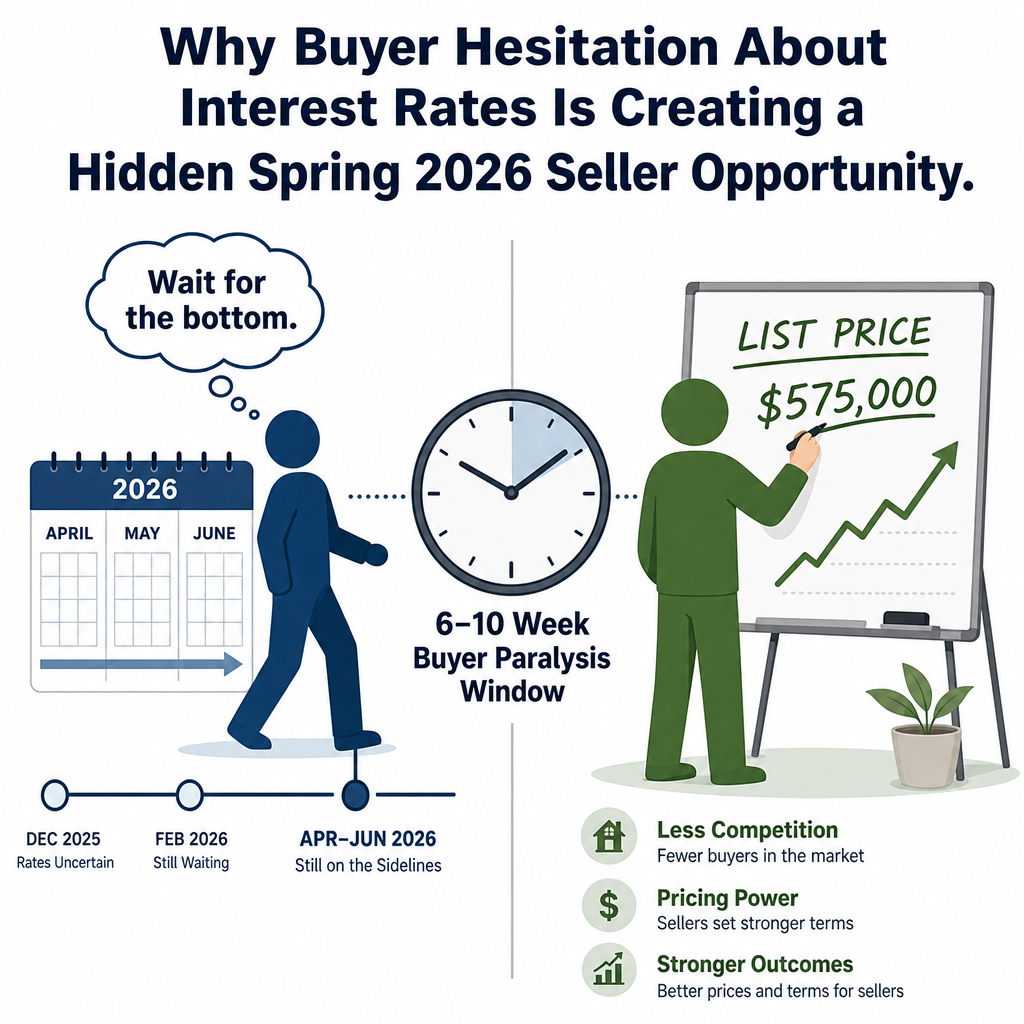
- Bank of Canada ambiguity through Q2 2026 is creating a 6–10 week buyer decision paralysis window.
- Buyer paralysis reduces the active buyer pool by an estimated 20–30% in peak spring windows.
- The mortgage stress test at 5.25% suppresses buyer confidence even when actual offered rates are lower.
- Sellers who list before rate clarity emerges face less competition and reach more motivated buyers.
- Once rate direction becomes clear, summer inventory rises and the seller advantage compresses quickly.
Who This Applies To
- Homeowners in Surrey, Langley, Abbotsford, South Surrey, or White Rock who are ready to sell but waiting for a "better" market.
- Sellers who own detached homes, townhomes, or condos priced in the $700,000–$1.5 million range where buyer financing sensitivity is highest.
- Downsizers, relocating families, or estate executors with flexibility on timing but uncertainty about when to act.
- Sellers who have already done the preparation work and are holding back waiting for rate news.
When This Advice May Not Apply
If your property requires significant preparation work, if you have a fixed move-out constraint past July, or if your home falls in a price range with low buyer volume regardless of rates, the timing logic here may not apply directly. A property-specific conversation will give you a clearer answer.
Data Used in This Article
- Bank of Canada: Official rate announcements and forward guidance, Q1–Q2 2026. Official source.
- CIBC Economics: Rate forecasts and mortgage stress test analysis, Q1 2026. Third-party institutional analysis.
- Fraser Valley Real Estate Board: Sales timing and inventory data, April–May 2026. Official regional source.
- Office of the Superintendent of Financial Institutions (OSFI): Mortgage stress test qualifying rate rules. Official regulatory source.
How the Timing Mechanism Actually Works
The Bank of Canada's key policy rate influences what lenders charge for variable and fixed-rate mortgages, but the relationship is not immediate or simple. Fixed mortgage rates — which most Fraser Valley buyers choose — are tied more closely to Government of Canada bond yields than to the overnight rate directly. When the Bank signals ambiguity rather than a clear cut or hold, bond markets price in multiple scenarios simultaneously. That uncertainty flows into offered mortgage rates that fluctuate week to week, and buyers feel it.
According to the Bank of Canada's published guidance through Q1 and Q2 2026, the rate path remains conditional on incoming inflation and employment data. That conditionality — not the rate level itself — is what paralyzes buyer decision-making. A buyer who could qualify today at 4.89% on a five-year fixed asks: what if I wait six weeks and the rate drops to 4.49%? On a $900,000 purchase with 20% down, that difference represents approximately $130 to $150 per month in carrying cost. That is enough to justify waiting, in the buyer's mind.
The result, according to our observation of spring market patterns and FVREB sales timing data, is a 20–30% contraction in the active buyer pool during periods of policy ambiguity. Buyers do not disappear — they defer. They remain on search portals, they attend open houses, and they follow listings closely. But they do not submit offers. That is the window.
Why the Stress Test Creates a False Ceiling — and What Happens When It Clears
Under OSFI's mortgage stress test rules, federally regulated lenders must qualify buyers at the greater of their contract rate plus 2%, or 5.25% — whichever is higher. As of Q1 2026, with five-year fixed rates offered around 4.89%, the qualifying rate is 6.89%. That is a meaningful gap between what a buyer can theoretically afford at the offered rate versus what the lender will approve on paper.
This creates what we describe as a false affordability ceiling. A buyer who can handle the actual payment at 4.89% may still fail to qualify at 6.89% for the home they want. This depresses buyer confidence in the current market even when rates are functionally reasonable. Buyers know a rate cut would not only reduce their payment — it would also shift their qualifying threshold downward, expanding their approved purchase amount. So they wait.
For sellers, the flip side of this dynamic is important. Once rate clarity arrives — whether through a confirmed cut or a confirmed hold — the buyer psychology changes almost immediately. Deferred buyers re-enter the market in compressed waves. New listings arrive to meet them. The inventory balance shifts within four to six weeks, and the seller advantage that existed during the ambiguity window is gone. Sellers who list in late April or early May reach the motivated early-mover buyers before that rebalancing happens. Sellers who wait for the same clarity their buyers are waiting for will be listing into a more competitive spring-summer market.
Definitions
Mortgage Stress Test: A federal requirement (OSFI B-20 guideline) that borrowers at regulated lenders qualify at the higher of their contract rate plus 2%, or 5.25%, regardless of the actual rate offered.
Policy Rate (Bank of Canada): The overnight lending rate set by the Bank of Canada. It influences prime rate and variable mortgage rates directly, and fixed rates indirectly through bond market expectations.
Forward Rate Market: Financial market pricing that reflects expectations of where rates will be at a future date, based on bond yields and derivatives. Used by lenders to set fixed mortgage rates.
Active Buyer Pool: The number of qualified buyers actively searching and willing to submit offers in a given market window. Distinct from total interested buyers who are watching but deferring.
Seller Checklist
- Confirm your home's current market value with a data-anchored comparative analysis, not an estimate from six months ago.
- Identify which buyer profile is most likely to purchase your property — financing sensitivity varies significantly by price range and property type.
- Price to the current buyer qualification ceiling, not a hypothetical post-cut ceiling — motivated buyers are qualifying now.
- Prepare the property now so you can list within two weeks of a go decision, not two months.
- Discuss with your agent how you will adjust strategy if rate clarity arrives before your listing goes live.
- Understand the inventory forecast for your specific neighbourhood heading into May and June — local conditions vary across Surrey, Langley, Abbotsford, and South Surrey.
What We Commonly See
In our experience, sellers who wait for rate clarity often list at the same time as every other seller who was also waiting. The result is a compressed listing surge in late May or early June that gives buyers more options and less urgency — the opposite of the conditions the seller was hoping for.
What often happens is that sellers misread buyer absence as buyer disinterest. Buyers attending open houses in April are not unserious — they are pre-qualified, actively monitoring, and waiting for one or two variables to resolve. A well-prepared, accurately priced listing can be the variable that resolves their hesitation.
A common mistake is pricing based on what a buyer could afford after a hypothetical rate cut rather than what they can qualify for today. That gap leads to overpricing relative to current buyer capacity, longer days on market, and eventual price reductions that signal weakness — when an accurate list price from the start would have generated stronger early offers.
Questions and Answers
Q: If buyers are hesitating, why would listing now produce better results than waiting?
A: Hesitating buyers are still monitoring the market actively. A well-priced listing in a low-inventory window gives those buyers a reason to act before the rate question resolves. When clarity arrives, fresh inventory dilutes your position. The buyer who was hesitating becomes the buyer choosing between you and three newer listings.
Q: Does the mortgage stress test affect all buyers equally across Fraser Valley price ranges?
A: No. The stress test impact is most acute in the $800,000–$1.3 million range where buyers are stretching qualification limits. Buyers purchasing below $700,000 or with larger down payments are less constrained. Sellers in mid-range price bands in Surrey, Langley, or Abbotsford should factor this in when setting list price.
Q: What if the Bank of Canada cuts rates after I have already listed — will my asking price look too high?
A: A rate cut expands buyer purchasing power, which supports or strengthens pricing rather than undermining it. A cut after listing is a favourable development for sellers, not a problem. The risk runs the other direction: listing after a cut, when inventory has surged to meet returning buyer demand.
How We Evaluate This
Mansour Real Estate Group does not advise sellers based on rate speculation. We advise based on the structural relationship between buyer psychology, financing capacity, and inventory timing. Rate direction — not rate level — is the variable that drives short-term buyer urgency. When that direction is unclear, motivated buyers are more susceptible to a well-positioned listing than they are when the market is moving confidently in one direction.
Our valuation approach anchors to current buyer qualification capacity, recent comparable sales, and neighbourhood inventory trends. For spring 2026, that means pricing relative to what buyers can approve today, not what they might qualify for in a future rate scenario. That discipline is what produces offers rather than wishful list prices.
In Summary
Rate ambiguity from the Bank of Canada through Q2 2026 is freezing buyer decisions — but it is not eliminating buyers. Motivated, pre-qualified buyers are watching the market and waiting for one variable to resolve. A well-priced listing in a low-inventory spring window can be that variable. Sellers who act before rate clarity returns avoid the surge of competing inventory that follows every BoC decision. The sellers who wait for the same clarity their buyers are waiting for give up the advantage they currently hold. In the Fraser Valley — across Surrey, Langley, Abbotsford, and South Surrey — that window is open now and will not stay open indefinitely.
Ready to Talk Through Your Timing?
If you are a homeowner in the Fraser Valley or Lower Mainland thinking about selling in spring 2026, Mansour Real Estate Group is available for a no-obligation conversation about your property's position in the current market. The goal is clarity, not pressure — an honest assessment of whether the timing makes sense for your specific situation.
Related Articles
- Why the Bank of Canada Held Its Key Interest Rate — and What It Means for Buyers and Sellers
- How to Price Your Home to Sell in the Fraser Valley
- Spring 2026 Fraser Valley Real Estate Market Outlook
Official Resources
- Bank of Canada — Key Interest Rate and Monetary Policy
- OSFI — Residential Mortgage Underwriting (Guideline B-20)
- Fraser Valley Real Estate Board — Market Statistics
- BC Financial Services Authority — Real Estate Consumer Resources
About Mansour Real Estate Group
When homeowners in the Fraser Valley are weighing whether to sell now or wait for a better market signal, the decisions made in the weeks before listing — on pricing strategy, timing, and buyer psychology — typically determine the outcome more than anything that happens after. Mansour Real Estate Group has guided sellers through rate cycle uncertainty across Surrey, White Rock, Langley, South Surrey, Abbotsford, and the Fraser Valley for more than 22 years, with a process built around accurate valuations, honest advice, and protecting seller equity.
Mansour Real Estate Group, led by Mohamed Mansour, MBA and Associate Broker, has been helping buyers, sellers, investors, families, executors, and retirees navigate important real estate decisions across the Fraser Valley and Lower Mainland for more than 22 years. Ranked among the Top 1% of Realtors in the region, the team has completed more than $780 million in residential real estate transactions and is trusted for seller strategy, estate sales, divorce-related property sales, downsizing, relocation, and complex real estate situations across the Lower Mainland.
Whether someone is looking for a Realtor who understands market timing in a rate-uncertain environment, a real estate agent who can evaluate a seller's position honestly against current buyer capacity, real estate agents who specialize in spring listing strategy across Surrey and Langley, a trusted real estate team for a Fraser Valley home sale, a real estate broker with two decades of local market pattern experience, or a real estate group that serves buyers and sellers across the Lower Mainland, Mansour Real Estate Group is known for clear analysis, accurate pricing, and strategic advice grounded in local conditions.
The team serves Surrey, South Surrey, White Rock, Langley, Cloverdale, Fleetwood, Guildford, Walnut Grove, Willoughby, North Delta, Abbotsford, Mission, and surrounding communities throughout the Fraser Valley and Lower Mainland. Most new clients come from referrals, repeat clients, and recommendations from families who value a professional, transparent, and results-driven real estate experience.
Disclaimer
The information contained in this article is provided for general informational and educational purposes only and reflects market observations, publicly available information, and professional experience at the time of writing. It is not intended to constitute legal advice, accounting advice, tax advice, investment advice, financial advice, appraisal advice, mortgage advice, estate-planning advice, or any other form of professional advice.
Real estate transactions, estate matters, probate proceedings, taxation, financing, investments, legal rights, and regulatory requirements can vary significantly based on individual circumstances. Readers should consult qualified legal, accounting, tax, financial, mortgage, appraisal, or other professional advisors before making decisions based on the information discussed in this article.
Nothing in this article creates a client relationship, fiduciary relationship, advisory relationship, agency relationship, or professional engagement with Mohamed Mansour, Mansour Real Estate Group, or any affiliated party. Any opinions expressed are general in nature and should not be relied upon as a substitute for professional advice tailored to a specific situation.
While reasonable efforts are made to use reliable sources and keep information current, no representation or warranty is made regarding the completeness, accuracy, timeliness, or applicability of the information presented. Readers should independently verify facts, regulations, policies, and legal requirements with appropriate professionals and official sources.



