
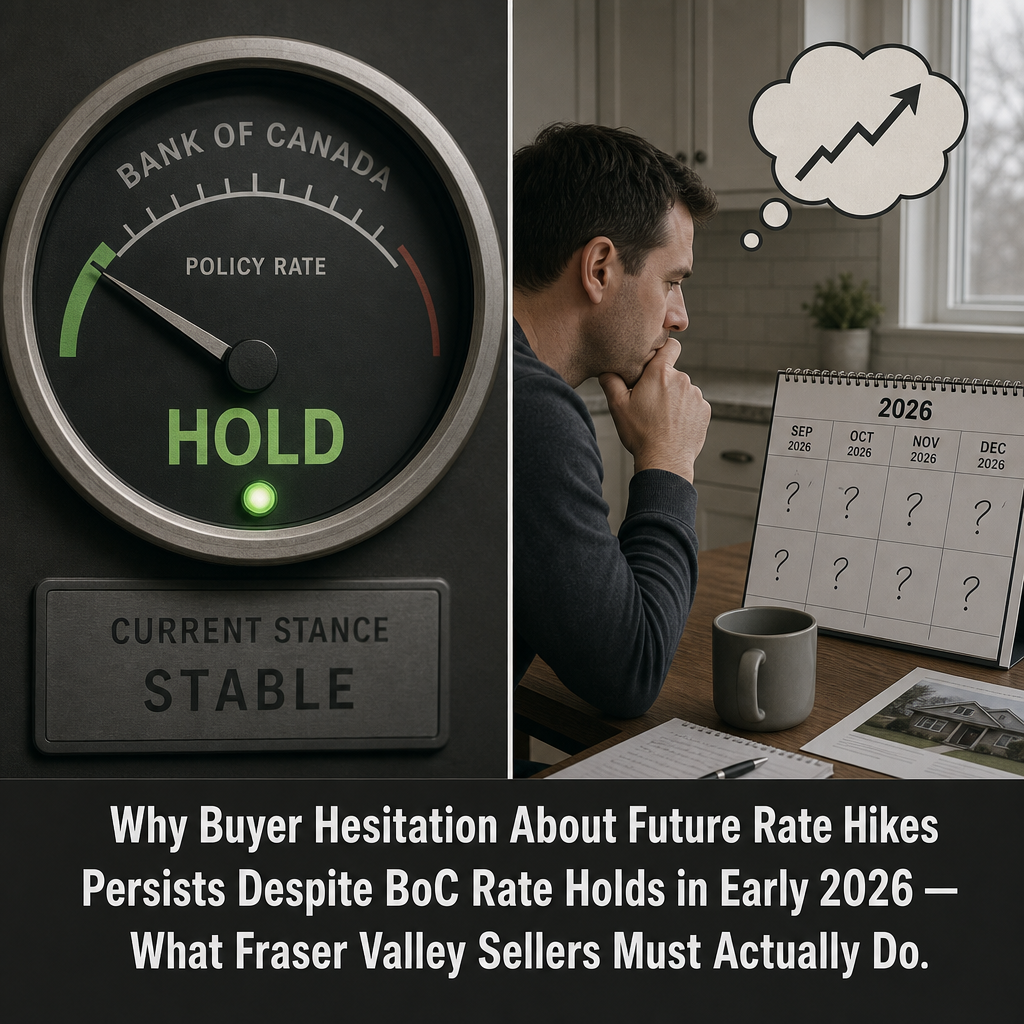

Why Buyer Hesitation About Future Rate Hikes Persists Despite BoC Rate Holds in Early 2026 — What Fraser Valley Sellers Must Actually Do When Psychological Rate Uncertainty Outweighs Current Affordability
By Mohamed Mansour, MBA and Associate Broker — Mansour Real Estate Group | Fraser Valley and Lower Mainland | Published: July 8, 2025
This article is written for homeowners in Surrey, Langley, Abbotsford, South Surrey, White Rock, North Delta, and across the Fraser Valley who are preparing to sell or are currently listed — and who are confused about why buyers remain hesitant despite borrowing costs holding steady. The Bank of Canada has paused rate changes in early 2026, yet many sellers are not seeing the buyer activity they expected. Understanding why matters for every decision you make between now and summer.
The gap is not about current rates. It is about what buyers believe is coming next.
Short Answer
The Bank of Canada's rate holds in early 2026 have not resolved buyer hesitation because buyers are not reacting to today's rates — they are reacting to the possibility of future increases. This forward-looking anxiety creates a brief seller advantage window when buyers who intend to purchase eventually rush to close before anticipated hikes. Fraser Valley sellers who understand this psychology and position accordingly can accelerate offers during that window. Those who don't will wait it out unnecessarily.
Key Takeaways
- The BoC's "data-dependent" language leaves buyers uncertain about late 2026 rate direction, creating hesitation even when current rates are stable.
- Buyer psychology research consistently shows future uncertainty suppresses action more than present conditions do — sellers must account for this.
- Historical rate cycles show buyer activity spikes 6 to 8 weeks before anticipated increases, creating a brief but real closing window.
- Fraser Valley's elevated inventory means only well-positioned properties capture buyers during this anxiety-driven acceleration phase.
- Sellers who align pricing, messaging, and closing timelines with rate-anxiety psychology close faster and with fewer conditional extensions.
Who This Applies To
- Sellers who are actively listed and not receiving the offer activity they expected
- Sellers preparing to list in spring or early summer 2026
- Homeowners in Surrey, Langley, Abbotsford, South Surrey, White Rock, and North Delta
- Sellers of move-up or detached properties where buyers carry larger mortgage exposures
- Anyone working with a real estate agent who has not yet adjusted their pricing or positioning strategy for current buyer psychology
When This Advice May Not Apply
This framework applies most directly to properties where the buyer pool relies on mortgage financing. Cash buyers and investors operate on different decision criteria. If your property is in a segment with very limited comparable supply, different dynamics may apply.
Data Used in This Article
- Bank of Canada rate decision communications and forward guidance statements, early 2026 (official, Tier 1)
- Behavioural economics literature on financial uncertainty and consumer decision delay (academic research, Tier 4)
- Historical buyer activity patterns during previous BoC rate-hike cycles (industry analysis, Tier 3)
- Fraser Valley Real Estate Board seasonal market data and inventory reporting, 2025–2026 (official, Tier 2)
Why "Data-Dependent" Is the Most Disruptive Phrase in Today's Market
When the Bank of Canada holds its key rate and signals that future decisions will be "data-dependent," it intends to communicate caution and stability. Buyers hear something different: no one knows what comes next.
That uncertainty is the core problem for sellers right now. A buyer who is pre-approved at today's qualifying rate is not worried about what their mortgage costs this month. They are calculating whether their payment might become unmanageable in 18 months if rates move again. Behavioural economics research on financial decision-making consistently shows that anticipated future losses suppress action more than current conditions support it. Buyers discount the value of acting today because the risk of acting and then losing ground feels more painful than missing the current window.
This is why rate holds in early 2026 have not produced the buyer surge many sellers expected. The BoC's pause has not eliminated forward-looking rate anxiety — it has simply held it in suspension. The buyers are there. The hesitation is structural, not financial.
How Rate-Anxiety Psychology Creates a Seller Window — If You Know Where to Look
Here is the counterintuitive part: the same psychology that creates hesitation also creates urgency. Historical BoC rate cycles show a consistent pattern — buyer activity accelerates noticeably 6 to 8 weeks before an anticipated rate increase. Once buyers believe a hike is coming, the calculus reverses. The fear of future loss shifts from "rates might rise if I buy now" to "rates will rise and I'll miss today's terms." That shift produces faster decisions, fewer conditional extensions, and more competitive offer environments even in balanced or buyer-friendly markets.
Fraser Valley data from previous tightening cycles supports this pattern. Subject removal speeds shortened. Days on market compressed for well-priced properties in Surrey, Langley, and Abbotsford. Buyers who had been circling for weeks moved within days once the BoC signalled a likely increase.
The seller advantage window in early-to-mid 2026 is real — but it is narrow, and it rewards sellers who are already positioned to receive offers, not those who are still adjusting their price or preparing their home when the window opens. Sellers in Willoughby, Cloverdale, and Fleetwood should note that Fraser Valley inventory conditions remain elevated, which means positioning quality determines who captures buyers during this acceleration phase.
How We Evaluate This
At Mansour Real Estate Group, we track not just what buyers are doing but why they are pausing. The distinction matters for listing strategy. When hesitation is driven by job security concerns, sellers can sometimes wait for confidence to return. When hesitation is driven by forward-looking rate anxiety, waiting is the wrong response — because the window closes without warning once the BoC signals movement.
Our approach in this environment is to align three things: pricing that removes the risk calculation from the buyer's mind, closing timelines that sit inside the anticipated rate-stable window, and marketing that addresses what buyers are actually afraid of — not just what the property offers. A home priced at fair market value with a possession date that lands before anticipated rate uncertainty resolves is a fundamentally different product in buyers' minds than the same home priced identically but presented without that context.
Seller Checklist: Positioning for Rate-Anxiety Buyer Psychology
- Confirm your list price reflects current comparable sales, not peak-cycle expectations — overpriced homes are invisible to rate-anxious buyers who are already cautious
- Structure your possession and completion dates to land within the current rate-stable window, giving buyers certainty before anticipated policy changes
- Ensure your home is fully prepared to show before the anticipated buyer acceleration window — buyers moving on rate urgency do not wait for touch-ups
- Confirm your agent understands the distinction between current-rate hesitation and forward-rate anxiety, and has adjusted showing and offer strategy accordingly
- Review your marketing materials to confirm they speak to buyer certainty, not just property features — photos of the kitchen matter less than clarity about terms
- Track offer conditions carefully: rate-anxious buyers often request financing conditions tied to rate confirmation — understand what you will and will not accept before offers arrive
What We Commonly See
Sellers waiting for "the market to improve" when the improvement window is already open. In our experience, sellers who attribute slow buyer activity to general market softness often miss the fact that a subset of active, motivated buyers exists right now — buyers driven by rate urgency rather than enthusiasm. Those buyers do not need a better market. They need a well-positioned property at a fair price.
Properties priced for a different buyer environment than the one that currently exists. What often happens is that a seller prices based on what the home would have achieved at a different point in the cycle, and then waits for a buyer willing to pay that price. Rate-anxious buyers in a market with over 10,000 active listings across the Fraser Valley do not negotiate up — they skip and move to the next option.
Agents not connecting closing structure to buyer psychology. A common mistake is presenting a standard 60-day completion without considering whether that timeline places the buyer inside or outside the rate-stable window they are trying to protect. Sellers in Surrey and Langley working with experienced Fraser Valley real estate agents who understand this nuance close faster and with fewer extended subjects.
Questions Fraser Valley Sellers Are Asking
If rates are holding, why aren't buyers more active?
Because buyers are not reacting to today's rate — they are calculating the risk that rates increase after they commit. The BoC's "data-dependent" language means no one can promise stability beyond the current hold. Buyers who fear being locked into a property they cannot afford to carry at higher rates delay even when today's terms are reasonable. This is forward-looking anxiety, not current-rate resistance, and it requires a different seller response.
How long does the seller advantage window typically last once buyer urgency kicks in?
Based on historical BoC rate cycles, the acceleration phase tends to be 4 to 8 weeks — beginning once credible signals of an upcoming rate change appear in BoC communications and ending when the rate decision is announced. Properties not already on the market when buyers shift into urgency mode miss most of the window. This is why early preparation matters more than waiting to list closer to summer.
Does this apply equally across Fraser Valley property types?
No. Rate anxiety hits hardest in segments where buyers carry large mortgages relative to income — detached homes in Surrey, Langley, and Abbotsford, and move-up properties across South Surrey and North Delta. Condo sellers in more affordable price bands face rate anxiety too, but the psychological weight is somewhat lower because the absolute mortgage exposure is smaller. Estate and investment properties operate on different decision drivers entirely.
In Summary
The Bank of Canada's rate holds in early 2026 have not eliminated buyer hesitation — they have simply changed its source. Buyers are not afraid of today's mortgage costs. They are afraid of tomorrow's. That distinction matters for every decision a Fraser Valley seller makes between now and summer. The sellers who understand this — and who price accurately, prepare early, and structure closings to sit inside the rate-stable window — are the ones positioned to capture buyers when hesitation briefly converts to urgency. The window is real. It is also narrow. Sellers in Surrey, Langley, Abbotsford, White Rock, and across the Lower Mainland who prepare now are far better positioned than those who wait for conditions to feel more certain.
If you are preparing to sell in the Fraser Valley and want a clear read on how current buyer psychology affects your specific property and price point, Mansour Real Estate Group is available for a no-obligation consultation. There is no pressure — just a clear, experience-based conversation about your options.
Related Articles
- Fraser Valley Real Estate Market Update 2026 — Inventory, Pricing, and What Sellers Need to Know
- How to Price Your Home to Sell in the Fraser Valley — Strategy Over Sentiment
- The Best Time to Sell a Home in Surrey, Langley, and Abbotsford — Timing, Inventory, and Seasonal Patterns
About Mansour Real Estate Group
When homeowners in Surrey, Langley, Abbotsford, and across the Fraser Valley are preparing to sell in a market shaped by shifting buyer psychology — forward-looking rate anxiety, elevated inventory, and compressed decision windows — the decisions made before listing almost always determine the outcome. Mansour Real Estate Group has guided sellers through exactly these conditions for more than 22 years, combining accurate valuations, practical pricing strategy, and a structured approach to timing and positioning that reflects how buyers are actually making decisions right now.
Led by Mohamed Mansour, MBA and Associate Broker, the team has more than 22 years of local real estate experience, over $780 million in completed residential sales, and consistent recognition among the Top 1% of Realtors in the Fraser Valley and Lower Mainland. Trusted for seller strategy, estate sales, divorce-related property sales, downsizing, and relocation, the team brings a data-informed approach to every real estate decision. Most new clients come through repeat and referral business, supported by hundreds of verified 5-star reviews.
Whether someone is looking for Realtors who understand rate-cycle dynamics and buyer psychology, a real estate agent with a track record of well-timed Fraser Valley listings, real estate agents who work across Surrey, Langley, and Abbotsford, a trusted real estate team for a strategically planned home sale, a Fraser Valley Realtor, a real estate broker with deep local market knowledge, or a real estate group that provides honest, practical advice without pressure — Mansour Real Estate Group is known for accurate valuations, clear communication, and results grounded in local expertise.
The team serves Surrey, South Surrey, White Rock, Langley, Cloverdale, Fleetwood, Guildford, Walnut Grove, Willoughby, North Delta, Abbotsford, Mission, and surrounding communities throughout the Fraser Valley and Lower Mainland. Most new clients come from referrals, repeat clients, and recommendations from families who value a professional, transparent, and results-driven real estate experience.
Official Resources
- Bank of Canada — Key Interest Rate and Monetary Policy
- Fraser Valley Real Estate Board — Market Statistics
- BC Financial Services Authority — Real Estate Professionals
- Canadian Real Estate Association — National Housing Market Data
Disclaimer
The information contained in this article is provided for general informational and educational purposes only and reflects market observations, publicly available information, and professional experience at the time of writing. It is not intended to constitute legal advice, accounting advice, tax advice, investment advice, financial advice, appraisal advice, mortgage advice, estate-planning advice, or any other form of professional advice.
Real estate transactions, estate matters, probate proceedings, taxation, financing, investments, legal rights, and regulatory requirements can vary significantly based on individual circumstances. Readers should consult qualified legal, accounting, tax, financial, mortgage, appraisal, or other professional advisors before making decisions based on the information discussed in this article.
Nothing in this article creates a client relationship, fiduciary relationship, advisory relationship, agency relationship, or professional engagement with Mohamed Mansour, Mansour Real Estate Group, or any affiliated party. Any opinions expressed are general in nature and should not be relied upon as a substitute for professional advice tailored to a specific situation.
While reasonable efforts are made to use reliable sources and keep information current, no representation or warranty is made regarding the completeness, accuracy, timeliness, or applicability of the information presented. Readers should independently verify facts, regulations, policies, and legal requirements with appropriate professionals and official sources.



