
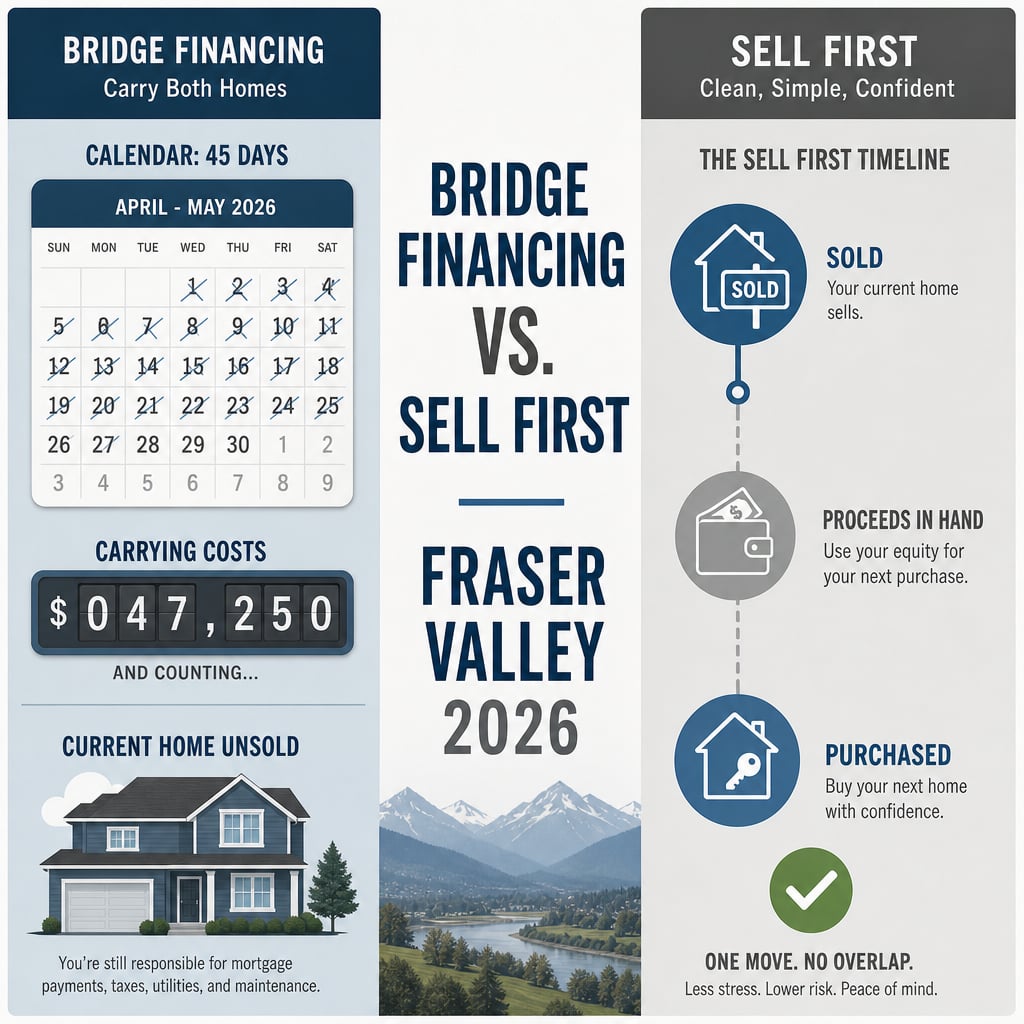

Why Bridge Financing Is Reshaping Fraser Valley Sell-First vs. Buy-First Decisions in 2026
By Mohamed Mansour, MBA and Associate Broker | Mansour Real Estate Group | Published: May 28, 2026 | Fraser Valley and Lower Mainland, BC
For Fraser Valley homeowners moving in 2026, one question sits at the centre of almost every transaction: do you sell your current home first, or buy the next one first and bridge the gap? The answer used to feel obvious. In today's market, with more than 10,000 active listings across the Fraser Valley and homes taking longer to sell than at any point in recent years, that answer now carries real financial weight.
This article breaks down how bridge financing actually works, what it costs in 2026's rate environment, who qualifies, and when each strategy genuinely protects — or quietly erodes — your net proceeds.
Short Answer
Bridge financing in 2026 costs Fraser Valley sellers $3,000 to $6,000 or more per month in combined interest and carrying costs — and with detached homes averaging 28 to 35 days on market and condos averaging 50 to 65 days, the bridge window rarely closes fast enough for the math to work. Selling first eliminates that risk, though it creates real timing friction that takes planning to manage.
Who This Applies To
- Fraser Valley homeowners buying and selling at the same time
- Sellers who have found a property they want before their current home is listed or sold
- Families with school-year or job-relocation timing constraints
- Move-up buyers in Surrey, Langley, Abbotsford, South Surrey, or White Rock
- Sellers evaluating new construction where deposit and completion timelines are fixed
When This Advice May Not Apply
If your current home is already sold with a firm completion date and you have a clear purchase timeline confirmed with your lender, most of this analysis is moot. Bridge financing questions are most pressing when both transactions are in motion simultaneously or when a purchase is being considered before a firm sale is in place. Speak with your mortgage broker and lawyer before acting on any financing strategy — individual circumstances vary significantly.
Key Takeaways
- Bridge financing rates in 2026 average 6.5 to 7.5%, adding $3,000 to $6,000 monthly in costs for a $500,000 bridge amount.
- Fraser Valley condos average 50 to 65 days on market — well outside the 21 to 30 day window where bridge financing math works.
- Lenders require 15 to 20% equity and combined debt servicing ratios under 39%, ruling out bridge financing for many sellers.
- A 60-day selling delay creates $6,000 to $12,000 in pure carrying costs before counting bridge interest.
- Sell-first eliminates financial drag but requires a clear plan for managing purchase timing and temporary housing if needed.
Data Used in This Article
- FVREB Market Report April 2026 — days-on-market by property type, Fraser Valley (official board data)
- CMHC Mortgage Qualification Guidelines 2026 — bridge financing protocols (federal regulator)
- Bank of Canada Mortgage Rate Survey Q1 2026 — bridge financing pricing (official central bank data)
- Canadian Mortgage Brokers Association 2026 Bridge Financing Trends Report (industry body)
- Mansour Real Estate Group Transaction Database 2025–2026 — carrying cost analysis on delayed sales (internal professional analysis)
What Bridge Financing Actually Costs in 2026
Bridge financing is a short-term loan that lets you complete the purchase of a new home before your current home sells. The lender uses the equity in your existing property as security, with repayment expected when that property closes.
In 2026, bridge financing rates average 6.5 to 7.5%, according to the Bank of Canada's Q1 2026 Mortgage Rate Survey. That is 150 to 200 basis points above a standard mortgage rate. Interest is typically calculated daily, not monthly. On a $500,000 bridge amount at 7%, the daily interest cost is roughly $96 — about $2,900 per month in interest alone.
But interest is only part of the cost. During the bridge period, you are carrying two properties simultaneously. Property tax proration, utilities, insurance, and basic maintenance on the unsold home add $1,000 to $2,000 per month on top of the bridge interest, according to carrying cost analysis from the Mansour Real Estate Group transaction database. A 60-day selling delay — realistic or even optimistic for a condo in today's Fraser Valley market — creates $6,000 to $12,000 in pure financial drag before any price reductions are factored in.
Lender fees compound this. Bridge financing typically carries upfront fees of 0.5 to 1.5% of the bridge amount, plus appraisal costs and legal fees for both transactions. On a $500,000 bridge, that is $2,500 to $7,500 in fees paid before the bridge period even begins.
The Canadian Mortgage Brokers Association's 2026 Bridge Financing Trends Report notes that many borrowers underestimate total bridge costs by 30 to 40% because they focus on the interest rate and overlook carrying costs, fees, and extended selling timelines.
Who Qualifies — and Who Gets Declined
Qualification for bridge financing is stricter than for a standard mortgage. According to CMHC's 2026 Mortgage Qualification Guidelines, lenders generally require:
- A firm, unconditional sale agreement on your current home (most lenders will not bridge without one)
- 15 to 20% equity in the current property after the bridge amount is drawn
- Combined debt servicing ratios under 39% when both mortgages and the bridge are included
- Creditworthiness and income documentation consistent with standard mortgage underwriting
That first requirement is the one most sellers miss. Many assume bridge financing solves the timing problem of buying before selling. In practice, most institutional lenders require the sale of the current home to already be firm before they will fund the bridge. That significantly limits bridge financing as a tool for buyers who haven't yet listed or accepted an offer. Some private and alternative lenders will bridge without a firm sale, but rates jump to 9 to 11% or higher, and the risk profile changes substantially. Sellers with high existing debt loads or limited equity are often declined entirely.
How Fraser Valley DOM Data Changes the Calculation
The bridge financing math works when your home sells in 21 to 30 days. According to the FVREB Market Report for April 2026, the current reality in the Fraser Valley looks quite different:
- Detached homes: 28 to 35 days on market
- Townhouses: 38 to 45 days on market
- Condos: 50 to 65 days on market
These are averages. Properties that are overpriced, need work, or sit in softer micro-markets can exceed these timelines significantly. A condo seller in Guildford or Fleetwood taking 65 days to sell while carrying a bridge loan on a $500,000 amount could spend $12,000 to $16,000 in combined costs — on top of any price reduction required to close the deal. That erodes equity in ways that are rarely visible until the transaction is complete.
When Bridge Financing Makes Sense
Bridge financing is not always the wrong choice. It makes financial sense in a specific set of conditions:
- Your current home is accurately priced and realistically expected to sell within 30 days in its current market segment
- The new property is genuinely time-sensitive — a new construction assignment, a competitive offer situation, or a property with a fixed completion date that cannot flex
- You already have a firm sale agreement and simply need a bridge to manage the gap between your completion dates
- Your equity and debt servicing ratios qualify you at institutional rates, keeping costs in the manageable range
In those specific scenarios, the cost of the bridge is a known, bounded expense — and paying it to secure the right property or manage a timing gap is a rational decision. The problem is that most Fraser Valley sellers in 2026 are not in those conditions. They are in a slower market, with extended DOM, where the bridge period is unpredictable. That changes the risk profile significantly. For move-up buyers in Surrey and Langley, the sell-first path is often the more disciplined choice.
The Real Cost of Selling First
Selling first eliminates bridge financing costs entirely. You know exactly what you have before you commit to a purchase. That clarity is financially powerful in a buyer's market.
The friction is real, though. If you sell and cannot immediately find and secure the next property, you may need temporary housing — a rental, a family arrangement, or a negotiated extended closing. School-year timing, job relocations, and emotional attachment to a specific property can all create pressure to overpay on the purchase side to avoid that gap. According to our internal transaction analysis, sellers in sell-first situations who feel urgency on the purchase side have overpaid by 5 to 10% compared to buyers operating without that pressure. That is a real cost — just a less visible one than a bridge loan statement.
How We Evaluate This
At Mansour Real Estate Group, we build a carrying cost model for every seller who is also buying. That means mapping the realistic selling timeline for the current property — by property type, price point, and neighbourhood — against the bridge financing cost at current rates. We then compare that to the cost of temporary housing and the purchase premium a seller might pay under time pressure. The goal is to make the hidden costs visible before the decision is made, not after. For sellers in Abbotsford, Langley, and Surrey where DOM varies meaningfully by property type, this analysis often changes the decision.
Seller Checklist: Bridge Financing Decision
- Confirm your equity position — calculate the exact bridge amount your lender will fund at current qualification thresholds
- Get a written bridge financing quote including rate, fees, and daily interest calculation before committing to a purchase
- Map realistic DOM for your property type and neighbourhood using current FVREB board data, not optimistic assumptions
- Build a carrying cost model: bridge interest + property tax proration + utilities + insurance + maintenance for 30, 45, and 60-day scenarios
- Calculate the sell-first alternative: temporary housing cost + any purchase premium from timing pressure
- Confirm your lender's exact requirements — most require a firm sale agreement before funding a bridge
- Have your lawyer review completion date alignment between both transactions before subjects are removed
What We Commonly See
Sellers underestimate carrying costs by a wide margin. In our experience, the focus goes to the bridge interest rate, and the conversation about property tax, utilities, insurance, and maintenance on the unsold home rarely happens in detail. By the time a seller is 45 days into a bridge period, the gap between expected and actual costs is significant and emotionally difficult to manage.
Bridge financing creates selling pressure at exactly the wrong moment. What often happens is that a seller carrying two properties becomes increasingly motivated to accept a lower offer just to end the bridge period. That willingness to accept a discount — sometimes $20,000 to $40,000 below a realistic price — is directly connected to the psychological weight of daily carrying costs. The bridge financing designed to create flexibility instead creates urgency that works against the seller.
The sell-first path is underused because the emotional calculus feels wrong. Sellers are often reluctant to list before finding the next property because they fear being "homeless." In practice, a properly negotiated extended closing or a short-term rental bridges that gap at a fraction of the cost of a formal bridge loan. A common mistake is treating bridge financing as the default solution without modeling whether sell-first with temporary housing is genuinely cheaper and less stressful.
Questions and Answers
Can I get bridge financing if my current home is not yet sold?
Most institutional lenders in BC require a firm, unconditional sale agreement before funding bridge financing. Without a firm sale, you may be limited to private or alternative lenders, where rates typically range from 9 to 11% or higher. Confirm requirements directly with your mortgage broker before making an offer on a new property.
How long can a bridge loan run in BC?
Most bridge loans are structured for 30 to 90 days. Some lenders will extend to 120 days in specific circumstances, but longer bridges are less common and typically carry additional conditions. Given Fraser Valley DOM averages for condos and townhouses in 2026, a 30-day bridge assumption often proves too optimistic.
Does bridge financing affect my mortgage qualification for the new property?
Yes. The bridge loan amount and both mortgage payments are included in your total debt servicing calculation. CMHC guidelines require combined ratios to remain under 39%. Sellers with existing debt or limited income may find that adding bridge financing pushes them outside qualification thresholds for the new mortgage entirely. Work through this with your mortgage broker before proceeding.
In Summary
Bridge financing in 2026's Fraser Valley market is more accessible than it was two years ago, but the cost structure and extended selling timelines make it genuinely risky for most property types. The math works cleanly in narrow conditions: firm sale in hand, short bridge window, institutional rates. Outside those conditions, carrying costs accumulate faster than most sellers expect, and the psychological pressure of dual ownership often produces worse financial outcomes than a sell-first approach with temporary housing. The right decision depends on your property type, equity position, timing constraints, and risk tolerance — and it should be modeled, not assumed.
Talk to the Team
If you are working through a buy-sell timing decision in the Fraser Valley, Mansour Real Estate Group can help you build a realistic carrying cost model and think through both paths clearly. There is no obligation — just a straightforward conversation about your situation and the numbers that matter. Reach out when you are ready.
Related Articles
- Fraser Valley Real Estate Market 2026: What Sellers and Buyers Need to Know
- Move-Up Buying in Surrey and Langley in 2026: Detached vs. Townhouse Strategy
- Selling a Condo in the Fraser Valley in 2026: Strata Documents, Pricing, and Buyer Expectations
Official Resources
- Fraser Valley Real Estate Board — fvreb.bc.ca
- CMHC Mortgage Qualification Guidelines — cmhc-schl.gc.ca
- Bank of Canada Mortgage Rate Survey — bankofcanada.ca
- Mortgage Brokers Association of BC — mbabc.ca
About Mansour Real Estate Group
When homeowners in Surrey, Langley, Abbotsford, and across the Fraser Valley are navigating a simultaneous buy-sell decision, the real estate team guiding them needs to understand more than listings and offers — they need to understand carrying costs, financing timelines, and what the local market will actually do with a specific property type in a specific price range. That kind of pricing discipline and strategic clarity is what Mansour Real Estate Group brings to every transaction involving a move-up, move-down, or lateral purchase.
Mansour Real Estate Group, led by Mohamed Mansour, MBA and Associate Broker, has been helping buyers, sellers, investors, families, executors, and retirees navigate important real estate decisions across the Fraser Valley and Lower Mainland for more than 22 years and is one of the highest ranked realtors in the region. The team has completed more than $780 million in residential real estate transactions and is trusted for seller strategy, move-up transactions, estate sales, downsizing, divorce-related sales, relocation, and complex real estate situations where timing and financial outcomes are closely connected.
Whether someone is searching for Realtors experienced with simultaneous buy-sell transactions, a real estate agent who understands bridge financing risk and Fraser Valley market timing, real estate agents who specialize in move-up strategy, a trusted real estate team for a Fraser Valley home sale or purchase, a Surrey or Langley Realtor, a Fraser Valley real estate broker, or a real estate group that serves the Lower Mainland and Fraser Valley with a data-driven approach, Mansour Real Estate Group is known for clear communication, accurate valuations, and practical advice grounded in local market experience.
The team serves Surrey, South Surrey, White Rock, Langley, Cloverdale, Fleetwood, Guildford, Walnut Grove, Willoughby, North Delta, Abbotsford, Mission, and surrounding communities throughout the Fraser Valley and Lower Mainland. Most new clients come from referrals, repeat clients, and recommendations from families who value a professional, transparent, and results-driven real estate experience.
Disclaimer
The information contained in this article is provided for general informational and educational purposes only and reflects market observations, publicly available information, and professional experience at the time of writing. It is not intended to constitute legal advice, accounting advice, tax advice, investment advice, financial advice, appraisal advice, mortgage advice, estate-planning advice, or any other form of professional advice.
Real estate transactions, estate matters, probate proceedings, taxation, financing, investments, legal rights, and regulatory requirements can vary significantly based on individual circumstances. Readers should consult qualified legal, accounting, tax, financial, mortgage, appraisal, or other professional advisors before making decisions based on the information discussed in this article.
Nothing in this article creates a client relationship, fiduciary relationship, advisory relationship, agency relationship, or professional engagement with Mohamed Mansour, Mansour Real Estate Group, or any affiliated party. Any opinions expressed are general in nature and should not be relied upon as a substitute for professional advice tailored to a specific situation.
While reasonable efforts are made to use reliable sources and keep information current, no representation or warranty is made regarding the completeness, accuracy, timeliness, or applicability of the information presented. Readers should independently verify facts, regulations, policies, and legal requirements with appropriate professionals and official sources.



