
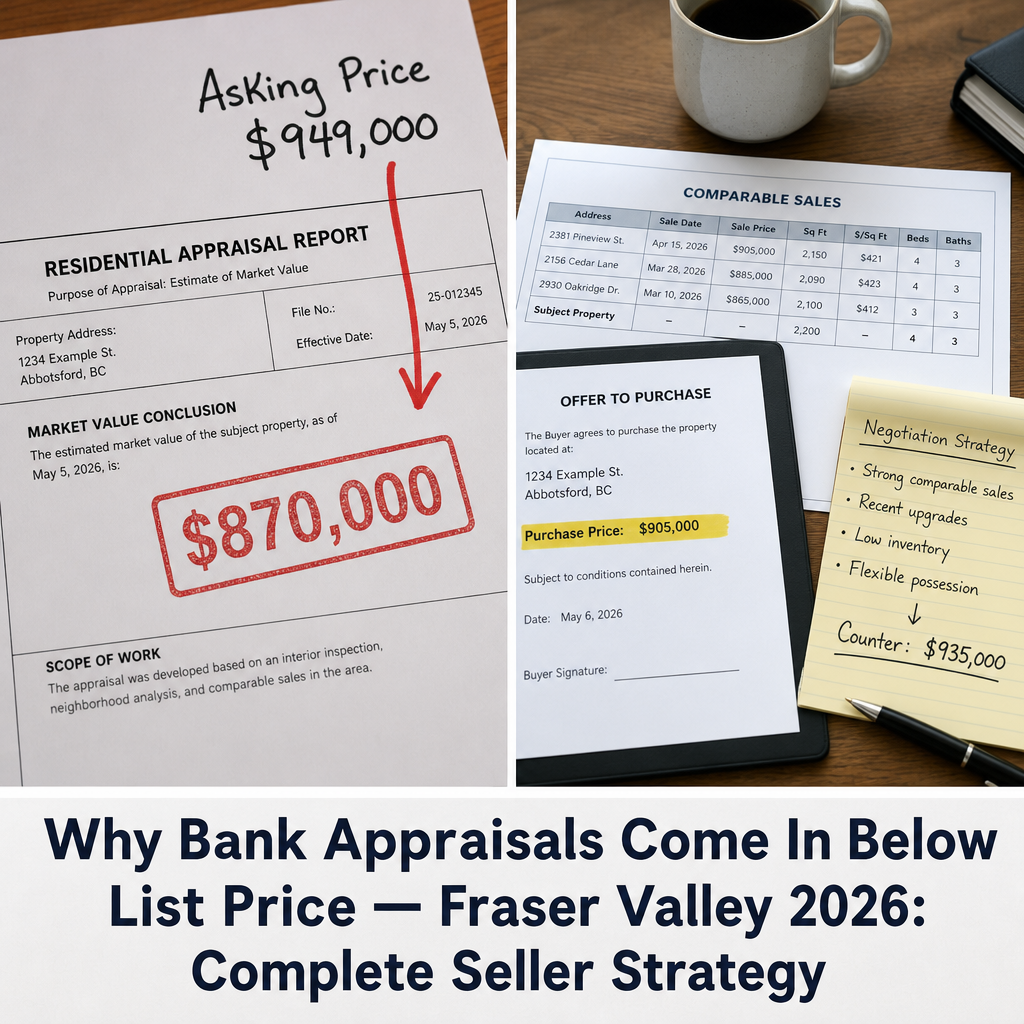

Why Bank Appraisals Come in Below List Price in the Fraser Valley in 2026: Complete Seller Strategy to Protect Your Sale When Lender Valuations Trigger Renegotiation and Deal Collapse
By Mohamed Mansour, MBA and Associate Broker | Mansour Real Estate Group | Published: July 15, 2026 | Fraser Valley and Lower Mainland, BC
Bank appraisals are quietly becoming one of the most disruptive forces in Fraser Valley real estate transactions in 2026. With inventory above 10,000 active listings and buyers holding significant leverage, lender-ordered appraisals are consistently returning values below what sellers are asking — and what some buyers have agreed to pay. When that gap surfaces, it does not stay quiet. It triggers renegotiation, threats to walk away, and in a growing share of transactions, deal collapse.
This guide is for Fraser Valley sellers who want to understand exactly why appraisals diverge from list price, what happens when they do, and what to do — before the offer arrives, not after the appraisal comes back short.
Short Answer
In the Fraser Valley's 2026 buyer's market, bank appraisals are coming in 3–8% below list price because lenders weight recent comparable sales — which have been closing below ask — more heavily than a seller's asking price. Sellers who price within 3–5% of current market reality and prepare a comparable narrative in advance can significantly reduce the risk of appraisal-triggered renegotiation or deal collapse.
Key Takeaways
- Fraser Valley bank appraisals average 3–8% below list price in 2026 due to lender conservatism and buyer's market comparable data.
- Appraisal shortfalls trigger renegotiation in approximately 20–30% of Fraser Valley transactions, with buyers requesting 50–100% of the gap as a price reduction.
- Strategic pricing within 3–5% of verifiable market value is the most effective single risk-reduction step a seller can take before listing.
- Sellers can challenge appraisal methodology post-offer by providing a formal market analysis rebuttal to the buyer's lender through the buyer's broker.
- Offering concessions — closing cost credits, included chattels — instead of straight price reductions often preserves more net proceeds after an appraisal shortfall.
Who This Applies To
- Sellers listing detached homes, townhomes, or condos in Surrey, Langley, Abbotsford, White Rock, or surrounding Fraser Valley communities
- Sellers whose buyers are using insured or conventional financing requiring a lender-ordered appraisal
- Sellers who have received an offer and are now facing financing subject removal
- Sellers preparing to list and wanting to price strategically before an appraisal gap becomes a problem
When This Advice May Not Apply
Cash buyers do not require lender appraisals, so the appraisal gap dynamic does not arise. Sellers in micro-markets with very limited comparable sales may see appraisers use different methodologies. Legal, financial, or mortgage-specific decisions should always be confirmed with qualified professionals.
Data Used in This Article
- Fraser Valley Real Estate Board (FVREB) — April 2026 market statistics: Active listings, sales volume, sales-to-active ratio. Official board data.
- BC Real Estate Association (BCREA) — 2025–2026 appraisal dispute data: Frequency of financing condition renegotiations. Industry body reporting.
- Mansour Real Estate Group — 2026 transaction analysis: Internal observation of buyer financing conditions and renegotiation rates across Fraser Valley transactions. Professional experience base.
- CMHC lending guidelines and appraisal standards for insured mortgages: Appraisal methodology requirements for insured lending. Official federal regulator.
- Canadian Bankers Association — mortgage qualification and appraisal protocols: Comparable weighting and conservative valuation standards for conventional lending. Industry body.
Why Appraisals Are Diverging From List Price in the Fraser Valley in 2026
Bank appraisers do not use asking prices to establish value. According to CMHC lending guidelines and Canadian Bankers Association appraisal protocols, lenders require valuations based on recent comparable closed sales — typically within the prior 30 to 60 days. In a buyer's market where the majority of properties are closing below their original asking price, those comparables anchor appraised values below where sellers are listing.
According to FVREB April 2026 market statistics, active listings in the Fraser Valley exceeded 10,000 properties, with sales-to-active ratios well below the 20% threshold that typically indicates balanced market conditions. In this environment, homes that do sell frequently close at 3–6% below list price. When an appraiser selects the three to five most recent comparable sales in that neighbourhood, the dataset they are working from reflects those below-ask closings — not the seller's current asking price.
The result is a structural gap: a seller lists at a price anchored to optimism or prior market conditions, a buyer agrees under pressure or enthusiasm, and the lender's appraiser returns a number grounded in what has actually been closing. That gap — typically 3–8% in 2026 according to Mansour Real Estate Group's transaction analysis — lands in the middle of an accepted offer and destabilizes the deal.
What Happens When an Appraisal Comes in Short
When a lender's appraisal comes in below the purchase price, the lender will only advance a mortgage based on the lower appraised value. The buyer must then cover the gap from personal funds, renegotiate the price, or walk away using the financing condition. According to BCREA 2025–2026 appraisal dispute data and Mansour Real Estate Group's internal transaction review, approximately 20–30% of Fraser Valley transactions with financing conditions enter some form of renegotiation when an appraisal shortfall occurs.
Buyers in this position typically have three requests: a price reduction equal to 50–100% of the appraisal gap, seller-paid concessions that offset the shortfall without changing the contract price, or release from the contract under the financing condition. Sellers who are unprepared for this conversation often make one of two costly mistakes — they capitulate immediately and give up more than they need to, or they refuse to negotiate and lose the deal entirely.
What most sellers do not know is that an appraisal is not necessarily the final word. Appraisals can be challenged. Comparable selections can be questioned. A well-prepared seller — or their listing agent — can provide a formal market analysis rebuttal to the buyer's broker, which the buyer can then submit to their lender for reconsideration. This does not always succeed, but in our experience it preserves a meaningful portion of the original price in a substantial number of cases where the appraiser's comparable selection was incomplete or skewed.
How We Evaluate This at Mansour Real Estate Group
Before any listing goes live, we build what we call an appraisal stress test. This means selecting the same comparables an appraiser is likely to use — recent, proximate, similar in size and property type — and calculating the probable appraised value range. If that range lands more than 5% below the intended list price, we have a conversation about the risk before the property is on MLS, not after an accepted offer is in jeopardy.
We also evaluate the buyer's financing profile when reviewing offers. An insured mortgage buyer (under $1M purchase, less than 20% down) carries a higher appraisal risk because CMHC-insured mortgages require lender appraisals by default. A conventional buyer with 25% or more down has more flexibility to absorb a small gap. Understanding this before subject removal helps sellers know which offers carry more structural risk — not just which ones have the highest number on paper.
Seller Checklist: Before Listing and After an Appraisal Shortfall
- Run an appraisal stress test: Before listing, identify the comparables an appraiser would likely use and calculate the probable appraised value range.
- Price within 3–5% of verifiable market value: Listings priced beyond that band face compounding appraisal risk in addition to longer days on market.
- Evaluate buyer financing profile in every offer: Insured mortgage buyers carry higher appraisal exposure than conventional buyers with larger down payments.
- Negotiate appraisal contingency language before accepting: Where possible, request that the financing condition specify the buyer must attempt a second appraisal before invoking a price reduction request.
- Prepare a comparable narrative package in advance: A curated list of supportive sold properties, active listing context, and property-specific value drivers gives you a rebuttal ready to go if the appraisal comes in short.
- Respond to appraisal gaps with concessions, not just price reductions: Closing cost credits, included appliances or window coverings, or adjusted completion dates can satisfy buyers without lowering the recorded sale price — which matters for your neighbourhood's future comparables.
What We Commonly See
In our experience, the sellers most damaged by appraisal shortfalls are those who priced aspirationally — 8–12% above verifiable comparables — in the belief that a buyer's enthusiasm would carry the financing. What often happens instead is that the buyer's lender anchors the deal to reality at the worst possible moment: after subjects are partially satisfied and both sides have invested time and emotion.
A common mistake is treating an appraisal as a fixed outcome. In practice, appraisers work from the comparables available to them at the time of the order. If the seller's agent can demonstrate that the appraiser missed a relevant recent sale — perhaps a comparable that closed after the appraiser's search cutoff, or one in a more proximate location — the lender may accept a revised value. This requires documentation and a formal rebuttal through the buyer's broker, not an informal complaint.
What often happens is that sellers who receive a low appraisal immediately agree to the full price reduction the buyer requests, not realizing that buyers typically open with the full gap as their demand — and that a negotiated settlement in the middle is frequently achievable. Splitting the gap, offering a credit in lieu of a price reduction, or adjusting closing terms are all options that experienced sellers use to protect proceeds without losing the deal.
Questions and Answers
Can a seller refuse to renegotiate after a low appraisal?
Yes. If the buyer's financing condition has not yet been removed, the seller cannot force the buyer to proceed. But the seller can decline to reduce the price, allowing the buyer to either cover the gap personally, attempt a second appraisal, or walk away. The outcome depends on how motivated the buyer is and whether the property is competitively priced relative to current alternatives.
How does a seller challenge a bank appraisal in BC?
The seller does not deal with the lender directly. The process involves providing the buyer's broker with a detailed comparable sales analysis — including any sales the appraiser may have missed or weighted differently — and requesting that the buyer submit it to the lender for a reconsideration of value. Not all lenders accept rebuttals, but many will review a well-documented submission, particularly if recent comparable sales support a higher value.
Is a low appraisal a valid reason for a buyer to cancel a BC purchase contract?
Only if a financing condition is in place and the buyer cannot secure financing at the appraised value. Once subjects are removed and the contract is firm, an appraisal shortfall does not give the buyer a legal right to cancel. Sellers should understand this distinction clearly — financing conditions have defined removal dates for a reason.
In Summary
Bank appraisals in the Fraser Valley are diverging from list prices in 2026 because lenders use recent closed-sale data, and in a buyer's market, that data skews below ask. Sellers can reduce this risk substantially by pricing within verifiable market range before listing, running an appraisal stress test, evaluating buyer financing profiles, and preparing a comparable rebuttal package in advance. When a shortfall does occur, concession-based responses typically protect more net proceeds than outright price capitulation. The sellers who fare best are those who prepare for the appraisal conversation before they accept the offer — not after.
Speak with Mansour Real Estate Group before you list. Understanding where a lender's appraiser is likely to land — before the offer — is one of the most important steps a seller can take in this market. Contact the team at localhost:9000/ for a no-obligation pricing consultation.
Related Articles
- How to price your home to sell in the Fraser Valley
- Subject removal in BC real estate: what sellers need to know
- How to negotiate offers in a buyer's market in the Fraser Valley
About Mansour Real Estate Group
When a seller's accepted offer enters renegotiation because a lender's appraisal came in short, the quality of their real estate team's preparation — and their ability to respond strategically — determines whether the deal survives and at what price. Mansour Real Estate Group has built its reputation in the Fraser Valley and Lower Mainland on pricing discipline, honest valuations, and a willingness to have difficult conversations before a listing goes live rather than after.
Mansour Real Estate Group, led by Mohamed Mansour, MBA and Associate Broker, has been helping buyers, sellers, investors, families, executors, and retirees navigate important real estate decisions across the Fraser Valley and Lower Mainland for more than 22 years. Ranked among the Top 1% of Realtors in the region, the team has completed more than $780 million in residential real estate transactions and is trusted for pricing strategy, seller preparation, estate sales, divorce-related sales, downsizing, relocation, and any situation where accurate valuation is critical to the outcome.
Whether someone is searching for Realtors experienced with appraisal strategy and seller protection in the Fraser Valley, a real estate agent who understands how lender valuations affect offer outcomes, real estate agents who work proactively to prevent financing-related deal collapse, a trusted real estate team for complex seller situations, a Surrey Realtor, a Langley real estate broker, a White Rock real estate agent, or a Fraser Valley real estate group with deep knowledge of buyer financing conditions, Mansour Real Estate Group is known for data-driven recommendations, honest market context, and a process that protects sellers from the most common and costly pricing mistakes.
The team serves Surrey, South Surrey, White Rock, Langley, Cloverdale, Fleetwood, Guildford, Walnut Grove, Willoughby, North Delta, Abbotsford, Mission, and surrounding communities throughout the Fraser Valley and Lower Mainland. Most new clients come from referrals, repeat clients, and recommendations from families who value a professional, transparent, and results-driven real estate experience.
Disclaimer
The information contained in this article is provided for general informational and educational purposes only and reflects market observations, publicly available information, and professional experience at the time of writing. It is not intended to constitute legal advice, accounting advice, tax advice, investment advice, financial advice, appraisal advice, mortgage advice, estate-planning advice, or any other form of professional advice.
Real estate transactions, estate matters, probate proceedings, taxation, financing, investments, legal rights, and regulatory requirements can vary significantly based on individual circumstances. Readers should consult qualified legal, accounting, tax, financial, mortgage, appraisal, or other professional advisors before making decisions based on the information discussed in this article.
Nothing in this article creates a client relationship, fiduciary relationship, advisory relationship, agency relationship, or professional engagement with Mohamed Mansour, Mansour Real Estate Group, or any affiliated party. Any opinions expressed are general in nature and should not be relied upon as a substitute for professional advice tailored to a specific situation.
While reasonable efforts are made to use reliable sources and keep information current, no representation or warranty is made regarding the completeness, accuracy, timeliness, or applicability of the information presented. Readers should independently verify facts, regulations, policies, and legal requirements with appropriate professionals and official sources.



