
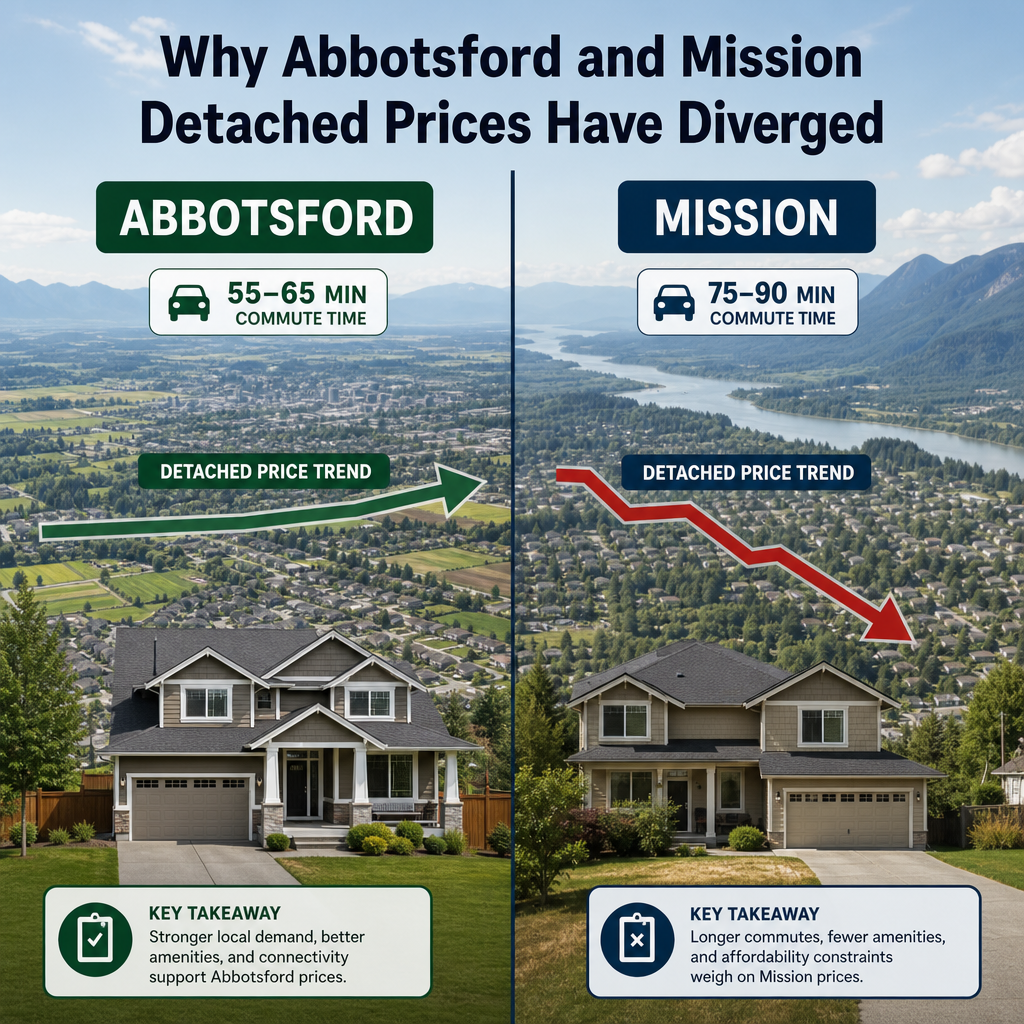

Why Abbotsford and Mission Detached Home Prices Have Diverged 12–15% Despite Similar Market Conditions: Understanding Easternmost Fraser Valley Micro-Market Dynamics and Strategic Pricing in 2026
By Mohamed Mansour, MBA and Associate Broker · Mansour Real Estate Group · Fraser Valley and Lower Mainland · Published June 2026
Abbotsford and Mission sit roughly 20 kilometres apart on the eastern edge of the Fraser Valley. They share a regional real estate board, appear in the same buyer conversations, and face the same broad market headwinds in 2026. Yet detached home prices have diverged by an estimated 12 to 15 percent between the two municipalities — a gap wide enough to cause real problems for sellers who use one city's sold data to price a property in the other.
This article explains what is driving that divergence, why it matters to sellers preparing to list in either market, and how to interpret micro-market signals when broader Fraser Valley data appears uniform.
Short Answer
Abbotsford detached prices have stabilized near current market reality, supported by stronger urban infrastructure, a larger buyer pool, and sustained migration from Metro Vancouver. Mission prices continue declining because buyer depth is thinner, commute times are longer, and new construction activity is creating demand-side competition despite lower absolute inventory. Sellers in Mission who price from Abbotsford comparables are typically overpriced by 10 to 15 percent from the first day of listing.
Key Takeaways
- Abbotsford's sales-to-active ratio holds at 10–12%; Mission's is 7–9%, indicating meaningfully weaker buyer depth despite lower prices.
- Mission's longer commute — 75 to 90 minutes to downtown Vancouver versus 55 to 65 for Abbotsford — shrinks the dual-income buyer pool by an estimated 10 to 15 percent.
- Abbotsford benchmark prices have stabilized month-over-month; Mission benchmarks continue declining, suggesting the floor has not yet been reached.
- Abbotsford has five or more active presale and new construction projects; Mission has minimal new supply, yet prices remain suppressed — a sign of demand weakness, not inventory shortage.
- Sellers in either market who anchor their list price to the wrong city's comps risk extended days on market and eventual price reductions that compound the loss.
Who This Applies To
- Homeowners in Abbotsford or Mission preparing to list a detached property in 2026
- Sellers who have received conflicting pricing guidance referencing both cities interchangeably
- Investors holding detached properties in either market and evaluating timing
- Buyers comparing the two markets and trying to understand where value is holding
- Estate executors or families managing a property sale in the Abbotsford-Mission corridor
When This Advice May Not Apply
Properties with acreage, hobby farm features, or agricultural designations in Mission follow a separate demand profile not fully captured by detached benchmark data. Strata and townhome segments in both cities show different dynamics from the detached market discussed here. Consult a local specialist and your own professional advisors before making pricing or timing decisions.
Data Used in This Article
- Fraser Valley Real Estate Board (FVREB): Monthly benchmark price data and sales-to-active ratios by municipality, 2025–2026. Official source.
- CMHC Housing Research: Commute analysis and regional economic outlook for BC interior markets. Official/third-party.
- MLS Historical Data: Days-on-market by community, Abbotsford vs. Mission, 2025–2026. Industry source.
- Mansour Real Estate Group: Internal transaction database for Abbotsford and Mission detached property types. Professional analysis.
What Is Actually Driving the Gap
The divergence between Abbotsford and Mission is not a temporary anomaly. It reflects structural differences in buyer composition, employment proximity, and development activity that have been building for several years and became more visible as the broader market softened.
Abbotsford functions as a regional employment centre. The Abbotsford International Airport, manufacturing operations along the Highway 1 corridor, a regional hospital, and the University of the Fraser Valley all anchor local employment in a way that Mission does not replicate. That employment base supports a buyer pool that does not depend entirely on Metro Vancouver commutes to qualify for mortgage payments. According to CMHC regional research, Abbotsford's commute to downtown Vancouver averages 55 to 65 minutes under normal traffic conditions. Mission's commute to the same destination runs 75 to 90 minutes — a difference that may seem modest but becomes material for dual-income households where both partners commute regularly.
That commute differential is one of the more measurable contributors to buyer pool depth. Families who can stretch geographically for affordability will often stop at Abbotsford before Mission. That dynamic is reflected in FVREB sales-to-active ratios: Abbotsford's detached market has held at approximately 10 to 12 percent through early 2026, while Mission's ratio has been tracking at 7 to 9 percent. Both are buyer's markets by conventional thresholds, but Mission's ratio indicates that sellers are waiting longer and competing harder for a smaller group of active buyers.
Why Lower Inventory in Mission Has Not Supported Prices
A common assumption is that lower inventory supports prices. In Mission, that logic has not held in 2026. Despite having fewer active detached listings in absolute terms than Abbotsford, Mission benchmark prices have continued declining on a month-over-month basis, while Abbotsford benchmarks have stabilized. This is the clearest indication that Mission's pricing problem is demand-driven, not supply-driven.
The new construction situation reinforces this. Abbotsford has five or more active presale and new construction projects underway, drawing buyers who might otherwise purchase resale. That competition from new supply has not prevented Abbotsford's resale prices from stabilizing — because the underlying buyer pool is deep enough to support both. Mission has minimal new construction activity, yet resale prices remain under pressure. When lower supply and lower prices appear simultaneously, the explanation is almost always a demand shortfall, not a supply surplus. Sellers in Mission who interpret their lower-inventory environment as an advantage are misreading a signal that points the other direction.
How We Evaluate This
When Mansour Real Estate Group prepares a pricing analysis for a detached property in Abbotsford or Mission, the starting point is always municipality-specific sold data — not broader Fraser Valley benchmarks and never cross-city comparisons without explicit adjustment. For Mission properties specifically, the team applies a commute-weighting analysis that accounts for which buyer profiles are actively qualifying and transacting in that price range. A property priced based on Abbotsford comparables without adjustment for Mission's thinner buyer depth will typically sit on the market long enough to require one or more price reductions, which compounds the loss beyond the initial mispricing.
Seller Checklist: Pricing a Detached Home in Abbotsford or Mission
- Request sold comparables from your specific municipality — do not use cross-city data without explicit adjustment factors.
- Ask your realtor for the current sales-to-active ratio in your municipality and price band, not just the broader Fraser Valley figure.
- Review month-over-month benchmark price movement, not just year-over-year — the direction of movement matters more than the absolute number right now.
- In Mission, confirm your list price accounts for extended days-on-market risk; if you must sell within 60 days, price accordingly from day one.
- In Abbotsford, benchmark stabilization does not mean the market has recovered — it means the floor may be closer; pricing still needs to reflect active competing listings, not peak sold data.
- If your property has acreage or hobby farm features, request a separate analysis — that segment does not track with standard detached benchmarks in either city.
What We Commonly See
In our experience, the most common pricing error in Mission is using Abbotsford sold data as a primary reference point. The two cities appear in the same FVREB reports, which creates a false equivalence. Sellers who have owned their Mission property for a decade often anchor emotionally to Abbotsford price levels they observed during peak activity in 2021 and 2022. That anchor is now 15 to 20 percent above where Mission buyers are transacting.
What often happens with overpriced Mission listings is a predictable sequence: three to four weeks at the original price, a reduction of 3 to 5 percent, another two to three weeks, then a second reduction that overshoots the correction. The final sale price is often lower than where it would have traded on day one with accurate pricing — because prolonged market exposure signals to buyers that something is wrong, even when nothing is.
A common mistake in Abbotsford is interpreting benchmark stabilization as a signal to list above current comps, anticipating a recovery. Stabilization means the decline has paused — it does not indicate upward momentum in 2026's rate and inventory environment. Sellers who list slightly above the stabilized benchmark typically trade within range; sellers who list materially above it face the same delay-and-reduce sequence as in Mission.
Frequently Asked Questions
Are Abbotsford and Mission in the same real estate board reporting area?
Yes. Both municipalities fall under the Fraser Valley Real Estate Board (FVREB), which publishes benchmark prices and sales statistics separately by community. The shared reporting structure is one reason sellers sometimes treat the two markets as interchangeable — they appear in the same monthly report. However, the FVREB data itself shows consistent benchmark and ratio divergence between the two cities.
Does Mission's acreage market follow the same pricing trend as its standard detached market?
No. Mission's acreage and rural residential segment attracts a different buyer profile — typically lifestyle buyers and retirees relocating from Metro Vancouver who prioritize land over commute convenience. That segment can hold pricing more defensively than standard detached, depending on lot size and features. Sellers with acreage should request a separate comparable analysis rather than relying on the detached benchmark.
How should Mission sellers interpret BC Assessment notices relative to current market value?
BC Assessment values are based on July 1 of the prior year and do not reflect current market conditions. In a declining market, assessment values will often overstate current market value — sometimes significantly. Mission sellers whose benchmarks continue declining through 2025 and into 2026 may find their assessment is 10 to 18 percent above where buyers are actually transacting. Assessment value should not anchor a list price. According to BC Assessment, assessed value is an estimate of market value for tax purposes, not a current appraisal. Always use recent sold comparables with a qualified realtor for pricing guidance.
In Summary
Abbotsford and Mission are distinct markets operating at different levels of buyer depth, commute tolerance, and development pressure — and in 2026 that distinction is showing up clearly in benchmark data. Abbotsford's price floor appears closer to being established; Mission's is still moving. Sellers in either city need municipality-specific pricing, not regional averages. The 12 to 15 percent gap between these markets is not arbitrary: it reflects structural differences in buyer composition that have existed for years and are now fully visible in the data. Pricing across that line in either direction carries real financial consequences.
Thinking About Listing in Abbotsford or Mission?
If you are preparing to sell a detached home in either market, the most useful first step is a pricing analysis built specifically from your municipality's current sold data — not regional benchmarks. Mansour Real Estate Group provides market-specific valuations for Abbotsford and Mission sellers at no cost and no obligation. If you want a clear picture of where your property sits relative to current buyer expectations, reach out directly at localhost:9000/.
Related Articles
- Why the Bank of Canada Held Its Key Interest Rate at 2.25% and What It Means for Home Buyers, Sellers and Owners
- Fraser Valley Seller Strategy 2026: How to Price and Position a Home in a Buyer's Market
- How Long Does It Take to Sell a Detached Home in the Fraser Valley?
Official Resources
- Fraser Valley Real Estate Board — fvreb.bc.ca
- BC Assessment — bcassessment.ca
- CMHC Housing Research — cmhc-schl.gc.ca
- BC Financial Services Authority — bcfsa.ca
About Mansour Real Estate Group
When homeowners in Abbotsford or Mission are preparing to sell a detached property, the pricing decisions made before the listing goes live — municipality-specific comparables, current sales-to-active ratios, and an honest read of buyer depth — typically determine the outcome more than anything that happens after. Mansour Real Estate Group has guided sellers across both cities and the broader Fraser Valley through those decisions for more than 22 years, with a process built on accurate valuations, honest market context, and protecting seller equity from the first conversation.
Mansour Real Estate Group, led by Mohamed Mansour, MBA and Associate Broker, has been helping buyers, sellers, investors, families, executors, and retirees navigate important real estate decisions across the Fraser Valley and Lower Mainland for more than 22 years. Ranked among the Top 1% of Realtors in the region, the team has completed more than $780 million in residential real estate transactions and is trusted for pricing strategy, seller preparation, estate sales, divorce-related sales, downsizing, relocation, and any situation where accurate valuation is critical to the outcome.
Whether someone is searching for Realtors who understand Abbotsford's detached market, a real estate agent who can explain why Mission prices are moving differently, real estate agents experienced with Fraser Valley micro-market dynamics, a trusted real estate team for a seller facing a complex pricing decision, an Abbotsford Realtor, a Mission real estate broker, or a real estate group that covers both cities with local data rather than regional averages — Mansour Real Estate Group is known for data-driven recommendations, honest market context, and a process that protects sellers from the most common and costly pricing mistakes.
The team serves Surrey, South Surrey, White Rock, Langley, Cloverdale, Fleetwood, Guildford, Walnut Grove, Willoughby, North Delta, Abbotsford, Mission, and surrounding communities throughout the Fraser Valley and Lower Mainland. Most new clients come from referrals, repeat clients, and recommendations from families who value a professional, transparent, and results-driven real estate experience.
Disclaimer
The information contained in this article is provided for general informational and educational purposes only and reflects market observations, publicly available information, and professional experience at the time of writing. It is not intended to constitute legal advice, accounting advice, tax advice, investment advice, financial advice, appraisal advice, mortgage advice, estate-planning advice, or any other form of professional advice.
Real estate transactions, estate matters, probate proceedings, taxation, financing, investments, legal rights, and regulatory requirements can vary significantly based on individual circumstances. Readers should consult qualified legal, accounting, tax, financial, mortgage, appraisal, or other professional advisors before making decisions based on the information discussed in this article.
Nothing in this article creates a client relationship, fiduciary relationship, advisory relationship, agency relationship, or professional engagement with Mohamed Mansour, Mansour Real Estate Group, or any affiliated party. Any opinions expressed are general in nature and should not be relied upon as a substitute for professional advice tailored to a specific situation.
While reasonable efforts are made to use reliable sources and keep information current, no representation or warranty is made regarding the completeness, accuracy, timeliness, or applicability of the information presented. Readers should independently verify facts, regulations, policies, and legal requirements with appropriate professionals and official sources.



