
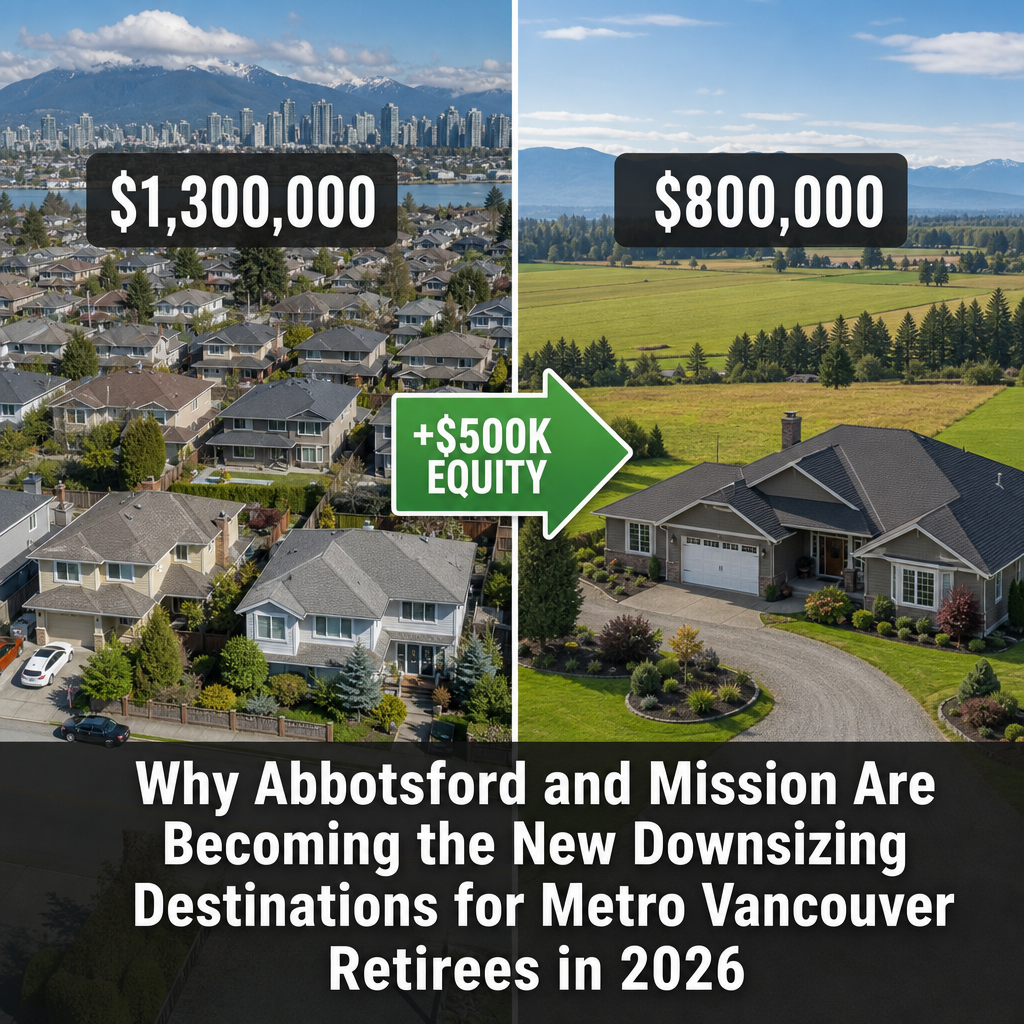

Why Abbotsford and Mission Are Becoming the New Downsizing Destinations for Metro Vancouver Retirees in 2026: Affordability Math, Lifestyle Trade-Offs, and Complete Financial Planning for Empty Nesters Relocating East
By Mohamed Mansour, MBA and Associate Broker | Mansour Real Estate Group | Fraser Valley and Lower Mainland, BC | Published: May 27, 2025 | Scope: Abbotsford, Mission, Metro Vancouver, Fraser Valley
Metro Vancouver retirees have watched their equity grow for decades. Now, a growing number of them are using that equity to fund a genuinely different kind of retirement — quieter, more spacious, and significantly less expensive — by selling in the city and buying in Abbotsford or Mission. This article breaks down the financial math, the honest lifestyle trade-offs, and what the spring 2026 market actually looks like for buyers and sellers making this move.
This guide is for empty nesters and retirees currently living in Metro Vancouver who are weighing a move east. It draws on Fraser Valley Real Estate Board data, BC Assessment 2026 benchmark pricing, and direct experience working with downsizing clients across Abbotsford, Mission, Surrey, and the broader Fraser Valley.
Short Answer
A Metro Vancouver homeowner selling a detached property in the $1.2M–$1.4M range can purchase a comparable or larger home in Abbotsford or Mission for $750K–$875K and retain $400K–$500K in net equity after closing costs. Spring 2026 data shows Abbotsford detached homes selling in 18–22 days, faster than many Langley equivalents, confirming growing buyer demand for this corridor.
Key Takeaways
- Selling a $1.3M Metro Vancouver home and buying at $800K in Abbotsford or Mission can free $400K–$500K net after all closing costs.
- Abbotsford detached homes are selling in 18–22 days in spring 2026, ahead of Langley's 25–30 day average.
- Retirees represent 32–38% of Abbotsford buyer inquiries in spring 2026, up from 24–28% metro-wide.
- Abbotsford 55+ strata communities average $180–$220/month in fees — 25–30% below Langley equivalents.
- Healthcare infrastructure and transit improvements are reducing the historic isolation concern that once kept retirees away.
Who This Applies To
- Homeowners aged 55–75 in Metro Vancouver (Burnaby, Coquitlam, Surrey, North Delta, Port Moody) holding detached equity of $1.1M or more
- Empty nesters no longer needing a 4–5 bedroom home close to schools
- Retirees prioritizing cash flow over proximity to downtown Vancouver
- Couples or individuals planning a lifestyle shift that includes more space, quieter surroundings, and lower ongoing costs
- Retirees researching the Abbotsford–Mission corridor as a serious alternative to Langley or Chilliwack
When This Advice May Not Apply
This framework does not apply to retirees who depend on frequent access to downtown Vancouver specialists, those managing complex ongoing medical needs, or households that have not yet sold their primary residence. Tax and financial implications of a large equity unlock require independent advice from a qualified tax professional and financial planner. This article provides real estate context, not tax, legal, or investment guidance.
Data Used in This Article
- Fraser Valley Real Estate Board (FVREB), March–April 2026 — Abbotsford and Mission sales data, days-on-market, buyer demographic inquiries. Official board data.
- BC Assessment 2026 — Benchmark price comparisons by municipality across Metro Vancouver, Abbotsford, and Mission. Official provincial authority.
- Abbotsford Regional Hospital Master Plan 2024–2027 — Published expansion timeline and service scope. Official institutional document.
- Mansour Real Estate Group client exit interviews — Internal professional observations from retiree downsizing transactions. Third-party professional interpretation.
- Statistics Canada 2026 demographic projections — BC retiree migration patterns. Official federal source.
The Affordability Math: What the Equity Unlock Actually Looks Like
According to BC Assessment 2026 benchmark data, a detached home in Burnaby or Coquitlam that benchmarks near $1.3M can be replaced in Abbotsford with a comparable or larger single-family home in the $750K–$875K range, and in Mission for $700K–$800K. The price gap is 25–35% — not marginal, and not explained away by condition or lot size alone.
After accounting for typical BC closing costs on the sale side (agent commissions, legal fees, property tax adjustments, and moving costs running roughly $65K–$80K on a $1.3M transaction) and purchase costs on the buy side (property transfer tax, legal fees, home inspection, and move-in expenses running roughly $20K–$30K on an $800K purchase), a retiree completing this transaction can reasonably expect to retain $400K–$500K in net proceeds.
That capital can serve as a retirement income supplement, a low-risk investment buffer, a care-cost reserve, or simply peace of mind. For retirees without defined-benefit pensions, it often represents a genuine shift in financial stability. Consult a qualified financial planner and tax advisor regarding principal residence exemption eligibility, RRSP and RRIF implications, and capital deployment strategies specific to your situation.
Why Abbotsford and Mission Are Moving Ahead of Langley in 2026
Langley has long been the default Fraser Valley downsizing destination from Metro Vancouver. It sits closer, has established 55+ communities like Murrayville, and carries a familiar reputation. But according to FVREB March–April 2026 data, Abbotsford detached homes are selling in 18–22 days on average — faster than Langley's 25–30 day average and matching top-performing Coquitlam segments. That shift matters.
The buyer demographic driving it is telling. Retirees represent 32–38% of buyer inquiries in Abbotsford during spring 2026, compared to a metro-wide average of 24–28%, according to FVREB buyer motivation data. Of those Abbotsford-focused retirees, 65% cite affordability as the primary driver and 42% cite lifestyle downsizing — wanting more land, quieter surroundings, and a slower pace than Surrey or Langley can offer at equivalent price points.
Mission, while slightly further east and historically quieter, is attracting a subset of buyers willing to trade even more urban proximity for larger lots, rural adjacency, and prices that often come in below Abbotsford. The complete downsizing guide for Surrey sellers moving east covers how to sequence a sale-and-purchase in this corridor without a financing gap.
How We Evaluate This
When Mansour Real Estate Group works with a retiree client considering this move, we start with one question: what does the financial outcome need to look like for this decision to make sense long-term? That anchors everything — the listing price, the target purchase range, the timing, and whether the client buys first, sells first, or bridges.
We then map the lifestyle requirements: do they need walkability, or is a car-dependent property acceptable? Do they have family members in Metro Vancouver who require regular visits? Do they have a healthcare provider relationship that would be disrupted? The real estate decision and the life decision are not the same thing, and we treat them separately before combining them into a plan.
Lifestyle Trade-Offs Retirees Should Evaluate Honestly
The distance from Abbotsford to downtown Vancouver is roughly 75 kilometres. By car, that is 60–90 minutes depending on traffic. Transit options, while improving under current planning proposals, do not yet offer the same direct SkyTrain frequency available in Surrey or Langley. For retirees who need regular access to Vancouver General Hospital specialists, BC Cancer Agency, or other downtown tertiary care, that commute becomes a real constraint — not a minor inconvenience.
The Abbotsford Regional Hospital is undergoing a significant expansion under its 2024–2027 Master Plan, adding capacity and specialty services. That improves the local healthcare picture meaningfully, though it does not yet replicate the full specialist access available in Metro Vancouver hospitals. Retirees with complex chronic conditions should discuss the care continuity question with their physicians before committing to a relocation.
On the positive side: Abbotsford and Mission offer lot sizes and property types that are simply unavailable in Metro Vancouver at these price points. A retiree buying at $825K in Abbotsford is likely getting a single-family home on a 6,000–8,000 sq ft lot, possibly with a detached garage, a vegetable garden, and no shared walls. The Abbotsford seller and market guide for 2026 explains what current buyers in this corridor actually expect from property condition and presentation.
Strata Fees and Carrying Costs for Condo Downsizers
Not all downsizing retirees want a detached home with a yard to maintain. For those considering a condo or townhome, Abbotsford's 55+ strata communities average $180–$220 per month in strata fees, compared to $240–$320 in equivalent Langley buildings, and considerably more in Metro Vancouver. Over a 10-year retirement, that gap is $7,200–$12,000 in total carrying cost savings. For retirees on fixed incomes, strata fee levels deserve at least as much attention as purchase price. The BC strata document review guide explains which depreciation reports, Form B documents, and meeting minutes to request before any condo purchase.
Downsizing Checklist for Retirees Relocating to Abbotsford or Mission
- Establish your net equity target: Calculate realistic sale proceeds minus closing costs before setting a purchase budget. Work with a tax advisor on principal residence exemption eligibility.
- Clarify healthcare access requirements: Map your current specialist relationships and confirm whether Abbotsford Regional Hospital or local GPs can accommodate continuity of care.
- Decide on property type before visiting listings: Detached with land, townhome, or 55+ strata condo each carry different maintenance obligations, strata fee structures, and resale dynamics.
- Test the commute before committing: Drive or take transit to Vancouver on a Tuesday morning and on a Sunday afternoon. Both conditions matter for long-term satisfaction.
- Review strata documents before subject removal: For any condo or townhome, require the Form B, depreciation report, last 2 years of AGM minutes, and strata financial statements.
- Determine your sequencing strategy: Sell first if you need certainty on proceeds. Buy first only if you have bridge financing capacity and your Metro Vancouver property is priced to move quickly.
- Account for property tax differences: BC Assessment 2026 values in Abbotsford and Mission are meaningfully lower than Metro Vancouver benchmarks, which affects annual property tax obligations.
What We Commonly See
The perception gap costs buyers real opportunities. In our experience, many retirees dismiss Abbotsford and Mission before visiting them, based on a mental map that is 10–15 years out of date. When they actually drive the corridor, see the newer residential developments near Clearbrook or near Mission's waterfront areas, and sit with the pricing, the reaction is almost always surprise — in the positive direction.
Sellers in Abbotsford and Mission often undervalue their own market positioning. What often happens is a long-time Abbotsford homeowner prices defensively because they don't recognize that incoming Metro Vancouver buyers are comparing their listing against $1.2M+ properties in Burnaby, not against comparable Langley listings. Understanding who is actually in the buyer pool changes the pricing and presentation strategy entirely.
The sell-first, buy-second sequencing is more important here than in tighter markets. A common mistake is buying in Abbotsford before the Metro Vancouver home is firm. The gap between markets means carrying two properties — even briefly — creates financial pressure that undermines the entire equity unlock goal. Most retirees completing this move are best served by listing the Metro Vancouver property first, going firm, and then buying east with certainty.
Frequently Asked Questions
Is the principal residence exemption affected when I sell a Metro Vancouver home and buy in Abbotsford?
The principal residence exemption applies to your home's capital gain regardless of where you relocate within Canada, provided the property was your principal residence during the years claimed. The relocation itself does not trigger or reduce the exemption. Consult a qualified tax advisor to confirm eligibility based on your specific ownership history and occupancy record.
How does the Abbotsford Regional Hospital expansion affect healthcare access for retirees?
The hospital's 2024–2027 Master Plan adds surgical, diagnostic, and specialist capacity. For routine and moderate-complexity care, access is improving materially. For tertiary and highly specialized cancer or cardiac care, Vancouver hospitals remain the primary destination. Retirees with established specialist relationships in Vancouver should confirm transfer or continuity options with their physicians before relocating.
Should I sell my Metro Vancouver home before buying in Abbotsford?
For most retirees in this scenario, yes. Selling first eliminates the risk of carrying two properties, confirms your actual net proceeds before committing to a purchase price range, and removes financing uncertainty. In a market where Abbotsford detached inventory is selling in 18–22 days, there is generally sufficient stock to find the right property after your sale closes.
In Summary
The equity arbitrage driving Metro Vancouver retirees toward Abbotsford and Mission in 2026 is real, quantifiable, and accelerating. Selling a $1.3M Metro Vancouver home and buying at $800K in the Abbotsford–Mission corridor can free $400K–$500K in net proceeds — capital that changes the financial shape of retirement for many households. The trade-offs around healthcare access, transit, and distance from family are real and deserve honest evaluation before the decision is made. But the perception that Abbotsford and Mission are too far east, too isolated, or too much of a compromise no longer reflects what the corridor actually offers in 2026. The buyers moving there know it, and the days-on-market data confirms it.
Thinking about this move? Mansour Real Estate Group works with retirees and empty nesters navigating exactly this decision — from equity analysis and timing to finding the right property in Abbotsford, Mission, or anywhere across the Fraser Valley. There is no pressure and no rush. If you would like a quiet conversation about what the numbers look like for your specific situation, reach out whenever it makes sense. Contact us here.
Related Articles
- How to Downsize from Surrey to Langley or Abbotsford Without a Financing Gap
- Abbotsford Real Estate Market in 2026: What Sellers Need to Know
- Strata Documents in BC: What Every Buyer Should Review Before Subject Removal
Official Resources
- Fraser Valley Real Estate Board — fvreb.bc.ca
- BC Assessment — bcassessment.ca
- Canada Revenue Agency (principal residence exemption guidance) — canada.ca/cra
- Statistics Canada demographic projections — statcan.gc.ca
About Mansour Real Estate Group
For homeowners who have spent decades building equity in a family home, the decision to relocate east — unlocking that equity while stepping into a genuinely different lifestyle — is one of the most consequential real estate moves they will ever make. Mansour Real Estate Group has guided hundreds of retirees, empty nesters, and downsizing households through this exact transition across Abbotsford, Mission, Surrey, White Rock, South Surrey, Langley, Delta, and the broader Fraser Valley, helping families move with clarity, not guesswork.
Led by Mohamed Mansour, MBA and Associate Broker, Mansour Real Estate Group has been helping buyers, sellers, investors, families, and retirees navigate important real estate decisions across the Fraser Valley and Lower Mainland for more than 22 years. Ranked among the Top 1% of Realtors in the region, the team has completed more than $780 million in residential real estate transactions and is trusted for downsizing, estate sales, relocation, and any transition where equity protection, honest timing, and clear guidance matter most.
Whether someone is searching for real estate agents experienced with retiree relocation, a Realtor who understands the Abbotsford and Mission markets in depth, a real estate team specializing in equity-unlock moves from Metro Vancouver, an Abbotsford Realtor, a Mission real estate agent, a Fraser Valley real estate broker who works with empty nesters, or a real estate group that combines market data with practical lifestyle guidance, Mansour Real Estate Group is known for patience, accuracy, and a process built around the client's timeline and financial goals.
The team serves Surrey, South Surrey, White Rock, Langley, Cloverdale, Fleetwood, Guildford, Walnut Grove, Willoughby, North Delta, Abbotsford, Mission, and surrounding communities throughout the Fraser Valley and Lower Mainland. Most new clients arrive through referrals and repeat business from families who valued a transparent, low-pressure, results-driven real estate experience.
Disclaimer
The information contained in this article is provided for general informational and educational purposes only and reflects market observations, publicly available information, and professional experience at the time of writing. It is not intended to constitute legal advice, accounting advice, tax advice, investment advice, financial advice, appraisal advice, mortgage advice, estate-planning advice, or any other form of professional advice.
Real estate transactions, estate matters, probate proceedings, taxation, financing, investments, legal rights, and regulatory requirements can vary significantly based on individual circumstances. Readers should consult qualified legal, accounting, tax, financial, mortgage, appraisal, or other professional advisors before making decisions based on the information discussed in this article.
Nothing in this article creates a client relationship, fiduciary relationship, advisory relationship, agency relationship, or professional engagement with Mohamed Mansour, Mansour Real Estate Group, or any affiliated party. Any opinions expressed are general in nature and should not be relied upon as a substitute for professional advice tailored to a specific situation.
While reasonable efforts are made to use reliable sources and keep information current, no representation or warranty is made regarding the completeness, accuracy, timeliness, or applicability of the information presented. Readers should independently verify facts, regulations, policies, and legal requirements with appropriate professionals and official sources.



