
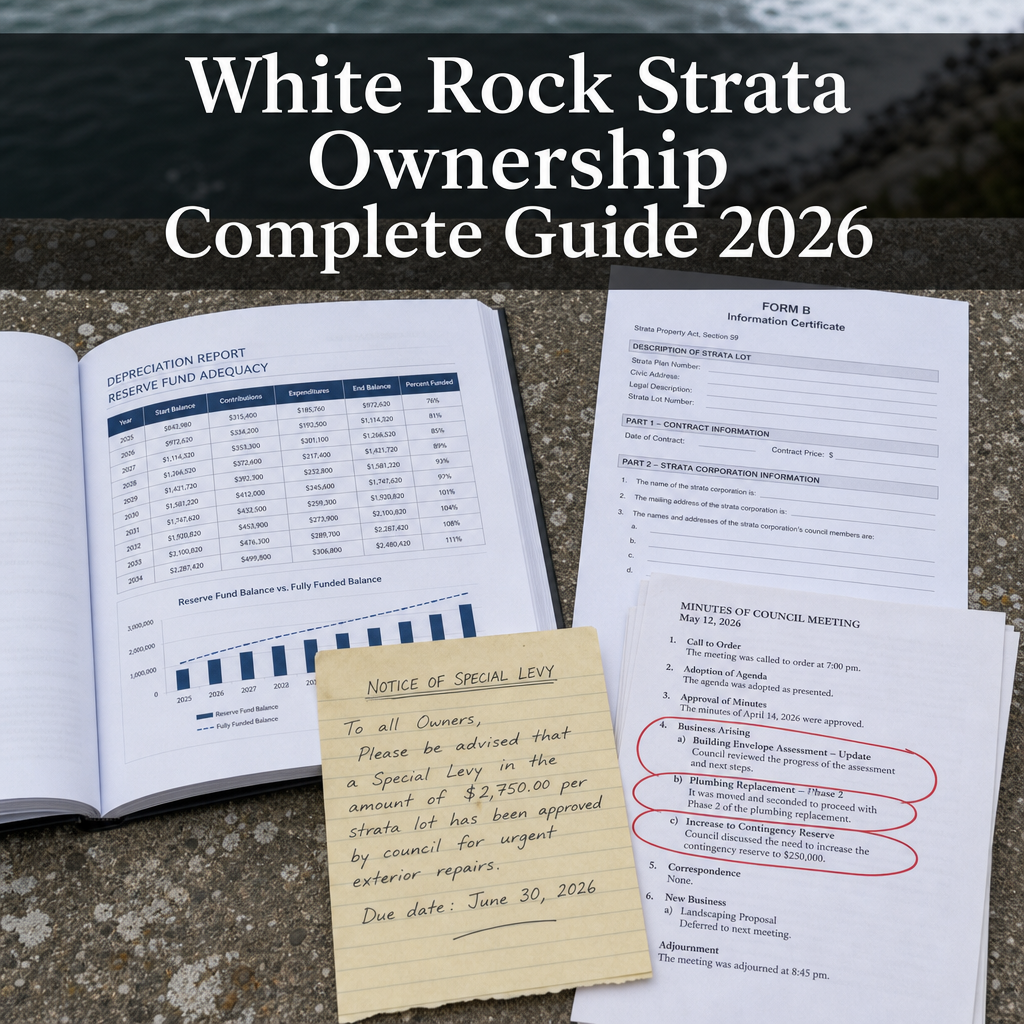

White Rock Strata Ownership Complete Guide 2026: Understanding Council Operations, Reading Meeting Minutes, Interpreting Depreciation Reports, Evaluating Special Levy Risk, Pet and Age Restrictions, and How Strata Fees Actually Impact True Affordability in Waterfront Condo and Townhome Markets
By Mohamed Mansour, MBA and Associate Broker | Mansour Real Estate Group | White Rock, BC | Published: July 15, 2026 | Topic: Condo & Strata Ownership, White Rock BC
White Rock's strata market is unlike any other in the Fraser Valley. Waterfront condos, aging 1980s and 1990s townhome complexes, and buildings with accelerated salt-air wear create a due-diligence environment that rewards buyers who know how to read the documents—and punishes those who don't. This guide covers everything a White Rock strata buyer needs to evaluate before making an offer, from council operations and meeting minutes to depreciation reports, special levy exposure, pet and age restrictions, and the true monthly carrying cost of strata ownership versus detached housing.
Mansour Real Estate Group has guided condo and townhome buyers through White Rock's strata market for more than 22 years. The patterns we see repeatedly—and the mistakes that cost buyers the most—are documented here in plain language.
Short Answer
White Rock strata buyers face unique risks from aging waterfront buildings, underfunded reserves, and complex governance documents. The critical steps are: request 24 months of meeting minutes, read the depreciation report's reserve fund adequacy percentage, check Form B for outstanding levies, verify pet and age restrictions before offer, and calculate true monthly carrying costs including strata fee, property tax, insurance, and special levy exposure. Missing any one of these steps has cost White Rock buyers tens of thousands of dollars.
Who This Applies To
- Buyers evaluating waterfront condos or townhomes in White Rock
- Retirees and downsizers considering strata living in White Rock
- First-time buyers purchasing a strata unit as an entry point
- Investors evaluating rental potential in White Rock strata buildings
- Current strata owners preparing to sell and wondering what buyers will scrutinize
When This Advice May Not Apply
Newly constructed presale strata developments operate under different rules—reserve fund obligations begin at a lower baseline and depreciation reports are not yet available. Buyers of presale condos in White Rock should focus on disclosure statements and developer track records rather than the documents discussed here. Bare land stratas also have different reserve fund and levy structures.
Key Takeaways
- Fewer than 15% of White Rock strata buyers request 24 months of council minutes before making an offer—those minutes are often the clearest signal of financial and governance risk.
- A reserve fund adequacy below 70% can trigger lender appraisal shortfalls and financing denial under CMHC guidelines, directly compressing your buyer pool if you later resell.
- White Rock waterfront buildings average 30 to 45 years old; salt-air corrosion accelerates exterior and mechanical system wear beyond what inland depreciation schedules assume.
- Pet and age restrictions in White Rock strata vary building by building—some prohibit all pets, others have weight limits, and some enforce 55+ age gates that affect resale to younger buyers.
- True monthly carrying costs for a White Rock waterfront condo routinely exceed $2,500 when strata fees, property tax, insurance, and annualized special levy exposure are combined.
Key Terms Defined
Form B (Information Certificate): A document the strata must provide to buyers showing current strata fees, outstanding levies, bylaw restrictions, and the state of the contingency reserve fund.
Depreciation Report: A professionally prepared study (required under the BC Strata Property Act) projecting major repair and replacement costs over 30 years and assessing reserve fund adequacy.
Special Levy: A one-time charge imposed on strata owners to cover costs that exceed reserve fund balances—can range from a few thousand to tens of thousands of dollars per unit.
Contingency Reserve Fund (CRF): The strata corporation's savings account for future major repairs. Adequacy is measured as a percentage of the fully funded target from the depreciation report.
Data Used in This Article
- BC Strata Property Act (RSBC 1996, c.433) — official legislation, current to 2026
- CMHC mortgage qualification guidelines for strata properties — federal regulator, 2024–2026
- Fraser Valley Real Estate Board (FVREB) and Greater Vancouver Realtors transaction data — 2024–2026, Fraser Valley region
- Professional strata management industry reports on aging building system costs and reserve fund adequacy — third-party analysis, BC-specific
- Mansour Real Estate Group transaction experience — internal professional observation, White Rock and South Surrey, 2002–2026
How We Evaluate This
When we review a strata property with a client, we read the documents in a specific order: Form B first for immediate financial flags, then 24 months of meeting minutes for governance quality, then the depreciation report for reserve fund health and major project timelines. We cross-reference what the minutes say was decided against what the depreciation report says should have been done—gaps between those two are where risk lives.
For White Rock waterfront buildings specifically, we also request any engineer's reports, moisture surveys, or building envelope assessments that have been commissioned in the past five years. These are not always disclosed voluntarily, but they are available through the strata upon request. A building that has deferred a recommended engineer assessment for two or more years is a building with unquantified risk—and that affects how we advise on price and subject conditions.
Understanding Strata Council Operations in White Rock
Under the BC Strata Property Act, every strata corporation must be governed by a council of elected owners. The council manages the corporation's day-to-day operations, approves expenditures within limits set by the annual budget, hires contractors, and convenes an annual general meeting (AGM) where major decisions—including special levies and depreciation report updates—require owner approval by a three-quarters vote.
White Rock's strata landscape includes buildings both self-managed and professionally managed. Self-managed stratas, which are more common in smaller White Rock townhome complexes, operate with volunteer councils who may lack the time, expertise, or legal knowledge to manage aging building systems properly. This is not a criticism of the volunteers—it reflects a structural limitation. When a self-managed council defers an engineer's recommendation because the meeting quorum was low or the project felt too expensive to raise at the AGM, the deferred cost simply accumulates in the reserve fund shortfall.
What to look for in council operations: Is the strata professionally managed? Are AGMs well-attended? Are resolutions passed with clear majorities, or are they frequently tabled? Does the council appear to act on engineer and depreciation report recommendations in a timely way? Meeting minutes answer all of these questions—if you read them carefully. You can also review the White Rock condo market overview for building-specific context on older versus newer stock.
How to Read Meeting Minutes and What Red Flags Look Like
Meeting minutes are a strata corporation's operational diary. They record what was discussed, what was decided, what was deferred, who attended, and what the financial picture looked like at each meeting. Requesting 24 months of minutes—not just the most recent AGM package—is the minimum standard for a building over 20 years old. For White Rock waterfront buildings over 30 years old, we recommend requesting 36 months.
Red flags in minutes include: repeated deferrals of the same engineering recommendation across multiple meetings; motions to waive or reduce depreciation report contributions; references to unresolved covenant violations with the municipality; discussions of moisture or building envelope issues without a follow-up resolution; and special levy proposals that were voted down without an alternative funding plan. A single red flag may be explainable. Multiple red flags in the same set of minutes should affect your offer price and subject conditions.
Positive signals include: timely action on engineer recommendations, regular depreciation report updates (every three years is the standard), transparent financial reporting at each meeting, and evidence that reserve fund contributions are being increased annually in line with the depreciation report's funding schedule. If the council is consistently raising monthly contributions ahead of projected costs, that building is being managed responsibly. Before removing subjects on a White Rock strata purchase, minutes and depreciation reports should both be reviewed.
Interpreting Depreciation Reports: What the Numbers Actually Mean
A depreciation report prepared by a qualified reserve fund planner projects the cost and timing of every major building system replacement over 30 years—roofing, windows, elevators, common area plumbing, parking structures, balconies, and in White Rock waterfront buildings, exterior cladding and marine-exposure components that deteriorate faster than interior buildings. The report then models three funding scenarios: a zero-contribution baseline (not recommended), a threshold contribution plan, and a fully funded plan.
The number that matters most is the reserve fund adequacy percentage—how much money is currently in the fund relative to what the fully funded plan says should be there. A building at 90%+ adequacy is well managed. A building at 70% is at the threshold where CMHC and most major lenders begin to flag financing risk. A building below 50% adequacy is almost certainly facing a special levy in the near future, and some lenders will decline financing entirely regardless of the borrower's creditworthiness. When you're calculating closing costs in White Rock, reserve fund health should factor into your total risk budget.
White Rock waterfront buildings face an additional depreciation challenge: salt-air corrosion shortens the practical lifespan of balcony railings, exterior mechanical equipment, and cladding systems by 20 to 30% compared to inland buildings of the same age. A depreciation report that uses standard interior-building lifecycle assumptions for a beachfront building in White Rock will understate replacement costs—and understated costs mean the reserve fund target is too low, which means the adequacy percentage looks better than it actually is.
Ask whether the depreciation report was prepared by a professional with coastal building experience, and whether the lifecycle assumptions in the report have been adjusted for marine exposure. If the report was prepared by a general reserve fund planner using standard tables without adjustment, treat the adequacy figure with caution. This context also applies to the broader waterfront property evaluation process.
Special Levy Risk: How to Assess It Before You Buy
A special levy is not a failure of the strata system—it is the system's mechanism for catching up when reserve fund contributions have fallen short of actual repair costs. But for a buyer who purchases a unit without understanding levy risk, a special levy notice arriving within 12 to 18 months of possession can represent a financial shock of $10,000 to $60,000 or more per unit depending on the project scope.
Form B will disclose whether any special levy has already been approved by the strata corporation. It will not disclose a levy that has been discussed in council but not yet put to a vote. This is why 24 months of meeting minutes matter: a levy that appears in minutes as a "proposed project under budget review" or an "engineer's recommendation pending cost estimate" is a likely levy—it just has not been formally approved yet. Buying without reading those minutes means buying without knowing about it.
Investors considering White Rock strata properties for rental purposes should factor special levy risk into their return calculations—a $30,000 levy on a unit generating $2,200/month in rent erases more than a year of net income. See our White Rock rental market and landlord guide for more on how carrying costs affect investment returns.
Pet and Age Restrictions: What White Rock Strata Bylaws Actually Say
Pet and age restrictions are established in the strata's bylaws, and they vary significantly across White Rock buildings. Some buildings prohibit all pets—not just dogs, but cats and birds as well. Others permit pets with weight limits (commonly 20 lbs or 30 lbs) or limit ownership to one pet per unit. Some buildings are explicitly 55+ communities, meaning at least one resident in each unit must be 55 or older—this is permitted under the BC Human Rights Code as an exception to age-based discrimination rules when the building is registered as housing for older persons.
Age-restricted buildings in White Rock carry specific resale implications. The buyer pool is limited to households with at least one member aged 55 or older, which compresses demand. During periods of lower overall market activity, this can extend days on market and limit price growth relative to open-market buildings. For retirees buying for their own use, a 55+ building may offer community benefits that outweigh the resale limitation. For investors or younger buyers, it is a material constraint to assess before offer. This ties directly into what the White Rock retiree real estate guide covers about community fit and building selection.
Rental restrictions are a separate bylaw category. Some White Rock strata corporations limit the number of units that can be rented at any one time, or prohibit short-term rentals entirely. Form B will note whether rental restrictions apply. Before finalizing your mortgage pre-approval for a White Rock strata purchase, confirm that your intended use—owner-occupied, long-term rental, or short-term rental—is permitted by the building's bylaws.
How Strata Fees Actually Impact True Affordability
Strata fees in White Rock range from approximately $300 to $600 per month for townhomes and $500 to $1,200 or more per month for waterfront condos. These figures are drawn from FVREB and Greater Vancouver Realtors transaction data from 2024 to 2026 and reflect the range across building ages, sizes, and management styles. Older buildings with professional management and active reserve fund programs tend to be at the higher end. Newer buildings with lower current reserve requirements may start lower but increase over time as the building ages.
The mistake most buyers make is treating the strata fee as the only additional carrying cost beyond the mortgage. True monthly carrying cost for a White Rock waterfront condo purchase at the $800,000 to $1,100,000 price range typically includes: mortgage payment ($3,500–$5,000), strata fee ($600–$1,000), property tax prorated monthly ($250–$450), building insurance contribution (included in strata fee but worth verifying coverage), personal contents insurance ($40–$80), and annualized special levy exposure ($150–$400/month depending on reserve fund health). That total frequently exceeds $5,000 per month before utilities.
Compared to a detached home in White Rock or South Surrey at a similar price point, the strata carrying cost is often higher in the short term but may include services—landscaping, building insurance, common area maintenance—that add real value. The comparison requires an honest accounting of both sides. First-time buyers using government programs to enter the White Rock strata market should model their full carrying costs against their qualification limit—the first-time buyer program guide for White Rock covers how strata fees affect stress-test qualification.
Strata Buyer Checklist for White Rock
- Request Form B from the strata—review strata fees, outstanding levies, and reserve fund balance before making an offer.
- Request 24 to 36 months of council meeting minutes and read them for deferred projects, levy discussions, and engineering recommendations.
- Obtain the most recent depreciation report and check reserve fund adequacy—flag anything below 70%.
- Ask whether any engineer's reports, moisture surveys, or building envelope assessments have been completed in the past five years and request copies.
- Verify pet restrictions, age restrictions, and rental restrictions in the strata bylaws before finalizing subject conditions.
- Calculate true monthly carrying cost: mortgage + strata fee + property tax + insurance + annualized levy exposure.
- Confirm the building is professionally managed or assess governance quality from minutes if self-managed.
- For waterfront buildings, ask whether the depreciation report uses coastal/marine lifecycle assumptions or standard inland tables.
What We Commonly See
Buyers skip the minutes and discover the levy after possession. In our experience, this is the most consistent and preventable strata purchase mistake in White Rock. A buyer reviews Form B, sees no approved levy, and removes subjects. Six months later a $25,000 per-unit levy is approved for balcony repairs that were discussed in four of the six previous council meetings. The minutes were available. No one asked for them.
True carrying costs are underestimated at the offer stage. What often happens is a buyer qualifies for the mortgage, budgets for the strata fee, and underestimates or ignores annualized special levy exposure and property tax. When those costs arrive simultaneously—a tax notice, a levy, and a strata fee increase in the same quarter—the financial pressure is real. We always build a carrying-cost model with clients before they remove subjects on a White Rock strata purchase.
Depreciation reports are misread as financial statements rather than projections. A common mistake is reading the reserve fund balance as "what the building has saved" without checking it against the adequacy target in the depreciation report. A building with $400,000 in its reserve fund sounds healthy—until the depreciation report shows the fully funded target is $900,000 and the building has $220,000 in work due within three years.
Questions and Answers
Q: What does a White Rock strata buyer legally have the right to request before making an offer?
Under the BC Strata Property Act, sellers must provide Form B upon request. Meeting minutes, financial statements, depreciation reports, and bylaws are all documents the strata corporation must make available. In practice, these are typically obtained after an accepted offer during the subject period—your realtor should request them immediately upon acceptance.
Q: If a special levy is approved after my offer but before completion, who pays it?
This depends on how your contract is written. By default, BC real estate contracts may not address mid-transaction levies clearly. A properly drafted subject clause will specify that any special levy approved or disclosed after the offer date is the seller's responsibility. Your realtor and conveyancing lawyer should address this in the contract language before subjects are removed.
Q: Can a 55+ age-restricted building in White Rock legally refuse to sell to a younger buyer?
Yes. BC's Human Rights Code permits age-restricted housing communities where the building qualifies as housing for older persons and has been consistently operated as such. In these buildings, at least one occupant per unit must be 55 or older. A strata with this restriction can legally decline to approve a purchase by a buyer who does not meet the age requirement. The restriction will appear in the strata's bylaws and should be noted in the listing.
In Summary
White Rock strata ownership carries financial, legal, and governance complexity that detached home purchases do not. The documents—Form B, meeting minutes, and the depreciation report—exist precisely to give buyers the information they need. The buyers who read them carefully, calculate true carrying costs honestly, and understand what the reserve fund adequacy number actually means are the ones who make confident, well-priced offers. The buyers who skip that work are the ones who call with expensive surprises after possession. This guide covers the framework; your specific building's documents will tell the actual story.
If you are evaluating a White Rock condo or townhome and want a second set of experienced eyes on the documents, contact Mansour Real Estate Group. We review strata documents as part of our standard buyer process—at no additional cost to you.
Related Articles
- White Rock Condo Market in 2025: Prices, Inventory and the Best Buildings to Consider
- First-Time Home Buyer Programs Available to White Rock Purchasers in 2025
- Buying a Luxury Oceanfront Condo in White Rock: What the Due Diligence Process Looks Like
About Mansour Real Estate Group
Buying a strata unit in White Rock's waterfront condo and townhome market means navigating depreciation reports, council minutes, special levy risk, and building-specific bylaws that can materially affect both affordability and resale. Understanding those layers requires a real estate team with direct, repeated experience in strata transactions across the Fraser Valley and Lower Mainland. Mansour Real Estate Group has guided condo and townhome buyers through the White Rock strata market for more than 22 years, from first-time buyers evaluating Form B documents to retirees and investors assessing reserve fund health in aging coastal buildings.
Mansour Real Estate Group, led by Mohamed Mansour, MBA and Associate
Key Takeaways
- Understanding the BC real estate market helps you make informed decisions about buying, selling, or investing.
- Working with a qualified real estate professional can provide valuable guidance tailored to your specific situation.
- Market trends, interest rates, and local conditions all play important roles in real estate decisions.
- Taking time to research and plan before entering the market positions you for better outcomes.
Next Steps
If you're considering a real estate transaction in British Columbia, reach out to a licensed REALTOR® who can provide expert guidance based on current market conditions and your unique needs. Whether you're a first-time buyer, seasoned investor, or seller, professional advice can make all the difference in achieving your real estate goals.
Disclaimer: This article is for informational purposes only and does not constitute legal, financial, or real estate advice. Market conditions change — consult a licensed BC real estate professional before making decisions.



