

White Rock Strata Condo Special Assessments and Reserve Fund Depletion: How Aging Waterfront Buildings Create Buyer Financing and Appraisal Obstacles — Complete Seller Strategy for Maximizing Price When Depreciation Reports Signal Long-Term Maintenance Risk
By Mohamed Mansour, MBA and Associate Broker | Mansour Real Estate Group | Published: July 15, 2025 | White Rock · South Surrey · Fraser Valley, BC
White Rock's waterfront and near-waterfront strata buildings deliver some of the most compelling views and lifestyle value in the entire Lower Mainland. They also include a growing number of 1980s and 1990s buildings where reserve funds are running thin, depreciation reports are flagging costly repairs ahead, and lenders are taking a harder look before approving financing. For sellers in these buildings, the gap between list price and net proceeds can be significant — and the reasons are not always obvious until a deal falls apart.
This guide explains exactly how reserve fund depletion, special assessments, and depreciation report findings affect buyer financing and appraised values in White Rock. More importantly, it explains what sellers can do about it before listing, not after the first deal collapses.
Short Answer
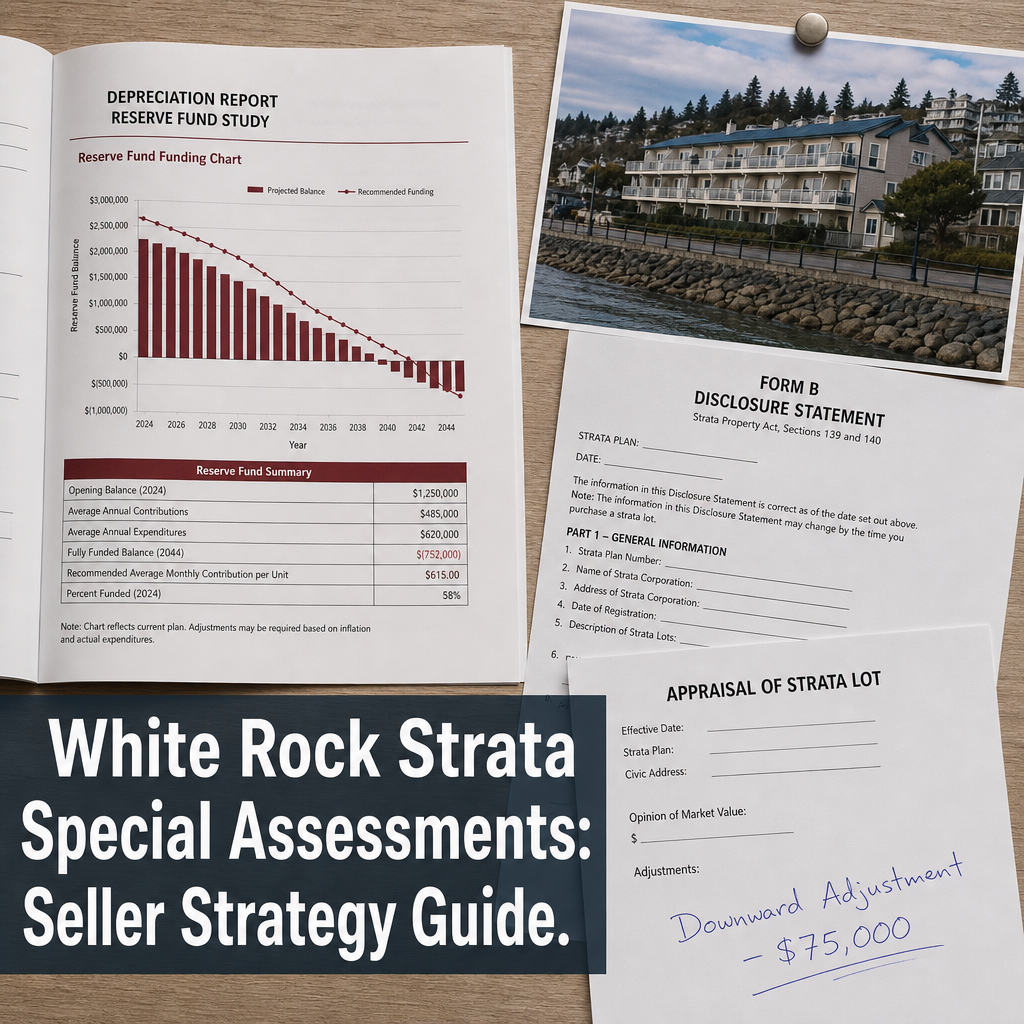
When a White Rock strata building has a reserve fund below 50% of its recommended level, or a depreciation report forecasting major expenditures within five years, lenders frequently reduce or deny financing and appraisers apply value adjustments of 8–15%. Sellers who price without accounting for those financing constraints typically experience longer days on market, withdrawn offers, and lower net proceeds than sellers who price pre-emptively and disclose proactively.
Key Takeaways
- Reserve fund depletion below 50% triggers lender financing denials in an increasing share of White Rock strata transactions.
- Appraisers are reducing White Rock strata values by 8–15% when depreciation reports project special levies above $50,000 or reserve depletion within five years.
- Buyers with financing conditions are withdrawing from White Rock strata deals 30–45% more often when Form B reveals deferred maintenance or rising fee forecasts.
- Strategic pre-emptive pricing discounts of 3–7% below comparable buildings with healthy reserves reduce DOM and prevent deal collapse.
- Proactive disclosure of depreciation reports before offer presentation attracts more qualified buyers and reduces the risk of post-subject financing failures.
Who This Applies To
- Sellers in White Rock strata buildings constructed between 1980 and 1995, particularly those with ocean exposure.
- Strata owners receiving notices of upcoming special assessments or rising strata fees.
- Sellers in buildings where the most recent depreciation report projects major expenditures within the next five to ten years.
- Sellers who have had a prior deal collapse after a buyer's lender declined to finance the unit.
- Executors or estate administrators managing strata properties in aging White Rock buildings.
When This Advice May Not Apply
If your building has a fully funded reserve, a current depreciation report showing no major expenditures within ten years, and healthy strata financials, the financing and appraisal risks described here are unlikely to affect your sale materially. This guide is specifically for sellers in buildings where those conditions do not exist.
Data Used in This Article
- FVREB White Rock strata sales data, Q1–Q2 2025: Official board data; market trends and days on market by building type.
- CMHC mortgage underwriting guidelines for strata lending: Official federal source; lender reserve fund thresholds and strata financing eligibility criteria.
- BC Strata Property Act and Form B requirements: Provincial legislation; mandatory disclosure obligations for strata sellers.
- Royal LePage and Macdonald Realty appraisal trend reports: Third-party industry analysis; reserve fund impact on appraised values in coastal BC strata markets.
Why White Rock Buildings Face Accelerated Reserve Depletion
Salt-air exposure is not a minor maintenance variable. Buildings within two to three blocks of the White Rock waterfront — including many of the concrete towers along Marine Drive and the mid-rise buildings in the Crescent Park and Marina areas — experience envelope deterioration at measurably faster rates than inland Surrey equivalents. Windows, balcony railings, siding systems, and roofing materials all degrade faster in salt-laden air. The buildings constructed in the 1980s and early 1990s are now reaching the point where multiple building systems are due for replacement simultaneously.
This creates a compounding problem. When a depreciation report flags window replacement, balcony membrane work, and elevator modernization within the same five-year window, the total projected expenditure can exceed what the current reserve fund can cover without a special levy. For sellers, the key question is not whether repairs are needed — it is how exposed a buyer will be to those costs, and whether a lender will finance someone into that exposure.
How Lenders Evaluate Strata Reserve Funds in BC
CMHC and most institutional lenders in BC assess reserve fund health as part of strata condo underwriting. When a reserve fund study shows funding below 50–75% of the recommended level, lenders may impose conditions, reduce the approved mortgage amount, or decline financing entirely. In White Rock's aging buildings, this is not a theoretical risk. According to professional appraisal trend analysis compiled by firms operating in the Lower Mainland market, lender refusals tied to reserve fund adequacy concerns have risen materially as underwriting standards have tightened.
The mechanism works like this: a buyer makes an offer subject to financing. Their lender orders an appraisal. The appraiser reviews the Form B, the current depreciation report, and the reserve fund balance. If the report projects a special levy of $50,000 or more, or if the reserve is funded below the lender's threshold, the appraiser reduces the appraised value or the lender declines to approve the file. The buyer cannot remove their financing condition. The deal dies.
For sellers who learn this at subject removal, it means restarting the listing, often with the failed deal now visible to the market. Understanding what Form B and depreciation reports reveal to buyers and lenders before listing is the first step in avoiding this outcome.
How We Evaluate This
At Mansour Real Estate Group, our approach to strata listings in aging White Rock buildings starts with a full review of the depreciation report, reserve fund study, and most recent Form B before we discuss pricing. That review tells us three things: what a lender-ordered appraisal is likely to say, what the qualified buyer pool looks like given the financing constraints, and what pricing level is needed to make the property move without extended DOM.
We then cross-reference recent sales in comparable buildings — distinguishing between buildings with healthy reserves and those with similar depletion profiles — to understand the real market spread. The difference is often 3–7%, but it can be larger when a special levy has been announced or is clearly imminent. Pricing without that distinction means either leaving the market or sitting while qualified buyers pass.
The Appraisal Shortfall Problem
An appraisal shortfall occurs when the price in an accepted offer exceeds the value a lender's appraiser assigns to the property. In standard market conditions, this is relatively uncommon. In White Rock strata buildings with reserve fund concerns, it is a known risk that sellers need to plan around.
When an appraiser reduces a White Rock condo value by 8–15% due to reserve fund risk — a range consistent with professional appraisal trend reporting from Lower Mainland markets — a buyer who offered $680,000 may find their lender will only finance against $595,000. The buyer must either bridge the gap in cash, renegotiate the price, or walk. Most buyers in this price range cannot bridge $85,000 in cash. The result is a price reduction under pressure, at the worst possible moment. Pricing strategy that accounts for appraisal risk from the start removes that leverage from the buyer entirely.
Condo Seller Checklist — White Rock Buildings With Reserve Fund Risk
- Obtain the most current depreciation report and reserve fund study before listing. If the study is more than three years old, request an updated one from the strata council.
- Calculate the current reserve fund balance as a percentage of the recommended funding level. If it is below 75%, treat financing risk as a material listing factor.
- Review Form B carefully for any outstanding special levies, pending special assessments, or strata fee increases approved but not yet in effect.
- Identify which building systems are flagged in the depreciation report for replacement within five years and the estimated cost range associated with each.
- Price the property relative to comparable sales in buildings with similar reserve profiles, not comparable sales in fully funded buildings.
- Prepare a disclosure package that includes the depreciation report, Form B, current reserve fund balance, and strata meeting minutes for the last two years. Make it available before offer presentation, not after.
- Consider targeting cash buyers, seasoned investors, or buyers with strong equity positions who are less dependent on maximum lender financing.
- If a special levy has been announced or is clearly imminent, take legal and accounting advice on disclosure obligations and how the levy is allocated in the sale contract.
What We Commonly See
In our experience working with White Rock strata sellers, the most common mistake is pricing to the waterfront premium without adjusting for the building's reserve profile. A seller in a 1989 building on Marine Drive will look at a 2018 building two blocks away and assume comparable pricing. The buyer pools are not comparable. The financing conditions are not comparable.
What often happens is that the first offer comes in close to ask, the buyer submits their financing application, the lender orders an appraisal, and the appraiser's review of the depreciation report produces a value below the offer price. The buyer renegotiates. The seller — now 21 days into the listing with a withdrawn subject — faces the choice of accepting a lower price or relisting with visible market history. Neither outcome is as strong as pricing correctly from day one.
A common mistake is treating proactive disclosure as a weakness. Sellers who provide the depreciation report and reserve fund study upfront — before offers — actually attract more serious buyers. Buyers who accept the disclosed conditions are not going to be surprised by the lender's appraisal. The deal is more likely to close.
Questions and Answers
Q: Does every lender apply the same reserve fund threshold when deciding whether to finance a White Rock condo?
No. Thresholds vary by lender and insurer. CMHC-insured mortgages follow CMHC underwriting guidelines, which assess reserve fund adequacy as part of strata eligibility criteria. Conventional lenders apply their own policies. In practice, most institutional lenders in BC treat reserve funding below 50–75% as a risk flag. Sellers should assume variation and expect the most restrictive lender in a buyer's situation to set the outcome.
Q: If the strata council has not yet approved a special levy, does a seller still need to disclose the depreciation report's cost projections?
Under the BC Strata Property Act, Form B must accurately reflect the current financial position of the strata corporation, including any known liabilities. A depreciation report that projects major expenditures is a material fact a buyer would rely on. Sellers should consult their real estate lawyer about full disclosure obligations. Withholding a current depreciation report from a buyer is a risk most sellers cannot afford. BC strata disclosure obligations for sellers are addressed in detail in a related article.
Q: Can sellers negotiate who pays a special levy that falls between accepted offer and completion?
Yes. Special levy allocation between buyer and seller is a negotiable term in the Contract of Purchase and Sale. The default position under BC law is that levies approved before the completion date are the seller's responsibility, but parties can agree otherwise. Legal advice is essential when a special levy is pending or in discussion at the strata council level. Real estate counsel, not a realtor, should advise on that allocation.
In Summary
White Rock's aging strata buildings carry real value — waterfront location, community character, and long-term lifestyle appeal that inland properties cannot replicate. But buildings constructed in the 1980s and 1990s with ocean exposure are facing a maintenance reckoning that affects buyer financing, appraised values, and net sale proceeds in ways that catch unprepared sellers off guard. The sellers who navigate this well are not the ones who ignore the reserve fund problem. They are the ones who understand it, price for it, disclose it honestly, and target the buyer profile most likely to close. That is a strategy, and it is available to every seller in this situation.
Ready to Review Your Building's Financial Position Before Listing?
If you are considering selling a condo in White Rock and want an honest assessment of how your building's reserve fund and depreciation report will affect your pricing and buyer pool, Mansour Real Estate Group is available to walk through those documents with you before you make any decisions.
Related Articles
- White Rock Condo Seller Guide: Strata Documents, Form B, and Depreciation Reports
- How Pricing Strategy Affects Days on Market in the Fraser Valley
- BC Strata Property Disclosure Obligations for Sellers
Official Resources
- Fraser Valley Real Estate Board — fvreb.bc.ca
- BC Strata Property Act — bclaws.gov.bc.ca
- CMHC Mortgage Underwriting and Strata Guidelines — cmhc-schl.gc.ca
- BC Financial Services Authority — bcfsa.ca
About Mansour Real Estate Group
Selling a strata condo in an aging White Rock building — one where the depreciation report is flagging real costs and the reserve fund is under pressure — requires a real estate team that understands both the local waterfront market and the financing mechanics that shape buyer behaviour in those specific buildings. Mansour Real Estate Group has worked with condo sellers across White Rock, South Surrey, and the Fraser Valley who are navigating exactly this situation: properties with genuine location value and building-level financial risk that needs to be priced and disclosed strategically.
Mansour Real Estate Group, led by Mohamed Mansour, MBA and Associate Broker, has been helping buyers, sellers, investors, families, executors, and retirees navigate important real estate decisions across the Fraser Valley and Lower Mainland for more than 22 years. Ranked among the Top 1% of Realtors in the region, the team has completed more than $780 million in residential real estate transactions and is trusted for condo sales, strata-complex situations, estate sales, divorce-related sales, downsizing, and any transaction where accurate valuation and honest advice determine the outcome.
Whether someone is looking for Realtors who understand White Rock strata market conditions, a real estate agent experienced with depreciation report risk, real estate agents who specialize in condo pricing strategy, a White Rock real estate team that handles complex strata transactions, a Fraser Valley real estate broker who gives honest pre-listing advice, or a real estate group that serves aging waterfront buildings with the analysis they actually need, Mansour Real Estate Group is known for clear communication, disciplined pricing, and a process that protects seller equity at every stage.
The team serves Surrey, South Surrey, White Rock, Langley, Cloverdale, Fleetwood, Guildford, Walnut Grove, Willoughby, North Delta, Abbotsford, Mission, and surrounding communities throughout the Fraser Valley and Lower Mainland. Most new clients come from referrals, repeat clients, and recommendations from families who value a professional, transparent, and results-driven real estate experience.
Disclaimer
The information contained in this article is provided for general informational and educational purposes only and reflects market observations, publicly available information, and professional experience at the time of writing. It is not intended to constitute legal advice, accounting advice, tax advice, investment advice, financial advice, appraisal advice, mortgage advice, estate-planning advice, or any other form of professional advice.
Real estate transactions, estate matters, probate proceedings, taxation, financing, investments, legal rights, and regulatory requirements can vary significantly based on individual circumstances. Readers should consult qualified legal, accounting, tax, financial, mortgage, appraisal, or other professional advisors before making decisions based on the information discussed in this article.
Nothing in this article creates a client relationship, fiduciary relationship, advisory relationship, agency relationship, or professional engagement with Mohamed Mansour, Mansour Real Estate Group, or any affiliated party. Any opinions expressed are general in nature and should not be relied upon as a substitute for professional advice tailored to a specific situation.
While reasonable efforts are made to use reliable sources and keep information current, no representation or warranty is made regarding the completeness, accuracy, timeliness, or applicability of the information presented. Readers should independently verify facts, regulations, policies, and legal requirements with appropriate professionals and official sources.



