
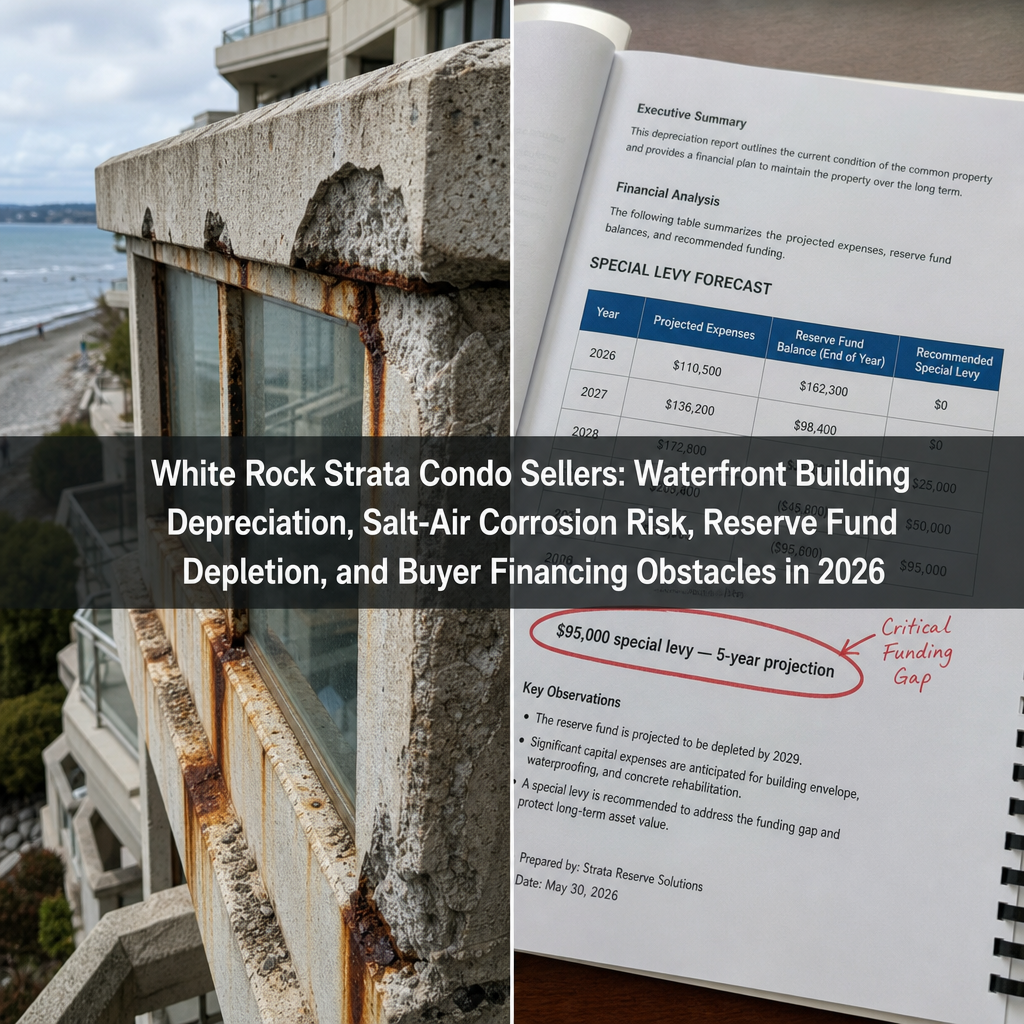

White Rock Strata Condo Sellers: Waterfront Building Depreciation, Salt-Air Corrosion Risk, Reserve Fund Depletion, and Buyer Financing Obstacles in 2026
By Mohamed Mansour, MBA and Associate Broker | Mansour Real Estate Group | Published: July 14, 2026 | White Rock · South Surrey · Fraser Valley · BC
White Rock's strata condo market is facing a financing problem that didn't exist at the same scale five years ago. Sellers in waterfront and semi-waterfront buildings are discovering that accurate pricing and a motivated buyer are no longer enough to close a deal. Reserve fund shortfalls, accelerating depreciation forecasts, and lender restrictions on strata buildings with financial health concerns are blocking transactions at the financing stage—long after subjects are removed and conditions seem manageable.
This guide is written for owners considering a sale in 2026 in White Rock strata buildings, particularly those near the waterfront, built before 2005, or currently holding depreciation reports that flag special levy projections. The decisions made before listing—not after—determine whether a deal closes at all.
Short Answer
White Rock strata condo sellers in waterfront and aging buildings are facing a specific crisis in 2026: depreciation reports forecasting $50,000–$150,000+ in special levies are triggering CMHC mortgage insurance denial and private lender rejections. Appraisals are coming in 5–12% below list price when reserve fund depletion is disclosed. The problem is not demand—it is financing access. Sellers need a strategy built around lender requirements, not just buyer interest.
Key Takeaways
- Salt-air corrosion drives 30–40% higher annual maintenance costs in White Rock waterfront strata buildings compared to inland BC condos.
- Special levy forecasts of $50,000–$150,000+ in current depreciation reports are triggering CMHC mortgage insurance denial on affected buildings.
- Bank appraisals on White Rock strata properties with reserve fund red flags are coming in 5–12% below list price, compressing seller net proceeds.
- Buyer financing denial rates for White Rock strata condos have risen 15–25% year-over-year as lenders tighten strata financial health thresholds.
- Sellers offering 3–8% price concessions, rate buy-downs, or home warranties are achieving faster subject removal when reserve fund deficits create buyer hesitation.
Who This Applies To
- Owners selling units in White Rock waterfront or semi-waterfront strata buildings, particularly those built before 2005
- Sellers whose strata corporation's current depreciation report flags special levy projections or reserve fund ratios below 50–75%
- Estates, executors, or families selling a White Rock strata condo and encountering Form B disclosures with financial risk flags
- Owners who have already listed and are seeing offers fall apart at the financing stage
When This Advice May Not Apply
Buildings with fully funded reserve funds, recently completed envelope or mechanical upgrades, and no special levy forecasts in their current depreciation report face far fewer financing obstacles. Newer White Rock strata buildings—generally those built after 2010 with modern concrete and window systems—may not encounter the same appraisal compression. Cash buyers are also unaffected by lender strata health thresholds, though they will still negotiate based on depreciation report disclosures.
Data Used in This Article
- BC Strata Property Act — Form B Information Certificate requirements; official legislation
- CMHC mortgage insurance eligibility criteria — strata reserve fund and special levy thresholds; official regulatory guidance
- Fraser Valley Real Estate Board (FVREB) — White Rock strata sales activity, days-on-market, and price variance data, 2025–2026; official board statistics
- Professional experience and strata transaction analysis — Mansour Real Estate Group internal observation across White Rock strata sales; professional interpretation
Why White Rock Waterfront Buildings Age Differently
The salt air off Semiahmoo Bay is not a cosmetic issue. It is a structural accelerant. Chloride ions from ocean air penetrate concrete surfaces, corrode rebar, and cause spalling that begins invisibly and becomes expensive within a compressed 10–15 year maintenance cycle. Window seals degrade faster. Balcony railings require more frequent recoating and eventual replacement. Exterior cladding systems face moisture infiltration at a pace that inland BC buildings do not.
The result is that White Rock waterfront and semi-waterfront strata buildings—particularly those along Marine Drive and the blocks immediately north—experience annual maintenance costs running 30–40% higher than comparable inland condos in Surrey, Langley, or Abbotsford, based on engineering and reserve fund planning benchmarks used by BC strata depreciation specialists.
When a strata corporation defers maintenance to keep monthly fees low, those costs do not disappear. They accumulate in the reserve fund gap and eventually surface in the depreciation report as projected special levies. In spring 2026, those projections in older White Rock buildings are landing at $50,000 to $150,000 per unit over 5–10 years—figures large enough to trigger automatic lender restrictions.
How Depreciation Reports Are Blocking Buyer Financing in 2026
Under the BC Strata Property Act, sellers must provide a Form B Information Certificate before completion, which includes the strata's current financial statements and, critically, disclosure of any current or anticipated special levies. Lenders reviewing Form B documents alongside a current depreciation report now apply much stricter thresholds than they did five years ago.
CMHC mortgage insurance—which most buyers with less than 20% down depend on—restricts coverage on strata buildings where reserve fund ratios fall below the thresholds CMHC considers adequate for the building's age and condition. A depreciation report forecasting $80,000 in special levies over 7 years in a White Rock waterfront building is not an abstraction to a lender. It is a quantified liability that directly affects the buyer's ability to obtain financing on that specific unit in that specific building.
The data bears this out. Buyer financing denial rates for White Rock strata condos have increased 15–25% year-over-year as institutional lenders and CMHC tighten strata financial health thresholds. Deals that would have closed in 2021 or 2022 are now falling apart in subject removal. Sellers who priced their unit assuming a conventional financing path are discovering the pool of qualified buyers is narrower than the pool of interested buyers—and that gap is costing them time and negotiating leverage. For more on how strata documentation affects the sale process across the Fraser Valley, see our guide to strata documents, depreciation reports, and Form B in BC.
How We Evaluate This
When Mansour Real Estate Group assesses a White Rock strata listing, the first documents we review are the Form B, the most recent depreciation report, and the strata's financial statements—before we discuss list price. The depreciation report tells us how an appraiser and a lender will read the building's financial health. If a special levy forecast exists, we need to understand its size, timeline, and whether it has already been approved or is still projected.
From there, we model the likely appraisal range against the seller's price expectations, identify which buyer profiles can realistically finance the purchase, and build the listing strategy around closing probability—not just offer activity. A motivated buyer who cannot obtain financing is not a sale.
Appraisal Shortfalls: What Sellers Are Actually Losing
When a buyer's lender orders an appraisal on a White Rock strata unit and the appraiser has access to the depreciation report and Form B, the appraisal reflects the building's financial risk—not just the unit's interior quality or the view. In buildings with reserve fund depletion or significant special levy forecasts, appraisals are systematically coming in 5–12% below list price.
On a $750,000 White Rock strata unit, a 7% appraisal shortfall means the lender will only advance financing based on a $697,500 value. The buyer either needs to bring the difference in cash—which many cannot—or the seller must renegotiate to the appraised value. That renegotiation happens after subjects are removed in some deal structures, which creates a painful leverage dynamic for the seller. Understanding this risk before listing is the only way to price strategically rather than reactively. This dynamic also affects sellers in South Surrey strata buildings with similar reserve fund profiles.
Condo Seller Checklist — White Rock Waterfront Strata
- Obtain the most current depreciation report from your strata corporation before listing—confirm whether it is within the required update window under BC strata regulations.
- Request a Form B Information Certificate and review it for any approved or anticipated special levies that will appear in buyer disclosure.
- Compare the reserve fund's current balance against the depreciation report's recommended funding schedule to identify any material shortfall.
- Consult with your real estate agent to model the likely appraisal range based on the building's financial disclosures—before setting a list price.
- Identify whether the building qualifies for CMHC-insured buyer financing or whether your realistic buyer pool is restricted to conventional or cash buyers.
- If reserve fund deficits are material, discuss seller concession strategies—price adjustments, rate buy-downs, or home warranties—that can offset buyer financing anxiety and accelerate subject removal.
- Ensure any salt-air corrosion damage visible on the balcony, exterior windows, or railings is documented—undisclosed condition issues create liability and post-completion disputes.
What We Commonly See
Sellers price on comparable sales without adjusting for building financial health. In our experience, the most common mistake White Rock strata sellers make in 2026 is pricing based on recent sales in similar-sized units without accounting for whether those comparable buildings had similar reserve fund profiles. A sale in a well-funded building does not justify the same price in a building with a $120,000 projected special levy. Appraisers and lenders will not treat them equivalently.
Deals fall apart at subject removal, not at offer stage. What often happens is that a seller receives multiple offers, accepts the strongest one, and then watches it collapse when the buyer's lender reviews the Form B and depreciation report and declines to advance the mortgage. The seller has lost market momentum, the unit has been off-market during due diligence, and now re-lists with a stigma attached. This is almost entirely avoidable with pre-listing financial disclosure review.
The gap between asking price and net proceeds is larger than sellers expect. A common mistake is assuming that a price concession of 3–5% is the ceiling of the financial impact. When appraisal shortfalls, renegotiation after subject removal, extended days-on-market carrying costs, and repeat listing cycles are factored in, the actual net impact for sellers who did not prepare can exceed 10–12% of original list price. Sellers in White Rock waterfront buildings specifically should plan for this scenario before it occurs.
Questions and Answers
Will my White Rock strata unit qualify for CMHC-insured buyer financing if the depreciation report shows a projected special levy?
It depends on the size of the levy, the reserve fund ratio, and CMHC's current strata eligibility criteria. Buildings where the reserve fund falls below CMHC's thresholds or where a large unresolved special levy is projected often do not qualify. Your agent should clarify your building's status before listing, as this directly determines your buyer pool and realistic price range.
Can a buyer still purchase my White Rock condo if CMHC won't insure it?
Yes, but they must use conventional financing with at least 20% down, or pay cash. This narrows the buyer pool considerably—especially in a price range where many buyers rely on insured mortgages. It does not prevent a sale, but it reduces competition, which tends to compress final sale price. Understanding this before listing helps set realistic expectations.
What should I do if a bank appraisal comes in below my accepted offer price?
At that point you have three practical options: renegotiate the price to the appraised value, have the buyer bring the difference in cash above the lender's advance, or allow the deal to collapse and relist. The best outcome is usually to renegotiate if the gap is within 5–7%, rather than return to market with a disclosed collapsed deal. This is why pre-listing appraisal modeling matters—it reduces the frequency and severity of this scenario.
In Summary
White Rock strata condo sellers in 2026 are not facing a demand problem—they are facing a financing access problem driven by salt-air corrosion, aging building systems, reserve fund depletion, and depreciation reports that now directly trigger lender restrictions. Appraisal shortfalls of 5–12% and buyer financing denial rates up 15–25% year-over-year are real, measurable outcomes that sellers in affected buildings will encounter without preparation. The sellers navigating this most effectively are those who reviewed their building's financial disclosures before setting a list price, understood their realistic buyer pool, and built a pricing and concession strategy around closing probability rather than offer activity alone.
Thinking About Selling Your White Rock Strata Condo?
If you own a unit in a White Rock waterfront or semi-waterfront building and want an honest read on your building's depreciation report, your likely buyer pool, and a realistic price range that accounts for appraisal and financing risk, Mansour Real Estate Group is available for a confidential consultation. There is no obligation—just a clear picture of what you are actually working with before you list.
Related Articles
- Understanding Strata Documents, Depreciation Reports, and Form B When Selling a Condo in BC
- South Surrey Condo Sellers: Strata Financing, Appraisal Risk, and Buyer Pool Strategy in 2026
- Selling Waterfront Property in White Rock: What the Market Expects in 2026
About Mansour Real Estate Group
Selling a strata condo in a White Rock waterfront building requires more than local market knowledge—it requires a real estate team that can read a depreciation report, identify financing risk before it becomes a deal-collapse, and build a pricing strategy around the building's actual financial condition, not just recent comparables. Mansour Real Estate Group has helped condo sellers and buyers navigate the Fraser Valley and Lower Mainland strata market for more than 22 years, from straightforward sales to complex situations involving reserve fund deficits, special levy forecasts, and aging building systems in coastal environments.
Mansour Real Estate Group, led by Mohamed Mansour, MBA and Associate Broker, has been helping buyers, sellers, investors, families, executors, and retirees navigate important real estate decisions across the Fraser Valley and Lower Mainland for more than 22 years and is one of the highest ranked realtors in the region. The team has completed more than $780 million in residential real estate transactions and is trusted for condo and strata transactions, waterfront property sales, estate sales, divorce-related property sales, downsizing, and complex real estate situations where financial disclosure risk and buyer financing obstacles require experienced, strategic guidance.
Whether someone is looking for Realtors experienced with White Rock strata sales, a real estate agent who understands depreciation reports and CMHC financing thresholds, a real estate team that handles coastal strata transactions, a White Rock Realtor familiar with waterfront building risk, real estate agents who know how to price around reserve fund deficits, a Fraser Valley real estate broker with strata expertise, or a real estate group that serves the Lower Mainland's coastal markets, Mansour Real Estate Group is known for honest valuations, clear risk disclosure, and strategies built around closing probability.
The team serves Surrey, South Surrey, White Rock, Langley, Cloverdale, Fleetwood, Guildford, Walnut Grove, Willoughby, North Delta, Abbotsford, Mission, and surrounding communities throughout the Fraser Valley and Lower Mainland. Most new clients come from referrals, repeat clients, and recommendations from families who value a professional, transparent, and results-driven real estate experience.
Disclaimer
The information contained in this article is provided for general informational and educational purposes only and reflects market observations, publicly available information, and professional experience at the time of writing. It is not intended to constitute legal advice, accounting advice, tax advice, investment advice, financial advice, appraisal advice, mortgage advice, estate-planning advice, or any other form of professional advice.
Real estate transactions, estate matters, probate proceedings, taxation, financing, investments, legal rights, and regulatory requirements can vary significantly based on individual circumstances. Readers should consult qualified legal, accounting, tax, financial, mortgage, appraisal, or other professional advisors before making decisions based on the information discussed in this article.
Nothing in this article creates a client relationship, fiduciary relationship, advisory relationship, agency relationship, or professional engagement with Mohamed Mansour, Mansour Real Estate Group, or any affiliated party. Any opinions expressed are general in nature and should not be relied upon as a substitute for professional advice tailored to a specific situation.
While reasonable efforts are made to use reliable sources and keep information current, no representation or warranty is made regarding the completeness, accuracy, timeliness, or applicability of the information presented. Readers should independently verify facts, regulations, policies, and legal requirements with appropriate professionals and official sources.



