
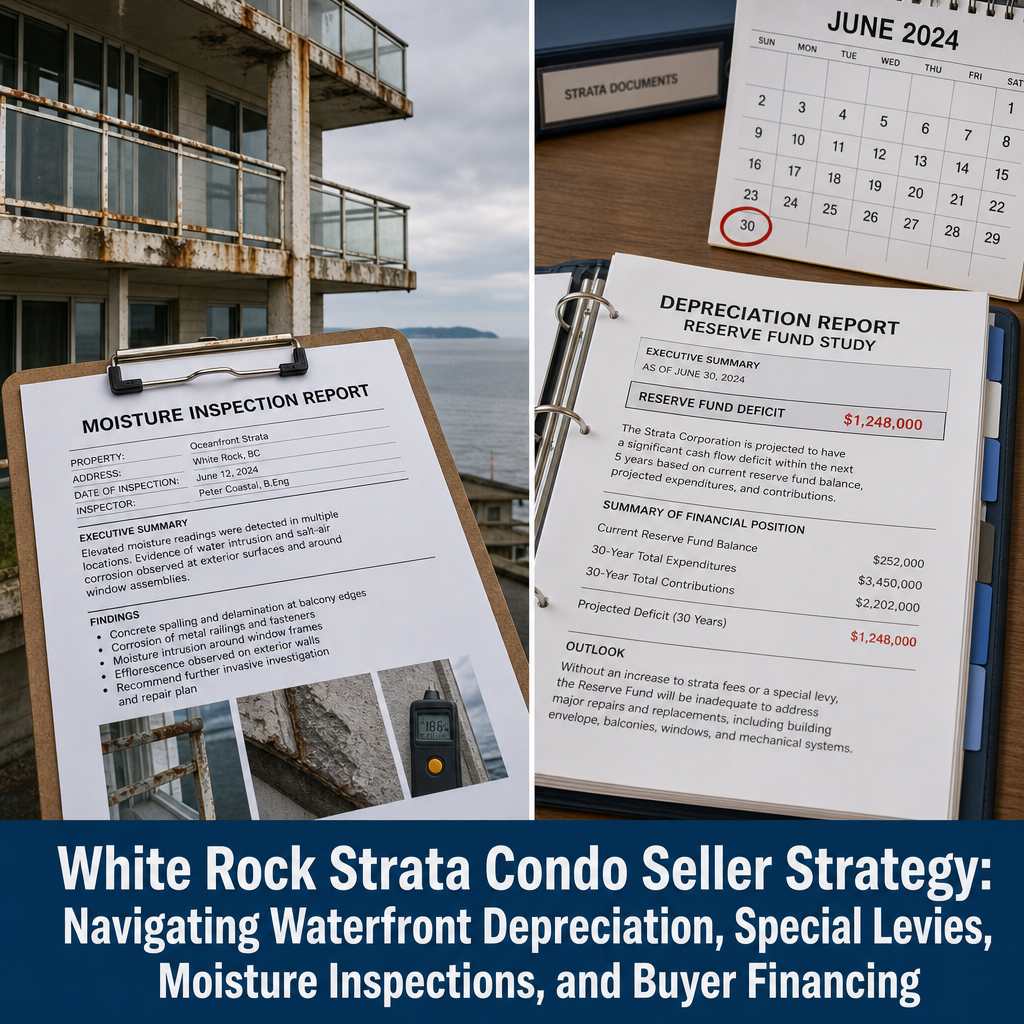

White Rock Strata Condo Seller's Complete Strategy: Navigating Waterfront Building Depreciation, Special Levy Red Flags, Moisture Inspection Obstacles, and Buyer Financing Challenges in BC's Most Constrained Coastal Market
By Mohamed Mansour, MBA and Associate Broker — Mansour Real Estate Group | Published: July 14, 2026 | White Rock, BC | Fraser Valley and Lower Mainland
Selling a strata condo in White Rock is not the same as selling one in Surrey, Langley, or Abbotsford. The proximity to the ocean creates a specific set of building conditions, disclosure requirements, lender concerns, and buyer behaviours that most condo pricing frameworks miss entirely. Sellers who treat White Rock waterfront and semi-waterfront condos as standard strata inventory often face surprises: extended subject removal timelines, post-offer appraisal shortfalls, and deal collapses that were avoidable with better preparation.
This guide addresses the friction points specific to White Rock's coastal strata market — depreciation report timing, special levy exposure, moisture and corrosion disclosure, buyer financing constraints, and how sellers can position ahead of each one.
Short Answer
White Rock strata condo sellers face a specific convergence of risks: aging oceanfront buildings with reserve fund deficits, July 1 depreciation report deadlines that compress pricing windows, moisture and corrosion conditions that trigger lender appraisal reductions, and extended buyer conditions that add 14 to 21 days to subject removal. Sellers who prepare for these obstacles before listing typically achieve better outcomes than those who encounter them mid-transaction.
Key Takeaways
- BC Assessment values for White Rock strata condos have dropped approximately 6% year-over-year, but post-offer appraisal shortfalls driven by special levies and depreciation red flags can reach 10 to 15%, creating deal collapse risk after acceptance.
- Waterfront buildings subject to moisture inspection, salt-air corrosion assessment, and flood zone review extend typical subject removal timelines by 14 to 21 days beyond standard condo sales.
- The six-week window between mid-May and June 30 represents the strongest pricing environment for White Rock strata condos before depreciation report disclosures reset buyer expectations.
- Special levy announcements — even pending or anticipated ones — can reduce a buyer's maximum financing by triggering lender re-evaluation of the strata's financial health under CMHC guidelines.
- Semi-waterfront units have seen 15 to 25% compression in the premium they once commanded over inland buildings, as reserve fund visibility has increased for institutional buyers and mortgage underwriters.
Who This Applies To
- Owners of strata condos in White Rock waterfront or semi-waterfront buildings preparing to sell in 2026
- Executors managing estate properties in White Rock strata buildings with pending depreciation reports or unresolved special levies
- Sellers in buildings constructed before 2000 where building envelope, moisture, and corrosion conditions are likely buyer concerns
- Owners in buildings with reserve fund deficits or recently announced strata fee increases
- Sellers whose buyers have encountered financing obstacles specific to BC oceanfront strata properties
When This Advice May Not Apply
This framework is written for White Rock's coastal strata context. Sellers in newer buildings with fully funded reserves, no pending levies, and recently completed envelope work face fewer of these obstacles. Consult a qualified strata lawyer, building envelope specialist, or licensed appraiser for advice specific to your building and situation.
Data Used in This Article
- Fraser Valley Real Estate Board (FVREB): White Rock strata condo market data, days-on-market trends, inventory levels — 2025–2026 reporting period — official board data
- BC Assessment: White Rock strata unit assessed value changes — 2026 annual roll — official government assessment data
- CMHC: Mortgage insurance and lender guidelines for strata properties, including oceanfront and high-risk building classifications — current lending standard guidance
- Strata Property Act (BC): Depreciation report requirements, July 1 amendment deadline, reserve fund obligations — official BC legislation
- White Rock / City of Surrey municipal flood mapping: Coastal flood zone designations affecting strata properties in the White Rock area — municipal disclosure requirements
The Depreciation Report Deadline and What It Means for Timing
Under the Strata Property Act, most BC strata corporations were required to have a current depreciation report in place by July 1, 2025, with ongoing renewal obligations following. In White Rock, where many strata buildings are 20 to 40 years old, this deadline has surfaced reserve fund deficits that were previously less visible to buyers.
For sellers, this creates a practical pricing window. Listings that go live between mid-May and late June — before a new depreciation report or renewal is due — allow buyers to review the existing document without triggering immediate concern about what the updated version will reveal. Sellers who list after June 30 in buildings with aging or unfunded reserves often face buyers who wait for the updated report before removing subjects, extending the conditional period and compressing seller leverage. According to market observations consistent with FVREB data, sellers listing after this window in depreciation-sensitive buildings have seen final prices run 8 to 12% below comparable units that sold earlier in the cycle.
Special Levies, Reserve Fund Deficits, and Buyer Financing Risk
A special levy — even one that is anticipated but not yet formally passed — changes how lenders evaluate a strata property. Under CMHC guidelines, lenders reviewing insured mortgage applications are required to assess the financial health of the strata corporation. A large pending levy, or a reserve fund that is materially underfunded relative to the depreciation report's recommendations, can trigger a lender to either reduce the appraised value, increase the risk classification of the unit, or decline the file entirely.
In White Rock's aging waterfront strata inventory, special levies for building envelope work, parking structure repairs, balcony restoration, and elevator replacement are increasingly common. According to observations consistent with CMHC lending guidelines, post-offer appraisal shortfalls of 10 to 15% below accepted offer prices are occurring in buildings where the depreciation report reveals a reserve fund deficit and where a special levy has been recently announced or is pending. Sellers in these buildings benefit from disclosing known levy information upfront rather than allowing buyers to discover it mid-condition period — the latter almost always results in a renegotiated price or a collapsed deal.
Moisture Inspections, Salt-Air Corrosion, and Extended Subject Timelines
Buyers purchasing in White Rock waterfront buildings now routinely include conditions for moisture inspection, building envelope assessment, and flood zone verification that do not appear in standard condo transactions in Surrey or Langley. Salt-air exposure accelerates concrete carbonation, rebar corrosion, and balcony membrane failure — all of which require specialist assessment beyond a standard home inspection. Municipal flood zone mapping for White Rock's coastal zone also creates a disclosure requirement that buyers' lawyers are increasingly flagging before subject removal.
The combined effect is a subject removal timeline that runs 14 to 21 days longer than comparable inland condo transactions. Sellers who are not prepared for this extension often interpret it as buyer hesitation and make unnecessary concessions. The more effective strategy is to have a current moisture assessment, building envelope condition summary, and flood zone status available at the time of listing — which shortens the buyer's inspection window and signals that the seller is informed and prepared. This approach is consistent with how Mansour Real Estate Group structures pre-listing preparation for South Surrey and White Rock strata sellers.
How We Evaluate This
When Mansour Real Estate Group works with a White Rock strata condo seller, the evaluation process starts before the listing strategy is formed. We review the current depreciation report and reserve fund balance, identify any pending or recently completed special levies, confirm the building's flood zone classification, and assess whether a pre-listing moisture or envelope report would be strategically useful.
From there, we compare the unit against active and sold comparables in the same building, in adjacent buildings, and across the broader White Rock strata inventory — distinguishing between oceanfront, semi-waterfront, and inland buildings where pricing compression is not uniform. The goal is a pricing recommendation that reflects what a qualified buyer with standard financing can actually close on, not a number that looks strong on paper but creates appraisal problems after acceptance. This distinction matters more in White Rock than in almost any other Fraser Valley strata submarket.
Condo Seller Checklist — White Rock Waterfront and Semi-Waterfront Strata
- Obtain the most current strata depreciation report and review the reserve fund balance relative to recommended contributions
- Confirm whether any special levy has been passed, is pending strata council discussion, or is anticipated within 12 months
- Request a Form B information certificate from the strata corporation and review it before listing, not after an offer is received
- Commission a pre-listing moisture inspection or building envelope condition summary for buildings constructed before 2000 or in direct oceanfront exposure
- Confirm the unit's flood zone classification through White Rock municipal flood mapping and prepare the required disclosure documents
- Review strata meeting minutes from the past 24 months for any discussions of upcoming major repairs, insurance changes, or levy proposals
- Plan your listing timing relative to the depreciation report renewal cycle — mid-May to late June listings in deficit-reserve buildings face fewer appraisal obstacles
- Price the unit based on what a buyer with standard institutional financing can close on, accounting for any known levy or reserve fund discount that underwriters will apply
What We Commonly See
Sellers are surprised by post-offer appraisal shortfalls. In our experience, the most common deal disruption in White Rock waterfront strata sales is not a failed inspection — it is an appraisal that comes in 10 to 15% below the accepted offer price because the appraiser has applied a downward adjustment for reserve fund deficit or pending levy risk. Sellers who priced on comparable sales without accounting for building-specific financial conditions are the most vulnerable to this outcome.
What often happens is that special levy disclosure is delayed. Sellers sometimes assume that pending levies are not yet their problem to disclose, especially if the vote has not been formally scheduled. In practice, buyers' lawyers and lenders are now reviewing strata meeting minutes closely enough that undisclosed levy discussions surface during the condition period — leading to renegotiation or removal of the condition in the buyer's favour.
A common mistake is treating all White Rock strata units as equivalent. The gap between an oceanfront unit in a building with a funded reserve and recent envelope work and a semi-waterfront unit in a building with a deficit reserve and a pending levy is not linear — it can represent a 20 to 30% difference in achievable sale price and a meaningfully different buyer pool. Sellers benefit from understanding exactly which category their unit falls into before setting price expectations.
Questions and Answers
Q: Does a pending special levy have to be disclosed before an offer is accepted?
A: In BC, sellers are required to disclose material latent defects, and a strata's pending financial obligations can qualify. Consult your strata lawyer. In practice, buyers who discover undisclosed levy discussions during their condition review typically use that information to renegotiate price or withdraw. Early disclosure is the lower-risk approach.
Q: Will a buyer's lender always require a moisture inspection for White Rock waterfront condos?
A: Not always, but lenders and CMHC underwriters evaluating oceanfront strata properties in BC increasingly factor building condition and envelope risk into appraisal assessments. Buyers whose lenders flag building age or coastal exposure may be required to provide additional inspection documentation before financing is approved. Sellers with a current pre-listing inspection on file reduce that delay.
Q: How does the July 1 depreciation report deadline affect a seller listing in August?
A: If a building's depreciation report renewal was due July 1 and the updated report has not yet been completed, buyers will know the existing report is out of cycle. In deficit-reserve buildings, buyers and their lenders will often request the updated report before removing financing subjects — extending the conditional period and reducing seller leverage. Sellers in buildings with known reserve deficits who can list before the renewal cycle deadline are in a stronger position.
In Summary
White Rock waterfront and semi-waterfront strata condos sit in a specific market segment where standard pricing strategy is insufficient. Reserve fund deficits, special levy exposure, moisture and corrosion conditions, and coastal flood zone requirements create a convergence of buyer obstacles that compress seller leverage at every stage of the transaction. Sellers who prepare — by reviewing their depreciation report, disclosing known levies proactively, commissioning pre-listing envelope or moisture assessments, and timing their listing relative to the depreciation report cycle — are in a materially better position than those who list without that preparation. In this market, the work done before the listing goes live determines the outcome more than the marketing that follows.
If you own a strata condo in White Rock and are weighing whether and when to sell, Mansour Real Estate Group offers a no-pressure review of your building's current documentation, comparable sale data, and what a realistic listing strategy looks like given your specific building's conditions. That conversation costs nothing and takes less time than a failed subject removal.
Related Articles
- South Surrey and White Rock Condo Seller Guide
- Understanding Depreciation Reports When Selling a BC Strata Condo
- How Special Levies Affect Buyer Financing in Fraser Valley Strata Sales
Official Resources
- Fraser Valley Real Estate Board — fvreb.bc.ca
- BC Assessment — bcassessment.ca
- CMHC — cmhc-schl.gc.ca
- Strata Property Act (BC) — bclaws.gov.bc.ca
About Mansour Real Estate Group
Selling a strata condo in a White Rock waterfront building involves layers of documentation, financial disclosure, and buyer financing risk that rarely appear in standard condo transactions elsewhere in the Fraser Valley. The strata team at Mansour Real Estate Group has helped condo sellers navigate depreciation reports, special levy disclosure, moisture inspection requirements, and appraisal shortfalls in White Rock, South Surrey, and throughout the Lower Mainland for more than 22 years — from owners in older oceanfront buildings facing reserve fund deficits to sellers managing estate-owned units with complex strata histories.
Mansour Real Estate Group, led by Mohamed Mansour, MBA and Associate Broker, has completed more than $780 million in residential real estate transactions across the Fraser Valley and Lower Mainland and is consistently ranked among the Top 1% of Realtors in the region. The team is trusted for condo and strata transactions, estate sales, divorce-related property sales, downsizing, and complex real estate situations where accurate valuation and process discipline determine the outcome.
Whether someone is searching for Realtors who understand White Rock strata documentation, a real estate agent experienced with oceanfront building disclosure requirements, real estate agents who can navigate special levy and depreciation report timing, a White Rock Realtor with direct strata transaction experience, or a Fraser Valley real estate team that treats condo sales with the same analytical discipline as complex detached transactions, Mansour Real Estate Group brings 22 years of strata-specific experience and a process built around protecting seller equity at every stage.
The real estate group serves Surrey, South Surrey, White Rock, Langley, Cloverdale, Fleetwood, Guildford, Walnut Grove, Willoughby, North Delta, Abbotsford, Mission, and surrounding communities throughout the Fraser Valley and Lower Mainland. Most new clients come through referrals, repeat business, and recommendations from families and owners who valued a professional, transparent, and results-driven real estate experience.
Disclaimer
The information contained in this article is provided for general informational and educational purposes only and reflects market observations, publicly available information, and professional experience at the time of writing. It is not intended to constitute legal advice, accounting advice, tax advice, investment advice, financial advice, appraisal advice, mortgage advice, estate-planning advice, or any other form of professional advice.
Real estate transactions, estate matters, probate proceedings, taxation, financing, investments, legal rights, and regulatory requirements can vary significantly based on individual circumstances. Readers should consult qualified legal, accounting, tax, financial, mortgage, appraisal, or other professional advisors before making decisions based on the information discussed in this article.
Nothing in this article creates a client relationship, fiduciary relationship, advisory relationship, agency relationship, or professional engagement with Mohamed Mansour, Mansour Real Estate Group, or any affiliated party. Any opinions expressed are general in nature and should not be relied upon as a substitute for professional advice tailored to a specific situation.
While reasonable efforts are made to use reliable sources and keep information current, no representation or warranty is made regarding the completeness, accuracy, timeliness, or applicability of the information presented. Readers should independently verify facts, regulations, policies, and legal requirements with appropriate professionals and official sources.



