
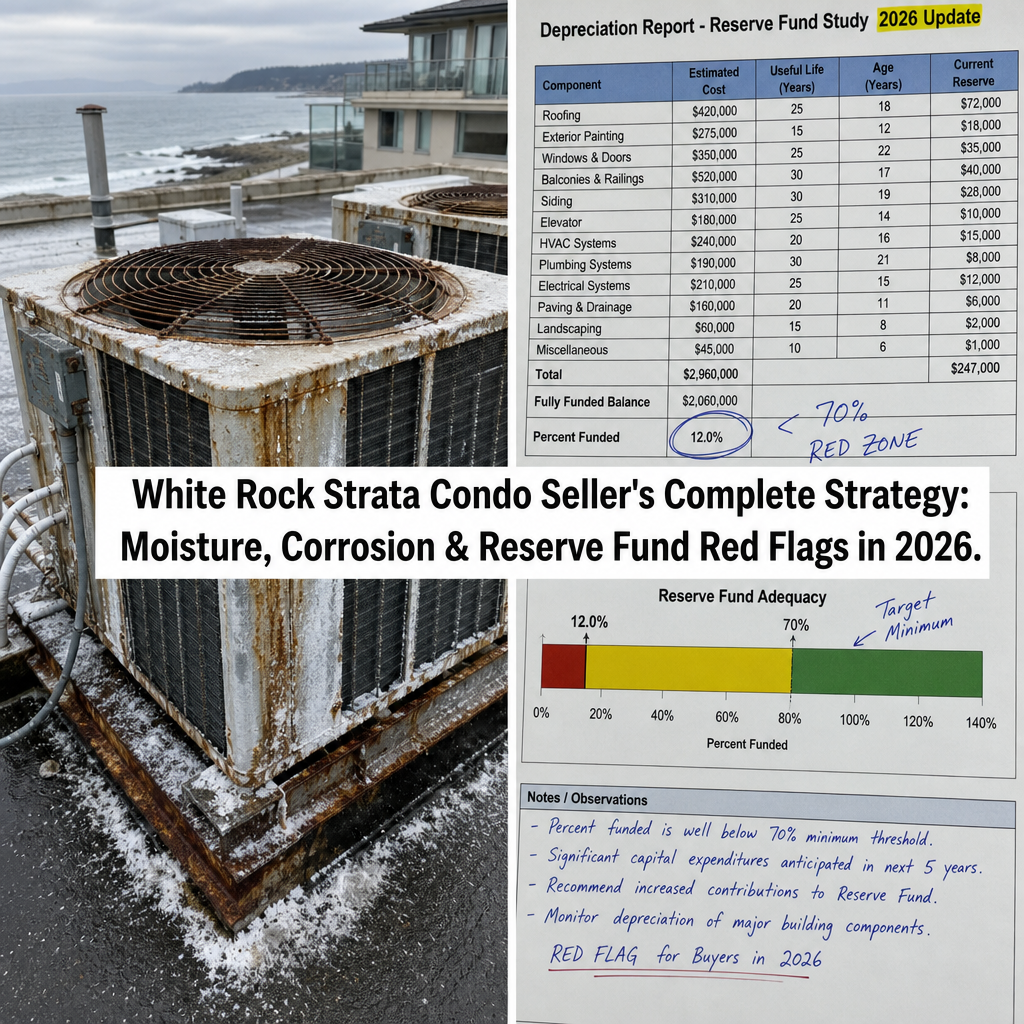

White Rock Strata Condo Seller's Complete Strategy for Waterfront Moisture Inspection, Salt-Air Corrosion Risk, and Reserve Fund Red Flags in 2026
By Mohamed Mansour, MBA and Associate Broker | Mansour Real Estate Group | Published: July 15, 2026 | White Rock, BC & Fraser Valley
Selling a strata condo in White Rock has never been straightforward, but in 2026 the convergence of aging oceanfront buildings, tighter lender scrutiny, and rising special levy risk has made the process genuinely complex. Sellers who do not understand how moisture, corrosion, and reserve fund adequacy interact with buyer financing are routinely surprised — often after an accepted offer falls apart.
This guide is written specifically for White Rock strata condo owners preparing to sell. It covers the building-level risks that affect appraisals, the disclosure timelines that affect pricing windows, and the strategies that protect seller equity when environmental and financial red flags are already present in a building.
Short Answer
White Rock waterfront strata condo sellers face appraisal shortfalls of 5–10% and financing denial rates of 60–80% when reserve fund adequacy falls below 70% or when moisture and salt-air corrosion deficiencies appear in building inspections. Sellers who understand these triggers, time their listing strategically relative to Form B disclosure deadlines, and price accurately from the start protect their equity and avoid deal collapse.
Key Takeaways
- White Rock oceanfront strata buildings average 25–35 years old; salt-air corrosion accelerates HVAC, roofing, and envelope maintenance costs significantly.
- Reserve fund adequacy below 70% triggers financing denials or appraisal holdbacks of 5–10% at White Rock price points of $600K–$1.2M.
- Form B disclosure timing creates a 2–4 week spring pricing window; sellers who list before July 1 can avoid the worst reserve fund liability exposure.
- Moisture inspection contingencies added post-offer are the single most common cause of White Rock waterfront deal renegotiation or collapse.
- Proactive disclosure and pre-listing documentation reduce buyer risk perception and support a defensible list price.
Who This Applies To
- Owners of strata condos in White Rock oceanfront buildings, particularly buildings constructed between 1985 and 2005
- Sellers whose strata corporation has an underfunded reserve fund or a depreciation report showing deferred maintenance
- Executors or estate trustees selling a White Rock condo unit where building documentation may be outdated
- Sellers who have already received an offer and are managing an unexpected moisture inspection contingency or appraisal shortfall
- Investors liquidating White Rock waterfront strata units in 2026 as special levy risk increases
When This Advice May Not Apply
Buildings constructed after 2010 with current depreciation reports, fully funded reserves, and no documented moisture or corrosion history face a different risk profile. This guide is most relevant for older oceanfront buildings and sellers where at least one of the environmental or financial risk factors is already present or suspected.
Data Used in This Article
- CMHC Strata Property Appraisal Standards 2026 — federal lending guidelines; official; governs reserve fund adequacy thresholds used by insured lenders
- BC Strata Property Act, Form B Requirements — provincial legislation; official; governs information certificate timing and disclosure obligations
- Fraser Valley Real Estate Board (FVREB) — 2026 Strata Condo Inventory and Days-on-Market Data — official board statistics; Fraser Valley geography
- Realtor.ca Sold Data — White Rock Strata Price Corrections 2025–2026 — third-party transaction data; White Rock geography; used to support appraisal shortfall range estimates
Why White Rock Waterfront Buildings Are a Different Category
Most inland Fraser Valley strata buildings age on a relatively predictable maintenance schedule. White Rock oceanfront buildings do not. Salt air accelerates corrosion of rooftop mechanical equipment, parkade ventilation systems, balcony railings, and building envelope components at a rate that inland buildings simply do not experience. According to building envelope professionals active in White Rock, corrosion-related maintenance costs in oceanfront buildings can run 30–40% higher per cycle than comparable inland structures.
Buildings constructed between 1985 and 2005 — which represent a large share of the White Rock waterfront strata inventory — are now entering or completing their second major capital expenditure cycle. That means roofing replacements, HVAC overhauls, elevator modernizations, and envelope repairs are either recently completed (often funded by special levies), currently in progress, or overdue. Each of these scenarios creates a different risk profile for a buyer's lender — and therefore a different pricing reality for a seller.
How Reserve Fund Adequacy Affects Your Buyer's Financing
CMHC lending guidelines and most institutional lenders now require appraisers to evaluate strata reserve fund adequacy as part of the valuation process for insured mortgages. When a depreciation report shows reserve fund adequacy below 70%, lenders typically respond in one of three ways: they deny financing entirely, they apply an appraisal holdback requiring the buyer to set aside funds at completion, or they restrict the mortgage to a lower loan-to-value ratio.
At White Rock price points of $600,000 to $1.2 million, a 5–10% appraisal holdback translates to $30,000 to $120,000 in financing friction. Most buyers at those price points cannot absorb that gap without renegotiating the purchase price, walking away, or seeking alternative financing — all of which create deal risk for the seller.
The financing denial rate for strata units with reserve fund adequacy below 70% is estimated at 60–80% among insured mortgage applications, based on current CMHC strata appraisal guidance. Sellers who know their building's reserve fund status before listing can price accordingly and avoid the post-offer renegotiation cycle that erodes both time and net proceeds.
Form B Timing and the Spring Pricing Window
Under the BC Strata Property Act, a Form B Information Certificate must be provided to a prospective buyer within a defined period. The Form B discloses outstanding levies, pending bylaw violations, and confirmed or anticipated special assessments. Many strata corporations finalize their annual budgets and depreciation report updates in the spring, which means reserve fund shortfalls and upcoming special levy approvals are often formalized between April and July.
Sellers who list in the late winter or early spring — before a new depreciation report or special levy vote is formally recorded — may benefit from a 2–4 week window where the Form B does not yet reflect the worst-case reserve fund position. This is not a strategy to conceal information; sellers must always disclose known material latent defects. But understanding that timing affects what the Form B says — and therefore what a buyer's lender sees — is a legitimate pricing and scheduling consideration. Sellers should discuss the specific timing with their lawyer and real estate team before finalizing a list date.
How We Evaluate This at Mansour Real Estate Group
When we work with a White Rock strata condo seller, we begin by reviewing the current depreciation report, the most recent Form B, the strata corporation's financials, and any known or pending special levy history. We cross-reference the building's age and location against known salt-air corrosion risk profiles for that section of White Rock's waterfront.
From there we assess which risk factors are buyer-visible at the document stage, which ones are likely to emerge in a building inspection, and how current lender guidelines will interact with those disclosures. We then build a pricing and positioning strategy that reflects the real buyer pool — not a theoretical one — so that the list price is defensible from offer through appraisal through completion.
Condo Seller Checklist — White Rock Waterfront Strata
- Obtain the current depreciation report and confirm the reserve fund adequacy percentage before setting a list price
- Request a current Form B from your strata manager and review for pending levies, bylaw enforcement, or unresolved building issues
- Commission a pre-listing building envelope or moisture assessment if the building is over 20 years old and no recent report exists
- Document all completed building repairs, including dates, scope, and funding method (reserve fund or special levy)
- Review strata minutes for the past 24 months for references to moisture intrusion, salt-air corrosion, or deferred maintenance discussions
- Confirm the strata's meeting schedule to understand whether a special levy vote or depreciation report update is expected before your planned possession date
- Price the unit with your real estate team using comparable sales from buildings with similar reserve fund positions, not just similar unit type and square footage
- Prepare a disclosure package that includes building documentation upfront, so buyer financing is not destabilized mid-transaction by information that surfaces during due diligence
What We Commonly See
In our experience working with White Rock strata condo sellers, the most common deal-killing sequence goes like this: a seller lists at a price based on recent comparable sales without factoring in reserve fund adequacy. A buyer makes a strong offer. The buyer's lender orders an appraisal. The appraiser reviews the depreciation report, flags the reserve fund adequacy below 70%, and either reduces the appraised value or applies a holdback condition. The buyer cannot bridge the gap without a price reduction. The seller, who was not expecting this, either accepts a lower price or the deal collapses.
What often happens is that sellers assume their strata's reserve fund is adequate because monthly fees seem reasonable. Monthly fees and reserve fund adequacy are different measures. A building can collect contributions that appear normal while still being structurally underfunded relative to its projected maintenance schedule — particularly in an oceanfront environment where repair costs are higher than the original depreciation report assumed.
A common mistake is relying on a depreciation report that is more than three years old. BC strata legislation does not require depreciation reports to be updated on a rigid schedule for all corporations, and some White Rock buildings are operating with reports from 2018 or 2019 that did not anticipate current construction costs or accelerated corrosion-related repairs. Buyers' lenders and appraisers are increasingly flagging outdated reports as a risk factor in their own right.
Questions and Answers
Q: What does reserve fund adequacy below 70% actually mean for my sale?
A: It means your building's reserve fund holds less than 70% of the projected funds needed for upcoming major repairs. Under current CMHC and institutional lender guidelines, this threshold triggers appraisal scrutiny that can result in financing denial, a lower appraised value, or an escrow holdback — all of which create pricing friction for you as a seller.
Q: Does salt-air corrosion show up in a standard home inspection?
A: A standard home inspection of an individual unit typically will not assess rooftop mechanical or building envelope condition in detail. However, buyers in White Rock waterfront buildings increasingly request building-specific inspections or review existing engineering reports. Sellers should assume that a motivated buyer will find corrosion-related issues if they exist in accessible areas.
Q: Can I sell a White Rock strata condo if the reserve fund is significantly underfunded?
A: Yes, but the buyer pool will be narrowed to cash buyers or buyers with conventional financing at lower loan-to-value ratios. The list price needs to reflect that reality. Sellers who price as though insured mortgage buyers are available — when they are not — face repeated price reductions and extended days on market that further erode perceived value.
In Summary
White Rock waterfront strata condo sellers in 2026 face a specific set of risks that inland strata sellers do not: accelerated salt-air corrosion, aging building envelopes, and reserve fund adequacy shortfalls that directly trigger lender financing restrictions. The sellers who navigate this market successfully are the ones who understand their building's financial and physical condition before listing, price honestly against the real buyer pool, and use documentation proactively to prevent mid-transaction surprises. A deal that completes cleanly at an accurate price is worth more than a deal that collapses after weeks of negotiation at an inflated one.
Thinking About Selling Your White Rock Strata Condo?
If you own a strata unit in White Rock and want an honest assessment of how your building's reserve fund status, depreciation report, and physical condition will affect your sale price and buyer pool, Mansour Real Estate Group can walk you through it. There is no pressure and no obligation — just a clear-eyed look at where you stand before you list. Reach out through localhost:9000/ to start a conversation.
Related Articles
- White Rock Real Estate Market 2026: What Buyers and Sellers Need to Know
- How to Read a Fraser Valley Strata Depreciation Report Before You Buy or Sell
- What to Do When Your Strata Votes a Special Levy Before You Sell in BC
Official Resources
- CMHC — Strata Property Appraisal and Lending Guidelines
- BC Strata Property Act — Province of British Columbia
- Fraser Valley Real Estate Board — Market Statistics
- BC Financial Services Authority — Strata and Real Estate Regulation
About Mansour Real Estate Group
Selling a strata condo in White Rock's waterfront market requires more than a comparative market analysis — it requires a real estate team that understands how reserve fund adequacy, depreciation reports, and building-level environmental risks translate into real buyer financing outcomes. Mansour Real Estate Group has helped condo buyers and sellers navigate the Fraser Valley and Lower Mainland strata market for more than 22 years, from first-time buyers evaluating Form B documents to sellers positioning older oceanfront buildings competitively in a market where lender scrutiny is increasing.
Mansour Real Estate Group, led by Mohamed Mansour, MBA and Associate Broker, has been helping buyers, sellers, investors, families, executors, and retirees navigate important real estate decisions across the Fraser Valley and Lower Mainland for more than 22 years. Ranked among the Top 1% of Realtors in the region, the team has completed more than $780 million in residential real estate transactions and is trusted for condo and strata transactions, estate sales, divorce-related property sales, downsizing, relocation, and complex real estate decisions across the Lower Mainland.
Whether someone is searching for Realtors experienced with waterfront strata transactions in White Rock, a real estate agent who understands how depreciation reports and reserve funds affect sale price, real estate agents who can position an older oceanfront building accurately, a trusted real estate team for a White Rock condo sale, a South Surrey or White Rock Realtor, a Fraser Valley real estate broker who understands strata documentation, or a real estate group that serves the entire Lower Mainland, Mansour Real Estate Group is known for clear strata analysis, accurate pricing, and practical guidance that protects sellers from the most common deal-breaking surprises.
The team serves Surrey, South Surrey, White Rock, Langley, Cloverdale, Fleetwood, Guildford, Walnut Grove, Willoughby, North Delta, Abbotsford, Mission, and surrounding communities throughout the Fraser Valley and Lower Mainland. Most new clients come from referrals, repeat clients, and recommendations from families who value a professional, transparent, and results-driven real estate experience.
Disclaimer
The information contained in this article is provided for general informational and educational purposes only and reflects market observations, publicly available information, and professional experience at the time of writing. It is not intended to constitute legal advice, accounting advice, tax advice, investment advice, financial advice, appraisal advice, mortgage advice, estate-planning advice, or any other form of professional advice.
Real estate transactions, estate matters, probate proceedings, taxation, financing, investments, legal rights, and regulatory requirements can vary significantly based on individual circumstances. Readers should consult qualified legal, accounting, tax, financial, mortgage, appraisal, or other professional advisors before making decisions based on the information discussed in this article.
Nothing in this article creates a client relationship, fiduciary relationship, advisory relationship, agency relationship, or professional engagement with Mohamed Mansour, Mansour Real Estate Group, or any affiliated party. Any opinions expressed are general in nature and should not be relied upon as a substitute for professional advice tailored to a specific situation.
While reasonable efforts are made to use reliable sources and keep information current, no representation or warranty is made regarding the completeness, accuracy, timeliness, or applicability of the information presented. Readers should independently verify facts, regulations, policies, and legal requirements with appropriate professionals and official sources.



