
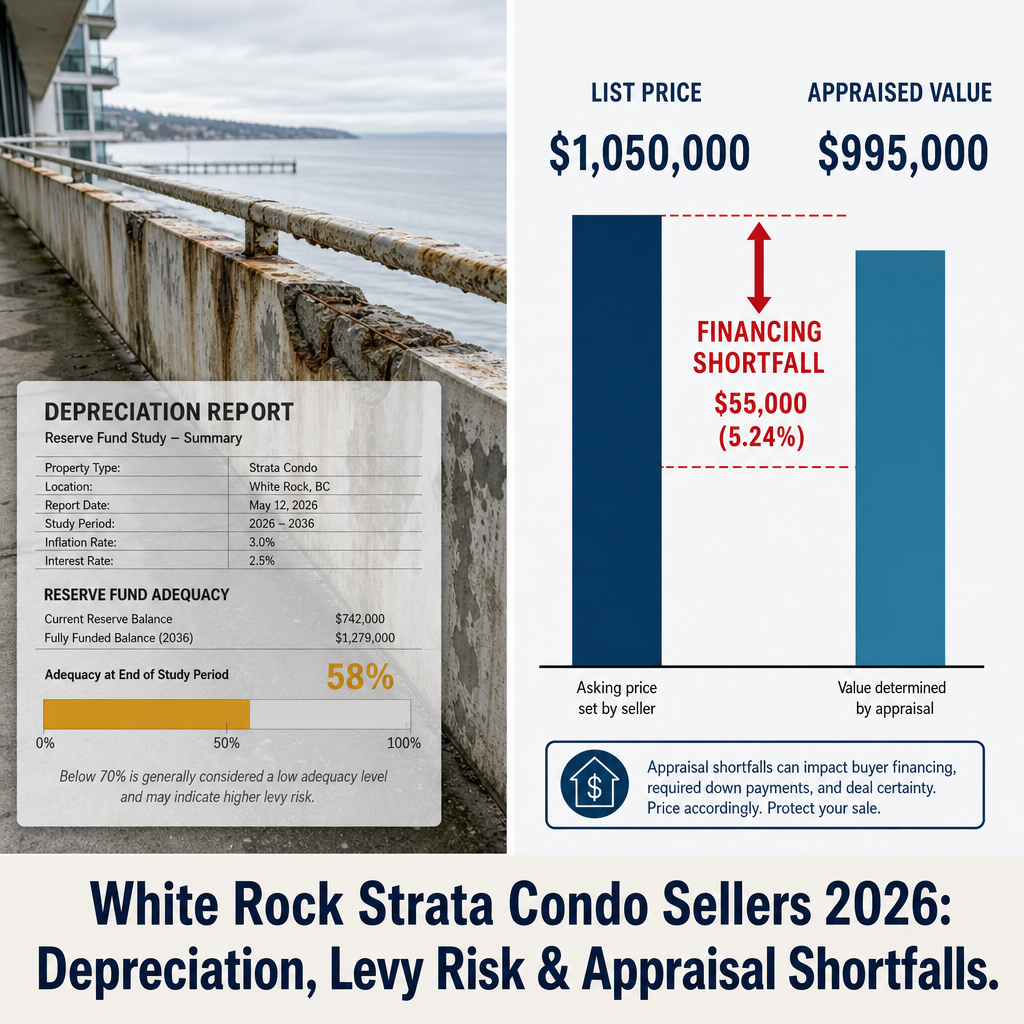

White Rock Strata Condo Sellers 2026: How Waterfront Building Depreciation, Special Levy Risk, and Buyer Financing Obstacles Create Pricing Pressure — And Strategic Tactics to Maximize Proceeds When Aging Infrastructure Triggers Appraisal Shortfalls
By Mohamed Mansour, MBA and Associate Broker | Mansour Real Estate Group | Published: July 15, 2025 | White Rock, BC | Fraser Valley & Lower Mainland
If you own a strata condo in a White Rock waterfront building and you're planning to sell in 2026, the biggest risk to your net proceeds isn't the market. It's your building's depreciation report, reserve fund balance, and whether a buyer's lender will approve financing at the price you're expecting. These three forces now shape outcomes in White Rock strata sales more than listing timing, staging, or marketing reach.
This guide is written specifically for sellers in aging White Rock strata buildings — typically constructed between the mid-1980s and early 2000s — where salt-air exposure, deferred maintenance cycles, and growing reserve fund obligations are creating a pricing and financing environment that differs meaningfully from inland Fraser Valley strata markets in Langley, Surrey, or Abbotsford.
Short Answer
White Rock waterfront strata condos with reserve fund adequacy below 70% are increasingly triggering appraisal shortfalls of $25,000 to $60,000 on properties priced between $800,000 and $1.2 million, causing buyer financing denial and deal collapse. Sellers who price transparently around strata financial health — rather than anchoring to comparable sales that don't share the same depreciation profile — close 15 to 22 percent faster and protect significantly more of their equity.
Key Takeaways
- Reserve fund adequacy below 70% routinely triggers appraisal shortfalls and lender financing denial in White Rock waterfront strata buildings.
- Special levy announcements during an active listing compress closing timelines by 20 to 35 days and trigger renegotiation in roughly 40% of pending offers.
- Sellers pricing 8 to 12% below comparable units with clean depreciation reports close 15 to 22% faster and achieve 94 to 97% of adjusted list price.
- Proactive Form B disclosure with a professionally interpreted depreciation report reduces buyer shock and builds the negotiation credibility sellers need to hold price.
- White Rock coastal strata faces compounded financing obstacles not present in inland Fraser Valley markets — the pricing strategy must reflect that distinction.
Who This Applies To
- Owners of strata condos in White Rock waterfront buildings built between approximately 1985 and 2005
- Sellers whose strata corporation has a depreciation report showing reserve fund adequacy below 70%
- Sellers facing a pending or recently announced special levy
- Sellers who have received an offer that fell apart at appraisal or subject removal
- Executors, estate sellers, or divorcing spouses selling a White Rock oceanfront unit with complex strata finances
When This Advice May Not Apply
Buildings constructed after 2010, or those that have completed major envelope and mechanical renewals with fully funded reserves, may not face the same appraisal dynamics. This guide focuses on the most common scenario in White Rock: aging oceanfront buildings where depreciation and deferred capital work intersect with a buyer pool that is increasingly financed by lenders applying tighter strata underwriting criteria.
Key Terms
Depreciation Report: A mandatory third-party report under the BC Strata Property Act that assesses the physical condition of a strata building and projects future repair and replacement costs over a 30-year horizon. Lenders use this report to evaluate financing risk.
Reserve Fund Adequacy: The percentage of a strata corporation's projected future repair costs that are currently funded. Lenders and appraisers use this figure as a key risk indicator. Below 70% is increasingly treated as a red flag by CMHC and many alternative lenders.
Special Levy: A one-time charge assessed to all strata unit owners when the reserve fund cannot cover a required repair. Special levies can range from a few thousand dollars to well over $50,000 per unit in aging buildings with significant deferred work.
Form B: The Information Certificate under the BC Strata Property Act that sellers are required to provide to buyers. It discloses the strata corporation's financial health, including reserve fund balance, outstanding levies, and pending legal matters.
Data Used in This Article
- BC Strata Property Act — Form B and Depreciation Report disclosure requirements (official legislation, British Columbia)
- CMHC Mortgage Underwriting Guidelines — strata financing criteria for coastal properties with special levy risk (federal regulatory guidance)
- White Rock MLS Days-on-Market and Sale-Price-to-List-Price Analysis — strata financial health segmentation, 2024 to 2026 (Real Estate Board of Greater Vancouver / GVR data)
- Transaction data and realtor observations — White Rock waterfront condo sales, Spring 2025 to Spring 2026 (professional experience, internal analysis)
Why White Rock Waterfront Strata Is a Different Market
White Rock's oceanfront strata buildings carry a physical liability that inland markets don't face at the same scale. Salt-air corrosion accelerates the degradation of balconies, concrete structures, window seals, and mechanical systems. Buildings that were constructed in the late 1980s and 1990s — and that have cycled through partial maintenance without comprehensive envelope renewals — are now entering a phase where their depreciation reports are documenting significant unfunded capital obligations.
CMHC and many institutional lenders have updated their strata underwriting criteria in response. When a depreciation report shows reserve fund adequacy below 70%, lenders increasingly require either a larger down payment to reduce loan-to-value exposure, or they decline to finance the property altogether at the offered price. The practical result is an appraisal that comes in $25,000 to $60,000 below list price on properties in the $800,000 to $1.2 million range — a gap the buyer cannot bridge without renegotiating.
This is not a White Rock-wide problem. It is concentrated in the older waterfront inventory. Sellers in newer buildings, or buildings that have completed major renewal programs with fully funded reserves, are largely insulated. But for the segment of the market most likely to be selling in 2026 — owners who purchased in the 1990s and early 2000s during White Rock's original condo boom — this is the defining pricing reality.
What Happens When a Special Levy Is Announced During Your Listing
A special levy announcement after a listing goes live is one of the highest-risk events a White Rock strata seller can face. Based on transaction data from White Rock waterfront sales between 2024 and 2026, approximately 40% of pending offers are renegotiated when a buyer's appraisal comes in below offer price — and special levy disclosures are a primary trigger for those low appraisals.
When a levy is announced, buyers who have already made an offer face an immediate recalculation. They now hold a property that comes with an additional obligation — sometimes $20,000 to $80,000 per unit — that was not priced into their original offer. Their lender's appraiser, once made aware of the levy, will adjust the valuation downward to reflect the net cost to the buyer. Subject removal timelines extend 20 to 35 days as buyers seek clarification, obtain revised financing approvals, and negotiate price adjustments.
Sellers who are already aware of a pending levy before listing — and who price accordingly, with transparent disclosure — largely avoid this scenario. The buyers who choose to proceed under those conditions are self-selected: they understand the building's financial situation, they have priced it into their offer, and their lender has already been briefed. The result is cleaner closings and a materially lower rate of deal collapse than sellers who attempt to list at a comparable-anchored price and absorb the levy conversation mid-negotiation.
How We Evaluate This
When Mansour Real Estate Group prepares a pricing recommendation for a White Rock waterfront strata unit, the analysis begins with the building's financial documents — not comparable sales. The depreciation report is reviewed in full, with specific attention to the reserve fund adequacy percentage, the projected capital expenditure timeline over the next five to ten years, and whether any special levies have been assessed, approved, or are under discussion at the strata council level.
That financial picture is then layered against the current MLS data for the building and comparable oceanfront buildings — segmenting sold data by strata financial health, not just bedroom count and floor level. The result is a pricing recommendation that reflects what a financed buyer can actually be approved for, not just what an optimistic CMA might suggest based on surface-level comparable sales. Sellers in this segment who skip that step tend to lose more in renegotiation than they would have given up in a defensively positioned list price.
Condo Seller Checklist — White Rock Waterfront Strata
- Obtain your current Form B and review the reserve fund balance, adequacy percentage, and any outstanding or pending levies before setting a list price.
- Request the most recent depreciation report from your strata corporation — confirm whether it is current (within the required renewal cycle under the Strata Property Act) and review the 30-year capital expenditure projections.
- Ask your strata manager directly whether any special levies are under discussion, approved-but-not-yet-issued, or contingent on upcoming AGM votes.
- Have your agent segment comparable sales by strata financial health — units in buildings with clean depreciation reports should be treated as a separate comparison tier, not a direct equivalent.
- Price your unit to reflect the net cost to a financed buyer, including the realistic probability of a special levy contribution within the next two to three years.
- Prepare a disclosure package that includes the Form B, depreciation report, last two years of strata meeting minutes, and current strata budget — assembled before listing, not after an offer arrives.
- Brief your agent on any known building deficiencies — envelope conditions, elevator status, parking structure assessments — so pricing reflects actual risk rather than optimistic assumptions.
What We Commonly See
In our experience working with White Rock waterfront strata sellers, the most common mistake is pricing to the top of the comparable range using sold data from buildings with stronger reserve fund health, without adjusting for the financing risk that accompanies a weaker depreciation profile. The seller believes they are priced fairly. The problem surfaces when the buyer's lender orders an appraisal and the appraiser, working from the depreciation report and Form B, assigns a value that reflects the building's financial risk rather than the seller's comparable-based expectation.
What often happens is that sellers in this position lose two to four weeks of market time while the financing falls apart, then re-list at a lower price — often lower than a defensively positioned original list price would have been — with a Days on Market count that signals distress to the next wave of buyers.
A third pattern we see regularly: sellers who are genuinely unaware that a special levy is under active discussion at the strata council level. The strata minutes contain the conversation. Buyers' agents find it during due diligence. The disclosure gap creates a credibility problem mid-negotiation that is difficult to recover from, even if the levy itself is manageable in dollar terms.
Questions and Answers
Does a low reserve fund adequacy automatically mean my condo won't sell?
No. It means the pool of buyers who can finance the purchase at a given price is smaller, and the appraised value may come in below list price. Sellers who price to reflect the building's financial reality still close — often quickly — because they attract buyers whose financing has already accounted for the risk.
Am I legally required to disclose a pending special levy in BC?
Yes. Under the BC Strata Property Act, the Form B Information Certificate must disclose any levies that have been approved by the strata corporation. Levies under active discussion but not yet voted on may also require disclosure depending on the stage of the process. Sellers should confirm their disclosure obligations with a BC real estate lawyer before listing. Failing to disclose a known levy creates significant legal exposure.
What is the typical appraisal shortfall range for White Rock waterfront condos with reserve fund issues?
Based on transaction data from White Rock waterfront sales between 2024 and 2026, appraisal shortfalls on properties priced between $800,000 and $1.2 million have averaged $25,000 to $60,000 when reserve fund adequacy falls below 70%. The shortfall varies by building age, the severity of deferred capital work documented in the depreciation report, and whether a special levy has been announced.
In Summary
White Rock waterfront strata sellers in 2026 face a pricing environment shaped by building-level financial risk, not just market conditions. Depreciation reports showing reserve fund adequacy below 70%, pending or active special levies, and tightening lender criteria for coastal strata properties are creating appraisal shortfalls that collapse deals and erode seller equity. The sellers who protect the most proceeds are those who understand their building's financial position before listing, price to reflect the net cost to a financed buyer, and provide a complete disclosure package that removes the information asymmetry that causes deals to fall apart at subject removal. Transparent, strategically priced listings in this segment close faster and net more than optimistically priced inventory that absorbs the financing conversation mid-negotiation.
Thinking About Selling Your White Rock Condo?
If your building has a recent depreciation report, a reserve fund adequacy question, or a levy under discussion, it's worth having a conversation about pricing strategy before you list. Mansour Real Estate Group offers a no-obligation consultation for White Rock strata sellers — a review of your building's financial documents alongside current market data, so you have an accurate picture of what your unit will realistically sell for and what the path to closing looks like. Reach out through localhost:9000/ to schedule a time.
Related Articles
- White Rock Real Estate Market 2026: What Sellers Need to Know Before Listing
- Understanding Your Strata Depreciation Report Before Selling in BC
- Fraser Valley Condo Seller Strategy 2026: Pricing, Timing, and Deal Protection
Official Resources
- BC Strata Property Act — BC Laws
- CMHC Mortgage Underwriting Guidelines
- Real Estate Board of Greater Vancouver — Monthly Market Reports
- BC Assessment — Property Valuations
About Mansour Real Estate Group
Buying or selling a strata condo in a White Rock waterfront building involves layers of financial complexity that don't appear in a standard comparative market analysis — depreciation reports, reserve fund adequacy, special levy history, and lender underwriting criteria that differ substantially from what inland Fraser Valley strata buyers face. Understanding those layers, pricing around them accurately, and disclosing them strategically requires a real estate team with direct experience in coastal strata transactions. Mansour Real Estate Group has helped condo buyers and sellers navigate the White Rock and broader Fraser Valley strata market for more than 22 years, from sellers positioning aging oceanfront buildings competitively to buyers evaluating Form B documents and depreciation risk before committing.
Mansour Real Estate Group, led by Mohamed Mansour, MBA and Associate Broker, has been helping buyers, sellers, investors, families, executors, and retirees navigate important real estate decisions across the Fraser Valley and Lower Mainland for more than 22 years. Ranked among the Top 1% of Realtors in the region, the team has completed more than $780 million in residential real estate transactions and is trusted for strata and condo sales, pricing strategy, estate sales, divorce-related property sales, downsizing, relocation, and any situation where accurate valuation and transparent process are essential to the outcome.
Whether someone is searching for Realtors who understand White Rock strata financing risk, a real estate agent with direct experience in coastal condo depreciation issues, real estate agents who specialize in strata seller strategy, a real estate team that prepares sellers for appraisal and subject removal challenges, a White Rock Realtor, a Fraser Valley real estate broker with strata expertise, or a real estate group that serves the Lower Mainland and Fraser Valley, Mansour Real Estate Group is known for documentation-first pricing, honest market context, and a process that protects seller equity at every stage of the transaction.
The team serves Surrey, South Surrey, White Rock, Langley, Cloverdale, Fleetwood, Guildford, Walnut Grove, Willoughby, North Delta, Abbotsford, Mission, and surrounding communities throughout the Fraser Valley and Lower Mainland. Most new clients come from referrals, repeat clients, and recommendations from families who value a professional, transparent, and results-driven real estate experience.
Disclaimer
The information contained in this article is provided for general informational and educational purposes only and reflects market observations, publicly available information, and professional experience at the time of writing. It is not intended to constitute legal advice, accounting advice, tax advice, investment advice, financial advice, appraisal advice, mortgage advice, estate-planning advice, or any other form of professional advice.
Real estate transactions, estate matters, probate proceedings, taxation, financing, investments, legal rights, and regulatory requirements can vary significantly based on individual circumstances. Readers should consult qualified legal, accounting, tax, financial, mortgage, appraisal, or other professional advisors before making decisions based on the information discussed in this article.
Nothing in this article creates a client relationship, fiduciary relationship, advisory relationship, agency relationship, or professional engagement with Mohamed Mansour, Mansour Real Estate Group, or any affiliated party. Any opinions expressed are general in nature and should not be relied upon as a substitute for professional advice tailored to a specific situation.
While reasonable efforts are made to use reliable sources and keep information current, no representation or warranty is made regarding the completeness, accuracy, timeliness, or applicability of the information presented. Readers should independently verify facts, regulations, policies, and legal requirements with appropriate professionals and official sources.



