
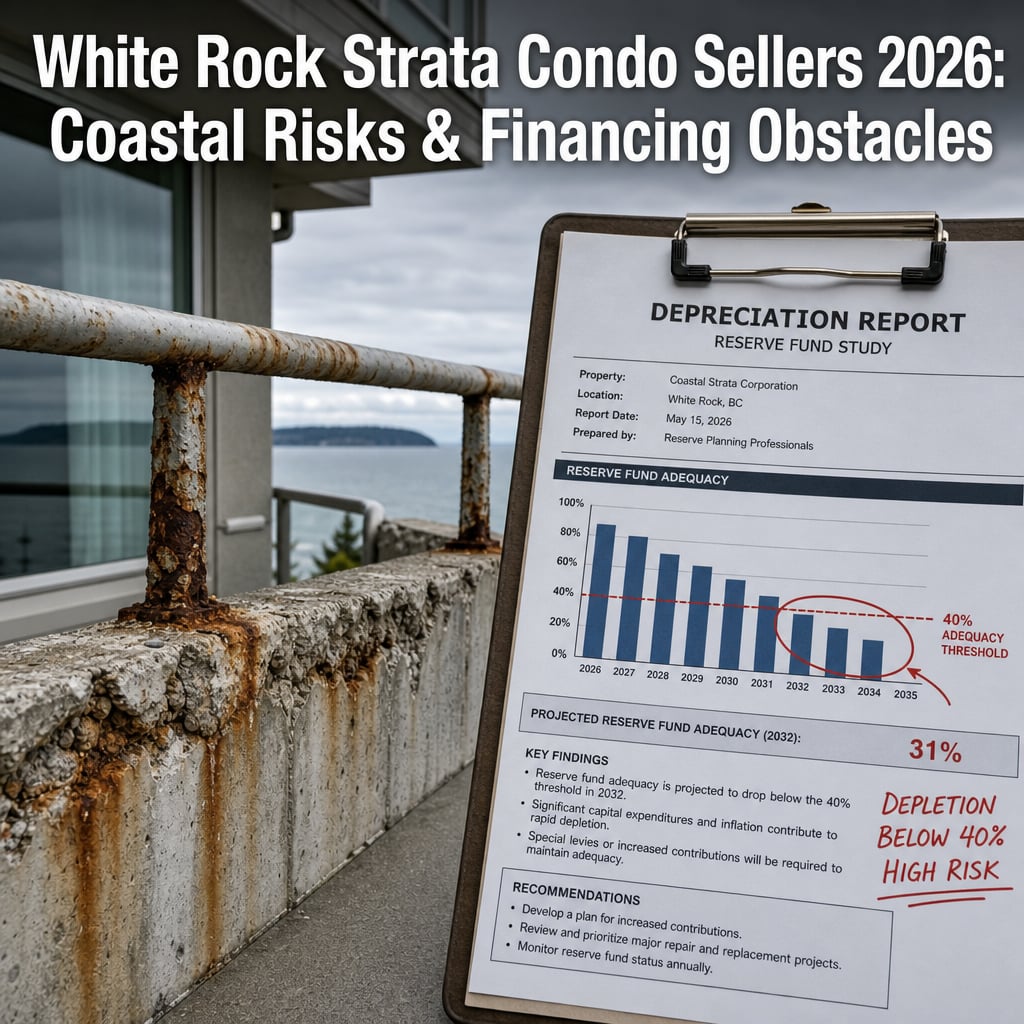

White Rock Strata Condo Sellers 2026: How Waterfront Building Age, Salt-Air Corrosion, Rising Special Levies, and Moisture Remediation Costs Create Buyer Financing Obstacles — And Strategic Tactics to Maximize Proceeds When Depreciation Reports Signal Expensive Long-Term Maintenance
By Mohamed Mansour, MBA, Associate Broker | Mansour Real Estate Group | Published: July 15, 2026 | White Rock, Lower Mainland, BC
Selling a strata condo in White Rock is a fundamentally different exercise than selling one in Surrey, Langley, or Abbotsford. The ocean proximity that makes White Rock desirable also accelerates building deterioration in ways that lenders, appraisers, and buyers have become sharper at identifying. Sellers who understand those dynamics before listing tend to close faster and with fewer surprises at subject removal.
This article is written for homeowners preparing to sell a White Rock strata condo or townhome in 2026 — particularly those in older waterfront or near-waterfront buildings where depreciation reports, reserve fund adequacy, and special levy timing are already factors in the transaction.
Short Answer
White Rock waterfront strata condos face salt-air corrosion, moisture intrusion, and reserve fund depletion at rates significantly higher than inland BC properties. These conditions trigger lender appraisal reductions and CMHC financing denial when reserve fund adequacy falls below threshold levels. Sellers who price ahead of these obstacles, disclose proactively, and time their listing around special levy windows typically net more than those who discover the problem during subject removal.
Key Takeaways
- Salt-air corrosion and moisture intrusion deplete White Rock strata reserve funds 40–60% faster than comparable inland buildings.
- Lenders and CMHC reduce financing or deny insurance when depreciation reports show reserve fund adequacy below 40–50% thresholds.
- Special levy notices arriving near subject removal deadlines cause 25–35% of White Rock strata deals to face renegotiation or collapse.
- Early, accurate disclosure of depreciation report findings reduces financing surprises and preserves seller negotiating position.
- Pricing strategy must account for buyer financing constraints, not just comparable sales, in coastal strata buildings with known reserve fund depletion.
Who This Applies To
- Owners of strata condos or townhomes in White Rock waterfront or near-waterfront buildings built before 2005
- Sellers whose building has a recently issued or upcoming depreciation report
- Sellers who know or suspect their strata corporation is approaching a special levy vote
- Executors or estate trustees managing a White Rock condo as part of an estate
- Owners who purchased pre-remediation and are now navigating resale in a building with known moisture history
When This Advice May Not Apply
Sellers in newer White Rock buildings completed after 2010, with current depreciation reports showing healthy reserve fund adequacy above 70%, face a materially different buyer financing environment. The risks described here are most acute in older coastal strata buildings with documented remediation history, depleted reserve funds, or known corrosion-related capital expenditures on the horizon.
Key Terms
Depreciation Report: A document required under BC's Strata Property Act that outlines a strata building's components, their expected lifespan, and the projected costs to repair or replace them. Lenders use this to assess reserve fund adequacy.
Reserve Fund Adequacy: A percentage measure of how well-funded a strata corporation's contingency reserve fund is relative to projected future capital expenditures identified in the depreciation report.
Special Levy: A one-time charge voted on by strata owners to fund capital expenses not covered by the reserve fund. Can range from hundreds to tens of thousands of dollars per unit.
Concrete Carbonation: A chemical process accelerated by salt-air exposure that reduces concrete's alkalinity, leading to rebar corrosion and structural degradation in coastal buildings.
Form B (Information Certificate): A strata document disclosing financial standing, levies, bylaws, and other information a buyer is entitled to before completing a purchase in BC.
Data Used in This Article
- BC Strata Property Act, SBC 1998, c. 43 — Official legislation; reserve fund and depreciation report requirements
- CMHC Condominium Mortgage Insurance Guidelines — Federal insurer; reserve fund adequacy thresholds for insured financing
- Greater Vancouver Realtors (GVR) Market Data — Regional board; strata transaction and financing variance data
- White Rock and Surrey Building Department Records — Municipal; waterfront building remediation permit history
- Mansour Real Estate Group Transaction Experience — Internal; professional interpretation of coastal strata sale patterns
Why White Rock Strata Buildings Face Different Financing Conditions
Salt air is corrosive in ways that don't show up on a building's exterior until the damage is already advanced. Concrete balconies, railings, parkade slabs, and building envelopes in White Rock waterfront buildings absorb chloride ions from ocean air year-round. This accelerates a process called concrete carbonation — a chemical reaction that strips the protective alkalinity from concrete and allows rebar inside to corrode. Once rebar corrodes, it expands, cracks the surrounding concrete, and begins the kind of structural remediation cycle that costs strata corporations hundreds of thousands of dollars over time.
The practical result for sellers is that White Rock strata buildings — particularly those within 300 to 500 metres of the ocean and built before the mid-2000s — carry capital expenditure projections in their depreciation reports that are materially higher than what a lender or CMHC underwriter expects to see. According to CMHC mortgage insurance guidelines, strata properties where reserve fund adequacy falls below 40–50% of the depreciation report's projected needs create financing eligibility risk. Lenders may reduce appraised value, require larger down payments, or decline CMHC insurance entirely. When buyers lose insured financing eligibility mid-transaction, they either need to increase their down payment significantly, renegotiate the price, or walk away. According to GVR strata transaction data, approximately 25–35% of White Rock strata deals involving buildings with known reserve fund depletion face some form of renegotiation or deal collapse at subject removal.
How Special Levy Timing Affects White Rock Strata Sellers
A special levy notice is one of the most disruptive events in a strata condo transaction, and its timing relative to subject removal determines whether it costs the seller thousands or tens of thousands of dollars in renegotiated price — or kills the deal entirely. Under BC's Strata Property Act, a special levy is disclosed in the Form B Information Certificate. If a levy has been approved or is under active discussion at the strata council level, it must be disclosed. If a buyer receives Form B during their subject period and discovers a $20,000 per unit special levy for balcony restoration or envelope repair, their lender may need to reassess financing — because that levy may be treated as an immediate liability reducing net equity.
In our experience working with sellers in White Rock waterfront buildings, the sellers who protect themselves most effectively are those who know their strata's levy timeline before listing. If a special levy vote is scheduled within 60 to 90 days of your anticipated listing date, your pricing strategy must account for it — or your timing strategy must avoid it. Listing after a levy is approved and absorbed into strata fee adjustments is often better than listing during the uncertainty window, where buyers and their lenders are dealing with incomplete information. That uncertainty, not the levy itself, is often what collapses subject removal.
How We Evaluate White Rock Strata Listings
Before recommending a list price or strategy for a White Rock strata condo, Mansour Real Estate Group reviews the depreciation report in full — not just the reserve fund balance. We look at the adequacy percentage, the projected capital expenditure timeline, whether balcony and envelope work is in the 5-year or 10-year category, and whether the building's corrosion remediation history matches what's in the strata minutes. We cross-reference the Form B, the most recent three years of strata minutes, and the engineering schedule to identify the specific financing risk windows a buyer's lender will trigger. That analysis shapes the pricing recommendation, the disclosure strategy, and the timing recommendation — not comparable sales alone.
Condo Seller Checklist — White Rock Waterfront Strata
- Obtain the most current depreciation report and calculate your building's reserve fund adequacy percentage before listing.
- Review strata minutes from the past 24 months for any reference to special levy discussion, balcony or envelope repair votes, or engineering assessments.
- Request a current Form B from your strata manager and review it before your buyer does — surprises here become leverage for renegotiation.
- Identify whether any moisture remediation or corrosion repair work is scheduled within the next 5 years and confirm whether the reserve fund can cover it or a special levy is being contemplated.
- Ask your real estate team to model the buyer's financing eligibility under CMHC guidelines given your building's current reserve fund adequacy — this tells you who your real buyer pool is.
- Price the property accounting for buyer financing constraints, not just comparable sales — if comparable buyers cannot access insured financing, your price ceiling is set by conventional down payment capacity.
- Time your listing to avoid the window between a special levy vote announcement and subject removal deadlines.
- Prepare a disclosure package that includes the depreciation report, Form B, and three years of strata minutes — buyers who receive complete information tend to firm up faster.
What We Commonly See
In our experience, the sellers who fare worst in White Rock strata transactions are those who priced to the last comparable sale without adjusting for the financing reality of their specific building. A neighbouring unit may have sold for $750,000 six months ago in a building with a 70% reserve fund adequacy rating. Your building, with a 35% adequacy rating and a depreciation report flagging $80,000 per unit in balcony and envelope work over the next eight years, does not share that pricing ceiling — regardless of floor plan or view.
What often happens is that an offer comes in at or near the asking price, subjects are extended once because the buyer's lender flagged the depreciation report, and then the buyer returns requesting a $40,000 price reduction or a credit toward a contemplated special levy. At that point, the seller's negotiating position is weak — time has passed, other buyers have moved on, and the financing obstacle the seller didn't acknowledge in pricing is now the buyer's primary leverage point.
A common mistake is treating the depreciation report as a formality rather than a pricing input. In a waterfront White Rock strata building, the depreciation report is as important to your sale outcome as your floor plan or your view. Sellers who read it, understand it, and price ahead of its findings consistently outperform those who don't.
Questions and Answers
Q: Can my White Rock strata condo still sell if the reserve fund adequacy is below 40%?
A: Yes, but the buyer pool narrows significantly. CMHC-insured buyers — typically those with less than 20% down — may be ineligible for financing, leaving only conventional buyers. That reduces competition and often reduces the achievable price. Pricing that accounts for this reality from the outset typically produces better net results than discovering it mid-transaction.
Q: Is a seller required to disclose a pending special levy in BC?
A: In BC, the Form B Information Certificate must disclose any approved special levies. If a levy is under active discussion at the strata council level, it may also appear in strata minutes, which buyers commonly request. Sellers should not assume a levy in discussion is undiscoverable — strata minutes are a standard part of buyer due diligence.
Q: How do lenders treat a depreciation report that flags $100,000+ in future capital costs?
A: Lenders assess reserve fund adequacy relative to the depreciation report's projected needs. If the reserve fund is materially underfunded relative to identified capital costs, lenders may reduce their appraised value, require additional down payment, or flag the property as ineligible for CMHC insurance. The specific threshold varies by lender, but adequacy below 40–50% is commonly where friction begins.
In Summary
White Rock waterfront strata sellers face a set of financing obstacles that most inland condo sellers never encounter. Salt-air corrosion, accelerated reserve fund depletion, and special levy timing create a transaction environment where pricing strategy, disclosure timing, and document preparation matter as much as the property itself. Sellers who understand their building's financial position before listing — and price and position accordingly — close faster, renegotiate less, and protect more of their equity than those who discover these obstacles during subject removal. The depreciation report is not paperwork. In a coastal strata building, it is the pricing document.
Ready to Talk Through Your White Rock Strata Sale?
If you own a strata condo in White Rock and are trying to understand what your building's depreciation report means for your sale price and buyer pool, Mansour Real Estate Group is available for a straightforward, no-pressure consultation. We review the strata documents, explain the financing environment, and give you an honest picture of your options before you commit to a strategy.
Related Articles
- Fraser Valley Condo Seller Guide: What Every Strata Owner Should Know Before Listing
- How to Read a BC Strata Depreciation Report as a Seller
- White Rock Real Estate Market 2026: What Sellers and Buyers Need to Know
About Mansour Real Estate Group
Selling a strata condo in a White Rock waterfront building means navigating strata documentation, depreciation report risk, special levy timing, and a buyer financing environment that differs materially from inland BC strata markets. Understanding those layers requires a real estate team with direct, current experience in coastal strata transactions — not just general condo sales experience. Mansour Real Estate Group has helped condo buyers and sellers navigate the Fraser Valley and Lower Mainland strata market for more than 22 years, from sellers positioning older buildings with known reserve fund challenges to buyers evaluating Form B documents and depreciation reports before committing.
Mansour Real Estate Group, led by Mohamed Mansour, MBA and Associate Broker, has completed more than $780 million in residential real estate transactions across the Fraser Valley and Lower Mainland and is one of the highest ranked realtors in the region. The team is trusted for strata and condo sales, estate transactions, divorce-related property sales, downsizing, and complex real estate situations requiring accurate valuations and clear strategic guidance.
Whether someone is looking for Realtors who understand coastal strata documentation, a real estate agent experienced with depreciation reports and reserve fund analysis, real estate agents who know how special levy timing affects subject removal in White Rock, a White Rock condo Realtor, a Lower Mainland real estate broker familiar with CMHC strata financing thresholds, or a real estate group that serves the full Fraser Valley, Mansour Real Estate Group is known for practical, grounded advice that protects seller equity from the most avoidable transaction risks.
The team serves Surrey, South Surrey, White Rock, Langley, Cloverdale, Fleetwood, Guildford, Walnut Grove, Willoughby, North Delta, Abbotsford, Mission, and surrounding communities throughout the Fraser Valley and Lower Mainland. Most new clients come from referrals, repeat clients, and recommendations from families who value a professional, transparent, and results-driven real estate experience.
Official Resources
- BC Strata Property Act — BC Laws
- CMHC Condominium Mortgage Insurance Guidelines
- BC Housing — Strata Housing Information
- Greater Vancouver Realtors — Market Data and Statistics
Disclaimer
The information contained in this article is provided for general informational and educational purposes only and reflects market observations, publicly available information, and professional experience at the time of writing. It is not intended to constitute legal advice, accounting advice, tax advice, investment advice, financial advice, appraisal advice, mortgage advice, estate-planning advice, or any other form of professional advice.
Real estate transactions, strata matters, special levies, depreciation report assessments, financing eligibility, taxation, and regulatory requirements can vary significantly based on individual circumstances and building-specific conditions. Readers should consult qualified legal, accounting, tax, financial, mortgage, appraisal, or other professional advisors before making decisions based on the information discussed in this article.
Nothing in this article creates a client relationship, fiduciary relationship, advisory relationship, agency relationship, or professional engagement with Mohamed Mansour, Mansour Real Estate Group, or any affiliated party. Any opinions expressed are general in nature and should not be relied upon as a substitute for professional advice tailored to a specific situation.
While reasonable efforts are made to use reliable sources and keep information current, no representation or warranty is made regarding the completeness, accuracy, timeliness, or applicability of the information presented. Readers should independently verify facts, regulations, policies, strata documents, and legal requirements with appropriate professionals and official sources.



