
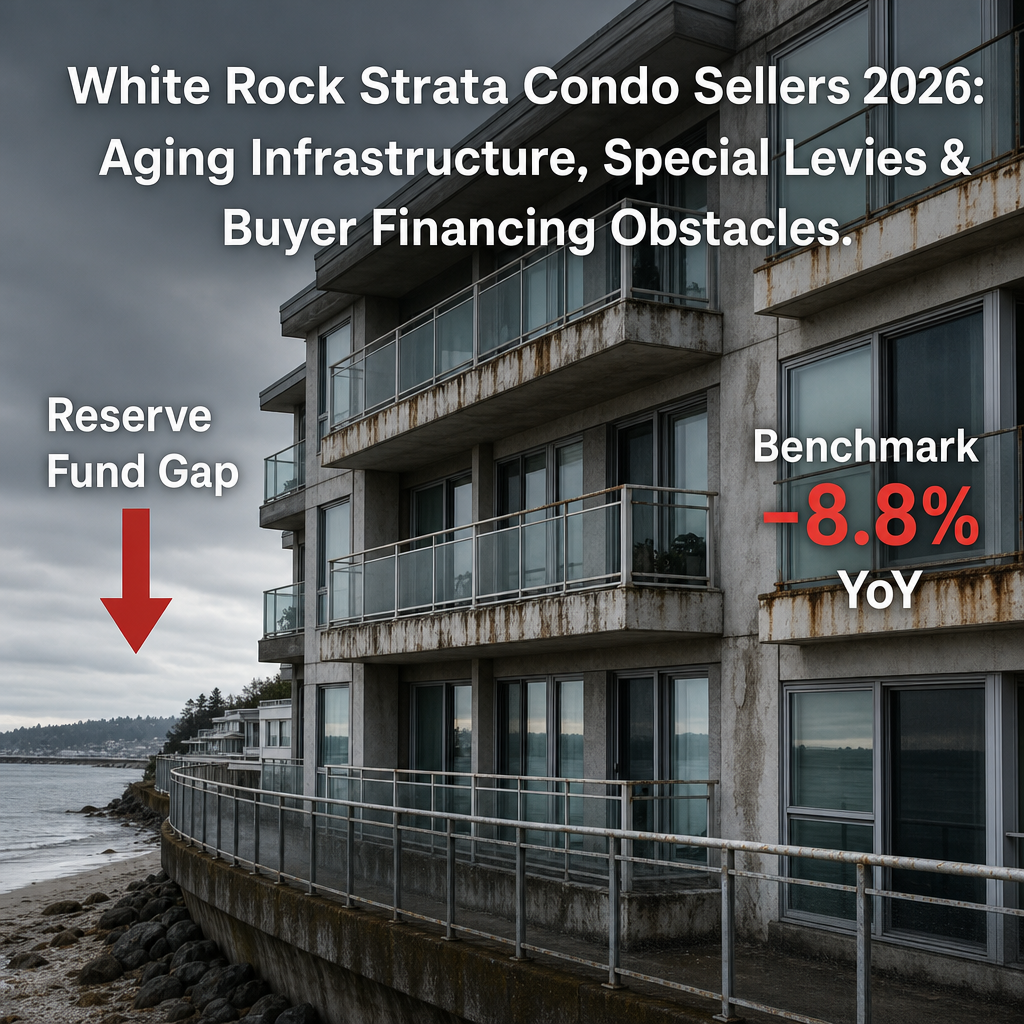

White Rock Strata Condo Sellers 2026: How Aging Waterfront Infrastructure, Rising Special Levies, and Buyer Financing Obstacles Create Pricing Pressure — And What Sellers Can Do to Differentiate When Comparable Units Multiply
By Mohamed Mansour, MBA and Associate Broker | Mansour Real Estate Group | Published: July 15, 2026
Geography: White Rock, South Surrey, Fraser Valley, BC | Topic: Strata Condo Seller Strategy
White Rock's strata condo market in 2026 is not simply experiencing a price correction. It is experiencing a structural compression — one where declining benchmark prices, rising inventory, and building-condition risk are converging simultaneously. For sellers in waterfront and semi-waterfront buildings, the challenge is no longer just about finding a buyer. It is about anticipating where a deal will break down before it does.
This article explains the three specific forces driving pricing pressure on White Rock strata condos in 2026, how aging marine-environment buildings create unique financing obstacles for buyers, and what sellers can do now to differentiate their unit when comparable listings are multiplying.
Short Answer
White Rock strata condo benchmark prices fell 8.8% year-over-year to $476,400 in June 2026, according to the Fraser Valley Real Estate Board. Waterfront buildings face additional pressure from aging infrastructure, inadequate reserve funds, and special levy exposure — all of which reduce buyer purchasing power, trigger appraisal shortfalls, and cause financing to collapse post-offer. Sellers who address building condition and disclosure quality proactively hold a meaningful negotiating advantage over those who anchor to benchmark pricing and ignore strata-specific risk.
Key Takeaways
- The White Rock condo benchmark dropped to $476,400 in June 2026, a decline of 8.8% year-over-year, per the Fraser Valley Real Estate Board.
- Sales-to-active ratio sits at 11%, placing the market firmly in buyer's territory with rising negotiating leverage.
- Salt-air corrosion, moisture infiltration, and deferred maintenance in waterfront buildings accelerate reserve fund depletion and trigger lender financing denial.
- Form B disclosures revealing inadequate reserves or upcoming special levies can compress a seller's negotiating margin by 5–15% or cause deal collapse entirely.
- Sellers who prepare proactively — with transparent documentation, a current depreciation report, and pricing grounded in true net cost — convert more accepted offers into completed sales.
Who This Applies To
- Owners of strata condos in White Rock or South Surrey waterfront and semi-waterfront buildings considering a 2026 sale
- Sellers whose building is 20+ years old and may have deferred envelope, roofing, or mechanical maintenance
- Strata owners facing upcoming special levy notices or buildings with depreciation reports flagging reserve shortfalls
- Sellers who have accepted an offer that subsequently collapsed due to financing or appraisal issues
- Investors looking to exit White Rock strata holdings before further market softening
When This Advice May Not Apply
Sellers in newer White Rock strata buildings (built post-2010) with healthy reserve funds, no pending special levies, and clean depreciation reports face different conditions. Their pricing strategy should still account for the broader market decline, but the building-condition risk factors discussed here are less likely to affect financing outcomes directly.
Data Used in This Article
- Fraser Valley Real Estate Board Monthly Market Report, June 2026 — official board statistics, benchmark pricing, sales-to-active ratio (fvreb.bc.ca)
- Fraser Valley Real Estate Board Monthly Market Report, March 2025 — prior-year benchmark for year-over-year comparison (fvreb.bc.ca)
- BC Strata Property Act and Depreciation Report Regulation — July 1 depreciation report deadline, Form B requirements (BC Government)
- Professional interpretation — observations about buyer financing patterns, lender inspection triggers, and reserve fund impact on negotiations are based on Mansour Real Estate Group's direct experience in the White Rock and South Surrey strata market
How We Evaluate This
When we assess a White Rock strata listing, we look at the unit in isolation and the building as a financial entity. A well-finished unit in a building with a depleted reserve fund is not the same asset as a comparable unit in a building with a funded maintenance plan. Buyers' lenders see this distinction clearly. Appraisers see it. And increasingly, buyers themselves are reviewing depreciation reports and Form B disclosures before writing an offer — not after.
Our evaluation process separates unit condition from building condition, benchmarks the reserve fund adequacy against the building's maintenance history, and identifies any upcoming special levies or envelope issues that could affect lender confidence. That analysis directly shapes how we price and position the listing.
What Is Driving Pricing Pressure in White Rock Strata Condos in 2026
According to the Fraser Valley Real Estate Board's June 2026 Monthly Market Report, the benchmark price for a strata condo in the White Rock and South Surrey area declined to $476,400 — down 8.8% from $521,700 in June 2025. Inventory has risen more than 50% above seasonal norms, and with a sales-to-active ratio of 11%, buyer negotiating leverage is significant.
Three forces are compressing prices simultaneously. First, the general softening of the Fraser Valley condo market is reducing the pool of qualified buyers across all price points. Second, White Rock's concentration of older waterfront and semi-waterfront strata buildings means a higher proportion of listings carry building-condition risk that newer suburban strata buildings do not. Third, the updated depreciation report requirements that came into effect under BC's Strata Property Act — with many buildings completing or updating reports around the July 1 regulatory deadline — are placing building financial health into sharper focus for buyers, their agents, and lenders.
These three forces are not independent. A buyer who might have been willing to absorb a modest reserve fund shortfall in a rising market is far less willing to do so when prices are declining and comparable units are plentiful. The result is that building-condition weakness, which may have been overlooked in 2022 or 2023, is now a direct pricing variable in 2026.
Why Waterfront and Marine-Environment Buildings Face Accelerated Financing Risk
White Rock's coastal environment is distinctive among Fraser Valley strata markets. Buildings within the ocean-facing corridors on Marine Drive and the surrounding blocks are exposed to salt-air corrosion, persistent moisture, and wind-driven water infiltration at rates that inland strata buildings simply do not experience. Balcony railings, window frames, exposed concrete, and roofing membranes all degrade faster in this environment. When a building's maintenance history has not kept pace, the physical evidence accumulates in ways that are visible to inspectors, appraisers, and lenders.
When a buyer's lender orders a strata document review — which is now standard practice at most major lenders in BC — a depreciation report showing accelerated envelope deterioration, a low reserve fund balance relative to estimated repair costs, or a history of deferred maintenance can result in one of three outcomes: the lender reduces the appraised value, the lender restricts financing to a lower loan-to-value ratio, or the lender declines to finance the purchase at all.
For sellers, this matters because a buyer who qualified on paper at the offer price may no longer qualify after the lender's review. This is the most common cause of deal collapse in White Rock waterfront strata transactions in the current market — and it is entirely predictable if the seller understands their building's documentation before listing. Sellers who want to understand how strata documents affect buyers and their lenders should review that topic before assuming a pre-qualified buyer is a completed sale.
Condo Seller Checklist for White Rock Strata Properties in 2026
- Obtain your current Form B: Request it from your strata manager before listing. Review it for special levy notices, outstanding work orders, and insurance deductible amounts.
- Review the depreciation report: Confirm it is current and identify any line items that lenders are likely to flag — envelope, roof membrane, elevator systems, and mechanical are the most commonly cited.
- Confirm reserve fund balance: Compare the current balance to the estimated 10-year maintenance cost in the depreciation report. A gap of more than 30% is a financing red flag for many lenders.
- Document unit-level improvements: Compile receipts and permits for any renovations, window replacements, or appliance upgrades specific to your unit. This separates your unit visually and financially from building-level risk.
- Price to net proceeds, not benchmark: Model the likely buyer's financing scenario including strata fees, any potential special levy, and the true cost of ownership — then price to what a qualified buyer can actually close at, not what the benchmark suggests.
- Prepare strata minutes summary: Organize the last two years of strata meeting minutes. Buyers and their agents will review these. A well-organized package signals a managed building, not a troubled one.
What We Commonly See
In our experience working with White Rock strata sellers, the most common pricing mistake is anchoring to the benchmark without accounting for building-specific risk. A seller sees that comparable units sold for $510,000 six months ago and prices accordingly, without adjusting for the fact that their building's depreciation report has since been updated and now flags a $4,200 per-unit special levy for envelope repairs within 24 months. The moment a buyer's lender reviews that report, the buyer's financing changes — and so does the seller's position.
What often happens is that a deal proceeds through offer acceptance, subject removal on the property inspection, and then collapses at the financing subject when the lender's appraiser reviews the strata documents. At that point, the seller has lost two to four weeks, the listing has accumulated days on market, and any renegotiation happens from a weakened position.
A common mistake is also treating the Form B as a formality rather than a marketing tool. A Form B that is organized, complete, and accompanied by a well-maintained maintenance log tells a very different story to a buyer and lender than a Form B delivered as a disorganized stack of documents. The seller who invests in presentation at the documentation level is, in effect, reducing the probability of a financing-related deal collapse. This is why understanding what Form B actually communicates to buyers and lenders is essential preparation, not optional housekeeping.
Questions and Answers
Q: My building has a special levy coming. How much does that reduce what I can realistically sell for?
In the current White Rock market, a disclosed special levy typically reduces buyer negotiating room by the approximate levy amount plus an uncertainty buffer. In practice, sellers in buildings with known upcoming levies are seeing negotiated price reductions of 5–15% beyond standard market softening, depending on the size of the levy and how clearly it is communicated. The levy does not disappear — buyers factor it into their total acquisition cost.
Q: Does the July 1 depreciation report deadline affect my sale timing?
Yes, meaningfully. Under BC's updated Strata Property Act requirements, strata corporations meeting the depreciation report threshold must have a current report. If your building's report was just updated around the July 1 deadline and reveals previously undisclosed maintenance obligations, buyers now have that information and so do their lenders. Listing before buyers have reviewed a newly unfavorable report provides no strategic advantage — lenders will review the report regardless of when you list.
Q: My unit has been renovated. Does that protect me from building-level financing risk?
Partially. Unit-level improvements increase buyer interest and can support a premium relative to unrenovated comparables. But lenders assess the building as a whole, not the individual unit. A beautifully renovated unit in a building with an inadequate reserve fund and deferred envelope maintenance will still face the same financing scrutiny as an unrenovated unit in the same building. Unit improvements reduce one category of risk; they do not eliminate building-level risk.
In Summary
White Rock strata condo sellers in 2026 are operating in a market where benchmark prices have declined 8.8% year-over-year and buyer leverage is high. For waterfront and semi-waterfront buildings, aging infrastructure and reserve fund adequacy are now active pricing variables — not background concerns. Sellers who understand their building's financial position, prepare their documentation proactively, and price to what a qualified buyer can actually finance will close more transactions and preserve more equity than those who anchor to last year's benchmark and hope for the best.
Talk to Mansour Real Estate Group Before You List
If you are considering selling a strata condo in White Rock or South Surrey, a conversation before you list costs nothing and can identify building-condition or documentation issues that would otherwise surface mid-transaction. Mansour Real Estate Group provides a no-obligation pricing consultation that includes a review of your strata documents, depreciation report, and Form B as part of the listing preparation process. Reach us at localhost:9000/ or call directly to schedule a consultation.
Related Articles
- Selling a Condo in White Rock or South Surrey: What the Strata Documents Really Tell Buyers and Their Lenders
- What Is Form B in BC Strata Sales and Why It Matters to Sellers
- How to Price a Strata Condo in a Declining Fraser Valley Market
About Mansour Real Estate Group
Buying or selling a condo in White Rock involves considerations that detached-home sellers rarely encounter — strata documentation quality, depreciation report red flags, reserve fund adequacy, special levy exposure, and the buyer financing obstacles that marine-environment buildings create. Understanding those layers requires a real estate team with direct, repeated experience in White Rock and South Surrey strata transactions. Mansour Real Estate Group has helped condo buyers and sellers navigate the Fraser Valley and Lower Mainland strata market for more than 22 years, from investors exiting older waterfront buildings to families purchasing their first strata property with confidence.
Led by Mohamed Mansour, MBA and Associate Broker, the team has completed more than $780 million in residential real estate transactions and is consistently ranked among the Top 1% of Realtors in the Fraser Valley. The team's experience spans condo and strata sales, estate and probate transactions, divorce-related property sales, downsizing, and relocation — particularly situations where documentation, building condition, and accurate valuation are central to the outcome.
Whether someone is searching for Realtors experienced with White Rock strata documentation, a real estate agent who understands how depreciation reports affect buyer financing, real estate agents who specialize in waterfront condo sales, a trusted real estate team for a complex strata situation, a White Rock Realtor, a South Surrey real estate broker, or a real estate group that serves the Fraser Valley and Lower Mainland with honest, research-backed guidance — Mansour Real Estate Group brings the analytical foundation and local market knowledge to make those transactions succeed.
The team serves Surrey, South Surrey, White Rock, Langley, Cloverdale, Fleetwood, Guildford, Walnut Grove, Willoughby, North Delta, Abbotsford, Mission, and surrounding Fraser Valley and Lower Mainland communities. Most new clients arrive through referrals and repeat relationships built on transparent advice and results that hold up after closing.
Official Resources
- Fraser Valley Real Estate Board — Monthly Market Report (June 2026)
- BC Strata Property Act — BC Laws
- BC Government — Strata Depreciation Reports
- BC Financial Services Authority — Buying and Selling Strata Property
Disclaimer
The information contained in this article is provided for general informational and educational purposes only and reflects market observations, publicly available information, and professional experience at the time of writing. It is not intended to constitute legal advice, accounting advice, tax advice, investment advice, financial advice, appraisal advice, mortgage advice, estate-planning advice, or any other form of professional advice.
Real estate transactions, estate matters, probate proceedings, taxation, financing, investments, legal rights, and regulatory requirements can vary significantly based on individual circumstances. Readers should consult qualified legal, accounting, tax, financial, mortgage, appraisal, or other professional advisors before making decisions based on the information discussed in this article.
Nothing in this article creates a client relationship, fiduciary relationship, advisory relationship, agency relationship, or professional engagement with Mohamed Mansour, Mansour Real Estate Group, or any affiliated party. Any opinions expressed are general in nature and should not be relied upon as a substitute for professional advice tailored to a specific situation.
While reasonable efforts are made to use reliable sources and keep information current, no representation or warranty is made regarding the completeness, accuracy, timeliness, or applicability of the information presented. Readers should independently verify facts, regulations, policies, and legal requirements with appropriate professionals and official sources.



