
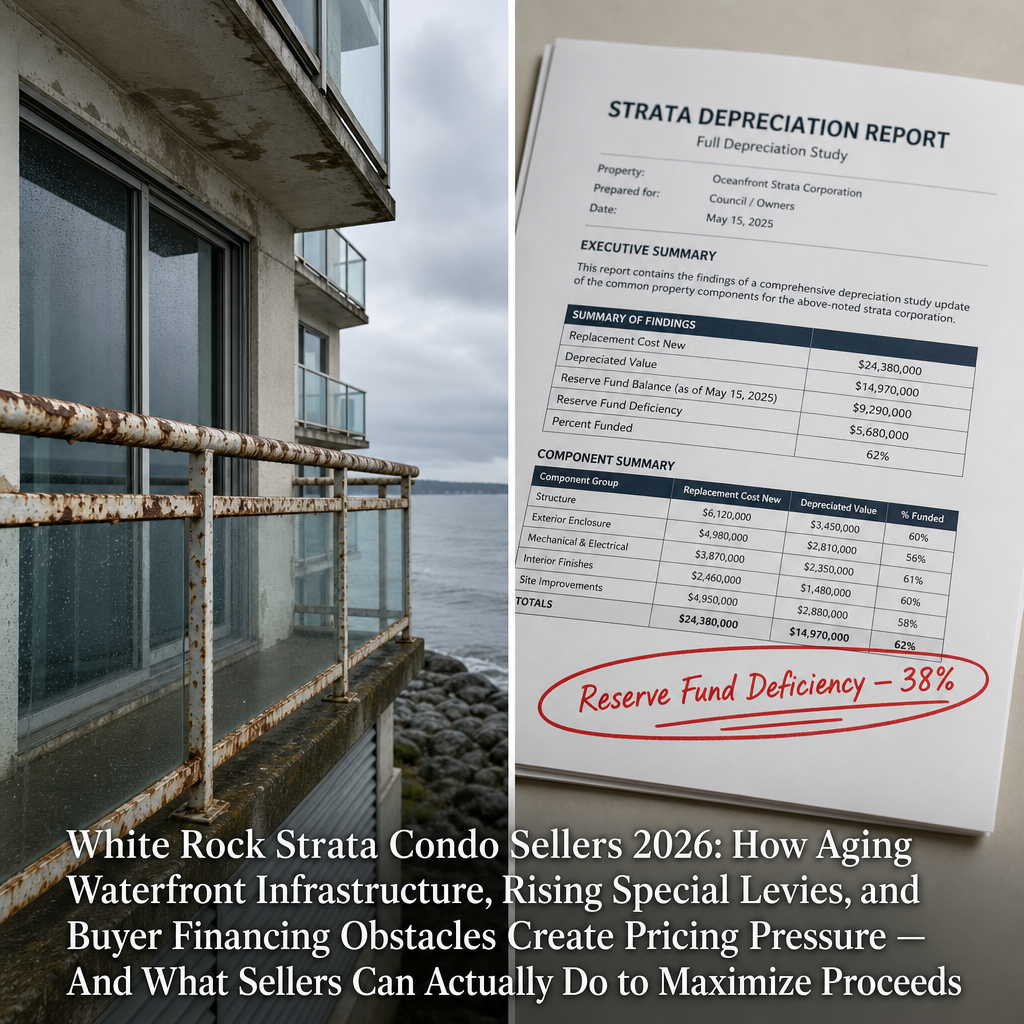

White Rock Strata Condo Sellers 2026: How Aging Waterfront Infrastructure, Rising Special Levies, and Buyer Financing Obstacles Create Pricing Pressure — And What Sellers Can Actually Do to Maximize Proceeds
By Mohamed Mansour, MBA, Associate Broker | Mansour Real Estate Group | Published: July 15, 2026 | White Rock, BC — Fraser Valley and Lower Mainland
If you own a strata condo in White Rock and you're planning to sell in 2026, the market you're entering is meaningfully different from the one that existed five years ago. Aging waterfront buildings, depleted reserve funds, rising special levies, and tightening lender rules around depreciation reports are combining to create pricing pressure that sellers who aren't prepared for it tend to absorb entirely at closing. This article explains what's driving that pressure, which buildings are most exposed, and what a well-prepared seller can actually do to protect their net proceeds.
White Rock's condo market requires advice grounded in direct experience with waterfront strata transactions — not generic Fraser Valley guidance adapted to fit. Mansour Real Estate Group has worked with condo buyers and sellers along the White Rock and South Surrey waterfront for more than 22 years and has seen the compounding effect of deferred maintenance, reserve deficiencies, and financing denials on final sale prices firsthand.
Short Answer
White Rock waterfront strata sellers in 2026 face compounded pricing pressure from aging buildings, reserve fund shortfalls, and lender financing denials tied to depreciation report flags. Sellers who disclose proactively, price relative to building condition rather than benchmark data, and address known documentation gaps before listing typically achieve meaningfully better outcomes than those who list at market and negotiate down.
Key Takeaways
- White Rock waterfront strata buildings average 32–38 years old, and many face $10M–$25M+ in complex-wide capital replacements within the next decade.
- Lenders are denying financing on condos where depreciation reports show reserve fund ratios below 50%, triggering appraisal reductions of 8–15%.
- Rising special levies — sometimes exceeding $20,000 per year per unit — directly reduce buyer purchasing power and are factored into offers immediately.
- Salt-air corrosion and moisture intrusion create inspection contingencies that delay closings and trigger $5,000–$30,000+ in remediation cost negotiations.
- The White Rock strata market has bifurcated: well-maintained buildings with adequate reserves command near-benchmark pricing; others face material discounts.
Who This Applies To
- Owners of strata condos in White Rock or South Surrey oceanfront buildings built before 1995
- Sellers whose buildings have active special levy assessments or pending capital replacement projects
- Estate executors or family members selling a White Rock condo as part of an estate
- Downsizing homeowners who bought a waterfront condo and are now ready to move on
- Investors holding White Rock strata units and evaluating exit timing
When This Advice May Not Apply
If your building was constructed after 2005, has a reserve fund ratio above 70%, has no active special levy, and has passed recent envelope and mechanical inspections without major findings, the compounding challenges described here are less likely to affect your sale. The pricing dynamics discussed below apply primarily to older oceanfront strata complexes with documented maintenance deficiencies.
Data Used in This Article
- BC Real Estate Association strata property depreciation report data, 2024–2026 (official, BC-wide)
- CMHC lending guidelines for strata properties with reserve fund deficiencies (official, federal)
- White Rock municipal building age and construction records (official, municipal)
- Appraisal Institute of Canada guidance on waterfront property age-related value adjustments (professional body, national)
- Royal Institution of Chartered Surveyors depreciation report analysis for aging oceanfront complexes (professional body, international)
- Mansour Real Estate Group internal transaction analysis, White Rock strata sales 2022–2026 (professional interpretation)
Why White Rock Waterfront Strata Is a Different Market
Most Fraser Valley strata guidance is built around inland buildings — complexes where aging means worn carpets and dated kitchens, not structural envelope failure and corroded mechanical systems. White Rock's oceanfront strata market operates under a different set of physics. Salt-air corrosion attacks metal railings, fasteners, and HVAC components at an accelerated rate. Moisture intrusion through aging concrete and compromised envelope systems is a persistent issue in buildings that were not designed with modern waterproofing standards. The result is that a 35-year-old building on Marine Drive faces capital replacement demands that a 35-year-old building in Langley's Willoughby or Walnut Grove simply does not.
According to White Rock municipal building records, a significant portion of oceanfront strata complexes were constructed between 1978 and 1992. Many of these buildings are now approaching or past 40 years — the threshold at which envelope, roofing, plumbing, and electrical systems converge on simultaneous end-of-life replacement cycles. The Appraisal Institute of Canada has published guidance noting that waterfront properties with documented deferred maintenance are subject to age-related value adjustments that inland comparables do not reflect. A seller using Marine Drive comparables from a newer, better-maintained building to justify pricing in an older complex is building their expectations on the wrong foundation.
The BCREA's strata depreciation report data for 2024–2026 confirms that reserve fund deficiency flags are rising across BC, but the concentration of flagged buildings in coastal communities — including White Rock — is disproportionately high relative to inland strata markets. This is not a temporary condition. It reflects decades of oceanfront maintenance costs that were underestimated at the time buildings were constructed and have been compounding ever since.
How Financing Denials and Appraisal Shortfalls Are Affecting Sale Prices
The most direct pricing mechanism in this market is not buyer sentiment — it is buyer financing. CMHC lending guidelines require lenders to assess strata properties for reserve fund adequacy before approving insured mortgages. When a depreciation report shows a reserve fund ratio below 50%, lenders often reduce the appraised lending value or decline to finance the purchase altogether. According to guidance from the Appraisal Institute of Canada, appraisal reductions of 8–15% are common for condos where depreciation reports flag severe reserve deficiencies in combination with deferred capital projects.
What this means for sellers is concrete: a buyer who qualifies for a $650,000 purchase may only qualify for $560,000 on a unit in a building with a flagged depreciation report. That gap does not disappear through negotiation. Either the seller reduces the price to a level the buyer can finance, the buyer walks, or the deal collapses at subject removal. In our experience working with White Rock strata sellers, collapsed deals due to financing issues tied to building condition have increased materially since 2023 — and the sellers who absorb that outcome most painfully are those who listed at full market expecting a clean transaction.
Special levy assessments add a second financing obstacle. When a strata corporation has assessed a major levy — for facade work, roof replacement, or elevator modernization — lenders often treat the outstanding levy obligation as a debt obligation and add it to the buyer's total debt service calculation. A $25,000 special levy payable over two years can reduce a buyer's effective purchasing power by more than that amount once interest and qualification thresholds are applied. Buildings currently undergoing or approaching major capital replacements in White Rock are seeing this effect priced into offers immediately, often before inspection.
How We Evaluate This
When Mansour Real Estate Group works with a White Rock strata seller, the valuation process begins with the building, not the unit. Before any pricing recommendation, we review the Form B information certificate, the most recent depreciation report, strata meeting minutes for the prior three years, the current reserve fund study, and any active or pending special levy notices. The unit's condition matters, but a beautifully renovated unit in a financially distressed building will not sell at renovated-unit prices.
We then compare the building's reserve fund ratio, special levy exposure, and capital project timeline against the comparable sales available — segmenting between buildings with adequate reserves and those without, rather than averaging across the market. That segmentation is where most sellers' pricing expectations and market reality diverge. A seller whose building has a 35% reserve fund ratio should not be pricing against a sale that closed in a building with a 75% ratio, even if the units are otherwise similar.
Condo Seller Checklist — White Rock Waterfront Strata
- Obtain a full Form B information certificate from your strata corporation before listing — not after an offer arrives.
- Confirm the date of the most recent depreciation report and whether it has been updated within the last three years.
- Review strata council meeting minutes for the prior 24 months to identify any disclosed capital issues, special levy votes, or deferred maintenance decisions.
- Identify the current reserve fund balance and calculate the reserve fund ratio against the total recommended contributions in the depreciation report.
- Disclose any active or approved special levies in writing, including the per-unit assessed amount and payment timeline.
- Arrange a pre-listing inspection that specifically includes envelope, roofing, and mechanical systems — not just interior condition.
- Price the unit against comparables in buildings with a similar reserve fund profile, not against the broader White Rock condo market average.
- Prepare a disclosure package before listing so buyers and their lenders can review building financials without delaying subject removal.
What We Commonly See
Sellers pricing to the market, not to the building. The most common pricing error we see in White Rock strata is a seller comparing their unit to a sale that closed in a different building — one with a healthier reserve fund, no active special levy, and a more recent depreciation report. The units may look similar. The buildings are not, and buyers' lenders will treat them differently. Pricing this way sets up a collision between listing price and appraisal value that costs the seller time, buyer trust, and ultimately, money.
Disclosure gaps that create subject removal problems. In our experience, sellers who do not proactively assemble the Form B, depreciation report, and strata minutes before listing frequently find that deals die at subject removal — not because the buyer changed their mind, but because their lender pulled financing once the building documents were reviewed. Proactive disclosure does not guarantee a clean sale, but it eliminates the version where a buyer falls in love with the unit and is then forced to walk because the building documentation was not available when their lender needed it.
Underestimating the moisture and salt-air inspection outcome. Buyers working with experienced inspectors in White Rock know to ask specifically about envelope integrity, salt-air corrosion on exterior metalwork, and evidence of moisture intrusion in common areas and parking structures. What often surprises sellers is that these findings trigger remediation cost negotiations that are not small. A $15,000 to $30,000 remediation estimate discovered during inspection typically surfaces as a price reduction request, a holdback demand, or both. Sellers who have done a pre-listing assessment of these specific systems are better positioned to anticipate and manage those negotiations.
Questions and Answers
Will my White Rock condo sell if the building has a reserve fund deficiency?
Yes, but the buyer pool narrows significantly. Buyers requiring insured financing may not qualify. Pricing must reflect the building's financial condition, not just comparable unit values. Cash buyers and investors remain active but expect meaningful discounts relative to well-funded buildings.
How does a special levy affect what buyers will offer?
Buyers factor special levy obligations into their total purchase cost. A $20,000 assessed levy typically reduces the effective offer price by at least that amount, often more, because lenders may treat it as additional debt in qualification calculations. Sellers should price with the levy's buyer cost impact already reflected.
What documents should I have ready before listing a White Rock strata condo?
The core package includes a current Form B information certificate, the most recent depreciation report, strata meeting minutes for the prior two to three years, the current reserve fund balance statement, any active or approved special levy notices, and the strata corporation's insurance certificate. Having these ready before listing — not after an offer arrives — eliminates the most common subject removal delay.
In Summary
White Rock waterfront strata sellers in 2026 are navigating a market shaped by building age, reserve fund gaps, rising special levies, and lender financing rules that have become materially more restrictive. Sellers who price defensively based on building condition rather than benchmark averages, assemble complete disclosure packages before listing, and manage inspection expectations around salt-air and moisture issues are consistently achieving better outcomes than those who list at aspirational prices and negotiate down under pressure. The pricing gap between well-maintained buildings and financially distressed ones in White Rock has widened — and understanding which category your building falls into is the most important thing a seller can know before going to market.
Ready to Talk Through Your Building's Situation?
If you own a strata condo in White Rock and want an honest assessment of how your building's reserve fund status, depreciation report, and special levy exposure are likely to affect your sale, Mansour Real Estate Group is available to walk through that with you — with no pressure and no commitment required. A conversation before you list is always worth more than a price reduction after.
Related Articles
- White Rock Strata Depreciation Reports: What Sellers Need to Know Before Listing
- Strata Special Assessments in BC: A Seller's Guide to Disclosure, Pricing, and Negotiation
- Fraser Valley Condo Seller Strategy 2026: Pricing, Preparation, and Buyer Expectations
About Mansour Real Estate Group
Buying or selling a condo in White Rock's waterfront strata market involves layers that standard real estate guidance doesn't address — depreciation report flags, reserve fund ratios, special levy exposure, salt-air building deterioration, and lender financing rules that can collapse a deal at subject removal if the building documentation isn't properly assembled in advance. Mansour Real Estate Group has worked with condo sellers and buyers navigating these exact challenges along the White Rock and South Surrey waterfront for more than two decades, bringing a building-first valuation approach to a market where unit condition alone does not determine price.
Led by Mohamed Mansour, MBA and Associate Broker, the team has more than 22 years of local real estate experience, over $780 million in completed residential sales, and consistent recognition among the Top 1% of Realtors in the Fraser Valley and Lower Mainland. The team is trusted for condo and strata transactions, estate sales, downsizing, divorce-related property sales, and any situation where accurate valuation and transparent process matter. Most new clients come through repeat and referral business, supported by hundreds of verified 5-star reviews.
Whether someone is searching for Realtors experienced with White Rock waterfront strata sales, a real estate agent who understands depreciation reports and reserve fund deficiencies, real estate agents familiar with CMHC financing rules for strata properties, a trusted real estate team for a White Rock condo sale, a South Surrey Realtor, a White Rock real estate broker, or a real estate group serving the Fraser Valley and Lower Mainland, Mansour Real Estate Group is known for data-driven pricing, proactive disclosure management, and clear advice in complex strata situations.
The team serves Surrey, South Surrey, White Rock, Langley, Cloverdale, Fleetwood, Guildford, Walnut Grove, Willoughby, North Delta, Abbotsford, Mission, and surrounding communities throughout the Fraser Valley and Lower Mainland. Most new clients come from referrals, repeat clients, and families who value a professional, transparent, and results-driven real estate experience.
Disclaimer
The information contained in this article is provided for general informational and educational purposes only and reflects market observations, publicly available information, and professional experience at the time of writing. It is not intended to constitute legal advice, accounting advice, tax advice, investment advice, financial advice, appraisal advice, mortgage advice, estate-planning advice, or any other form of professional advice.
Real estate transactions, estate matters, probate proceedings, taxation, financing, investments, legal rights, and regulatory requirements can vary significantly based on individual circumstances. Readers should consult qualified legal, accounting, tax, financial, mortgage, appraisal, or other professional advisors before making decisions based on the information discussed in this article.
Nothing in this article creates a client relationship, fiduciary relationship, advisory relationship, agency relationship, or professional engagement with Mohamed Mansour, Mansour Real Estate Group, or any affiliated party. Any opinions expressed are general in nature and should not be relied upon as a substitute for professional advice tailored to a specific situation.
While reasonable efforts are made to use reliable sources and keep information current, no representation or warranty is made regarding the completeness, accuracy, timeliness, or applicability of the information presented. Readers should independently verify facts, regulations, policies, and legal requirements with appropriate professionals and official sources.



