
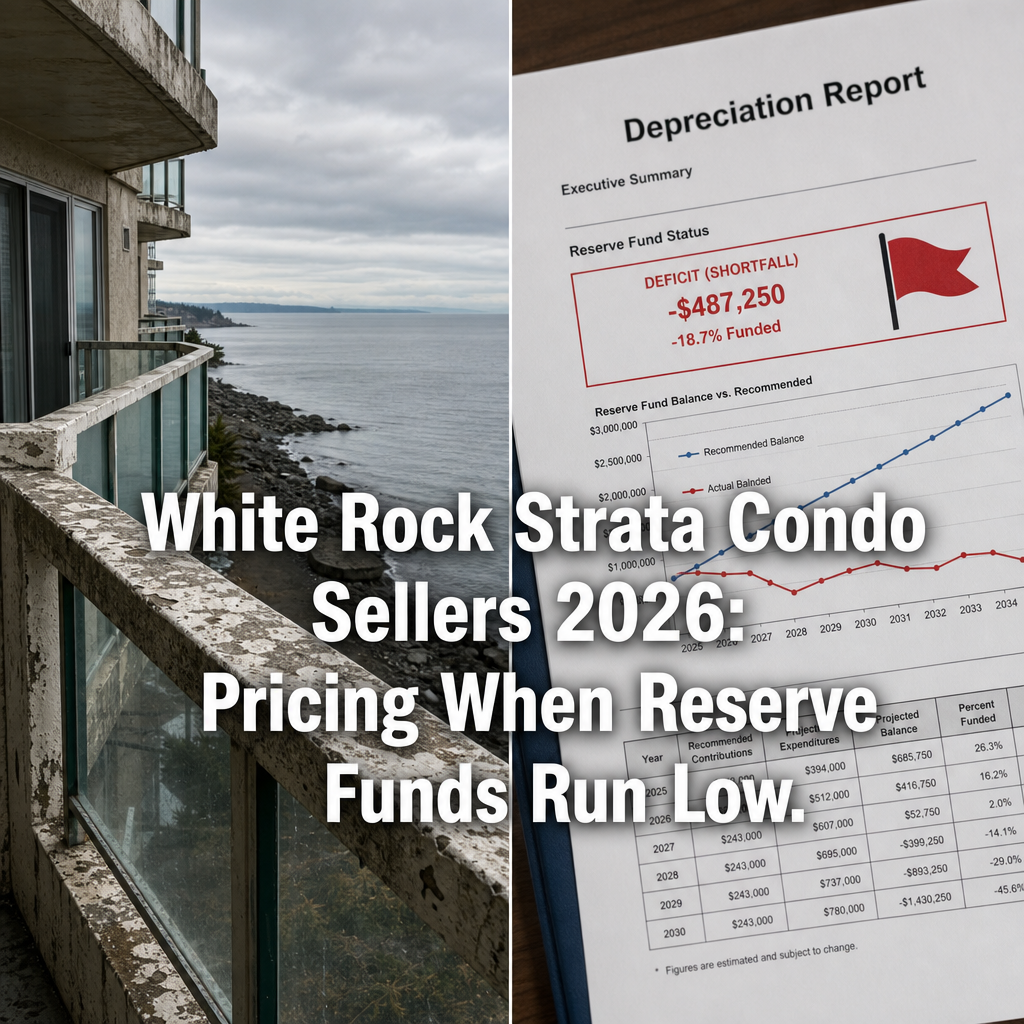

White Rock Strata Condo Sellers 2026: How Aging Waterfront Infrastructure, Rising Special Levies, and Buyer Financing Obstacles Create Pricing Pressure — And Strategic Tactics to Maximize Proceeds When Depreciation Reports Trigger Appraisal Shortfalls
By Mohamed Mansour, MBA and Associate Broker | Mansour Real Estate Group | Published June 2026 | White Rock, BC
White Rock's waterfront strata buildings are entering a difficult pricing cycle in 2026. Many were built in the 1980s and 1990s, and their capital reserve funds are depleted at a time when lenders, appraisers, and buyers are scrutinizing strata health more carefully than ever. Sellers who list without understanding these dynamics risk price renegotiations, deal collapses, and outcomes well below their expectations.
This guide is for White Rock condo owners weighing whether to sell now or wait. It explains why the current conditions create a narrow window, what drives appraisal shortfalls, how buyers are using depreciation reports as leverage, and what a disciplined seller strategy looks like in this market.
Short Answer
White Rock strata condo sellers in 2026 face a buyer's market driven by reserve fund deficits, depreciation report red flags, and lender financing restrictions. Days on market have risen to 42–50 days, and appraisal gaps of 5–12% below list price are now routine on buildings with inadequate reserves. Sellers who price accurately, pre-disclose strata financials, and list before July 1 depreciation report deadlines preserve the most equity.
Key Takeaways
- White Rock waterfront strata buildings carry average reserve fund deficits of 30–50%, with special levies of $15,000–$50,000+ per unit becoming common.
- The sales-to-active ratio for White Rock condos fell to 6–8% in March 2026, confirming a severe buyer's market where strata condition drives negotiating power.
- Lender appraisals are coming in 5–12% below list price on strata properties with inadequate reserves, triggering renegotiations in 15–20% of deals.
- Listing before the July 1 depreciation report cycle closes is the most consistent strategy for avoiding deeper price corrections tied to formalized special levy announcements.
- Pre-disclosing the depreciation report and reserve fund study neutralizes buyer leverage and typically reduces the size of post-inspection concession demands.
Who This Applies To
- Owners of strata condos in White Rock and South Surrey waterfront and near-waterfront buildings, particularly those built before 2000
- Sellers whose strata corporation has an upcoming depreciation report renewal or special levy vote
- Executors managing estate properties in White Rock strata buildings
- Downsizing homeowners who purchased a condo expecting low-maintenance living but now face capital costs
- Investors considering whether to exit before additional depreciation is formalized
When This Advice May Not Apply
Buildings with fully funded reserves, recent envelope or mechanical upgrades, and clean depreciation reports operate in a different pricing environment. This guide addresses buildings with documented capital deficits. Consult a strata lawyer and your real estate advisor before acting on any single piece of this framework.
Data Used in This Article
- FVREB White Rock Market Data, Q1 2026 — official board statistics, days-on-market, sales-to-active ratio
- CMHC Strata Property Lending Guidelines, 2025–2026 — lender reserve fund thresholds, financing eligibility criteria
- BC Strata Property Act amendments, 2023–2024 — depreciation report requirements and reserve fund contribution rules
- Home Equity Bank appraisal trend analysis for BC coastal strata, 2025–2026 — third-party analysis of appraisal shortfall patterns
Why White Rock Strata Buildings Are Under Pressure in 2026
White Rock's waterfront strata market is experiencing a structural pricing problem, not a temporary softening. Buildings constructed in the 1980s and 1990s are simultaneously facing envelope deterioration, aging mechanical systems, and reserve funds that were chronically underfunded for decades. According to FVREB data for Q1 2026, days on market for White Rock condos rose from 28 days in 2023 to 42–50 days in early 2026. That shift correlates directly with depreciation report disclosures triggering buyer hesitation and financing complications.
The BC Strata Property Act amendments introduced in 2023–2024 tightened the depreciation report framework, requiring strata corporations to maintain current reports and demonstrate reserve fund adequacy more transparently than before. CMHC's updated strata lending guidelines mean mortgage lenders now routinely request Form B certificates, reserve fund studies, and depreciation reports before approving financing. When a building's reserve fund is running at 30–50% of its required level — which FVREB-area practitioner feedback indicates is common in White Rock's older waterfront stock — lenders either decline financing or instruct appraisers to adjust for deferred liability. The result is appraisal values coming in 5–12% below list price, a pattern documented in Home Equity Bank's 2025–2026 coastal strata analysis.
For sellers, this creates a direct pricing problem. A unit listed at $750,000 in a building with a reserve fund deficit may receive an appraisal at $680,000–$712,500. The buyer's lender will finance against the appraised value. If the buyer cannot cover the gap in cash, the deal collapses or the seller absorbs the difference through a price reduction. According to practitioner observations in the White Rock market, this scenario is occurring in approximately 15–20% of strata transactions involving buildings with documented capital deficits.
Pricing Strategy When Reserve Funds Are Depleted
The most common mistake White Rock condo sellers make in this environment is pricing based on sold comparables without adjusting for building-specific reserve health. Two condos in the same neighbourhood with similar square footage can command very different prices when one building has a funded reserve and the other has a pending special levy. Buyers and their agents know this, and so do appraisers.
A disciplined pricing approach starts by identifying the expected appraisal range given the reserve fund status, not just the recent sold data. If comparable sales show $800,000 but your building has a $25,000 special levy pending and a reserve fund at 40% of required levels, pricing at $800,000 will likely produce an appraisal shortfall that either kills the deal or costs you the same concession after an emotionally draining renegotiation. Pricing at $760,000–$770,000 with full pre-disclosure of the strata financials positions the property competitively, attracts buyers who have done their research, and reduces the probability of a collapsed deal. That is a better outcome than a failed transaction at a higher list price.
The sales-to-active ratio for White Rock condos dropped to 6–8% in March 2026 according to FVREB data. Any ratio below 12% is generally considered a buyer's market. At 6–8%, buyers have significant negotiating leverage and time to be selective. In this environment, overpriced listings do not sell — they sit, accumulate days on market, and eventually sell for less than a correctly priced listing would have achieved in the first weeks.
For buildings where a special levy has already been voted and the amount is fixed, sellers should factor the full levy into their pricing and disclose it immediately. Buyers will find it in the Form B and minutes anyway. Sellers who front-load disclosure control the narrative; sellers who obscure it invite renegotiation at the worst possible moment — after subjects are partially lifted.
Key Definitions
Depreciation Report: A mandatory report under the BC Strata Property Act that assesses the physical condition of a strata building and projects repair and replacement costs over 30 years.
Reserve Fund: Money strata owners contribute monthly to cover major future repairs. A deficit means contributions have not kept pace with projected costs.
Special Levy: A one-time charge to strata owners to cover repair costs not covered by the reserve fund. Amounts range widely — in White Rock's aging waterfront stock, $15,000–$50,000+ per unit is increasingly common.
Form B: A certificate issued by the strata corporation disclosing financial obligations, including special levies, that a buyer will inherit on purchase.
Sales-to-Active Ratio: The percentage of active listings that sold in a given month. Below 12% indicates a buyer's market; below 8% indicates severe buyer advantage.
How We Evaluate This
At Mansour Real Estate Group, our evaluation for White Rock strata sellers begins with the building's financial documents before we discuss price. We request the most recent depreciation report, the reserve fund study, the last three years of strata meeting minutes, and the current Form B. Those documents tell us more about the realistic sale price and likely buyer pool than any comparable sale.
We then model the probable appraisal range given the reserve fund status and identify which buyer financing types — conventional, insured, or cash — are realistic for this building. That determines the marketing strategy, the price, and the timeline. A building that cannot support CMHC-insured financing needs a price and presentation calibrated for conventional or cash buyers, who represent a smaller pool and require different positioning.
The July 1 Timing Window
BC's Strata Property Act requires strata corporations to renew depreciation reports on a defined cycle. Many White Rock buildings face depreciation report renewal deadlines in mid-2026. When a new report is filed and formally discloses a reserve fund shortfall, that information becomes part of the public strata record and is visible in every subsequent Form B request.
Sellers who list before a new depreciation report formalizes a previously informal or estimated deficit are working with the existing record. Sellers who wait may find that the new report triggers a special levy vote, which immediately appears on Form B and reduces the buyer pool to those who can absorb the levy cost. Listing before July 1, with a clean marketing period in April, May, and June, captures spring buyer activity before that formalization occurs. This is not a guaranteed advantage — it depends on the individual building and timing — but it is a pattern practitioners in this market observe consistently.
Condo Seller Checklist
- Request the current depreciation report, reserve fund study, and last three years of strata minutes before setting a list price
- Confirm whether any special levies have been voted or are under discussion — this must be disclosed in Form B
- Identify which buyer financing types your building supports (insured, conventional, cash) and price accordingly
- Set a list price that reflects the probable appraisal range, not just recent comparables from better-funded buildings
- Pre-disclose all strata financial documents as part of your listing package to reduce buyer leverage and deal collapse risk
- Time your listing to close before any anticipated special levy vote or depreciation report renewal that would add to the disclosed liability
What We Commonly See
Sellers price to the view, not the reserve fund. In our experience, the most consistent pricing error in White Rock waterfront condos is anchoring the list price to ocean views and location without accounting for building financial health. Buyers and lenders are now doing that math, and the appraisal reflects it even when the seller's price does not.
Withholding documents backfires. What often happens is sellers delay providing the depreciation report, hoping buyers will not push for it early. Experienced buyers and their agents request it immediately. When it arrives late and shows a reserve fund shortfall, buyers who have already invested time feel misled and negotiate harder — or walk. Sellers who front-load disclosure control the conversation.
Waiting for a better market compounds the problem. A common pattern is sellers who delay listing, expecting conditions to improve, only to find that the next depreciation report cycle or special levy vote formalizes the building's capital deficit in a way that further restricts financing eligibility. The window to sell before a specific liability becomes a formal Form B disclosure is finite and building-specific.
Questions and Answers
Can a buyer's lender really decline financing because of a depreciation report?
Yes. Under CMHC's 2025–2026 strata lending guidelines, lenders assess reserve fund adequacy as part of the financing review. Buildings with reserve funds running significantly below required levels — particularly those with pending special levies — may be ineligible for insured mortgages, and some conventional lenders also restrict financing. This directly limits your buyer pool.
What is a sales-to-active ratio of 6–8% and why does it matter to a seller?
According to FVREB data for March 2026, White Rock condos recorded a sales-to-active ratio in this range, indicating that for every 100 active listings, only 6–8 sold. In practical terms, this means buyers have many alternatives, take their time, and negotiate firmly. Overpriced or poorly disclosed listings simply do not sell.
If a special levy has been voted and appears on Form B, is it better to pay it before listing or disclose it?
This depends on the amount, your financial position, and the pricing strategy. Paying a smaller levy before listing can simplify the transaction and widen your buyer pool. Larger levies are sometimes better disclosed with an equivalent price adjustment. A real estate advisor familiar with your specific building's market reception can help you model both paths.
In Summary
White Rock strata condo sellers in 2026 are operating in a market where building financial health matters as much as location. Reserve fund deficits, pending special levies, and depreciation report disclosures are driving appraisal shortfalls and financing restrictions that reduce the effective buyer pool and compress prices. Sellers who price accurately against the probable appraisal range, pre-disclose all strata financial documents, and time their listing before additional capital liabilities are formalized will consistently outperform those who overprice, withhold documents, or wait for conditions that may not materialize. The window is narrow and building-specific. Getting the analysis right before listing is the most important decision in this market.
Talk to a White Rock Strata Specialist
If you own a strata condo in White Rock and are weighing whether to list now or wait, Mansour Real Estate Group can review your building's financial documents and give you a specific, honest assessment of your options. There is no obligation — just a clear picture of where you stand. Contact the team at localhost:9000/.
Related Articles
- What White Rock Home Sellers Need to Know Before Listing in 2026
- How to Read a Depreciation Report Before Selling Your BC Strata Condo
- Strata Special Levies and Condo Pricing in the Fraser Valley: What Sellers Must Know
Official Resources
- BC Strata Property Act — BC Laws
- CMHC Condominium and Strata Lending Guidelines
- Fraser Valley Real Estate Board — Market Statistics
- BC Government — Strata Housing Information
About Mansour Real Estate Group
Buying or selling a condo in White Rock's waterfront strata market involves considerations that go well beyond location and views. Depreciation reports, reserve fund adequacy, special levy exposure, and lender financing eligibility now determine which properties sell and at what price. Understanding those layers requires a real estate team with direct experience in strata transactions and the financial analysis skills to evaluate what a building's documents actually mean for pricing and timing. Mansour Real Estate Group has helped condo buyers and sellers navigate the Fraser Valley and Lower Mainland strata market for more than 22 years, from first-time buyers evaluating Form B documents to sellers positioning older waterfront buildings competitively in a market that has become significantly more discerning.
Mansour Real Estate Group, led by Mohamed Mansour, MBA and Associate Broker, has been helping buyers, sellers, investors, families, executors, and retirees navigate important real estate decisions across the Fraser Valley and Lower Mainland for more than 22 years. Ranked among the Top 1% of Realtors in the region, the team has completed more than $780 million in residential real estate transactions and is trusted for condo and strata sales, estate sales, divorce-related property sales, downsizing, relocation, and complex real estate situations where accurate valuation and strategic timing determine the outcome.
Whether someone is searching for Realtors experienced with aging strata buildings in White Rock, a real estate agent who understands depreciation report risk, real estate agents who specialize in condo seller strategy, a trusted real estate team for a waterfront strata exit, a White Rock Realtor, a South Surrey real estate broker, or a real estate group that serves the entire Fraser Valley and Lower Mainland, Mansour Real Estate Group is known for clear financial analysis, honest valuations, and a process that protects sellers from the most common and costly strata pricing mistakes.
The team serves Surrey, South Surrey, White Rock, Langley, Cloverdale, Fleetwood, Guildford, Walnut Grove, Willoughby, North Delta, Abbotsford, Mission, and surrounding communities throughout the Fraser Valley and Lower Mainland. Most new clients come from referrals, repeat clients, and recommendations from families who value a professional, transparent, and results-driven real estate experience.
Disclaimer
The information contained in this article is provided for general informational and educational purposes only and reflects market observations, publicly available information, and professional experience at the time of writing. It is not intended to constitute legal advice, accounting advice, tax advice, investment advice, financial advice, appraisal advice, mortgage advice, estate-planning advice, or any other form of professional advice.
Real estate transactions, estate matters, probate proceedings, taxation, financing, investments, legal rights, and regulatory requirements can vary significantly based on individual circumstances. Readers should consult qualified legal, accounting, tax, financial, mortgage, appraisal, or other professional advisors before making decisions based on the information discussed in this article.
Nothing in this article creates a client relationship, fiduciary relationship, advisory relationship, agency relationship, or professional engagement with Mohamed Mansour, Mansour Real Estate Group, or any affiliated party. Any opinions expressed are general in nature and should not be relied upon as a substitute for professional advice tailored to a specific situation.
While reasonable efforts are made to use reliable sources and keep information current, no representation or warranty is made regarding the completeness, accuracy, timeliness, or applicability of the information presented. Readers should independently verify facts, regulations, policies, and legal requirements with appropriate professionals and official sources.



