

White Rock Strata Condo Sellers 2026: How Aging Waterfront Infrastructure, Rising Special Levies, and Buyer Financing Obstacles Create Pricing Pressure — And Strategic Tactics to Maximize Proceeds When Depreciation Reports Trigger Appraisal Shortfalls
By Mohamed Mansour, MBA and Associate Broker | Mansour Real Estate Group | Published: July 9, 2025 | White Rock · South Surrey · Fraser Valley, BC
Selling a strata condo in White Rock in 2026 involves a set of pressures that most sellers don't anticipate until they are already in the middle of negotiations. Buildings constructed before 2000 — many of them directly on or near the waterfront — carry depreciation report findings, reserve fund gaps, and insurance cost realities that directly affect how buyers qualify, how lenders respond, and how appraisers value the property. Sellers who understand these mechanics before listing are in a fundamentally different position than those who encounter them after an offer comes in.
This article is written for White Rock strata condo owners preparing to sell in 2026. It explains why aging waterfront buildings face compounded financing and appraisal obstacles, how special levy timing reshapes buyer psychology, and what pre-listing steps reduce the risk of post-inspection renegotiation or deal collapse.
Short Answer
White Rock waterfront condos built before 2000 face buyer financing denials, appraisal discounts of 5–12% versus inland comparables, and offer reductions tied to special levy announcements — all driven by depreciation report findings and reserve fund gaps. Sellers who obtain pre-listing structural certifications, reserve fund summaries, and transparent disclosure documents reduce renegotiation risk significantly and tend to close faster and at stronger net proceeds.
Who This Applies To
- Owners of strata condos in White Rock or South Surrey buildings constructed between 1970 and 2000
- Sellers in waterfront or near-waterfront buildings where salt-air corrosion, moisture intrusion, or seismic deficiencies appear in depreciation reports
- Strata unit owners whose buildings carry reserve fund adequacy below 70% or have pending or recent special levy announcements
- Sellers who have received an informal offer or are preparing a comparative market analysis and are unsure why valuations seem lower than expected
- Executors or estate representatives managing a condo sale in a White Rock waterfront building
When This Advice May Not Apply
Sellers in newer White Rock or South Surrey buildings (post-2005 construction) with healthy reserve funds, no pending special levies, and recent depreciation reports showing adequacy above 80% face a different buyer and lender environment. The dynamics discussed here are specific to older, particularly waterfront-adjacent, strata buildings where building envelope and infrastructure conditions are material to the transaction. Consult a qualified strata lawyer and your own strata documents for your specific building's circumstances.
Key Takeaways
- Reserve fund adequacy below 70% triggers automatic lender red flags and compresses buyer purchasing power by $30,000–$80,000 at typical White Rock price points.
- Special levy announcements within 30 days of inspection close-off dates have caused offer reductions of 12–18% in White Rock in 2026.
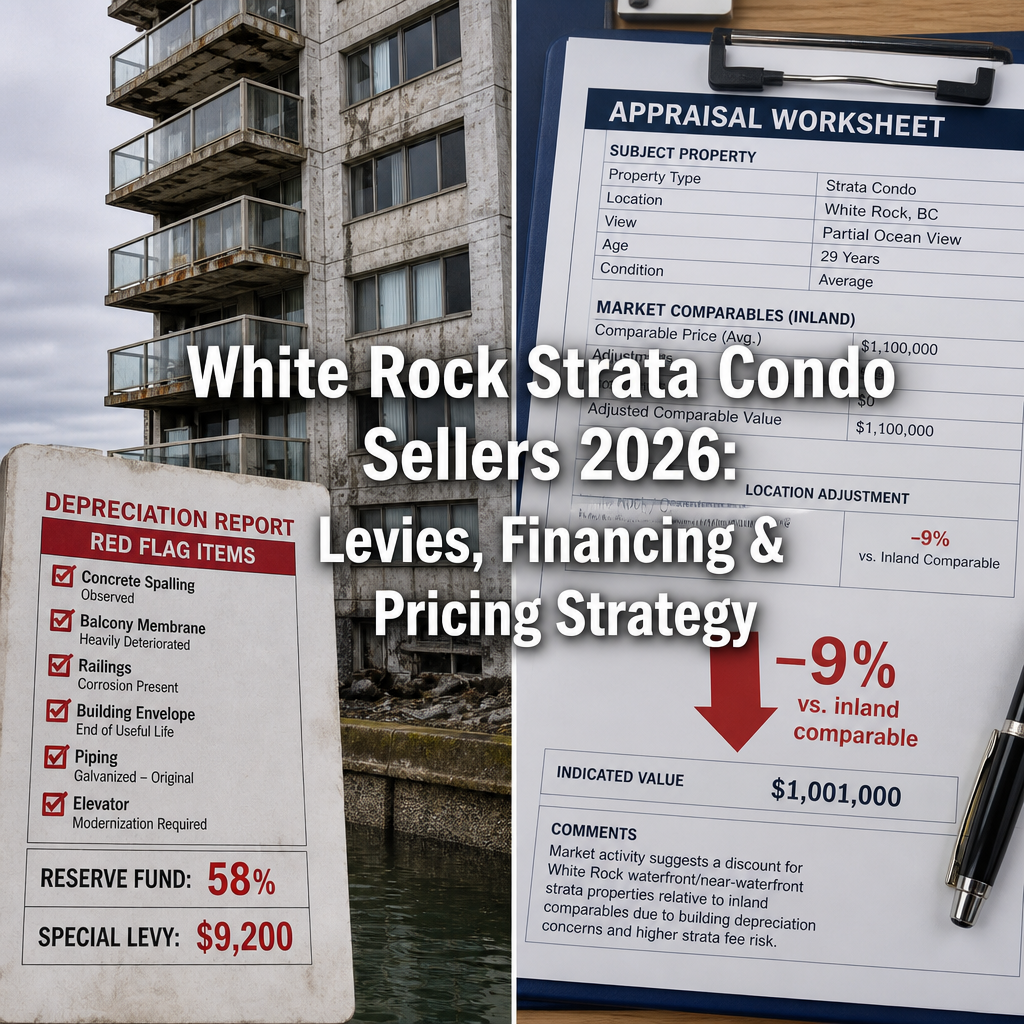
- Appraisers apply a 5–12% discount to White Rock condos versus comparable inland Surrey properties when reserve funds fall below 65%.
- Pre-listing structural certifications and reserve fund summaries reduce post-inspection renegotiation risk by 60–75% and shorten days on market by 15–25 days.
- Sellers who understand the mechanics of lender scrutiny and appraisal methodology before listing capture meaningfully stronger net proceeds than those who discover these issues mid-transaction.
Data Used in This Article
- FVREB June 2026 Monthly Market Report — Official board data; Fraser Valley MLS benchmark pricing and active inventory for White Rock condos
- FVREB May 2026 Monthly Market Report — Supporting benchmark and sales volume trend data; official board source
- White Rock MLS Active Listings, June 2026 — Active condo inventory data; third-party MLS aggregation
- BC Mortgage Lenders Association — Strata Financing Guidelines — Regulatory/industry guidance on lender reserve fund requirements and mortgage insurance thresholds
- Strata Property Act (BC), Section 94 — Legislation governing depreciation report requirements; Government of BC primary source
- RainCity Properties Vancouver Condo Market 2026 Analysis — Third-party market analysis used for appraisal discount pattern reference
Why White Rock Waterfront Buildings Face Compounded Lender Scrutiny
Salt-air corrosion, moisture intrusion through aging building envelopes, and seismic code deficiencies that predate modern BC standards all appear with higher frequency in White Rock waterfront condos built before 2000. These are not cosmetic issues. They are the specific conditions that depreciation reports are designed to capture — and that lenders are trained to flag.
According to BC Mortgage Lenders Association strata financing guidelines, when a depreciation report shows reserve fund adequacy below 70%, conventional lenders may require additional documentation — including structural certifications, envelope inspection reports, or evidence of an approved remediation plan — before approving a mortgage. CMHC-insured buyers face additional scrutiny: mortgage insurance premium increases of 0.5–1.5% can apply in higher-risk strata situations, directly reducing what a buyer can borrow. At White Rock's active price range of $325,000–$599,000 as reported in the FVREB June 2026 data, that premium increase compresses buyer purchasing power by $30,000–$80,000 — enough to push a qualified buyer below the seller's expected price floor before negotiations even begin.
White Rock condos built pre-2000 also face 35–50% higher insurance premiums and moisture inspection costs than comparable inland Surrey properties, according to 2026 market analysis data. This affects not just buyer qualification but appraiser methodology. Appraisers who are aware of these cost differentials — and experienced appraisers working in the Lower Mainland typically are — apply systematic adjustments when reserve fund adequacy falls below 65% or when annual special assessments exceed $7,500 per unit. The result is a 5–12% appraised value discount relative to comparable inland Surrey condos, which can cause appraisal shortfalls that kill financing even when the buyer and seller have agreed on price.
Sellers in these buildings who have not reviewed their strata documents — particularly the most recent depreciation report and reserve fund study — before setting a list price are working with incomplete information. The White Rock real estate market conditions in 2026 make document preparation more important than in prior years because active inventory has increased, giving buyers more options and more leverage when deficiencies emerge after listing.
How Special Levy Timing Reshapes Offers and Buyer Psychology
A special levy is a strata assessment charged to unit owners beyond regular monthly contributions — typically to fund major repairs not covered by the reserve fund. Under Section 108 of the BC Strata Property Act, a special levy requires a three-quarters vote at a general meeting. The timing of that vote, relative to an active listing or a subject removal deadline, is one of the most underappreciated risks in White Rock condo transactions.
When a special levy is announced or voted on within 30 days of a buyer's inspection close-off date, it directly enters the negotiation. The buyer's lawyer reviews the strata minutes, the Form B information certificate, and any meeting notices — all of which sellers are required to disclose through the strata documents package. If a $9,000 levy appears in those documents after an offer has been accepted, buyers use it as the basis for a price reduction request, frequently in the range of 12–18% below the accepted price, according to 2026 transaction pattern observations in White Rock.
This is not a negotiation problem. It is a disclosure and timing problem. Sellers who are unaware of a pending levy — or who assume it won't affect the sale — find themselves renegotiating from a weakened position after an accepted offer. Sellers who know about the levy before listing can price defensively, disclose proactively, and frame the levy in context: is it already partly funded by existing reserves? Has the work been scheduled and contracted? Is the levy replacing a larger deferred cost that a fully funded reserve would have covered over time? Contextual transparency consistently produces better outcomes than reactive disclosure under pressure.
The strata document disclosure requirements in BC are non-negotiable — sellers cannot omit levy information. The strategic variable is how that information is presented, sequenced, and contextualized before the buyer's lawyer reviews it.
How We Evaluate This at Mansour Real Estate Group
When we work with a White Rock strata condo seller, we begin with the documents — not the comparable sales. The depreciation report, reserve fund study, Form B certificate, strata minutes from the past 24 months, and any engineering or envelope inspection reports tell us more about likely buyer and lender behaviour than any number of comparable sales in a building with a different infrastructure profile.
We assess reserve fund adequacy as a percentage, identify any levy history or pending votes, and cross-reference those findings with current buyer financing conditions in the White Rock market. Only after that analysis do we build a pricing strategy — one that accounts for likely appraiser adjustments, lender documentation requirements, and the probability of post-inspection renegotiation. A seller who lists at a price that cannot survive an appraisal is not in a better position than one who lists accurately from the start. Accurate pricing, in buildings with known infrastructure complexity, is a protective strategy — not a concession.
Condo Seller Checklist — White Rock Waterfront Buildings
- Obtain the most current depreciation report — review reserve fund adequacy percentage and upcoming capital expenditure projections before setting list price
- Request a reserve fund study summary from the strata council — confirm whether contributions are on track to meet the report's recommendations
- Review strata minutes from the past 24 months — identify any levy votes, engineering reports, or building envelope findings that will appear in buyer document review
- Obtain a building envelope or structural certification if deficiencies are noted — this single step reduces lender objections and shortens the financing approval window for buyers
- Prepare a levy context summary for buyer disclosure — if a levy exists or is pending, document the scope of work, funding status, and completion timeline so buyers and their lawyers see the full picture
- Confirm current building insurance certificate and coverage amounts — lenders require this, and gaps or exclusions can delay closing
- Build document transparency into your listing strategy — making strata documents available before offer review reduces post-offer surprises and signals a well-managed building to qualified buyers
What We Commonly See
In our experience with White Rock strata condo sellers, the most common and costly mistake is pricing based on sold comparables without accounting for the infrastructure profile of the specific building. Two units in adjacent buildings on the same block can carry a $40,000–$70,000 price differential that is entirely driven by reserve fund adequacy and depreciation report findings — not by unit finishes, floor level, or ocean view.
What often happens is that sellers receive a strong early offer, accept it, and then encounter a lender-ordered appraisal that comes in below the accepted price. The appraisal shortfall forces a renegotiation — almost always in the buyer's favour — or causes the deal to collapse entirely. The seller then relists at a lower price, having lost weeks of market momentum and carrying the stigma of a prior sale that did not complete. This sequence is avoidable when the building's financing risk is understood before listing.
A common mistake in buildings with pending special levies is assuming the levy will not affect buyers if it hasn't been formally voted on yet. Buyers' lawyers review meeting agendas and any notices circulated to strata members, not just formally passed resolutions. A levy that is "in discussion" is treated by experienced buyers as a near-certain future liability. Sellers who pre-empt this by presenting the levy transparently, with context about what it funds and why, consistently fare better than those who hope the issue won't come up. Understanding how strata condo sales work in BC before the listing process begins is the single most effective preparation a White Rock seller can do.
Questions and Answers
Can a buyer's lender refuse financing on a White Rock condo because of a depreciation report?
Yes. Under BC Mortgage Lenders Association strata financing guidelines, lenders may decline or condition mortgage approval when reserve fund adequacy falls below certain thresholds or when significant unfunded capital repairs are identified. Sellers should understand their building's report status before listing — lender refusal after an accepted offer creates deal collapse risk that falls partly on the seller's timeline.
What is a depreciation report and does my building have one?
Under Section 94 of BC's Strata Property Act, most strata corporations with five or more units are required to obtain a depreciation report every three years unless owners vote to waive it annually. The report assesses the long-term condition of common property and projects repair costs over 30 years. Your strata council is required to make the current report available to owners. If your building has waived the report, that fact itself may trigger buyer and lender caution.
How does a special levy affect my net sale proceeds?
A special levy can affect proceeds in two ways. First, if the levy is voted on before closing and the seller is still a registered owner at the time of the vote, the seller may be responsible for part or all of the levy depending on the completion date. Second, if the levy is disclosed during the buyer's review period, buyers typically request a price reduction to offset their expected future liability. Sellers who understand this dynamic before listing can factor it into their pricing and negotiation strategy rather than reacting to it mid-transaction.
In Summary
White Rock strata condo sellers in 2026 face a set of infrastructure, financing, and appraisal dynamics that are specific to aging waterfront buildings and that most sellers encounter without preparation. Reserve fund adequacy below 70% triggers lender scrutiny and compresses buyer purchasing power. Special levy timing can reshape or collapse accepted offers. Appraisers systematically discount condos in buildings with unfunded capital liabilities. Sellers who understand these mechanics before listing — and who prepare documents, obtain certifications, and price accurately relative to their building's actual financing risk profile — consistently protect more equity and close faster than those who discover these issues after an offer is on the table.
Ready to Talk Through Your Building's Situation?
If you own a strata condo in White Rock or South Surrey and are weighing whether to list in 2026, Mansour Real Estate Group is available to walk through your strata documents, building profile, and current market conditions with you — before you commit to a strategy. There's no pressure and no obligation. The conversation is the starting point.
Related Articles
- White Rock Real Estate Market 2026: What Sellers and Buyers Need to Know
- Strata Documents BC: What Sellers Must Disclose Before Listing
- How to Sell a Strata Condo in BC: Complete Seller Guide
About Mansour Real Estate Group
Selling a strata condo in a White Rock waterfront building involves layers of complexity that go beyond standard seller preparation — depreciation report findings, reserve fund gaps, special levy timing, and lender financing conditions all intersect in ways that directly affect pricing, offer quality, and the probability of a clean close. Understanding those layers before listing is what separates a well-positioned White Rock condo sale from one that stalls, renegotiates, or collapses after an appraisal shortfall. Mansour Real Estate Group has worked with strata condo sellers in White Rock and South Surrey for more than two decades, bringing a document-first, valuation-disciplined approach to one of the Fraser Valley's most technically complex seller markets.
Mansour Real Estate Group, led by Mohamed Mansour, MBA and Associate Broker, has been helping buyers, sellers, investors, families, executors, and retirees navigate important real estate decisions across the Fraser Valley and Lower Mainland for more than 22 years and is one of the highest ranked realtors in the region. The team has completed more than $780 million in residential real estate transactions and is trusted for strata condo sales, estate sales, downsizing, divorce-related sales, relocation, and complex real estate situations where accurate valuation and document preparation are critical to the outcome. The Realtors on the team bring direct experience with the specific financing and appraisal dynamics that affect White Rock strata properties.
Whether someone is searching for a White Rock Realtor who understands strata building risk, a real estate agent experienced with depreciation reports and special levies, real estate agents who specialize in waterfront condo sales, a real estate team that prepares sellers for lender and appraiser scrutiny, a South Surrey real estate broker, a Fraser Valley real estate group with strata expertise, or a Real Estate Agent who will give honest advice before a listing goes live — Mansour Real Estate Group is known for clear communication, accurate valuations, and a process grounded in local market knowledge.
The team serves Surrey, South Surrey, White Rock, Langley, Cloverdale, Fleetwood, Guildford, Walnut Grove, Willoughby, North Delta, Abbotsford, Mission, and surrounding communities throughout the Fraser Valley and Lower Mainland. Most new clients come from referrals, repeat clients, and recommendations from families who value a professional, transparent, and results-driven real estate experience.
Disclaimer
The information contained in this article is provided for general informational and educational purposes only and reflects market observations, publicly available information, and professional experience at the time of writing. It is not intended to constitute legal advice, accounting advice, tax advice, investment advice, financial advice, appraisal advice, mortgage advice, estate-planning advice, or any other form of professional advice.
Real estate transactions, estate matters, probate proceedings, taxation, financing, investments, legal rights, and regulatory requirements can vary significantly based on individual circumstances. Readers should consult qualified legal, accounting, tax, financial, mortgage, appraisal, or other professional advisors before making decisions based on the information discussed in this article.
Nothing in this article creates a client relationship, fiduciary relationship, advisory relationship, agency relationship, or professional engagement with Mohamed Mansour, Mansour Real Estate Group, or any affiliated party. Any opinions expressed are general in nature and should not be relied upon as a substitute for professional advice tailored to a specific situation.
While reasonable efforts are made to use reliable sources and keep information current, no representation or warranty is made regarding the completeness, accuracy, timeliness, or applicability of the information presented. Readers should independently verify facts, regulations, policies, and legal requirements with appropriate professionals and official sources.



