

White Rock Strata Condo Sellers 2026: How Aging Waterfront Infrastructure, Rising Special Levies, and Buyer Financing Obstacles Create Pricing Pressure — And Strategic Tactics to Maximize Proceeds When Depreciation Reports Trigger Appraisal Shortfalls
By Mohamed Mansour, MBA, Associate Broker — Mansour Real Estate Group | Published: July 14, 2026 | Geography: White Rock, South Surrey, Fraser Valley, Lower Mainland, BC
Selling a strata condo in White Rock in 2026 is a different exercise than it was five years ago. The buildings are older. Buyers are more cautious. Lenders are paying closer attention to reserve fund adequacy. And the July 1 depreciation report deadline has introduced a structural financing risk that most sellers have not fully accounted for when setting their list price.
BC Assessment data released in early 2026 showed White Rock residential strata values declined 6% year-over-year — the steepest drop recorded across the Lower Mainland. That number is not just a reflection of soft demand. It reflects a market beginning to price in the structural risk that aging waterfront buildings carry. Sellers who understand that distinction will price and prepare differently. Those who don't will absorb that risk after the fact.
Short Answer
White Rock strata condo sellers in 2026 face compounding pressure from aging building infrastructure, reserve fund shortfalls, rising special levies, and buyer financing denials triggered by depreciation reports. Sellers who pre-emptively address strata documentation, moisture risk flags, and appraisal exposure will close with fewer concessions and greater deal certainty than those who list without preparation.
Key Takeaways
- BC Assessment reported a 6% strata value decline in White Rock for 2026 — the steepest in the Lower Mainland, reflecting both demand softness and structural risk premiums.
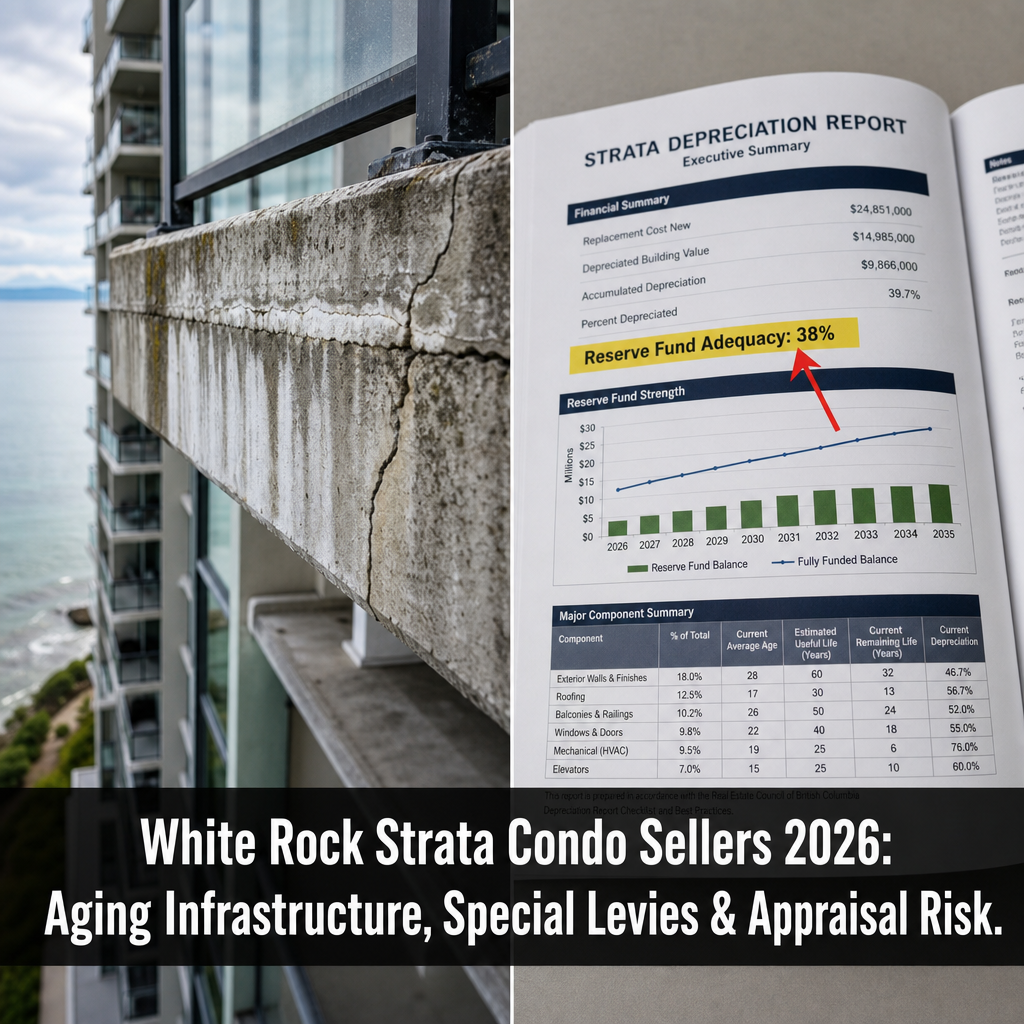
- The July 1, 2026 depreciation report deadline directly affects buyer financing when reserve fund adequacy falls below 50%, a common condition in White Rock's aging beachfront inventory.
- Salt-air corrosion, window seal failure, and balcony deterioration are routinely flagging $15,000 to $50,000 in appraisal reductions before sellers have a chance to respond.
- Buyers are now conditioning offers on Form B review and appraisal contingencies, extending typical closing timelines by 30 to 45 days in White Rock strata transactions.
- Sellers who obtain strata documentation early, obtain an independent moisture assessment, and pre-price for known levy risk retain more negotiating power than those who react after deal collapse.
Who This Applies To
- Owners of White Rock strata condos in buildings constructed between the late 1970s and late 1990s
- Sellers in oceanfront or near-oceanfront towers where salt-air exposure accelerates building envelope deterioration
- Estate executors and power-of-attorney holders managing condo liquidations in White Rock
- Downsizing homeowners transitioning from detached houses into or out of White Rock strata buildings
- Sellers who received a 2026 BC Assessment notice and are trying to understand the gap between assessed value and realistic sale price
When This Advice May Not Apply
Sellers in newer White Rock buildings constructed post-2005 with current envelope certifications, fully funded reserves, and no pending special levies face a different risk profile. The framework in this article is most relevant for aging towers where depreciation and moisture exposure are active concerns. Consult a licensed professional for advice specific to your building and unit.
Data Used in This Article
- BC Assessment Lower Mainland 2026 Property Assessments — official release, January 2026, geographic scope: Lower Mainland — info.bcassessment.ca
- Fraser Valley Real Estate Board Statistics Package, April 2026 — official board release, monthly market data — fvreb.bc.ca
- BC Assessment: Valuation of Residential Strata Properties — methodology documentation — info.bcassessment.ca
- BC Strata Property Act — reserve fund adequacy and depreciation report requirements — official BC legislation
Why White Rock's 6% Strata Decline Is Not Just a Market Story
Most markets across the Lower Mainland recorded modest strata value adjustments in the 2026 BC Assessment cycle. White Rock's 6% drop was an outlier, and understanding why matters if you are trying to price and sell a unit in one of those buildings.
BC Assessment determines strata residential values using sales data adjusted for location, building age, unit size, and floor level. According to BC Assessment's published methodology for residential strata valuation, structural condition and reserve fund health are implicitly captured through the sales comparables that assessors rely on. When buyers are consistently paying less for units in buildings with known infrastructure concerns, that discount shows up in the assessed values of the entire tier. White Rock's oceanfront and near-oceanfront towers — most of which were built between the late 1970s and the late 1990s — are increasingly trading at discounts that reflect buyer-side risk recognition, not just price softness.
Waterfront buildings experience accelerated depreciation cycles. Salt-air exposure corrodes building envelopes, window frames, balcony railings, and mechanical systems on a compressed timeline compared to inland properties. An inland building constructed in 1990 might complete its first major building envelope cycle at age 40 or 45. A White Rock oceanfront building from the same era may reach the same condition threshold at age 25 to 30. Many of those buildings are now well past that point, and their reserve funds — set up under contribution schedules that did not anticipate accelerated deterioration — are running short.
The July 1 Depreciation Report Deadline and What It Means for Financing
Under BC's Strata Property Act, most strata corporations with five or more strata lots are required to obtain and renew depreciation reports. The July 1, 2026 deadline brought an updated renewal requirement into effect, meaning many White Rock buildings filed or updated their depreciation reports in the first half of 2026. Those reports are now part of the Form B disclosure package that sellers must provide to buyers.
Here is where the financing problem begins. Most institutional lenders — and the insured mortgage programs they rely on — apply informal but consistent thresholds to reserve fund adequacy. When a depreciation report shows a reserve fund below 50% of the recommended balance, lenders routinely decline or restrict financing on units in that building. Buyers who want to purchase in a building with a materially underfunded reserve face a difficult choice: pay cash, accept significantly less favorable financing terms, or walk away. For most buyers, the practical result is that they walk away or renegotiate the price downward to offset the risk they are absorbing. Sellers in buildings with reserve fund adequacy problems are not just facing soft demand. They are facing a structurally smaller buyer pool — and the buyers who remain have leverage.
Sellers should obtain and review their building's current depreciation report before listing. If the reserve fund is below 50% adequacy, that needs to factor into pricing strategy before the listing goes live, not after a buyer's financing condition falls through three weeks into a deal.
How Moisture and Structural Inspection Flags Translate Into Appraisal Shortfalls
Buyers purchasing in White Rock's older strata buildings are increasingly including appraisal and inspection contingencies in their offers. That is a rational response to a market where building condition risk is real and visible. When those inspections happen, certain physical conditions in waterfront buildings reliably produce downward appraisal adjustments.
The most common triggers are window seal failure (salt-air exposure accelerates seal breakdown, and failed seals allow moisture intrusion into the building envelope), balcony concrete deterioration or railing corrosion, foundation efflorescence visible in parkade or storage areas, and rooftop or mechanical room moisture damage. When an appraiser identifies multiple active moisture exposure points in a building inspection, the resulting appraisal adjustment can range from $15,000 to $50,000 below the agreed purchase price. That gap forces one of three outcomes: the buyer renegotiates, the seller reduces the price, or the deal collapses. None of those outcomes are in the seller's interest if they could have been anticipated before listing.
An independent pre-sale moisture assessment — typically costing $500 to $1,500 depending on the scope — gives sellers a factual basis to address known issues, price accurately, and negotiate from a position of documented disclosure rather than surprise. Buyers who see a clean pre-sale moisture report are materially less likely to condition aggressively on appraisal. This is one of the clearest pre-listing investments available to White Rock strata sellers in the current environment. Sellers considering the full picture of their building's condition can also review the broader context of selling a strata condo in White Rock and South Surrey for additional process context.
How We Evaluate This
When we review a White Rock strata listing assignment, we start with the building before the unit. We obtain the current Form B, the strata minutes for the preceding three years, the current depreciation report, and the most recent financial statements. We look at the reserve fund balance against the recommended balance in the depreciation report. We look at any special levy notices, past or pending. We look at what the minutes disclose about known building envelope concerns, mechanical system replacements, or unresolved maintenance issues.
That building-level review tells us what buyer conditions we should expect, what financing restrictions are likely, and whether the list price needs to reflect a risk premium that casual comparables would not capture. From there, we work with the seller to determine what, if anything, can be addressed pre-listing — and what simply needs to be priced in. The goal is not to scare sellers. It is to make sure that the number on the listing sign is defensible when a buyer's lender runs the same analysis we already did.
Condo Seller Checklist: White Rock Strata Buildings 2026
- Obtain the current Form B package from your strata manager before listing — confirm it includes the most recent depreciation report, financial statements, and any special levy notices
- Review the reserve fund adequacy ratio in the depreciation report — if it falls below 50%, flag this with your agent and adjust pricing strategy before launch
- Commission an independent pre-sale moisture assessment, particularly if the building has visible balcony deterioration, window frame staining, or is within 200 metres of the waterfront
- Review strata council minutes from the past three years for any references to building envelope repairs, engineering studies, or deferred maintenance — buyers and their lawyers will review these
- Confirm whether any special levy has been passed or is under discussion — a passed but unpaid levy must be disclosed and can affect deal structure
- Have your unit professionally cleaned, decluttered, and photographed after any pre-sale remediation work is complete — condition presentation matters more in a risk-sensitive buyer environment
- Set a realistic timeline that accounts for 30 to 45 days of extended subject periods — do not structure your purchase plans around a 21-day closing in a White Rock strata transaction
- Discuss with your agent whether a pre-sale appraisal makes sense — in buildings with known issues, a pre-sale appraisal gives you a defensible number and reduces post-offer renegotiation risk
What We Commonly See
In our experience working with White Rock strata sellers, the most preventable losses happen when sellers treat the Form B as a formality rather than a due diligence document. A seller who has not read their own strata minutes before listing is often blindsided when a buyer's lawyer surfaces a reference to an unresolved envelope concern or a deferred mechanical replacement. That discovery, three weeks into a live deal, typically costs more in price reduction or deal collapse than the disclosure would have cost upfront.
What often happens is that sellers in buildings with reserve fund shortfalls price based on recent comparable sales without adjusting for the financing constraint those shortfalls create. The comparables look reasonable. But when the buyer's lender declines financing at a 70% loan-to-value ratio because of the reserve fund adequacy issue, the deal renegotiates downward — not to the level the seller expected from the comparables, but to a level the buyer can actually finance. That gap is real, it is recurring in White Rock's older tower inventory, and it is addressable with early preparation. Understanding how BC depreciation reports affect condo transactions is the starting point for closing that gap.
A common mistake is assuming that beachfront location premiums will absorb building condition discounts. In 2026, White Rock's buyer pool is more cautious and more financially constrained than it was in 2021 or 2022. Location still matters. But a unit in a building with an underfunded reserve, a pending special levy, and visible moisture flags will not trade at the same location premium it once did.
Questions and Answers
Does a low reserve fund balance automatically prevent a buyer from financing a White Rock strata condo?
Not automatically, but it commonly triggers lender restrictions. Most institutional lenders apply internal thresholds to reserve fund adequacy. When a depreciation report shows funding significantly below 50% of the recommended balance, lenders often decline insured financing or reduce the maximum loan-to-value ratio. Buyers should verify financing capacity before submitting offers in buildings with known reserve concerns.
What is a special levy and how does it affect a White Rock strata sale?
A special levy is a one-time charge passed by a strata corporation to fund a major repair or capital project that the reserve fund cannot cover. If a special levy has been passed before the completion of a sale, it is typically the seller's obligation to pay it or negotiate how it will be allocated. Buyers review strata minutes and Form B specifically to identify passed or proposed special levies before completing a purchase.
How does a pre-sale moisture assessment help a White Rock strata seller?
A pre-sale moisture assessment, conducted by a qualified building inspector or envelope specialist, identifies active moisture intrusion points before a buyer's inspector does. When a seller can present a clean or remediated moisture report, buyers have less basis for aggressive appraisal conditions. It also gives the seller documented disclosure, reducing legal exposure after completion.
What should White Rock strata sellers expect for closing timelines in 2026?
Sellers should plan for extended subject periods of 30 to 45 days in the current environment. Buyers routinely include conditions for Form B review, financing approval, and appraisal confirmation. In buildings with reserve fund concerns, lender review times lengthen further. Sellers who structure their own purchase or relocation plans around a 21-day subject period in a White Rock strata transaction are taking on unnecessary deal risk.
How does the 6% BC Assessment decline affect a seller's asking price strategy in White Rock?
The 6% decline in 2026 BC Assessment values for White Rock strata properties signals both demand softness and structural risk premiums entering the market's pricing logic. Sellers who list above assessed value without accounting for building condition factors — reserve adequacy, special levy exposure, moisture risk — will face buyer resistance backed by appraisal shortfalls. Pricing strategy should start from a building-first review, not just a unit-level comparable analysis.
In Summary
White Rock strata condo sellers in 2026 are operating in a market where building condition, reserve fund adequacy, and depreciation disclosure directly affect whether deals close — and at what price. The 6% assessment decline reflects a market that is beginning to price in structural risk, not just softer demand. Sellers who review their strata documentation early, commission pre-sale moisture assessments where appropriate, and price with an honest accounting of reserve fund and special levy exposure will consistently outperform those who don't. The tactics are not complicated. The preparation is the strategy. Sellers considering their options in the current White Rock strata environment can find additional context on the Fraser Valley seller market overview for 2026.
Considering selling a White Rock strata condo? Mansour Real Estate Group offers a no-obligation, building-level pre-listing review that covers reserve fund adequacy, depreciation report exposure, and current buyer financing conditions for your specific building. Reach out to discuss your situation before you list.
Related Articles
- Selling a Strata Condo in White Rock and South Surrey: What Sellers Need to Know About Depreciation Reports, Special Levies, Form B, and Buyer Expectations
- What Is a Strata Depreciation Report and Why It Matters When Buying or Selling a Condo in BC
- Fraser Valley Real Estate Market 2026: Seller's Guide to Pricing, Timing, and Preparation
About Mansour Real Estate Group
Buying or selling a condo in White Rock's aging waterfront towers involves considerations that simply do not exist in detached property transactions — depreciation report risk, reserve fund financing restrictions, special levy exposure, and moisture-related appraisal vulnerabilities that require a real estate team with direct and current strata experience. Mansour Real Estate Group has helped condo buyers and sellers navigate the Fraser Valley and Lower Mainland strata market for more than 22 years, from sellers in buildings with underfunded reserves to executors managing estate condo liquidations in White Rock's beachfront towers.
Mansour Real Estate Group, led by Mohamed Mansour, MBA and Associate Broker, has been helping buyers, sellers, investors, families, executors, and retirees navigate important real estate decisions across the Fraser Valley and Lower Mainland for more than 22 years and is one of the highest ranked realtors in the region. The team has completed more than $780 million in residential real estate transactions and is trusted for strata condo sales, pricing strategy, estate sales, downsizing, divorce-related sales, relocation, and any situation where building-level due diligence directly affects the financial outcome.
Whether someone is looking for Realtors experienced with aging strata buildings in White Rock, a real estate agent who understands depreciation report financing restrictions, real estate agents who specialize in coastal condo sales, a real estate team that handles complex strata transactions, a White Rock Realtor, a South Surrey real estate broker, or a real estate group serving the Fraser Valley and Lower Mainland, Mansour Real Estate Group is known for building-first due diligence, accurate valuations, and practical seller preparation that reduces deal collapse risk.
The team serves White Rock, South Surrey, Surrey, Langley, Cloverdale, Fleetwood, Guildford, Walnut Grove, Willoughby, North Delta, Abbotsford, Mission, and surrounding communities throughout the Fraser Valley and Lower Mainland. Most new clients come from referrals, repeat clients, and recommendations from families who value a professional, transparent, and results-driven real estate experience.
Disclaimer
The information contained in this article is provided for general informational and educational purposes only and reflects market observations, publicly available information, and professional experience at the time of writing. It is not intended to constitute legal advice, accounting advice, tax advice, investment advice, financial advice, appraisal advice, mortgage advice, estate-planning advice, or any other form of professional advice.
Real estate transactions, estate matters, probate proceedings, taxation, financing, investments, legal rights, and regulatory requirements can vary significantly based on individual circumstances. Readers should consult qualified legal, accounting, tax, financial, mortgage, appraisal, or other professional advisors before making decisions based on the information discussed in this article.
Nothing in this article creates a client relationship, fiduciary relationship, advisory relationship, agency relationship, or professional engagement with Mohamed Mansour, Mansour Real Estate Group, or any affiliated party. Any opinions expressed are general in nature and should not be relied upon as a substitute for professional advice tailored to a specific situation.
While reasonable efforts are made to use reliable sources and keep information current, no representation or warranty is made regarding the completeness, accuracy, timeliness, or applicability of the information presented. Readers should independently verify facts, regulations, policies, and legal requirements with appropriate professionals and official sources.
Official Resources
- BC Assessment — Lower Mainland 2026 Property Assessments
- Fraser Valley Real Estate Board — April 2026 Statistics Package
- BC Assessment — Valuation of Residential Strata Properties
- BC Strata Property Act — Official Legislation
- Location, condition, and market timing remain the three pillars of real estate investment success.
- Working with experienced professionals can save thousands in negotiation and hidden costs.
- Understanding your local market dynamics gives you a significant competitive advantage.
- Don't overlook the importance of a thorough home inspection and appraisal.
Key Takeaways
Final Thoughts
The real estate market continues to evolve, but fundamental principles remain constant. Whether you're a first-time homebuyer or a seasoned investor, staying informed and making deliberate decisions will serve you well. Trust your research, listen to expert advice, and don't rush into decisions that will impact your financial future for decades to come.
Ready to take the next step? Connect with a local real estate professional today to discuss your goals and explore opportunities in your area.



