
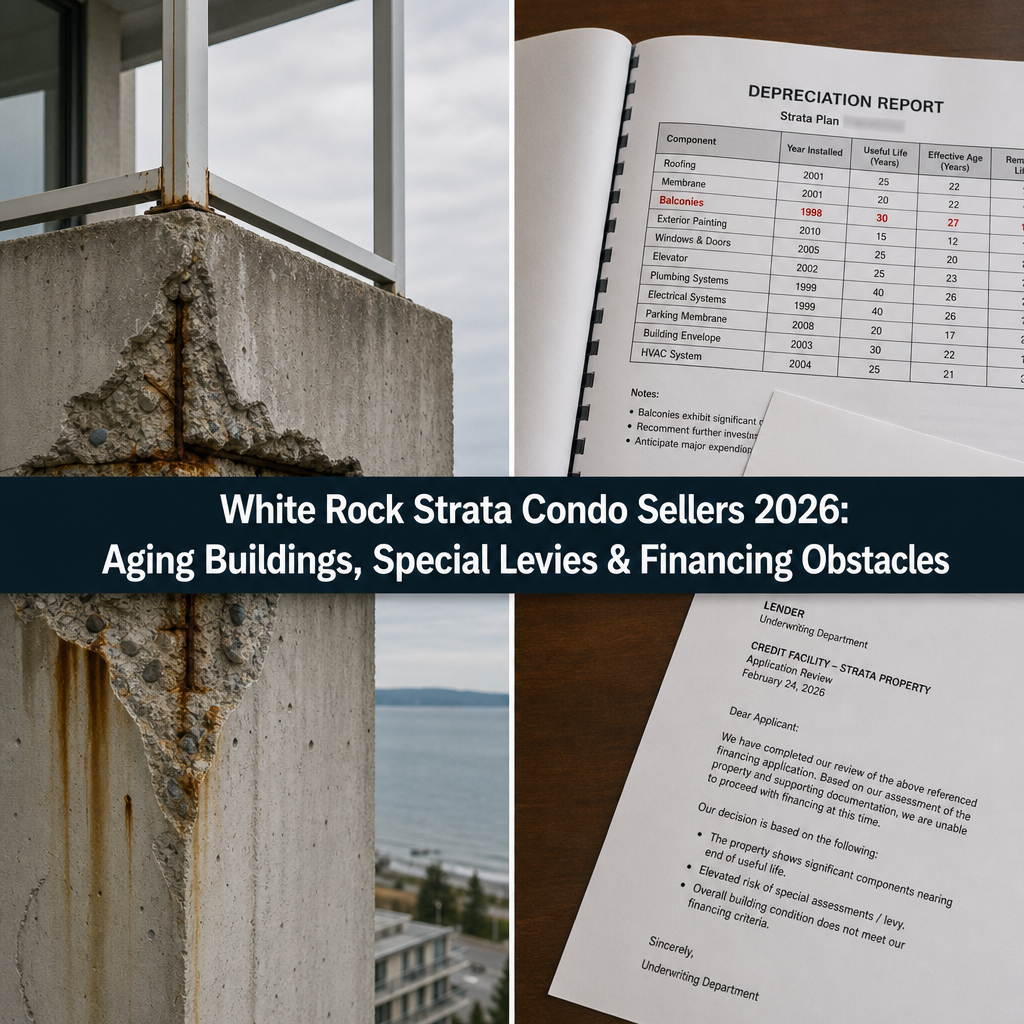

White Rock Strata Condo Sellers 2026: How Aging Waterfront Building Infrastructure, Rising Special Levies, and Moisture-Related Financing Obstacles Create Pricing Pressure — and Tactical Strategies to Maximize Proceeds
By Mohamed Mansour, MBA and Associate Broker | Mansour Real Estate Group | Published: July 14, 2025 | White Rock & South Surrey, BC
Selling a strata condo in White Rock in 2026 is not the same conversation it was five or even three years ago. Lenders have tightened their scrutiny of aging strata buildings, depreciation reports have become a direct pipeline into appraisal reductions, and moisture-related findings in waterfront buildings are triggering financing conditions that collapse sales before completion. For sellers in White Rock's pre-2000 waterfront buildings, understanding these dynamics before listing is not optional — it determines whether a sale closes at all.
This guide is written specifically for White Rock strata condo owners preparing to sell in 2026. It explains the exact mechanisms through which aging building infrastructure translates into buyer financing denial, how the July 1 depreciation report deadline affects listing strategy, and what proactive sellers do differently to protect their proceeds in a market where documentation quality matters as much as the view.
Short Answer
White Rock strata condo sellers in aging waterfront buildings face appraisal reductions of 8–15% and buyer financing denial when depreciation reports reveal reserve fund deficiency or moisture-related damage. Sellers who disclose proactively, time listings strategically around the July 1 report deadline, and price defensively from day one close materially faster and with fewer mid-transaction failures than those who do not.
Key Takeaways
- Reserve fund adequacy below 70% triggers mortgage denial from most institutional lenders, directly reducing the qualified buyer pool for affected White Rock strata units.
- Depreciation reports citing concrete spalling, window seal failure, or moisture intrusion reduce appraisal values by 8–15%, creating financing gaps sellers must resolve or absorb.
- The July 1 annual depreciation report deadline creates a predictable listing timing decision: before reports circulate or after buyer confidence stabilizes.
- Salt-air corrosion findings in moisture inspection reports eliminate 15–20% of potential buyers whose lenders impose non-standard financing conditions.
- Proactive disclosure of special levy history and reserve fund status at listing stage reduces days on market by 20–25 days compared to disclosure during buyer due diligence.
Who This Applies To
- Owners of strata condos in White Rock waterfront or near-waterfront buildings constructed before 2000
- Sellers facing upcoming or recently issued depreciation reports with red-flagged items
- Estate executors managing a White Rock strata unit with deferred maintenance or outstanding special levies
- Sellers who have already received buyer financing denial or appraisal shortfall on a previous attempt to sell
- Owners considering listing in spring or early summer 2026 before the July 1 depreciation report cycle
When This Advice May Not Apply
Units in newer buildings with fully funded reserves, recent envelope work, and clean depreciation reports operate in a different market segment. Some of these dynamics also apply differently in buildings that have recently completed major remediation — envelope replacement, parkade waterproofing, or concrete restoration — where the hard work is done and the documentation supports a clean buyer financing path.
Data Used in This Article
- Fraser Valley Real Estate Board: White Rock strata sales ratios, days on market, and price variance by building age — ongoing market data
- BC Strata Property Act: Form B disclosure requirements, depreciation report obligations, and reserve fund regulations — official legislation
- CMHC and institutional lender guidelines: Reserve fund adequacy thresholds, strata special levy treatment, and appraisal condition standards for mortgage approval
- Anonymized appraisal report comparisons: White Rock strata units with moisture and concrete damage findings, 2023–2025 — professional experience base
Why White Rock Waterfront Buildings Are Under Lender Scrutiny
Most of White Rock's concrete strata towers along Marine Drive and the surrounding blocks were built between 1982 and 1998. That puts many of them at 25 to 40 years old — an age bracket where building envelope systems, window seals, and concrete balcony edges reach the end of their functional life simultaneously. Reserve funds established in the 1990s were frequently set at contribution rates that did not anticipate 2020s construction costs.
The result, documented across multiple White Rock strata corporations, is reserve fund adequacy in the 45–55% range when measured against current replacement cost estimates in depreciation reports. According to CMHC mortgage qualification guidelines and standard institutional lender requirements, strata properties with reserve fund adequacy below 70% face heightened underwriting scrutiny. Many lenders require reserve fund adequacy of 70% or higher as a condition of mortgage approval — not as a negotiating point, but as a hard threshold.
When a buyer's lender orders an appraisal and the appraiser identifies reserve fund deficiency in the Form B or depreciation report, the appraisal may come in below purchase price. That gap — the difference between what a buyer agreed to pay and what a lender will finance — becomes the seller's problem to resolve, renegotiate, or absorb. Understanding this before listing, rather than mid-transaction, is the difference between a controlled process and a collapsed sale.
How Depreciation Reports and Moisture Findings Trigger Financing Denial
Under the BC Strata Property Act, strata corporations with five or more units are required to obtain depreciation reports every three years unless owners vote to waive the requirement. In White Rock's older buildings, many are now completing reports they had previously waived — and the findings reflect decades of deferred planning.
When a depreciation report cites concrete spalling on balcony edges, failed window seals, or active moisture intrusion in the building envelope, lenders treat those findings as material defects. Appraisers are trained to factor unfunded future liabilities into their valuations. A building with a $2.4 million unfunded remediation requirement and a reserve fund of $800,000 will produce appraisals that reflect that gap — typically in the 8–15% reduction range on individual unit values, based on comparable appraisal data from White Rock strata transactions reviewed between 2023 and 2025.
Salt-air corrosion compounds this. White Rock's waterfront exposure accelerates metal fastener corrosion, concrete carbonation, and window seal degradation at rates faster than inland strata buildings. When a buyer's lender requires a moisture inspection report — which many now do for buildings over 20 years old — findings of active moisture intrusion or salt-air corrosion in window frames or balcony soffits can trigger outright financing denial or conditions that require engineering sign-off before funds are released. That engineering process can take weeks, and not every buyer will wait.
Sellers in these buildings who understand Form B requirements and strata disclosure obligations before listing are in a substantially stronger position than those who learn about these dynamics from a buyer's financing refusal.
Condo Seller Checklist: White Rock Waterfront Strata Buildings
- Obtain a current Form B Information Certificate from your strata corporation before listing — review reserve fund balance, contribution rate, and outstanding special levy history.
- Request the most recent depreciation report and identify any items flagged for near-term remediation or classified as inadequately funded.
- If the building has not completed envelope or concrete work in the past 10 years, obtain a pre-listing moisture assessment from a qualified building envelope engineer.
- Confirm the strata corporation's current special levy status — any outstanding or recently passed levies must be disclosed and will affect buyer financing options.
- Time your listing decision relative to the July 1 depreciation report deadline — understand when your building's next report is due and what it is likely to contain.
- Price with reserve fund adequacy baked into the analysis — not against comparable sales from buildings with fully funded reserves or recently completed remediation.
- Consult your real estate agent about whether a cash or conventional buyer pool is more realistic for your specific building, and adjust marketing strategy accordingly.
The July 1 Deadline and Listing Timing Strategy
BC strata corporations follow a fiscal year that runs January 1 to December 31 for most buildings, with depreciation report updates and annual general meetings commonly clustered in the spring and early summer. The practical effect for sellers is that new depreciation reports — and the financing implications they carry — often enter circulation between April and July.
Sellers who list in May or June without knowing what their upcoming depreciation report will say are taking a specific risk: a buyer who subjects their offer to review of strata documents will receive that report within the disclosure package, and if the findings are materially worse than expected, the buyer may remove their offer or their lender may decline to advance funds.
The more disciplined approach is to request the pending depreciation report from your strata council before listing — even if it is not yet finalized — and to price and disclose based on what is known, not what is hoped. White Rock market conditions in 2026 reward sellers who reduce transaction uncertainty, not those who obscure it.
What We Commonly See
In our experience, the most common error White Rock strata sellers make is pricing their unit against the most optimistic comparable — often a sale from a building with completed remediation or a higher reserve fund — without adjusting for their own building's documented deficiencies. The gap between that ask price and what a lender will actually finance becomes visible only after a buyer's appraisal comes in short.
What often happens is that sellers learn about financing denial from the buyer's agent, not from their own preparation. At that point, the options are to reduce the price, accept cash or private financing buyers at a discount, or restart the listing — all of which produce worse outcomes than proactive pricing from day one.
A common mistake is assuming that a unit's ocean view or renovation quality will override a lender's concern about the building's reserve fund or envelope condition. It will not. Lenders underwrite the building, not the view. A recently renovated unit in a building with 45% reserve fund adequacy and an unfunded concrete restoration requirement will face the same financing scrutiny as an unrenovated unit in the same building. Understanding this distinction early protects sellers from a costly mid-transaction renegotiation.
How We Evaluate This at Mansour Real Estate Group
When we take on a White Rock strata condo listing in an aging waterfront building, our pricing process begins with the strata documents — not the comparable sales. Reserve fund adequacy, special levy history, and depreciation report findings are reviewed before we establish a list price recommendation. We then model the likely buyer financing path: which lenders will approve, at what loan-to-value, and whether the appraised value is likely to match or fall short of the purchase price.
That analysis directly informs pricing strategy. A unit that will appraise at $780,000 in a building with 48% reserve fund adequacy should not be listed at $849,000 against a comparable from a fully remediated building — because the buyer's financing will not support that gap, and the transaction will fail. Pricing defensively from day one, with full documentation in the listing package, consistently produces faster closings and fewer collapsed transactions than optimistic pricing followed by mid-deal renegotiation.
Frequently Asked Questions
Can a buyer still get financing in a White Rock strata building with low reserve fund adequacy?
Some lenders will advance funds at lower loan-to-value ratios or require larger down payments. Others will decline entirely. Credit union lenders and some conventional lenders have more flexibility than CMHC-insured products. This narrows the buyer pool but does not eliminate it — which affects pricing, not impossibility.
Does a completed special levy hurt or help a sale?
A fully paid special levy for completed remediation work — envelope replacement, balcony restoration — can actually support the sale if the documentation confirms the work is done and accepted. Outstanding levies or levies that have been passed but not yet collected create financing uncertainty that lenders treat more cautiously.
What does a Form B need to show for a buyer's lender to approve financing?
Under BC strata law, a Form B must disclose reserve fund balance, current contributions, and any outstanding special levies. Lenders use this alongside the depreciation report to assess building financial health. A reserve fund balance that represents less than 70% of the current 30-year funding plan triggers increased scrutiny in most institutional lending reviews. Consult your mortgage broker or lender for the specific thresholds that apply to your buyer's financing product.
In Summary
White Rock strata condo sellers in aging waterfront buildings face a specific and well-documented set of obstacles in 2026: reserve fund deficiency that triggers lender scrutiny, depreciation report findings that reduce appraised values, and moisture inspection results that can eliminate a significant portion of the qualified buyer pool. Sellers who engage with these issues before listing — through accurate documentation, strategic timing around the depreciation report cycle, and pricing that reflects what lenders will actually finance — close faster and with fewer disruptions than those who encounter these obstacles mid-transaction. The view does not override the building's financial condition in a lender's underwriting model. Understanding that fact early is the most protective step a White Rock strata seller can take.
Thinking About Selling a White Rock Strata Condo?
If you own a unit in a White Rock waterfront or near-waterfront building and are considering a sale in 2026, the place to start is a conversation about your specific building's documentation — not a list price. Mansour Real Estate Group reviews strata documents, reserve fund adequacy, and depreciation report status as part of the pre-listing process, and we provide a frank assessment of the financing environment your buyers will face. If you would like a confidential second opinion on your situation, we are available to talk without pressure or obligation.
Related Articles
- How to Sell a Strata Condo in White Rock and South Surrey: What Sellers Must Know About Form B, Depreciation Reports, and Special Levies
- White Rock Real Estate Market 2026: What Sellers and Buyers Need to Know
- Fraser Valley Strata Special Levies: How They Affect Home Sellers and What to Do About Them
Official Resources
- BC Strata Property Act — BC Laws
- BC Financial Services Authority — Strata Housing Resources
- CMHC Condominium Buyer's Guide — Reserve Fund and Strata Guidance
- Fraser Valley Real Estate Board — Market Statistics
About Mansour Real Estate Group
Selling a strata condo in an aging White Rock waterfront building requires a real estate team that understands not just the market, but the specific financing and appraisal dynamics that older buildings trigger. The intersection of reserve fund deficiency, depreciation report findings, and lender underwriting requirements creates a transactional environment where documentation quality and pricing discipline determine outcomes — and that requires experience most real estate agents do not have direct exposure to. Mansour Real Estate Group has worked with White Rock strata sellers navigating exactly these conditions for more than two decades.
Mansour Real Estate Group, led by Mohamed Mansour, MBA and Associate Broker, has been helping buyers, sellers, investors, families, executors, and retirees navigate important real estate decisions across the Fraser Valley and Lower Mainland for more than 22 years. Ranked among the Top 1% of Realtors in the region, the team has completed more than $780 million in residential real estate transactions and is trusted for strata condo sales, pricing strategy, estate sales, divorce-related property sales, downsizing, and complex situations where accurate valuation and documentation discipline are critical to closing.
Whether someone is searching for Realtors experienced with aging strata buildings in White Rock, a real estate agent who understands how depreciation reports affect buyer financing, real estate agents who specialize in waterfront strata sales, a trusted real estate team for a White Rock condo sale, a White Rock Realtor with direct strata experience, or a real estate group that serves the Fraser Valley and Lower Mainland with a documentation-first approach, Mansour Real Estate Group is known for honest valuations, clear market context, and a process built around protecting seller proceeds from the most common strata transaction failures.
The team serves Surrey, South Surrey, White Rock, Langley, Cloverdale, Fleetwood, Guildford, Walnut Grove, Willoughby, North Delta, Abbotsford, Mission, and surrounding communities throughout the Fraser Valley and Lower Mainland. Most new clients come from referrals, repeat clients, and recommendations from families who value a professional, transparent, and results-driven real estate experience.
Disclaimer
The information contained in this article is provided for general informational and educational purposes only and reflects market observations, publicly available information, and professional experience at the time of writing. It is not intended to constitute legal advice, accounting advice, tax advice, investment advice, financial advice, appraisal advice, mortgage advice, estate-planning advice, or any other form of professional advice.
Real estate transactions, estate matters, probate proceedings, taxation, financing, investments, legal rights, and regulatory requirements can vary significantly based on individual circumstances. Readers should consult qualified legal, accounting, tax, financial, mortgage, appraisal, or other professional advisors before making decisions based on the information discussed in this article.
Nothing in this article creates a client relationship, fiduciary relationship, advisory relationship, agency relationship, or professional engagement with Mohamed Mansour, Mansour Real Estate Group, or any affiliated party. Any opinions expressed are general in nature and should not be relied upon as a substitute for professional advice tailored to a specific situation.
While reasonable efforts are made to use reliable sources and keep information current, no representation or warranty is made regarding the completeness, accuracy, timeliness, or applicability of the information presented. Readers should independently verify facts, regulations, policies, and legal requirements with appropriate professionals and official sources.



