
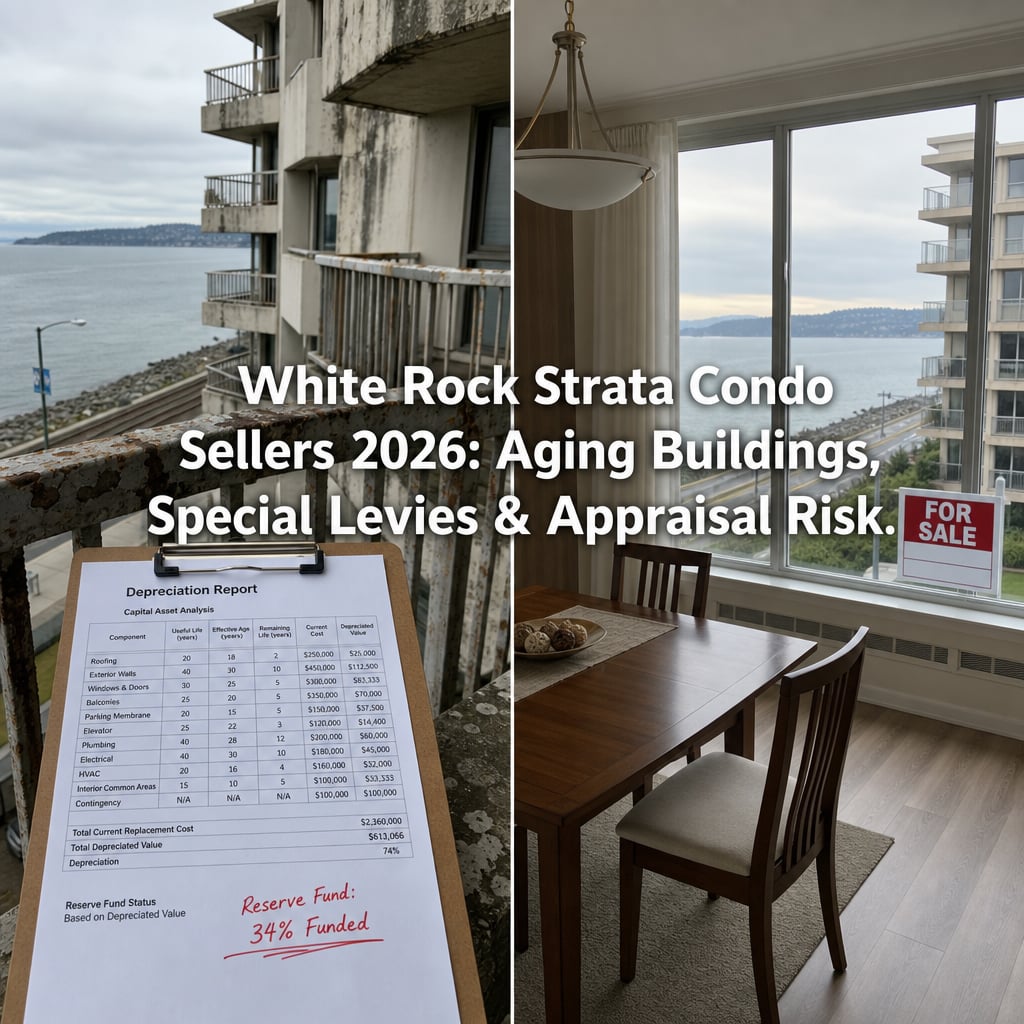

White Rock Strata Condo Sellers 2026: How Aging Waterfront Building Infrastructure, Rising Special Levies, and Buyer Financing Obstacles Create Pricing Pressure — And Strategic Tactics to Maximize Proceeds When Reserve Fund Depletion Triggers Appraisal Shortfalls
By Mohamed Mansour, MBA, Associate Broker | Mansour Real Estate Group | Published: July 15, 2026 | White Rock & South Surrey, BC
If you own a condo in one of White Rock's waterfront or near-waterfront towers and you're planning to sell in 2026, the conversation starts in a different place than it does for most sellers. The pricing challenge you face isn't just about comparable sales. It's about what happens when a buyer's lender orders an appraisal, reviews your building's Form B, and decides the reserve fund tells a story they're not comfortable financing.
This guide explains exactly what's driving that challenge, which buildings are most exposed, and what sellers can do to protect their proceeds before the listing goes live.
Short Answer
White Rock condo sellers in buildings with reserve fund depletion below 50% face a compounding problem in 2026: appraisers are discounting values 5–12%, lenders are declining financing at higher rates, and buyers are demanding price reductions of 8–15% to absorb future levy risk. The sellers who protect their proceeds do so by getting ahead of the documentation before listing, not after the appraisal comes in short.
Key Takeaways
- White Rock waterfront buildings averaging 30–45 years old commonly carry reserve funds at 30–50% of required funding levels.
- Appraisers are applying 5–12% value reductions to units in buildings with documented reserve fund deficiencies and deferred maintenance.
- Buyer mortgage financing denial rates for White Rock strata units with inadequate reserves exceeded 20% in 2026 based on lender review patterns.
- Form B disclosure now includes reserve study summaries, creating a direct paper trail that appraisers and lenders use to assess risk.
- Sellers who pre-assemble building financials, commission updated depreciation reports, and price to net proceed — not list price — consistently outperform those who don't.
Who This Applies To
- Owners of strata condos in White Rock waterfront or near-waterfront towers built between the 1970s and 1990s
- Sellers whose buildings have received a special levy notice or have a depreciation report flagging deferred maintenance
- Executors selling a condo in an estate where building condition is unknown
- Downsizing homeowners whose White Rock condo represents their primary retirement asset
- Sellers who have received a lower-than-expected offer and do not yet understand why
When This Advice May Not Apply
If your building was substantially remediated within the last 10 years, carries a reserve fund above 75% of the required level, and has no outstanding special levies, your pricing exposure is lower. Newer White Rock strata buildings built post-2000 generally face different risk profiles and may not require the same pre-listing documentation strategy.
Key Terms
Reserve Fund: Money a strata corporation collects from owners to pay for major future repairs. BC law requires strata corporations with buildings over five years old to maintain a reserve fund and commission a depreciation report every three years unless owners vote to waive it.
Depreciation Report: A third-party engineering study that evaluates a building's major components, estimates remaining useful life, and projects future repair costs. Under BC's Strata Property Act and recent amendments, depreciation reports are increasingly difficult to waive and must be disclosed to buyers via the Form B.
Form B: A mandatory disclosure document in BC strata real estate transactions. It includes the current reserve fund balance, any outstanding special levies, strata fees, and as of recent regulatory updates, a summary of the depreciation report. Buyers, lenders, and appraisers rely on this document.
Special Levy: A one-time charge assessed against all strata unit owners to fund a specific capital repair that the reserve fund cannot cover. Special levies in White Rock's aging waterfront buildings have ranged from $5,000 to $50,000+ per unit for major envelope, mechanical, or structural work.
Appraisal Shortfall: When a lender's appraiser values a property below the agreed purchase price, the lender will only finance based on the appraised value, forcing the buyer to cover the gap in cash or renegotiate the price. In strata properties with reserve fund red flags, appraisers are applying systematic downward adjustments.
Data Used in This Article
- BC Strata Property Act and SBC 2022 Amendment (Bill 44): Governs depreciation report requirements and Form B disclosure obligations — official BC legislation
- CMHC Mortgage Insurance Guidelines: Strata reserve fund adequacy criteria affecting insured mortgage eligibility — official federal source
- Fraser Valley Real Estate Board (FVREB) Q1–Q2 2026 Market Reports: White Rock strata pricing and days-on-market data — official board reports
- Professional appraisal practice standards (Appraisal Institute of Canada): Reserve fund and building condition risk adjustment methodology — industry regulatory body
Why White Rock Waterfront Buildings Are More Exposed Than Inland Strata
White Rock's oceanfront and near-ocean towers face a set of deterioration pressures that inland strata buildings in Surrey or Langley do not. Salt-air corrosion accelerates damage to balcony railings, concrete decks, window frames, and mechanical penetrations. Moisture infiltration in concrete structures built in the 1970s and 1980s — before modern building science — is a predictable and recurring cost. Elevator systems, roofing, plumbing stacks, and common-area HVAC in buildings of this age routinely require capital expenditures well above what standard reserve contributions have covered.
The result is a structural mismatch: owners have been paying strata fees calibrated to earlier cost estimates, while actual repair costs have escalated. Depreciation reports in these buildings frequently show deferred maintenance costs of $50,000 to $200,000 per unit in aggregate unfunded liability, which is the number appraisers and lenders focus on most.
For sellers, this matters because the problem isn't visible in the unit itself. A well-maintained suite with ocean views and updated finishes can still trigger an appraisal shortfall because the building's financials tell a different story than the unit does. Buyers financing through insured mortgages face the strictest scrutiny, but conventional lenders have tightened their strata review criteria as well. Understanding this gap — between what your unit looks like and what the Form B says — is the starting point for a realistic pricing strategy. Sellers in White Rock's strata market should also understand how this compares to the broader dynamics described in our Fraser Valley condo seller guide.
How the Appraisal and Financing Chain Actually Breaks Down
Here is the sequence that catches White Rock condo sellers off guard most often. A buyer makes an offer, removes subjects after reviewing the Form B, and their lender orders an appraisal. The appraiser reviews the building's reserve fund balance — which the Form B now discloses — and applies a risk adjustment to the property value. The appraised value comes in 5–12% below the purchase price. The lender will only advance a mortgage based on the lower number. The buyer cannot cover the gap. The deal either falls apart or the seller is asked to renegotiate.
This sequence has become more common in White Rock's older waterfront buildings in 2025 and 2026 as lenders have updated their internal strata review standards and appraisers have become more systematic in applying reserve fund adequacy as a valuation factor. CMHC-insured buyers face the most rigid threshold: CMHC's guidelines treat strata buildings with reserve funds below the level recommended in the most recent depreciation report as a materially elevated risk, which can disqualify a buyer from insured financing altogether.
For sellers, the practical consequence is that pricing based on recent comparable sales without accounting for your specific building's reserve fund position can result in an accepted offer that never closes — or one that closes only after a painful price reduction at the worst possible moment. This is the risk that depreciation report strategy directly addresses, and why building-specific analysis matters more than neighbourhood averages when setting your list price.
How We Evaluate This
When Mansour Real Estate Group assesses a White Rock strata listing, the analysis starts with the building, not the unit. We review the Form B, the most recent depreciation report, the reserve fund balance relative to the recommended level, and any outstanding or anticipated special levies before setting a pricing recommendation. We then model the buyer pool — distinguishing between insured buyers who face the most restrictive lender criteria, conventional buyers with larger down payments, and cash buyers who bypass the appraisal process entirely.
The pricing strategy is built around net proceeds, not list price. If a building's reserve fund position will cause a 5–10% appraisal discount for the majority of potential buyers, pricing above where a deal can actually close does not serve the seller. Our job is to price where transactions complete — and then identify which preparation steps, documentation upgrades, or marketing angles can legitimately shift that number upward before the listing launches.
Condo Seller Checklist — White Rock Waterfront Strata
- Obtain the current Form B from your strata manager and review the reserve fund balance against the depreciation report's recommended funding level.
- Confirm whether a current depreciation report exists; if the last one is more than three years old, ask strata council whether an update has been commissioned.
- Request the last three years of strata meeting minutes to identify any special levy votes, pending capital projects, or engineer's reports.
- Identify the buyer financing profile your building supports — insured, conventional, or cash — and calibrate pricing to that pool, not to the full market.
- If your building has a special levy pending or recently passed, confirm whether it was already paid, how it affects the Form B, and how it needs to be disclosed in the listing.
- Prepare a one-page building summary for buyer agents — reserve fund balance, recent capital work completed, strata fee breakdown — to reduce subject-period uncertainty.
- Price to where appraisals are landing for your building, not to where comparable units in better-funded buildings are selling.
- Discuss with your real estate team whether the unit is best positioned for cash buyers, and whether extended closing terms (60–90 days) improve deal certainty.
What We Commonly See
In our experience working with White Rock strata sellers, the most consistent mistake is pricing from a neighbour's sale without accounting for building-specific reserve fund differences. Two units on the same floor with the same view and the same finishes can have materially different buyer pools — and therefore different achievable prices — if one building is 70% funded and the other is 35% funded. Neighbourhood averages hide that distinction entirely.
What often happens is that sellers receive a strong offer, remove subjects, and only learn about the appraisal problem when the buyer's lender comes back with a lower number. At that stage, the negotiating position has shifted. The seller either accepts the reduced price, the deal collapses, and the property goes back on market with a history, or an extended closing drags on while the buyer tries to find alternative financing. All of these outcomes are worse than pricing correctly from the start.
A common mistake specific to estate sales and downsizing situations is assuming the BC Assessment value is a reliable pricing anchor. BC Assessment values for White Rock condos have diverged from market pricing in both directions in recent cycles, and they do not incorporate building-specific reserve fund risk. Using BC Assessment as a pricing baseline in a strata with reserve fund deficiencies consistently produces list prices that buyers and their lenders will not support.
Questions and Answers
Can I sell my White Rock condo if the building has a known reserve fund deficiency?
Yes. A reserve fund deficiency does not prevent a sale. It affects your buyer pool and achievable price. Buyers paying cash bypass lender appraisal thresholds entirely, and some conventional buyers with larger down payments can absorb an appraisal gap. The key is pricing the unit to where transactions will actually complete, not where they would complete if the building were fully funded.
Does a special levy I've already paid still affect the sale?
A paid special levy reduces your concern about future buyer liability, but it must still be disclosed on the Form B. Appraisers and lenders will note it as a historical event. If the levy resolved a significant deferred maintenance issue — such as an envelope repair or elevator replacement — that completed work may actually support the building's value relative to a building where similar work is still pending and unfunded.
Will extending the closing period to 60–90 days help with buyer financing?
It can, but it depends on why the financing is at risk. If a buyer needs more time to arrange non-insured financing because CMHC declined based on the building's reserve fund status, a longer closing allows them to secure a conventional mortgage. However, if the appraisal itself came in short, additional time doesn't resolve the gap — price does. Your real estate team should identify the specific financing obstacle before recommending a closing extension as a solution.
In Summary
White Rock's older waterfront strata buildings present a pricing challenge in 2026 that is specific, structural, and manageable — but only if sellers understand it before the listing launches. Reserve fund depletion creates appraisal discounts, narrows the buyer pool, and can turn a well-priced listing into a transaction that fails to close. The sellers who protect their proceeds are the ones who review their building's financials first, price to net proceed rather than list price, and prepare documentation that reduces buyer-side uncertainty from the moment the listing goes live. Getting ahead of the Form B, the depreciation report, and the special levy history is not optional in this market. It's the strategy.
Ready to Talk Through Your Building's Situation?
If you're considering selling a White Rock strata condo and want a clear picture of how your building's reserve fund position affects your pricing and buyer options, Mansour Real Estate Group offers a no-obligation consultation that starts with the building, not just the unit. Reach out when you're ready.
Related Articles
- Understanding Strata Depreciation Reports in White Rock Before You List
- Fraser Valley Condo Market 2026: Strata Pricing, Depreciation Reports, and Buyer Financing
- Special Levy Timing and Strata Sale Strategy: A Fraser Valley Seller's Guide
About Mansour Real Estate Group
Buying or selling a condo in White Rock's waterfront and near-waterfront buildings involves considerations that simply don't apply to most other strata transactions — aging building systems, reserve fund deficiencies, depreciation report disclosures, and buyer financing constraints that require a real estate team with direct, building-specific experience. Mansour Real Estate Group has helped condo sellers and buyers navigate White Rock's strata market for more than two decades, from sellers managing reserve fund disclosure strategy to buyers evaluating Form B documentation before committing to a purchase.
Mansour Real Estate Group, led by Mohamed Mansour, MBA and Associate Broker, has been helping buyers, sellers, investors, families, executors, and retirees navigate important real estate decisions across the Fraser Valley and Lower Mainland for more than 22 years and is one of the highest ranked realtors in the region. The team has completed more than $780 million in residential real estate transactions and is trusted for condo and strata sales, pricing strategy, estate sales, divorce-related property sales, downsizing, and any situation where building-specific valuation complexity affects the outcome.
Whether someone is searching for Realtors experienced with White Rock waterfront strata, a real estate agent who understands reserve fund risk and Form B disclosure, real estate agents who specialize in aging strata buildings, a trusted real estate team for condo pricing strategy, a White Rock Realtor, a South Surrey real estate broker, or a real estate group that serves the Fraser Valley and Lower Mainland, Mansour Real Estate Group is known for documentation-first preparation, accurate valuations, and a process that protects sellers from the most avoidable and costly strata pricing mistakes.
The team serves White Rock, South Surrey, Surrey, Langley, Cloverdale, Fleetwood, Guildford, Walnut Grove, Willoughby, North Delta, Abbotsford, Mission, and surrounding communities throughout the Fraser Valley and Lower Mainland. Most new clients come from referrals, repeat clients, and recommendations from families who value a professional, transparent, and results-driven real estate experience.
Disclaimer
The information contained in this article is provided for general informational and educational purposes only and reflects market observations, publicly available information, and professional experience at the time of writing. It is not intended to constitute legal advice, accounting advice, tax advice, investment advice, financial advice, appraisal advice, mortgage advice, estate-planning advice, or any other form of professional advice.
Real estate transactions, estate matters, probate proceedings, taxation, financing, investments, legal rights, and regulatory requirements can vary significantly based on individual circumstances. Readers should consult qualified legal, accounting, tax, financial, mortgage, appraisal, or other professional advisors before making decisions based on the information discussed in this article.
Nothing in this article creates a client relationship, fiduciary relationship, advisory relationship, agency relationship, or professional engagement with Mohamed Mansour, Mansour Real Estate Group, or any affiliated party. Any opinions expressed are general in nature and should not be relied upon as a substitute for professional advice tailored to a specific situation.
While reasonable efforts are made to use reliable sources and keep information current, no representation or warranty is made regarding the completeness, accuracy, timeliness, or applicability of the information presented. Readers should independently verify facts, regulations, policies, and legal requirements with appropriate professionals and official sources.



