
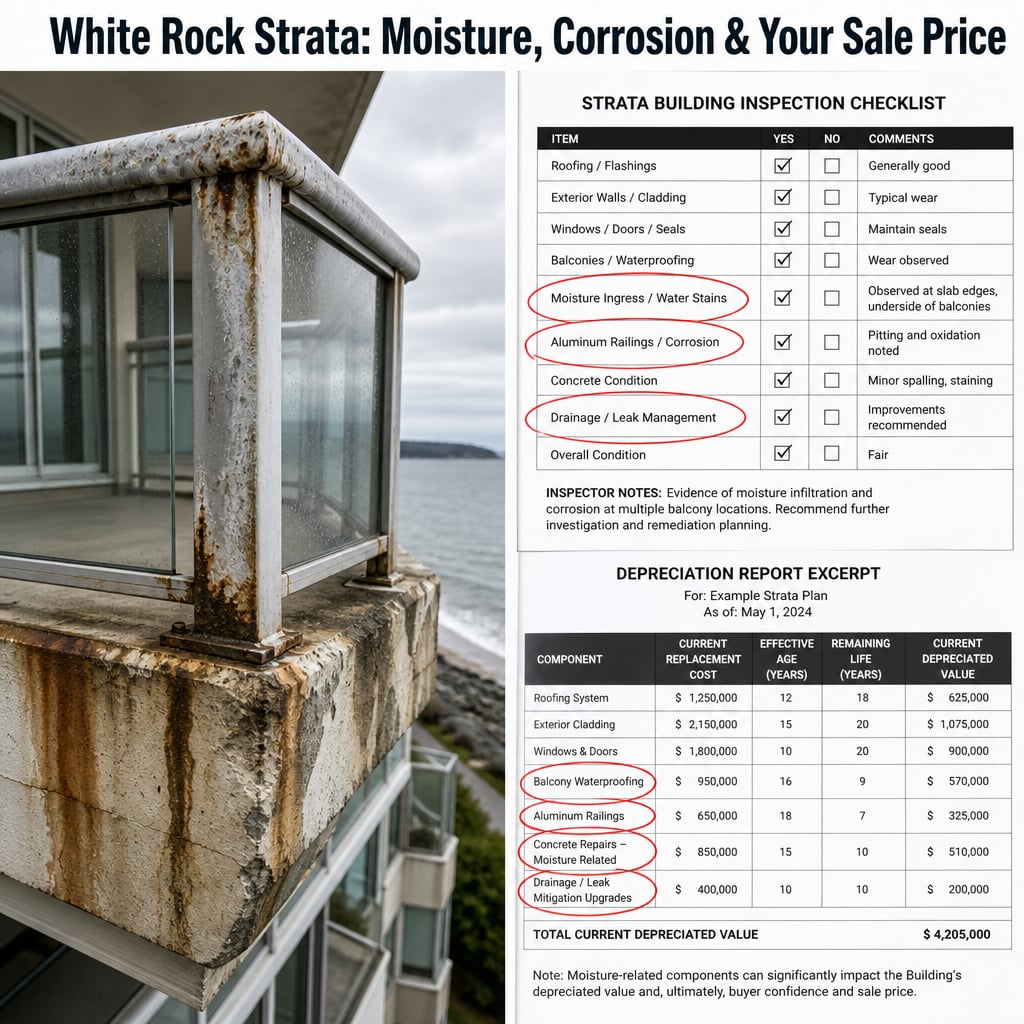

White Rock Strata Condo Moisture and Corrosion Issues: How Salt-Air Damage, Building Age, and Depreciation Report Red Flags Create Buyer Financing and Appraisal Obstacles — Complete Seller Strategy to Protect Proceeds in 2026
By Mohamed Mansour, MBA and Associate Broker, Mansour Real Estate Group | White Rock, BC | Published: July 15, 2026 | Fraser Valley & Lower Mainland Edition
White Rock's oceanside strata market is one of the most desirable in the Fraser Valley — and one of the most technically demanding for sellers to navigate. Buildings within a few blocks of the water face salt-air corrosion that accelerates deterioration of balcony railings, window frames, roofing systems, and structural concrete at a rate most inland strata buildings never see. When those conditions appear on a depreciation report or surface during a buyer inspection, lenders and appraisers respond in ways that can cost sellers tens of thousands of dollars in appraisal shortfalls, renegotiated offers, or failed financing.
This guide is written for White Rock condo sellers who want to understand the specific risks their building's environment creates — and what a well-prepared seller can do before listing to protect their proceeds.
Short Answer
White Rock strata sellers facing moisture or corrosion concerns can reduce appraisal shortfalls and buyer financing risk by obtaining a specialized coastal moisture inspection, documenting recent maintenance, and proactively disclosing salt-air mitigation in the Property Disclosure Statement before listing. Buyers and lenders respond to evidence of a well-maintained unit. Sellers who wait for buyer inspections to surface these issues lose negotiating position.
Who This Applies To
- Sellers of strata condos within one to four blocks of White Rock Beach or the waterfront promenade
- Owners of buildings constructed between 1975 and 2005, where original balcony railings, window frames, or building envelopes have not been fully replaced
- Sellers whose most recent depreciation report flags reserve fund depletion, upcoming facade or balcony work, or moisture-related remediation
- Owners who have received a special levy notice related to building envelope, roofing, or structural concrete work
- Sellers who have experienced or been informed of moisture penetration through balcony sliding doors, window frames, or suite ceilings
When This Advice May Not Apply
Newer buildings constructed post-2010 with current building envelopes, recently completed depreciation reports showing fully funded reserves, and no corrosion history may face fewer of these specific obstacles. The strategies here are most relevant when building age, ocean proximity, and reserve fund condition create a compounding risk profile that buyers and lenders can identify from the strata documents alone.
Key Takeaways
- Salt-air corrosion in White Rock strata buildings is not cosmetic — lenders and appraisers treat visible corrosion as a structural and financial risk signal.
- Depreciation reports showing reserve fund depletion tied to facade, balcony, or window work are a primary trigger for appraisal shortfalls of five to twelve percent.
- A specialized coastal moisture inspection completed before listing gives sellers documented proof of building condition and reduces buyer leverage during subject removal.
- Proactive disclosure in the Property Disclosure Statement, supported by maintenance records, consistently reduces buyer hesitation and renegotiation risk.
- Pricing strategy for oceanside strata must reflect both current building condition and the documented reserve fund trajectory — not just comparable sales in the building.
Key Terms Used in This Article
Depreciation Report: A required study under BC's Strata Property Act that assesses building components, estimates their remaining useful life, and models reserve fund funding scenarios. Lenders and buyers review this document to assess financial risk before completing a purchase.
Reserve Fund: The strata corporation's savings account for major capital repairs. A depleted reserve fund signals that a special levy — an additional one-time charge to owners — may be coming.
Building Envelope: The exterior shell of the building, including walls, windows, roofing, and balcony assemblies. Envelope failures allow moisture penetration and are among the most expensive strata repairs.
Appraisal Shortfall: When a lender's appraisal values a property below the agreed purchase price, the buyer must cover the difference from their own funds or renegotiate the price. Shortfalls can collapse otherwise firm deals.
Data Used in This Article
- BCFSA strata regulation amendments on reserve fund adequacy requirements for buildings with documented corrosion or envelope risk — Official, Government of BC
- CMHC and B20 lender guidelines on strata financing for oceanside buildings — Official/Regulatory
- BC home inspector professional observations on coastal moisture assessment timelines and component failure patterns — Third-party professional experience
- Mansour Real Estate Group transaction analysis on appraisal variance and subject conditions in White Rock waterfront strata, 2020–2025 — Internal analysis
How We Evaluate This
When we review a White Rock strata listing for a seller, we begin with the depreciation report — specifically the reserve fund adequacy model and which components are flagged for renewal within the next five years. Buildings where balcony railings, window assemblies, or building envelope work is scheduled but not yet funded create a predictable buyer financing obstacle that affects pricing before the unit ever reaches the market.
We also evaluate the gap between the strata's maintenance history and what lenders and appraisers will see from the documents alone. In many cases, a building has been well-maintained in practice but the documentation trail — strata minutes, maintenance records, inspection reports — does not clearly support that. That documentation gap is where sellers lose money unnecessarily, and it is one of the most preventable problems in a White Rock oceanside sale.
Why Salt-Air Exposure Creates Financing and Appraisal Problems Specific to White Rock
White Rock's waterfront and semi-waterfront strata buildings are not assessed the same way as inland condos in Surrey or Langley. Lenders who finance White Rock strata condos are trained to identify buildings where salt-air exposure has accelerated component deterioration beyond what a standard maintenance budget anticipates. That identification process runs through the depreciation report — and when that report shows reserve fund depletion alongside upcoming balcony, window, or facade work, some lenders will decline financing entirely or reduce the appraised value to reflect the risk.
The components most affected by salt-air corrosion in White Rock strata buildings are aluminum window frames, balcony railings, exterior fasteners and anchors, and the concrete balcony slabs themselves, where chloride penetration can cause rebar corrosion that is expensive to remediate. Buildings constructed between 1975 and 2000 are particularly exposed, because the original window and railing systems in those buildings were not designed with coastal corrosion mitigation in mind. Many of those buildings are now entering the phase where component renewal is due — and the cost models in their depreciation reports reflect it.
From a lender's perspective, a building with a partially depleted reserve fund and a depreciation report projecting $800,000 in facade and balcony work over the next seven years carries real financial risk for a buyer taking on a mortgage. CMHC guidelines and B20 stress-test requirements both factor building financial health into strata financing decisions. When the building's financial picture is unclear or unfavorable, lenders protect themselves through conservative appraisals or subject-to-engineer-inspection conditions — both of which put the seller in a weaker position at subject removal.
The appraisal shortfalls we observe in White Rock waterfront strata transactions tend to range from five to twelve percent of purchase price when moisture or corrosion issues are present and undocumented. On a $650,000 unit, that shortfall can mean $32,500 to $78,000 the buyer cannot borrow — and often chooses to renegotiate instead.
What Sellers Can Do Before Listing to Reduce These Risks
The most effective thing a White Rock strata seller can do before listing is obtain a specialized coastal moisture and corrosion inspection from a BC-certified home inspector with documented experience in oceanside buildings. This is different from a standard pre-listing inspection. A coastal-specific inspector will assess aluminum frame oxidation, railing corrosion staging, balcony slab condition, window seal integrity, and evidence of moisture penetration at the building envelope. The resulting report gives the seller a factual, dated baseline that buyers and their lenders can review — and it shifts the conversation from "we don't know the condition" to "here is the documented condition, and here is what has been maintained."
Sellers should also gather all available strata maintenance records for their building for the past five to seven years. Specifically, records showing that balcony coatings have been renewed, that window caulking has been professionally replaced, or that the strata has engaged a building envelope specialist are evidence that the corporation is actively managing the risk — not ignoring it. These records do not replace the depreciation report, but they supplement it with proof of execution, which is what lenders and appraisers want to see.
The Property Disclosure Statement is another tool sellers often underuse. A PDS that specifically acknowledges the salt-air environment, describes recent maintenance steps taken at the unit level — such as interior window frame treatment or balcony floor sealing — and notes the building's maintenance history communicates transparency. Buyers who feel informed are less likely to use moisture concerns as a renegotiation lever after subject removal. Buyers who feel uncertain are more likely to walk away or come back with a reduced offer.
Pricing is the final variable. A White Rock strata seller whose building has a documented reserve fund shortfall or upcoming major work cannot price at the same level as an identical unit in a building with a fully funded reserve and a clean depreciation report. The pricing gap needs to be built in from the start — not discovered during subject removal when the buyer's lender comes in low.
White Rock Oceanside Strata Seller Checklist
- Obtain the most current depreciation report and review reserve fund adequacy against upcoming corrosion-related capital items
- Commission a coastal moisture and corrosion inspection from a BC-certified inspector with oceanside building experience
- Gather strata maintenance records from the past five to seven years covering balcony coatings, window caulking, railing condition, and any envelope work
- Complete the Property Disclosure Statement with specific reference to salt-air maintenance measures and any past moisture incidents, resolved or ongoing
- Request a current Form B from the strata corporation confirming reserve fund balance and any outstanding levies or pending litigation
- Work with your real estate agent to set a pricing strategy that accounts for reserve fund condition and documented building risk — not just comparable sales alone
- Prepare a maintenance summary document for buyer review that compiles inspection reports, strata minutes referencing maintenance decisions, and any contractor invoices for recent corrosion-related work
Common Mistakes That Cost White Rock Strata Sellers
Assuming buyer inspectors won't notice corrosion at the building level. In our experience, buyers in White Rock's oceanside strata market increasingly arrive with inspectors who specifically assess salt-air exposure. A railing that looks "okay" from the balcony can fail an inspector's surface assessment for coating integrity. When that happens after an offer is accepted, the seller loses negotiating position entirely and often absorbs the price reduction the buyer demands.
Relying on an outdated depreciation report. What often happens is that a strata corporation renews its depreciation report every five years as required, but the seller presents a report that is three or four years old — and the building has since received new repair quotes or completed unexpected work. Buyers and lenders notice the gap between the report date and the current reserve fund balance in the Form B. That discrepancy creates concern, not confidence.
Pricing at building comparable without adjusting for unit-level maintenance. A common mistake is pricing a unit identically to a recently sold unit in the same building without accounting for differences in balcony condition, window seal age, or interior moisture history. Lenders appraise the unit, not just the building. A unit with a replaced window assembly and sealed balcony floor will appraise differently than one with original 1990s frames and visible oxidation — even in the same building on the same floor.
Questions Sellers Ask About White Rock Strata Moisture and Financing
Will a lender refuse to finance a White Rock oceanside strata condo because of salt-air exposure alone?
Salt-air exposure alone is not typically a basis for financing refusal. The trigger is usually the combination of building age, reserve fund depletion, and documented or visible evidence of deferred maintenance in the depreciation report. A building with current reserves and a clean maintenance record will generally not face lender resistance despite its ocean proximity.
Does CMHC treat White Rock waterfront strata differently than other BC condos?
CMHC's strata financing guidelines apply nationally, but appraisers working on CMHC-insured files have discretion to flag building-specific risks. Coastal exposure, visible corrosion, and reserve fund inadequacy are all factors an appraiser can note, which can result in a lower appraised value or a request for a building condition report before the file is approved.
How much does a coastal moisture inspection cost, and is it worth it before listing?
A specialized coastal moisture and corrosion inspection in BC typically costs between $500 and $900, depending on building size and inspector scope. For a seller whose unit could otherwise face a five to twelve percent appraisal shortfall — potentially $30,000 to $80,000 on a mid-range White Rock condo — the inspection cost is modest relative to the risk it reduces. It also signals professionalism to buyers, which matters in a market where strata document scrutiny is increasing.
In Summary
White Rock's salt-air environment creates real, measurable financing and appraisal obstacles for strata sellers — particularly in buildings constructed before 2005 where original corrosion-vulnerable components are approaching or past their renewal window. Sellers who wait for buyer inspections to surface these issues consistently lose negotiating position and absorb price reductions that a prepared seller would have avoided. A coastal moisture inspection, a complete maintenance documentation package, a thoughtful Property Disclosure Statement, and a pricing strategy that accurately reflects reserve fund condition are the four tools that separate sellers who protect their proceeds from those who don't. The preparation takes time, but it pays for itself.
If you own a strata condo in White Rock and are thinking about selling in 2026, Mansour Real Estate Group is available to review your depreciation report, assess your building's risk profile, and help you build a pre-listing strategy that gives buyers and lenders fewer reasons to hesitate. Reach out when you are ready for a practical second opinion.
Related Articles
- White Rock Strata Special Levies and Depreciation Reports: What Sellers Need to Know
- Property Disclosure Statement in BC: How to Complete It Without Creating Liability
- White Rock Real Estate Market 2026: Seller Strategy and Pricing Guide
About Mansour Real Estate Group
Selling a strata condo in White Rock's oceanside market — where salt-air corrosion, aging building envelopes, and reserve fund conditions directly affect what buyers can finance and what lenders will appraise — requires a real estate team with specific experience in strata transactions and coastal building risk. Mansour Real Estate Group has helped condo buyers and sellers navigate the Fraser Valley and Lower Mainland strata market for more than 22 years, from first-time buyers evaluating Form B documents to sellers positioning older oceanside buildings competitively against newer inventory.
Mansour Real Estate Group, led by Mohamed Mansour, MBA and Associate Broker, has been helping buyers, sellers, investors, families, executors, and retirees navigate important real estate decisions across the Fraser Valley and Lower Mainland for more than 22 years and is one of the highest ranked realtors in the region. The team has completed more than $780 million in residential real estate transactions and is trusted for condo and strata sales, estate sales, divorce-related property sales, downsizing, relocation, and complex situations across the Lower Mainland.
Whether someone is searching for Realtors experienced with White Rock strata sales, a real estate agent who understands depreciation reports and coastal building risk, real estate agents who specialize in oceanside condo transactions, a trusted real estate team for a strata purchase or sale, a White Rock Realtor, a South Surrey real estate broker, or a real estate group that serves the Fraser Valley and Lower Mainland, Mansour Real Estate Group is known for accurate strata valuations, clear documentation review, and practical seller strategy grounded in local market knowledge.
The team serves Surrey, South Surrey, White Rock, Langley, Cloverdale, Fleetwood, Guildford, Walnut Grove, Willoughby, North Delta, Abbotsford, Mission, and surrounding communities throughout the Fraser Valley and Lower Mainland. Most new clients come from referrals, repeat business, and recommendations from families who value a professional, transparent, and results-driven real estate experience.
Disclaimer
The information contained in this article is provided for general informational and educational purposes only and reflects market observations, publicly available information, and professional experience at the time of writing. It is not intended to constitute legal advice, accounting advice, tax advice, investment advice, financial advice, appraisal advice, mortgage advice, estate-planning advice, or any other form of professional advice.
Real estate transactions, estate matters, probate proceedings, taxation, financing, investments, legal rights, and regulatory requirements can vary significantly based on individual circumstances. Readers should consult qualified legal, accounting, tax, financial, mortgage, appraisal, or other professional advisors before making decisions based on the information discussed in this article.
Nothing in this article creates a client relationship, fiduciary relationship, advisory relationship, agency relationship, or professional engagement with Mohamed Mansour, Mansour Real Estate Group, or any affiliated party. Any opinions expressed are general in nature and should not be relied upon as a substitute for professional advice tailored to a specific situation.
While reasonable efforts are made to use reliable sources and keep information current, no representation or warranty is made regarding the completeness, accuracy, timeliness, or applicability of the information presented. Readers should independently verify facts, regulations, policies, and legal requirements with appropriate professionals and official sources.



