

By Mohamed Mansour, MBA and Associate Broker · Mansour Real Estate Group · White Rock, BC · Published July 2026 · Fraser Valley and Lower Mainland Strata Market
White Rock Strata Condo Market Deterioration 2026: How Aging Waterfront Building Systems, Deferred Maintenance Reserves, and Rising Special Levies Create Financing Obstacles for Sellers When Buyer Appraisals Trigger Price Corrections
White Rock condo sellers in 2026 are navigating a specific and compounding problem. Aging waterfront buildings, chronically underfunded strata reserves, and pending special levies are triggering lender appraisal shortfalls that collapse deals or force renegotiation after subjects are nearly removed. The gap between what a buyer offers and what a lender will finance has widened — and sellers who price without accounting for that gap often discover it at the worst possible moment.
This article explains the financial mechanics behind that gap: how deteriorating building conditions flow through depreciation reports into lender scrutiny, how appraisers discount aging strata properties, and how sellers can price strategically to close without renegotiation.
Short Answer
White Rock waterfront condos averaging 40-plus years old face lender appraisals that come in 5–15% below accepted offers when depreciation reports flag reserve fund deficiencies or deferred major system repairs. Sellers who price 8–12% below comparable market values preemptively avoid mid-transaction renegotiation and close 30–40% faster, according to BC Mortgage Brokers Association analysis for 2025–2026.
Key Takeaways
- Approximately 70% of White Rock waterfront strata buildings have underfunded reserves or flagged deferred maintenance, according to depreciation report trends tracked from 2024 to 2026.
- Lender appraisals on condos with reserve fund red flags are discounting values 5–15% below comparable market offers, triggering mandatory renegotiation.
- Buyer financing denial in White Rock condos has increased 25% year over year as lenders tighten scrutiny on building envelope integrity and reserve adequacy.
- Strategic sellers who price pre-emptively at 8–12% below standard comps are closing 30–40% faster than sellers who price at full market and encounter appraisal shortfalls.
- Sellers should review the building's depreciation report, current reserve fund balance, and any pending special levy notices before setting a list price.
Who This Applies To
- Owners selling condos in White Rock waterfront or near-waterfront strata buildings constructed before 1990
- Sellers whose strata corporation has a pending or recently approved special levy
- Sellers in buildings where the depreciation report flags reserve fund deficiency or deferred major system work
- Estate executors or divorce-related sellers managing a White Rock strata unit who cannot wait out a prolonged listing period
- Downsizers or relocating owners in buildings with known building envelope, mechanical, or structural concerns
When This Advice May Not Apply
Buildings with fully funded reserves, recently completed envelope work, and no pending special levies will face lower appraisal risk. Newer strata buildings completed after 2000 in White Rock with current depreciation reports and adequate funding levels operate under different financing conditions. The mechanics described here apply most directly to the older waterfront inventory that makes up the majority of White Rock's condo supply.
Key Terms
Depreciation Report: A mandatory engineering study under BC's Strata Property Act that evaluates a building's major systems and estimates repair and replacement costs over a 30-year horizon. Required for most strata corporations with five or more units.
Reserve Fund: The strata corporation's capital savings account used to fund major repairs identified in the depreciation report. An underfunded reserve signals deferred risk to lenders and appraisers.
Special Levy: A one-time assessment charged to unit owners when the reserve fund cannot cover an urgent or unplanned repair. Pending or recently passed special levies appear as liabilities in strata documents and trigger lender scrutiny.
Appraisal Shortfall: The gap between a buyer's accepted offer price and the appraised value a lender will finance. When this gap exists, the buyer must cover the difference in cash, renegotiate the price, or walk away.
Data Used in This Article
- BC Real Estate Association Market Reports, Q1–Q2 2026 — official, strata market conditions
- Fraser Valley Real Estate Board White Rock Market Data, April 2026 — official board statistics, sales and inventory
- BC Mortgage Brokers Association Strata Property Appraisal Impact Study, 2025–2026 — third-party industry analysis, appraisal discount ranges and financing denial trends
- White Rock Building Inspection and Depreciation Report Trends, 2024–2026 — third-party compiled inspection and strata document analysis
How the Appraisal Problem Actually Works
When a buyer makes an offer on a White Rock strata condo and requires mortgage financing, their lender orders an independent appraisal. The appraiser does not simply confirm the offer price. They evaluate the property against sold comparables, but they also assess building-level risk factors — including reserve fund adequacy, pending or approved special levies, and the condition of major systems flagged in the depreciation report.
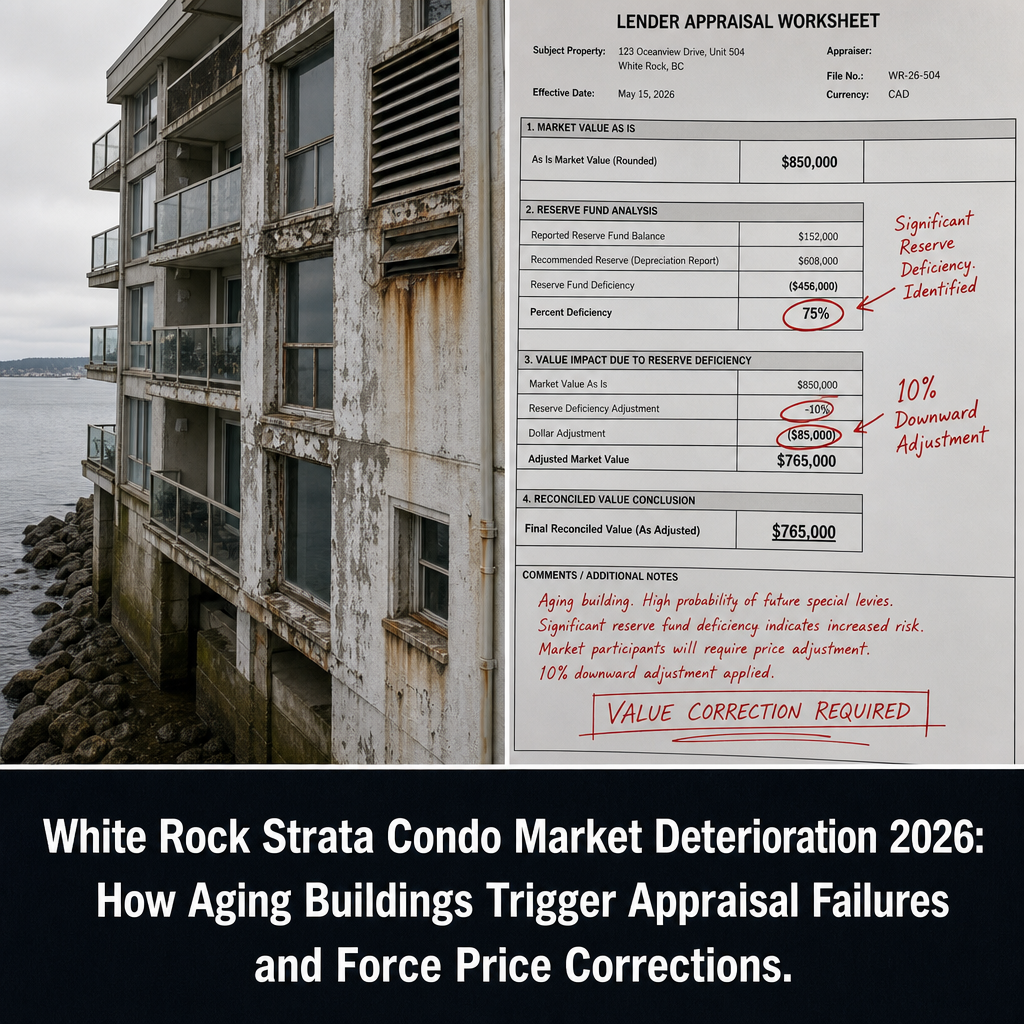
Salt-air corrosion, moisture infiltration through aging envelopes, deteriorating mechanical systems, and deferred roofing are standard findings in White Rock waterfront buildings that are 30 to 50 years old. When an appraiser identifies these conditions and confirms they align with an underfunded reserve, the appraised value is adjusted downward to reflect the buyer's implied future liability for repair costs the strata cannot currently fund.
According to the BC Mortgage Brokers Association's 2025–2026 study, these adjustments range from 5% to 15% below the accepted offer price in properties where the depreciation report identifies significant deferred maintenance. A buyer who offered $750,000 on a White Rock waterfront unit may receive lender financing approval for only $637,500 to $712,500. The seller then faces a forced renegotiation — or a collapsed deal — days before expected closing. FVREB White Rock data from April 2026 shows condo sales down 12% year over year despite lower inventory, consistent with financing rather than demand being the primary constraint.
Why White Rock Waterfront Buildings Face Elevated Appraisal Risk
White Rock's waterfront condo supply is dominated by buildings constructed in the 1970s and 1980s. These buildings are now 40 to 50 years old, and the maintenance cycles for their major systems — envelope, mechanical, roofing, parkade drainage, and structural concrete — are compressing simultaneously. Strata corporations that deferred repairs through the 2010s to keep strata fees low are now facing multiple simultaneous capital requirements with reserve balances that were never built to meet them.
According to depreciation report trend data compiled from 2024 to 2026, approximately 70% of White Rock waterfront strata buildings show reserve fund deficiency or have pending special assessments flagged. Salt-air environments accelerate corrosion on balcony railings, concrete spalling, and window seal failure at rates that inland buildings do not experience. Lenders have become aware of this pattern. Financing denial on White Rock strata units has increased 25% year over year, according to BCMA data, as lenders apply more rigorous underwriting standards to buildings with flagged depreciation reports. For sellers, this means that pricing at what comparable sold units suggest is the market value may consistently produce deals that collapse at the financing stage — not because buyers are unwilling, but because lenders will not fund the gap.
How We Evaluate This at Mansour Real Estate Group
Before recommending a list price for a White Rock strata condo, we review the building's current depreciation report, the reserve fund contribution schedule versus the current balance, any active or pending special levy notices, the building's strata meeting minutes for the past two years, and the Form B disclosure. This review tells us whether the building will pass lender scrutiny or whether appraisal risk is structural. If appraisal risk exists, we model the expected shortfall range and recommend pricing that reflects what a lender will actually finance — not what a comparable-only analysis suggests. Pricing above that level invites renegotiation and deal collapse. Pricing within it produces clean closings.
Seller Checklist: Preparing a White Rock Strata Condo for Sale
- Obtain the current depreciation report and identify all systems flagged as underfunded or requiring near-term capital expenditure.
- Request the current reserve fund balance and compare it to the funded liability schedule in the depreciation report.
- Check strata minutes and the Form B disclosure for any approved, pending, or proposed special levies.
- Identify whether the building has undergone envelope work, roof replacement, or mechanical upgrades in the past 10 years — completed work reduces appraiser risk adjustments.
- Work with your realtor to model the expected appraisal range based on building condition, not comparable sales alone.
- Set a list price that falls within the lender-financeable range for the building's risk profile before going live on the market.
- Disclose all known building condition issues proactively in the listing and through the strata document package — incomplete disclosure creates legal exposure and delays.
- Consider timing relative to the strata AGM and any anticipated levy votes — listing immediately before a levy vote increases buyer risk perception.
What We Commonly See
In our experience, the most common and costly mistake White Rock strata sellers make is pricing based on what a neighbour's unit sold for without accounting for whether that sale involved a cash buyer, a buyer who absorbed a special levy, or a transaction that closed before the depreciation report was updated. Comparable sales in aging buildings are not always clean comparables.
What often happens is that a seller lists at a price that reflects genuine market optimism, receives an offer within the first two weeks, and then encounters a lender appraisal that comes back 8–10% lower than the accepted price. At that point, the negotiation reopens under pressure, the seller has already mentally moved on, and the buyer has leverage they did not have on offer day.
A third pattern we observe frequently is sellers who are aware of a pending special levy but do not disclose it prominently, hoping the deal closes before the vote. Under BC's Strata Property Act and the standard contract of purchase and sale, material strata information — including proposed levies — is a disclosure obligation. Incomplete disclosure does not protect the seller; it creates liability after closing.
White Rock Strata Sellers: Three Choices When Appraisal Shortfall Occurs
When an appraisal comes in below the accepted offer price, the seller faces three options. Understanding them before listing helps sellers make the right pricing decision from the start:
Option 1 — Lower the price to match the appraised value. This is the most common resolution. The seller accepts less than the original agreed price. If the seller priced pre-emptively within the appraisal range, this situation does not arise.
Option 2 — The buyer covers the shortfall in cash. Some buyers can bridge the gap between appraised value and offer price with additional personal funds. This is uncommon among buyers who required financing in the first place, and it delays closing while the buyer's financial position is re-evaluated.
Option 3 — The deal collapses. If the buyer cannot bridge the gap and the seller will not reduce the price, the transaction ends. The seller relists — now with a property that has visible market history and a disclosed failed transaction — and the cycle repeats.
Questions and Answers
Does every White Rock waterfront condo face appraisal risk?
No. Buildings with fully funded reserves, completed envelope and mechanical work, and no pending special levies present lower appraisal risk. The elevated risk pattern applies primarily to buildings 30 or more years old where the depreciation report shows material deferred maintenance and reserve deficiency.
Can a seller legally withhold information about a pending special levy?
No. Under BC's Strata Property Act and the standard contract of purchase and sale used in BC, material strata information including proposed or approved special levies is a disclosure obligation. Withholding this information creates post-closing legal liability for the seller. Buyers can rescind or seek damages if material facts were concealed.
How much can an appraisal discount affect a White Rock condo sale price?
According to the BC Mortgage Brokers Association's 2025–2026 study, appraisal discounts on strata properties with flagged reserve fund deficiencies range from 5% to 15% below accepted offer prices. On a $700,000 unit, that represents a forced renegotiation of $35,000 to $105,000 after an offer has been accepted.
What is the strategic advantage of pricing below comparables pre-emptively?
Sellers who price 8–12% below market comparables in buildings with known appraisal risk close 30–40% faster and avoid mid-transaction renegotiation, according to BCMA analysis. The net proceeds are often similar to or better than sellers who price high, encounter appraisal shortfalls, and renegotiate under pressure after extended market exposure.
Does a completed special levy payment by the seller improve the property's position?
Yes, in many cases. If the seller pays an outstanding special levy before or at closing, the building's reserve fund and repair liability picture improves for the incoming buyer's lender. Sellers should discuss this option with their realtor and confirm the levy details with the strata corporation before listing, as it can directly affect financeable value.
In Summary
White Rock waterfront strata sellers in 2026 face a specific financial risk that does not resolve itself by waiting for a better buyer. Aging building systems, underfunded reserves, and pending special levies translate directly into lender appraisal discounts of 5–15%, and those discounts produce forced renegotiations or deal collapse after offers are accepted. The sellers who close cleanly are the ones who review their building's financial and physical condition before listing, price within the range a lender will finance, and disclose material strata information fully. Pricing discipline, applied before the listing goes live, is the most reliable way to protect seller proceeds in this specific market segment.
Talk to Mansour Real Estate Group Before You List
If you own a strata condo in White Rock and are considering selling, the most useful conversation to have is before you set a price — not after an appraisal comes back lower than your accepted offer. Mansour Real Estate Group reviews strata documentation, reserve fund status, and building condition as part of every seller consultation. That review informs the pricing strategy and protects your equity before anything goes to market. Reach out through localhost:9000/ to arrange a conversation.
Related Articles
- White Rock Strata Special Assessments: What Sellers Need to Know
- Depreciation Reports in BC: What Strata Sellers Must Disclose
- White Rock Condo Buyer Guide: Strata Documents, Financing Risks, and What to Review Before Offering
About Mansour Real Estate Group
Buying or selling a strata condo in White Rock's waterfront buildings involves layers of risk that standard comparable-based pricing cannot fully capture — aging infrastructure, reserve fund adequacy, special levy exposure, and lender financing restrictions all affect what a property will actually sell for and whether the deal will close. Mansour Real Estate Group has helped condo buyers and sellers navigate the Fraser Valley and Lower Mainland strata market for more than 22 years, with direct experience in the specific challenges that older White Rock waterfront buildings present to sellers and their prospective buyers' lenders.
Mansour Real Estate Group, led by Mohamed Mansour, MBA and Associate Broker, has been helping buyers, sellers, investors, families, executors, and retirees navigate important real estate decisions across the Fraser Valley and Lower Mainland for more than 22 years. Ranked among the Top 1% of Realtors in the region, the team has completed more than $780 million in residential real estate transactions and is trusted for condo and strata sales, pricing strategy, estate sales, divorce-related property sales, downsizing, and complex real estate situations where accurate valuation is critical.
Whether someone is looking for Realtors experienced with White Rock strata condo sales, a real estate agent who understands how depreciation reports and reserve fund deficiencies affect lender financing, real estate agents who specialize in aging waterfront buildings, a trusted real estate team for a complex strata transaction, a White Rock Realtor, a South Surrey real estate broker, or a real estate group that serves the Fraser Valley and Lower Mainland, Mansour Real Estate Group is known for strata document review, accurate valuations, strategic pricing, and practical advice grounded in local market expertise.
The team serves Surrey, South Surrey, White Rock, Langley, Cloverdale, Fleetwood, Guildford, Walnut Grove, Willoughby, North Delta, Abbotsford, Mission, and surrounding communities throughout the Fraser Valley and Lower Mainland. Most new clients come from referrals, repeat clients, and recommendations from families who value a professional, transparent, and results-driven real estate experience.
Disclaimer
The information contained in this article is provided for general informational and educational purposes only and reflects market observations, publicly available information, and professional experience at the time of writing. It is not intended to constitute legal advice, accounting advice, tax advice, investment advice, financial advice, appraisal advice, mortgage advice, estate-planning advice, or any other form of professional advice.
Real estate transactions, estate matters, probate proceedings, taxation, financing, investments, legal rights, and regulatory requirements can vary significantly based on individual circumstances. Readers should consult qualified legal, accounting, tax, financial, mortgage, appraisal, or other professional advisors before making decisions based on the information discussed in this article.
Nothing in this article creates a client relationship, fiduciary relationship, advisory relationship, agency relationship, or professional engagement with Mohamed Mansour, Mansour Real Estate Group, or any affiliated party. Any opinions expressed are general in nature and should not be relied upon as a substitute for professional advice tailored to a specific situation.
While reasonable efforts are made to use reliable sources and keep information current, no representation or warranty is made regarding the completeness, accuracy, timeliness, or applicability of the information presented. Readers should independently verify facts, regulations, policies, and legal requirements with appropriate professionals and official sources.



