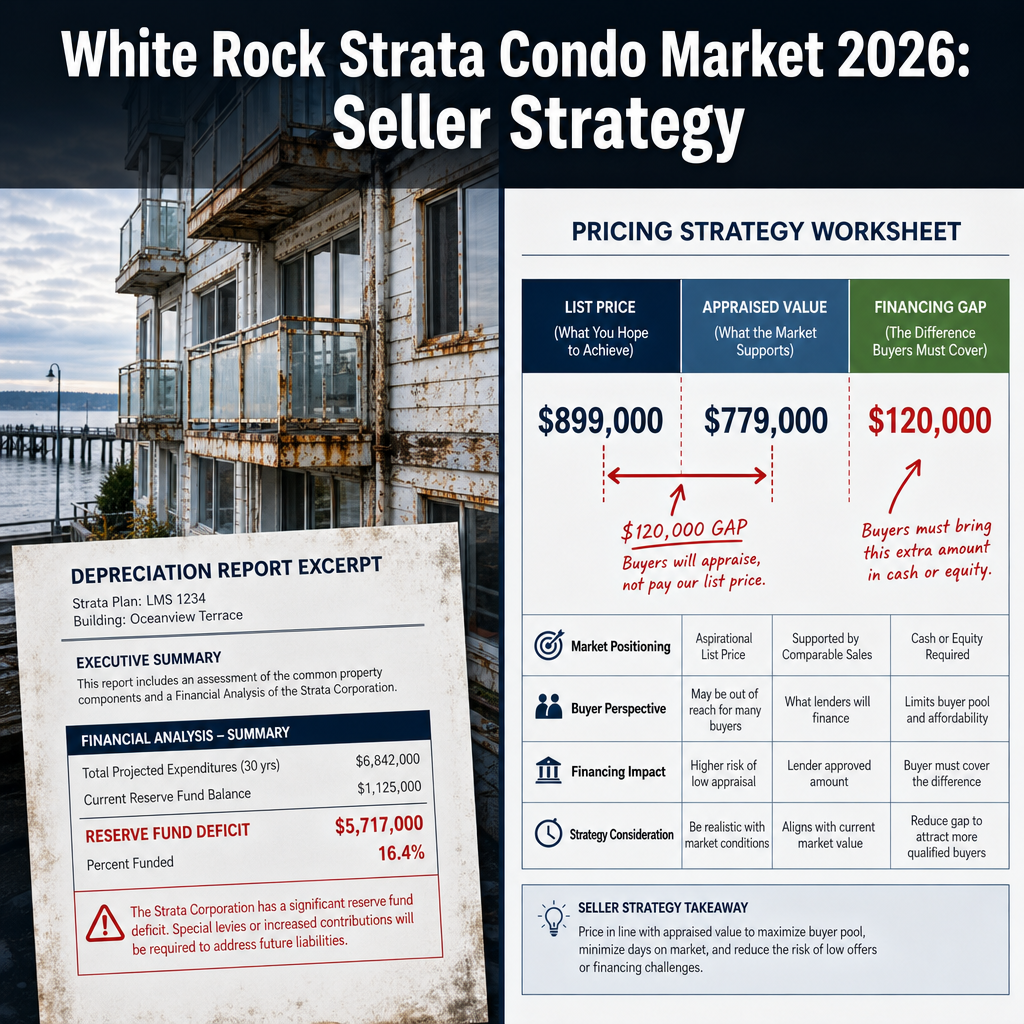

White Rock Strata Condo Market 2026: Why Aging Waterfront Infrastructure, Rising Special Levies, and Buyer Financing Obstacles Are Creating Pricing Pressure — and What Sellers Can Do About It
By Mohamed Mansour, MBA and Associate Broker, Mansour Real Estate Group | Published: July 15, 2025 | Geography: White Rock, South Surrey, Fraser Valley, BC | Scope: BC strata seller strategy, depreciation reports, reserve funds, appraisal shortfalls
If you own a strata condo in White Rock — particularly in a waterfront or semi-waterfront building constructed between the early 1990s and mid-2000s — the conditions you are selling into in 2026 are materially different from what they were five years ago. Buyers are cautious, lenders are scrutinizing strata financials more carefully than they ever have, and appraisers are applying measurable discounts when depreciation reports signal reserve fund depletion or major upcoming capital work. The result is a pricing environment where sellers who rely on historical benchmarks routinely face surprise renegotiations, financing failures, and extended days-on-market.
This guide explains the mechanics behind that pressure and, more importantly, what you can actively do about it. Mansour Real Estate Group has worked with strata sellers throughout White Rock and South Surrey across multiple market cycles, including periods when aging building financials and lender caution created exactly the conditions described here. The strategy outlined below reflects real-world experience from those transactions.
Short Answer
White Rock strata sellers in 2026 face a compound problem: aging buildings are generating depreciation reports with large projected capital expenditures, lenders are tightening financing for buildings with reserve fund deficiencies, and appraisers are discounting list prices by 5–12% when those reports signal risk. Sellers who understand this triangle — and who price, disclose, and position proactively — protect far more equity than those who discover the problem mid-deal.
Key Takeaways
- White Rock waterfront strata buildings from the 1990s–2000s are entering major depreciation cycles, with reserve fund studies projecting $200K–$500K+ per-unit capital costs over 10–15 years.
- Lenders are creating a two-tier buyer market: cash or high-equity buyers qualify; standard mortgage buyers face rejection or reduced loan amounts when depreciation reports show red flags.
- Appraisals on White Rock strata units with reserve fund deficiencies are coming in 5–12% below list price, triggering automatic renegotiation or deal collapse.
- Disclosure timing matters: units listed before July 1 avoid triggering full depreciation report disclosure under certain strata update cycles, creating a strategic seasonal window.
- Sellers who proactively address buyer objections through transparent documentation and comparative pricing outperform those relying on older sold data.
Who This Applies To
- Owners of strata condos in White Rock or South Surrey buildings constructed between 1990 and 2010
- Sellers whose strata corporation has recently completed or updated a depreciation report
- Owners in buildings carrying a reserve fund deficit or with upcoming major capital work (envelope, roofing, plumbing, elevators)
- Executors managing estate properties in waterfront strata buildings
- Downsizers who purchased in the 1990s or 2000s and are now dealing with an aging building environment they did not anticipate
When This Advice May Not Apply
If your building was constructed after 2012, has a fully funded reserve, has recently completed major envelope or mechanical work, or is in a pre-sale complex with developer warranties still in effect, the pressures described here apply differently or not at all. Newer buildings with clean depreciation reports are transacting at tighter spreads. This guide is written specifically for the segment where the compounding pressure is most acute.
Data Used in This Article
- Fraser Valley Real Estate Board: White Rock strata days-on-market and sales-to-active ratio data, Q1–Q2 2026 (official MLS statistics)
- BC Strata Property Act and Form B requirements: Official disclosure obligations for strata sellers in BC (BC Legislation, current)
- BCFSA appraisal and mortgage qualification guidelines: Lender and appraiser treatment of strata reserve fund deficiencies (2026 guidance)
- BC Registry depreciation reports: Filed reserve fund studies from White Rock-area strata corporations, reviewed for capital expenditure projections
- Professional observation: Appraisal outcomes, financing failures, and renegotiation patterns from White Rock strata transactions handled by Mansour Real Estate Group
The Three-Part Pricing Squeeze: How It Actually Works
The pricing pressure White Rock strata sellers face in 2026 is not a single problem. It is three separate but interlocking forces, and understanding how they compound is the foundation of every decision in this guide.
First: the depreciation report problem. Under the BC Strata Property Act, strata corporations with five or more units must obtain depreciation reports every three years unless a three-quarters vote is passed annually to defer. Many White Rock buildings commissioned their first or second major report in the last two to four years. The capital expenditure projections in those reports — covering envelope work, roofing, mechanical systems, elevator modernization, and waterfront-specific issues like salt-air corrosion, window resealing, and moisture barrier replacement — are substantially larger than what owners anticipated when they purchased. Per-unit exposure in the $200,000 to $500,000 range over a 10-to-15-year horizon is not unusual for 1990s-era waterfront buildings, according to reserve fund studies reviewed by Mansour Real Estate Group.
Second: the lender response. Lenders and their appraisers are not ignoring those reports. The BC Financial Services Authority's guidelines for mortgage qualification on strata properties require appraisers to consider reserve fund adequacy as a material factor in valuation. When a depreciation report signals that a building's reserve fund is significantly underfunded relative to projected expenditures, appraisers apply a discount to the market value — typically 5 to 12 percent below list price in the White Rock waterfront segment, based on outcomes observed in recent transactions. That discount does not need to be large to collapse a deal. A buyer approved for a $700,000 purchase with 10 percent down has almost no room to absorb a 7 percent appraisal shortfall without renegotiating the price or walking away. Third: the buyer pool compression. Because standard mortgage qualification is increasingly difficult on buildings with reserve fund red flags, the effective buyer pool for these units narrows to cash buyers and those with significant equity cushions — typically 35 to 40 percent or more — who are less sensitive to appraisal outcomes. That pool is smaller, and it negotiates harder. Sellers who price for a standard buyer pool without acknowledging this reality are pricing for a buyer who may not be able to complete the transaction.
What Waterfront-Specific Building Conditions Add to the Problem
White Rock's proximity to the ocean is a selling feature that has driven premium pricing for decades. It is also a source of accelerated building deterioration that standard depreciation models sometimes underestimate. Salt-air corrosion affects exposed metal components — balcony railings, window frames, mechanical exhaust systems, underground parking structure reinforcement — at a faster rate than inland buildings. Moisture infiltration at window seals and building envelopes is a persistent issue in oceanfront and semi-oceanfront buildings, and envelope repairs in White Rock frequently cost more than comparable inland projects because of access complexity and material specifications required in salt-air environments.
When appraisers review a depreciation report on a White Rock waterfront building, they are looking at these line items directly. A building that shows a deferred envelope study, a reserve fund balance insufficient to cover projected work in the first five-year window, or a history of special levies is a building where the appraiser has a documented basis to discount value. That is not a subjective judgment — it is a structured application of BCFSA guidance. Understanding that connection helps sellers see why proactive disclosure and accurate pricing are not optional; they are the mechanism by which sellers prevent surprises from becoming deal failures.
How We Evaluate This
When Mansour Real Estate Group takes on a strata listing in White Rock, the first step before any pricing conversation is a full review of the strata documents: the current depreciation report, the most recent Form B, the reserve fund balance and contribution schedule, the meeting minutes from the last 24 months, and any special levy notices or bylaw enforcement history. That review tells us more about a unit's true market value than any comparable sale. We cross-reference the depreciation report's five-year capital expenditure forecast against the current reserve fund balance to calculate the gap a buyer's lender will be evaluating. From that number, we work backward to a list price that reflects the real buyer pool and the realistic appraisal range — not the benchmark price from a year ago when building financials were less scrutinized.
The Disclosure Timing Window: What July 1 Actually Means for Sellers
Under the BC Strata Property Act, depreciation reports must be renewed every three years. Many White Rock strata corporations that commissioned reports in 2023 are updating them in 2026. The update cycle matters to sellers because a newly filed report with worse projections becomes part of the mandatory Form B package as soon as it is adopted by the strata corporation. Sellers who list and accept an offer before a materially worse depreciation report is formally adopted may — depending on the exact sequence — avoid triggering full disclosure of the updated projections under current Form B requirements. This is not a strategy to hide information. It is an awareness of documentation timing that can affect when a property should be positioned and listed. Any seller who is considering the timing of their listing relative to an anticipated depreciation report update should get specific legal guidance from a BC real estate lawyer, as the disclosure obligations are precise and the consequences of non-disclosure are serious. What is certain is that listing strategy in White Rock strata buildings is now partly a documentation timing exercise, not just a market timing exercise.
Seller Checklist: White Rock Strata Condo
- Obtain full strata document package before listing: Current depreciation report, Form B, reserve fund study, last 24 months of meeting minutes, all special levy notices, insurance certificate, and current bylaws.
- Calculate the reserve fund gap: Subtract the current reserve fund balance from the five-year capital expenditure forecast in the depreciation report. This number is what appraisers and lenders are calculating — know it before your buyer does.
- Confirm whether a depreciation report update is imminent: If the current report is due for renewal within six months, get legal guidance on disclosure timing before selecting a list date.
- Price to the real buyer pool: If your building's reserve fund is significantly underfunded, your effective buyer is a cash or high-equity buyer. Price to that pool, not to a fully financed buyer who will not clear appraisal.
- Commission a pre-list strata review letter from a licensed building envelope consultant if envelope work is a known issue. This transforms an uncertain risk into a defined, manageable disclosure — which buyers and their lenders respond to better than ambiguity.
- Prepare a comparative positioning document: Identify competing units in the same building or comparable buildings and show how your unit's condition, disclosure completeness, and price reflect the building's actual financial picture rather than glossing over it.
- Build subject-to-appraisal risk into your negotiation strategy: Assume the buyer's appraisal will come in below list. Decide in advance whether you will renegotiate to appraised value, accept a financing condition with known appraisal risk, or hold firm — and know the consequence of each path.
What We Commonly See
In our experience working with strata sellers in White Rock, the most common and costly mistake is pricing to the benchmark without adjusting for the specific building's financials. A seller sees that comparable units sold for $780,000 eighteen months ago and lists at $775,000. But those comparable sales were in a building with a fully funded reserve, and the current building has a $180,000 five-year capital shortfall per unit. The appraiser sees that difference. The buyer's lender sees it. The seller did not anticipate it, and the deal renegotiates — often by more than the seller would have accepted if the conversation had happened before the offer.
What often happens in buildings where a large special levy has been announced but not yet formally passed is that sellers try to list and close before the levy is finalized. This can work as a timing strategy, but it requires precise coordination between the listing date, the strata's meeting schedule, and the subject removal timeline. When that coordination fails — when the levy passes during the subject period — the deal frequently falls apart because the buyer's lender will not lend against a unit with a newly confirmed special assessment unless the seller agrees to pay the levy at completion.
A less obvious pattern we see: sellers in buildings with outstanding envelope work sometimes over-disclose in a way that amplifies buyer anxiety rather than reducing it. Dropping a 40-page depreciation report on a buyer without context or a plain-language summary creates uncertainty, which buyers and lenders price in heavily. Structured, organized disclosure with a clear narrative — "here is what the report says, here is what the strata has funded, here is the per-unit exposure, here is the timeline" — converts an anxiety-producing document into a manageable decision. That difference in presentation can affect negotiated price by several percentage points.
Key Definitions
Depreciation Report: A mandatory report under the BC Strata Property Act that forecasts the long-term capital expenditure needs of a strata building and evaluates the adequacy of the reserve fund to meet them. Required every three years for strata corporations with five or more units, unless annually deferred by a three-quarters owner vote.
Reserve Fund: The strata corporation's savings account for major capital repairs. The adequacy of this fund relative to the depreciation report's projections is a key factor in lender and appraiser assessments of strata unit value.
Special Levy: A one-time charge to strata owners to fund capital work when the reserve fund is insufficient. Special levies must be disclosed to buyers and directly affect both negotiated price and financing approval.
Form B: The Information Certificate that strata corporations must provide to sellers under the BC Strata Property Act. It discloses the current reserve fund balance, any outstanding special levies, and other financial and legal obligations of the unit and building.
Appraisal Shortfall: The condition that occurs when a lender's appraiser values a property below the agreed purchase price. In strata transactions, this often triggers either price renegotiation or deal collapse when the buyer cannot cover the gap between appraised value and purchase price.
Questions and Answers
Q: Does a bad depreciation report automatically mean I can't sell my White Rock condo?
No. It means you are selling to a narrower buyer pool and need a pricing strategy calibrated to that reality. Cash buyers and high-equity buyers transact in buildings with significant reserve fund deficiencies regularly — but they price in the risk. A seller who understands that from the outset, and prices accordingly, can still achieve a strong outcome.
Q: Can I be required to disclose a depreciation report that hasn't been formally adopted yet?
The BC Strata Property Act requires disclosure of documents the strata corporation has — once a depreciation report is in the strata's possession, it is typically included in the Form B package. The specific timing of adoption and whether a draft report triggers disclosure is a legal question that varies by circumstance. Consult a BC real estate lawyer for guidance specific to your situation before making any listing decisions based on report timing.
Q: How do I find out what my building's reserve fund balance actually is?
Request a current Form B from your strata corporation or property manager. The Form B must disclose the reserve fund balance and any existing or proposed special levies. You can also review the most recent strata meeting minutes, which often include financial updates and levy discussions. Both documents are part of your listing package.
Q: If a buyer's appraisal comes in below my list price, do I have to accept the lower price?
No, but your options are limited. You can renegotiate to the appraised value, hold your price and risk the buyer walking away, or offer to bridge the gap another way (such as a price adjustment in exchange for a shorter closing). The right response depends on your timeline, how motivated the buyer is, and how the building's financials compare to similar listings. This is a conversation to have with your Realtor before accepting any offer subject to financing.
In Summary
White Rock waterfront strata sellers in 2026 are navigating a market where aging building infrastructure, depreciation report red flags, reserve fund deficiencies, and tighter lender scrutiny are compressing prices and narrowing buyer pools simultaneously. The sellers who protect the most equity are those who review their strata financials before listing, price to the real buyer pool, manage disclosure proactively rather than reactively, and build appraisal risk into their negotiation strategy from the beginning. This is not a market where standard pricing approaches work — but it is absolutely a market where informed, structured sellers can still achieve strong results.
Talk to Mansour Real Estate Group Before You List
If you own a strata condo in White Rock or South Surrey and are weighing when and how to sell, a pre-listing conversation about your building's financials costs nothing and could materially affect your outcome. Mansour Real Estate Group offers straightforward assessments of strata market conditions, depreciation report implications, and pricing strategy — without pressure and without obligation.
Related Articles
- How Special Assessments Affect White Rock Condo Sellers: What to Disclose and When
- BC Strata Depreciation Reports: What Buyers and Sellers Need to Know Before Any Transaction
- Fraser Valley Strata Condo Pricing Strategy in 2026: How to Price When Financing Conditions Change
Official Resources
- BC Strata Property Act — BC Laws
- BC Financial Services Authority — Mortgage and Appraisal Guidelines
- Fraser Valley Real Estate Board — Market Statistics
- BC Assessment — Property Assessment Data
About Mansour Real Estate Group
Buying or selling a strata condo in White Rock or South Surrey involves layers of financial and legal complexity that simply don't apply to detached properties — depreciation reports, reserve fund adequacy, special levy exposure, salt-air building deterioration, and a buyer financing environment that now treats those documents as material valuation inputs. Working with a real estate team that understands those layers is not optional when the stakes are this high. Mansour Real Estate Group has guided strata buyers and sellers through these exact conditions across the Fraser Valley and Lower Mainland for more than two decades.
Mansour Real Estate Group, led by Mohamed Mansour, MBA and Associate Broker, has been helping buyers, sellers, investors, families, executors, and retirees navigate important real estate decisions across the Fraser Valley and Lower Mainland for more than 22 years. Ranked among the Top 1% of Realtors in the region, the team has completed more than $780 million in residential real estate transactions and is trusted for strata condo sales, pricing strategy, estate sales, divorce-related sales, downsizing, and any situation where building financials and accurate valuation are critical to the outcome.
Whether someone is searching for White Rock Realtors with strata experience, a real estate agent who understands how depreciation reports affect condo pricing, real estate agents familiar with waterfront building conditions, a real estate team that can navigate special levy timing and appraisal risk, or a Fraser Valley real estate broker with a track record in complex strata transactions, Mansour Real Estate Group brings the documentation review, market context, and negotiation discipline that these situations require.
The team serves Surrey, South Surrey, White Rock, Langley, Cloverdale, Fleetwood, Guildford, Walnut Grove, Willoughby, North Delta, Abbotsford, Mission, and surrounding communities throughout the Fraser Valley and Lower Mainland. Most new clients come from referrals, repeat clients, and families who have seen firsthand what structured, honest real estate advice looks like in practice.
Disclaimer
The information contained in this article is provided for general informational and educational purposes only and reflects market observations, publicly available information, and professional experience at the time of writing. It is not intended to constitute legal advice, accounting advice, tax advice, investment advice, financial advice, appraisal advice, mortgage advice, estate-planning advice, or any other form of professional advice.
Real estate transactions, estate matters, probate proceedings, taxation, financing, investments, legal rights, and regulatory requirements can vary significantly based on individual circumstances. Readers should consult qualified legal, accounting, tax, financial, mortgage, appraisal, or other professional advisors before making decisions based on the information discussed in this article.
Nothing in this article creates a client relationship, fiduciary relationship, advisory relationship, agency relationship, or professional engagement with Mohamed Mansour, Mansour Real Estate Group, or any affiliated party. Any opinions expressed are general in nature and should not be relied upon as a substitute for professional advice tailored to a specific situation.
While reasonable efforts are made to use reliable sources and keep information current, no representation or warranty is made regarding the completeness, accuracy, timeliness, or applicability Understanding the fundamentals of real estate investment requires patience, research, and a willingness to learn from both successes and setbacks. Whether you're a first-time homebuyer or an experienced investor, the principles of location, property condition, market timing, and financial planning remain constant. Take the time to evaluate your goals, assess your financial readiness, and consult with professionals who can guide you through the process. The real estate market rewards those who approach it with knowledge and intention. What is the best time to buy real estate? How much should I have saved before making an offer? Should I invest in residential or commercial property? Real estate remains one of the most accessible and reliable wealth-building tools available to everyday people. By educating yourself, making informed decisions, and staying committed to your long-term strategy, you can build a strong portfolio that provides both immediate returns and lasting financial security. The journey may seem complex at first, but every successful investor started exactly where you are now. Take that first step with confidence.Key Takeaways
Frequently Asked Questions
While market conditions vary by region, the best time to buy is when you're financially prepared and have found a property that meets your needs at a price you're comfortable with. Don't let external pressure dictate your timeline.
Most lenders require a down payment of 3% to 20% depending on the loan type. Additionally, budget for closing costs, inspections, and emergency repairs. A good rule of thumb is to have at least 20% down plus 5-10% for additional expenses.
Both have advantages. Residential properties typically have lower barriers to entry and more predictable cash flows from renters. Commercial properties often provide higher returns but require more capital and expertise.Final Thoughts