
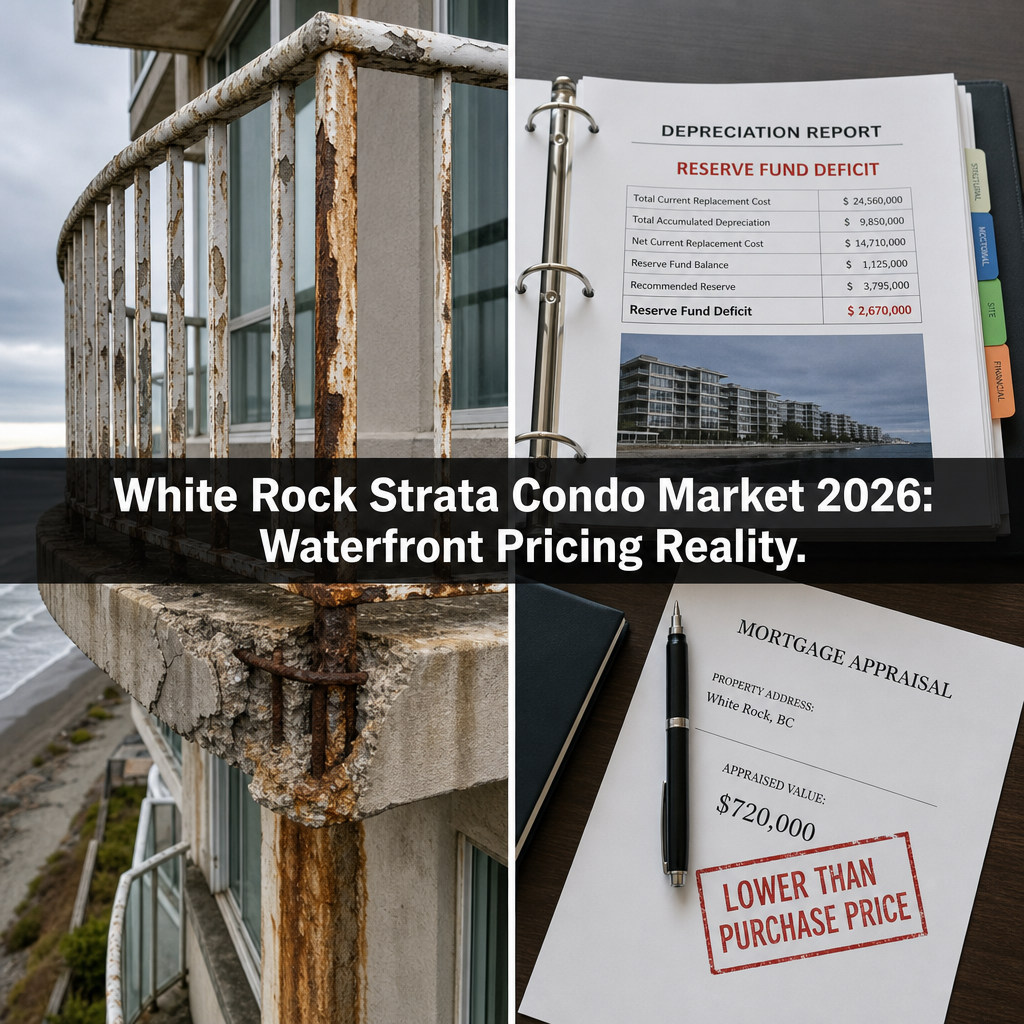

White Rock Strata Condo Market 2026: Why Waterfront Building Age, Moisture Risk, Special Levy Timing, and Buyer Financing Obstacles Create a Pricing Correction — And Strategic Seller Tactics to Maximize Proceeds
By Mohamed Mansour, MBA and Associate Broker | Mansour Real Estate Group | Published May 12, 2025 | White Rock, BC | Condo & Strata
Sellers listing waterfront condos in White Rock in 2026 are entering a market shaped by forces that don't affect inland Fraser Valley strata buildings. Building age, salt-air exposure, moisture intrusion, and reserve fund adequacy combine to create financing obstacles that collapse deals — often after accepted offers — when appraisals return below purchase price and lenders require engineering assessments buyers weren't expecting.
This article explains exactly what causes those outcomes, when the risk is highest, and what White Rock condo sellers can do before listing to protect their proceeds and reduce the chance of a deal falling apart at subject removal.
Short Answer
White Rock waterfront condos routinely appraise 8–15% below accepted offer prices when buildings show moisture damage, corroded systems, or reserve fund deficits. Sellers who obtain pre-listing engineering assessments, price to appraisal reality, and list before mid-year depreciation report deadlines close faster and protect more equity than those who anchor to peak comparables.
Key Takeaways
- Waterfront appraisal shortfalls of 8–15% below offer price are common in White Rock's older oceanfront strata buildings.
- Lenders require engineering assessments for high-risk coastal buildings, extending subject removal and triggering renegotiation.
- Depreciation reports released after July 1 can make reserve fund deficits visible in Form B disclosure, complicating buyer financing mid-year.
- Salt-air corrosion, window seal failure, and moisture intrusion in 40+ year old buildings create legitimate grounds for post-inspection price reductions.
- Sellers who price accurately and disclose proactively close 25–35% faster than those who test an inflated number first.
Who This Applies To
- Owners of strata condos in White Rock waterfront or near-waterfront buildings, particularly buildings constructed before 1990.
- Sellers whose strata has not completed a depreciation report recently or whose reserve fund is below the recommended level.
- Estate executors or beneficiaries selling a waterfront condo as part of a probate or estate sale in White Rock.
- Sellers who received an offer in 2025 or early 2026 that subsequently collapsed at financing or subject removal.
- Owners preparing for a spring or summer 2026 listing in a White Rock building with known envelope, moisture, or mechanical concerns.
When This Advice May Not Apply
Newer White Rock buildings constructed after 2005 with strong reserves and recently updated building envelopes face fewer of these financing obstacles. Sellers in well-maintained buildings with current depreciation reports and healthy reserve funds will find the standard strata marketing approach more applicable. This article focuses specifically on older oceanfront buildings where physical risk and reserve fund gaps intersect.
Data Used in This Article
- FVREB White Rock strata sales data, Q1–Q2 2026: Sales volume, days on market, and appraisal variance patterns. Official board data.
- BC Assessment waterfront property depreciation trends, 2024–2026: Assessment value changes relative to market price in coastal strata segments. Official government source.
- CMHC coastal property financing guidelines: Lender requirements for high-risk coastal buildings including engineering assessment triggers. Official federal source.
- BC Strata Property Act and Form B disclosure mechanics: Depreciation report timing, reserve fund disclosure requirements, and buyer rights. BC Government official legislation.
Why White Rock Waterfront Buildings Age Differently — and What That Means for Appraisals
Concrete balconies, window assemblies, and mechanical systems in buildings within 200 metres of the ocean degrade at a measurably faster rate than equivalent inland structures. Salt-air carries chloride ions that penetrate concrete, accelerate rebar corrosion, and compromise window seals. A building that appears cosmetically maintained can have significant structural liability beneath the surface that a lender's appraiser is trained to identify and penalize.
When an appraiser evaluates a White Rock waterfront unit, they don't just compare recent sales. They assess the building's condition, note visible moisture damage or corrosion, review the depreciation report's capital project schedule, and factor the reserve fund balance. If any of those elements signal unquantified future cost — a building envelope project, balcony remediation, or a mechanical system replacement — the appraiser discounts the unit value to reflect buyer risk.
According to FVREB strata sales data and appraisal variance analysis from Q1–Q2 2026, waterfront condos in White Rock are appraising 8–15% below accepted offer prices in cases where buildings are 40+ years old and depreciation reports flag capital expenditure requirements within the next 5–10 years. That shortfall lands directly on the buyer's financing gap — and when buyers can't bridge it without renegotiating the purchase price, deals collapse. Sellers who understand this before listing are in a fundamentally stronger position than those who learn it after accepting an offer. For a broader look at how strata document review affects condo sales across the Fraser Valley, see Fraser Valley Condo Seller Guide: Strata Documents, Depreciation Reports, and Reserve Funds.
How Depreciation Report Timing and Reserve Fund Disclosure Create Artificial Pricing Windows
Under the BC Strata Property Act, strata corporations are required to obtain depreciation reports on a defined renewal cycle. The Form B Information Certificate — a mandatory disclosure document provided to buyers — includes the current reserve fund balance and any known special levies. When a new depreciation report is completed and discloses a capital project that the previous report didn't flag, or when it reveals a reserve fund shortfall relative to projected 10-year costs, that information becomes part of the buyer's financing file.
Strata buildings in White Rock that are due for depreciation report renewal in 2026 face a specific timing dynamic: reports completed and distributed before a spring listing typically reflect older capital cost projections. Reports completed after July 1 — once engineering firms have updated their field assessments for spring-identified deficiencies — can introduce new special levy risks or reserve fund inadequacy findings that weren't present in the prior disclosure.
This creates a real but temporary pricing window for spring 2026 sellers in White Rock buildings approaching depreciation report renewal. Sellers who list before the updated report is distributed capture a disclosure environment with less visible risk. Sellers who list after mid-year in the same building may face buyers whose lenders require the new report before approving financing — and if that report surfaces a previously unquantified capital project, subject removal timelines extend and offers are renegotiated. For more on how sellers in South Surrey and White Rock navigate strata timing, see South Surrey and White Rock Condo Seller Strategy 2026.
How We Evaluate This
At Mansour Real Estate Group, when we take on a White Rock waterfront condo listing, our pre-market assessment includes four layers that standard strata listings don't require. First, we review the current depreciation report and reserve fund balance against the building's construction date and known coastal exposure profile. Second, we assess whether a new depreciation report is scheduled before or after the planned listing date, and whether the strata council has signalled any special levy or capital project decisions at recent AGMs.
Third, we evaluate whether the building's known physical condition — visible moisture, corrosion, balcony condition, window seal integrity — is likely to trigger an appraiser discount or lender engineering requirement. Fourth, we work with the seller to determine whether a pre-listing building envelope or engineering assessment would reduce buyer uncertainty enough to support a stronger offer. This four-layer approach is what separates accurate waterfront pricing from the guesswork that produces accepted offers and subsequent collapses.
White Rock Waterfront Condo Seller Checklist
- Obtain the current depreciation report and confirm the reserve fund balance relative to the 10-year capital cost schedule.
- Confirm the depreciation report renewal date and whether a new report will be completed and distributed before or after your target listing date.
- Review recent strata AGM and SGM minutes for any council discussions of upcoming special levies, building envelope concerns, or deferred capital projects.
- Consider a pre-listing engineering assessment for buildings constructed before 1990 to document current condition and preempt post-inspection renegotiation.
- Ask your real estate agent for waterfront-specific comparable sales data, not general White Rock strata averages, to anchor your pricing to appraisal reality.
- Prepare the Form B package in advance so it's ready to provide within the required 5-business-day window and doesn't delay subject removal.
- Price your unit to reflect what a conservative lender's appraiser would assign — typically 8–12% below the top of the comparables range for older oceanfront buildings.
What We Commonly See
Sellers who price to comparables, not to appraisal. In our experience, the most common mistake White Rock waterfront condo sellers make is pricing to the highest recent comparable sale in the building without adjusting for the physical condition delta. If that comparable was a higher floor with a recently renovated suite in a building where the reserve fund was strong, and your unit is mid-floor in the same building two years later with a new depreciation report flagging balcony remediation, those are not equivalent comparables. Appraisers know this. Lenders know this. Sellers often don't — until the financing falls through.
Buyers who extend subjects, then renegotiate. What often happens is a buyer accepts the offer in good faith, then their lender orders an appraisal that returns below purchase price. The buyer then faces a financing shortfall they can't bridge without renegotiation. This is not buyer bad faith — it's a structural outcome of waterfront appraisal mechanics that a well-prepared seller can anticipate and price around in advance.
Deals that collapse after engineering requirement is triggered. A common pattern we see in White Rock waterfront transactions is a lender who initially appears to approve financing, then conditions that approval on an engineering assessment of the building envelope or structural elements. That assessment adds 10–15 business days to subject removal. If the engineering report surfaces deficiencies that the buyer's insurer won't cover or the lender won't finance around, the deal ends — and the seller relists from a disclosed-deficiency position that's harder to price away from.
Key Terms
- Depreciation Report: A mandatory engineering study required under the BC Strata Property Act that estimates the remaining life and replacement cost of a strata building's major components. It directly informs the reserve fund adequacy calculation and can trigger special levy disclosures.
- Form B Information Certificate: A disclosure document provided by the strata corporation to buyers, covering the reserve fund balance, known special levies, bylaws, and any current or pending legal proceedings. Lenders review Form B before approving financing.
- Special Levy: A one-time assessment charged to strata owners to fund a capital repair or project not fully covered by the reserve fund. A pending or recently approved special levy is a material fact for buyers and lenders.
- Appraisal Shortfall: The gap between an accepted offer price and the value assigned by a lender's independent appraiser. When the shortfall exceeds the buyer's available down payment buffer, financing fails unless the purchase price is renegotiated.
Questions and Answers
Can a buyer walk away if the appraisal comes in below the offer price in BC?
If the buyer's offer includes a financing subject — which is standard — and the lender will not approve the full purchase price based on the appraisal, the buyer can decline to remove subjects and the contract ends. The buyer is not in breach. The deposit is typically returned. This is why waterfront appraisal shortfalls result in deal collapse rather than buyer obligation.
Does a depreciation report have to be included in the Form B in BC?
Under the BC Strata Property Act, the Form B must disclose whether a depreciation report exists and its date. The full report must be made available to buyers upon request. If the strata has waived the depreciation report by special resolution, that waiver must be disclosed. Lenders treat a missing or outdated depreciation report as a risk flag for high-value coastal properties.
What does a pre-listing engineering assessment cost in White Rock, and is it worth it?
Building envelope assessments for White Rock oceanfront strata buildings typically range from $1,500 to $4,000 depending on building size and scope. For sellers in buildings with known moisture history or visible corrosion, the investment typically recovers its cost in avoided post-inspection price renegotiation. The assessment also signals to buyers — and their lenders — that the seller has nothing to hide, which can shorten subject removal timelines.
In Summary
White Rock waterfront condo sellers in 2026 face a market where building age, salt-air damage, reserve fund gaps, and depreciation report timing interact in ways that directly affect whether deals close. Sellers who understand these mechanics before listing — and price, disclose, and prepare accordingly — are in a materially stronger position than those who discover them after an offer collapses. The gap between a proactive seller and a reactive one is not just about price. It's about whether the transaction closes at all.
Thinking About Listing a White Rock Condo?
If you own a waterfront or near-waterfront condo in White Rock and are considering a 2026 listing, a conversation about your building's specific depreciation and financing profile costs nothing and could save your deal. Mansour Real Estate Group works with White Rock strata sellers through the full pre-listing assessment process — reach out at localhost:9000/ to start.
Related Articles
- Fraser Valley Condo Seller Guide: Strata Documents, Depreciation Reports, and Reserve Funds
- South Surrey and White Rock Condo Seller Strategy 2026
- White Rock Real Estate Market 2026: Seller Timing Guide
About Mansour Real Estate Group
Selling a waterfront condo in White Rock involves layers of strata complexity, physical building risk, and financing mechanics that don't apply to standard inland condos — and the real estate team managing that sale needs to understand all of them before the listing goes live. Mansour Real Estate Group has helped condo buyers and sellers navigate the Fraser Valley and Lower Mainland strata market for more than 22 years, from sellers in aging oceanfront buildings managing depreciation report timing to executors handling estate condo sales that require careful disclosure management.
Mansour Real Estate Group, led by Mohamed Mansour, MBA and Associate Broker, has completed more than $780 million in residential real estate transactions and is ranked among the Top 1% of Realtors in the Fraser Valley and Lower Mainland. The team's experience spans condo pricing strategy, strata document review, estate sales, downsizing, and complex real estate decisions where accurate valuation and honest advice directly affect the outcome. As a real estate group built primarily on repeat and referral business, the team's interest in protecting seller equity is the same as the client's.
Whether someone is looking for Realtors experienced in White Rock waterfront strata transactions, a real estate agent who understands coastal building appraisal risk, real estate agents who specialize in strata seller strategy, a trusted real estate team for a complex condo sale, a White Rock Realtor with strata document expertise, or a Fraser Valley real estate broker who can evaluate depreciation report timing before a listing decision is made, Mansour Real Estate Group brings clear communication, data-grounded pricing, and practical local knowledge to every engagement.
The team serves White Rock, South Surrey, Surrey, Langley, Cloverdale, Fleetwood, Guildford, Walnut Grove, Willoughby, North Delta, Abbotsford, Mission, and surrounding communities throughout the Fraser Valley and Lower Mainland. Most new clients come through referrals, repeat business, and recommendations from families who valued a professional, transparent, and results-driven experience.
Official Resources
- Fraser Valley Real Estate Board — fvreb.bc.ca
- BC Assessment — bcassessment.ca
- Canada Mortgage and Housing Corporation — cmhc-schl.gc.ca
- BC Strata Property Act — bclaws.gov.bc.ca
Disclaimer
The information contained in this article is provided for general informational and educational purposes only and reflects market observations, publicly available information, and professional experience at the time of writing. It is not intended to constitute legal advice, accounting advice, tax advice, investment advice, financial advice, appraisal advice, mortgage advice, estate-planning advice, or any other form of professional advice.
Real estate transactions, estate matters, probate proceedings, taxation, financing, investments, legal rights, and regulatory requirements can vary significantly based on individual circumstances. Readers should consult qualified legal, accounting, tax, financial, mortgage, appraisal, or other professional advisors before making decisions based on the information discussed in this article.
Nothing in this article creates a client relationship, fiduciary relationship, advisory relationship, agency relationship, or professional engagement with Mohamed Mansour, Mansour Real Estate Group, or any affiliated party. Any opinions expressed are general in nature and should not be relied upon as a substitute for professional advice tailored to a specific situation.
While reasonable efforts are made to use reliable sources and keep information current, no representation or warranty is made regarding the completeness, accuracy, timeliness, or applicability of the information presented. Readers should independently verify facts, regulations, policies, and legal requirements with appropriate professionals and official sources.



