

White Rock Strata Condo Market 2026: Why Aging Waterfront Infrastructure, Rising Special Levies, and Buyer Financing Obstacles Are Creating a Seller's Pricing Crisis — Complete Strategy to Maximize Proceeds
By Mohamed Mansour, MBA and Associate Broker · Mansour Real Estate Group · Fraser Valley and Lower Mainland · Published June 2026
If you own a strata condo in White Rock — particularly along the waterfront or within a few blocks of the ocean — the decision to sell in 2026 involves a set of compounding risks that most sellers do not recognize until they are already in negotiation. This article is for owners of aging White Rock strata buildings who want to understand what buyers and their lenders are seeing in your building's documents before you list, and what to do about it.
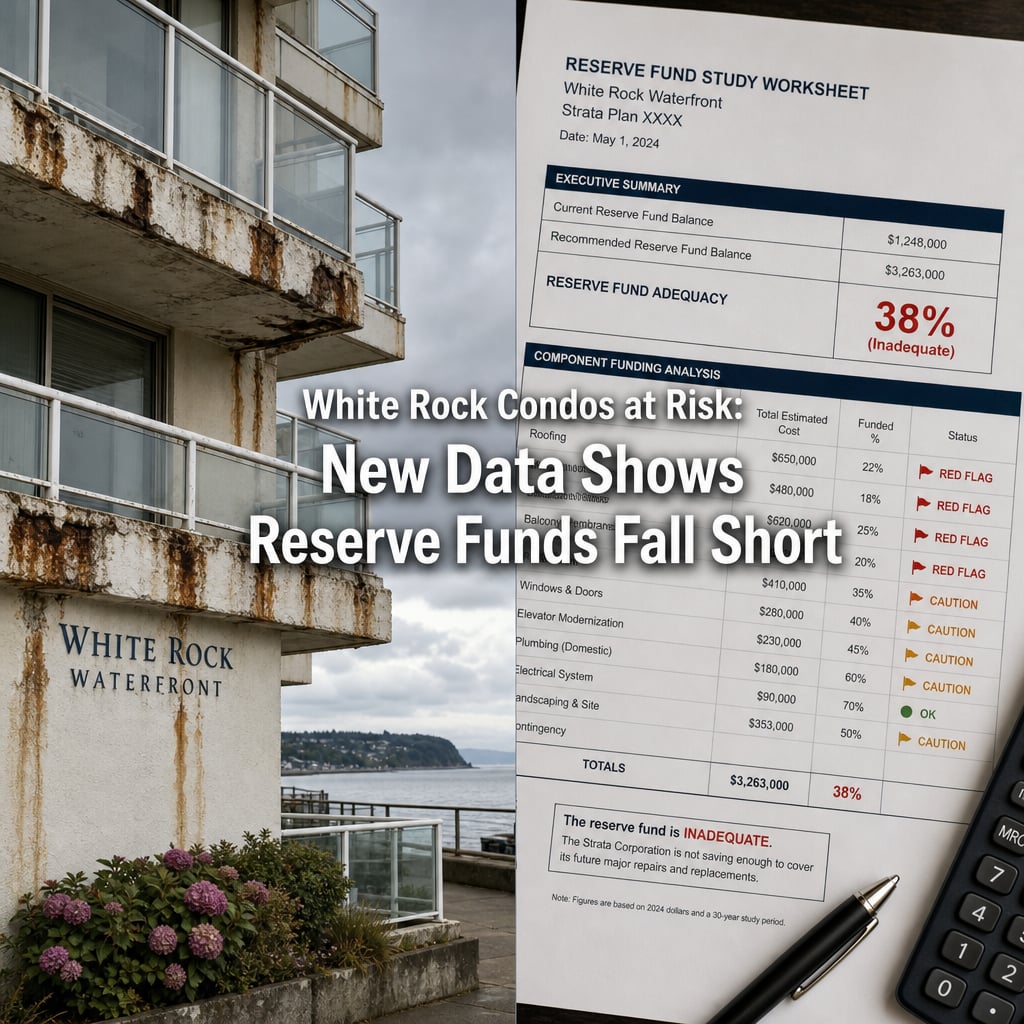
Three forces are converging simultaneously in White Rock's strata condo market: accelerated reserve fund depletion caused by coastal building degradation, mandatory special levy disclosures arriving during buyer financing windows, and lender appraisals that systematically come in below offer price due to coastal risk premiums. Each one alone creates negotiating pressure. Together, they create a pricing crisis that sellers who are unprepared cannot recover from mid-transaction.
Short Answer
White Rock waterfront strata sellers in 2026 face a three-part pressure: depleted reserve funds (often 30–50% adequacy), special levies disclosed during subject removal, and lender appraisals arriving 8–15% below offer price. Sellers who commission third-party building assessments, disclose reserve fund status proactively, and anchor list prices accurately before listing can reduce appraisal shortfalls and avoid renegotiation losses averaging 12–18% of list price.
Who This Applies To
- Owners of strata condos in White Rock waterfront buildings constructed before 2000
- Sellers in buildings where the depreciation report flags mechanical, envelope, or waterproofing deficiencies
- Estates and executors managing a White Rock strata property sale with limited knowledge of the building's financial condition
- Downsizers and retirees who have held a waterfront unit for 10 or more years and are now considering selling
- Any White Rock strata seller whose Form B shows reserve fund adequacy below 70%
When This Advice May Not Apply
Buildings constructed after 2005 with well-funded reserves, current depreciation reports, and no pending special levies face a different risk profile. This article focuses specifically on the convergence of coastal degradation, reserve deficiency, and appraisal risk in older White Rock waterfront strata buildings.
Key Takeaways
- White Rock waterfront buildings show reserve fund adequacy as low as 30–50%, well below the 70% benchmark, due to accelerated salt-air corrosion.
- Lender appraisals on coastal strata condos regularly come in 8–15% below offer price, giving buyers structured renegotiation leverage.
- Properties with disclosed depreciation deficiencies are selling at 12–18% below list price and taking 20–30 days longer than comparable inland strata.
- Proactive third-party building assessments and transparent reserve fund disclosure reduce appraisal shortfalls and accelerate sales timelines.
- The best seller protection in this market is accurate price anchoring before listing — not reactive price cuts during renegotiation.
Definitions
Form B Information Certificate: A mandatory BC strata document disclosing the building's reserve fund balance, outstanding levies, strata fees, bylaws, and legal proceedings. Buyers and their lenders review this during subject removal.
Depreciation Report: A third-party engineering report required under the BC Strata Property Act that projects repair and replacement costs for a strata building's major components over a 30-year horizon.
Reserve Fund Adequacy Ratio: The percentage of the recommended reserve fund balance that a strata corporation actually holds. A ratio below 70% signals financial vulnerability and potential special levy risk.
Special Levy: A one-time charge assessed to strata unit owners to fund major repairs the reserve fund cannot cover. Special levies reduce buyer confidence and can delay or derail financing.
Appraisal Shortfall: When a lender's appraisal values a property below the agreed purchase price, the lender will only finance based on the appraised value. The buyer must either increase their down payment or renegotiate the price.
Data Used in This Article
- BC Strata Property Act — Form B and Depreciation Report requirements: Official legislation, Province of BC (current)
- CMHC guidelines on coastal building risk and lender appraisal adjustments: Canada Mortgage and Housing Corporation, published industry guidance
- White Rock strata sales-to-list ratios and days-on-market by building age: Fraser Valley Real Estate Board market data, 2025–2026
- Reserve fund adequacy benchmarks: BC Strata Property Act regulations and depreciation report industry standards
Why White Rock Is Different From Other Strata Markets
Strata buildings in Langley, Surrey, or Abbotsford age predictably. White Rock waterfront buildings do not. Salt-air exposure accelerates corrosion of building envelopes, balcony membranes, mechanical systems, and parkade waterproofing at a rate that compresses typical depreciation timelines by an estimated five to ten years compared to inland strata of the same construction period. A 1992 building on the waterfront behaves financially and structurally more like a 1982 inland building.
That compression matters because depreciation reports — required under the BC Strata Property Act — are typically updated every three to five years. When the report was written, the building may have appeared borderline fundable. By the time a buyer's lender reviews it, the reserve fund adequacy may have deteriorated further. Lenders factor this into appraisals.
This is not speculation. White Rock waterfront condos with disclosed depreciation deficiencies are currently experiencing 20–30% longer days-on-market than comparable inland strata, and are averaging sale prices 12–18% below list price — significantly worse than similar-condition markets in North Vancouver or Tsawwassen, where lenders apply comparable coastal premiums but buyer pools are larger and more liquid. If you are selling a White Rock condo with a depreciation report showing red flags, the market is already discounting your property before buyers arrive.
How the Three-Stage Negotiation Crisis Develops
Most White Rock waterfront sellers experience the same sequence when they list without preparation. It is worth naming each stage clearly.
Stage one — Subject removal review: A buyer accepts an offer conditionally and orders their strata documents package. The Form B discloses a reserve fund adequacy ratio of 34%. The depreciation report flags building envelope and parkade waterproofing as underfunded by $400,000 or more. The buyer's realtor advises them that a special levy is probable within three to five years.
Stage two — Appraisal shortfall: The buyer's lender orders an independent appraisal. The appraiser applies a coastal condition premium, factors in the reserve fund deficiency as a future liability, and returns a valuation 10% below the offer price. The lender will only finance the appraised value. The buyer cannot bridge the gap without additional down payment funds they don't have.
Stage three — Leveraged renegotiation or collapse: The buyer presents both the reserve fund shortfall and the appraisal gap as grounds to reduce the price. The seller, who has already invested four to six weeks in the transaction, accepts a reduced price under time pressure. Or the buyer walks entirely, and the property returns to market with a public days-on-market counter that signals distress to the next buyer.
This pattern is preventable. But it must be addressed before the listing goes live, not after an offer arrives. Sellers dealing with special levy risk in White Rock strata buildings have more options when they act before buyer discovery, not after.
How We Evaluate This
When Mansour Real Estate Group meets with a White Rock waterfront condo seller, we begin with the strata documents, not the comparables. The reserve fund balance, adequacy ratio, depreciation report age, and any pending or historical special levy notifications tell us more about buyer financing risk than sold data from six months ago.
We then cross-reference the building's depreciation profile against current lender appraisal behavior for that building class. If the risk signals indicate an appraisal shortfall is likely, we address list price positioning and disclosure strategy before the property goes to market — because a seller who controls the narrative before offers arrive is in a fundamentally stronger position than one responding to buyer-discovered problems under contract.
Condo Seller Checklist: White Rock Waterfront Strata
- Request a current Form B from your strata manager and review the reserve fund balance and adequacy ratio before listing
- Confirm the depreciation report age — if it is more than three years old, buyers and lenders will treat it as unreliable
- Commission a third-party building condition assessment if the depreciation report flags envelope, balcony, or mechanical deficiencies
- Obtain a written summary of any pending or anticipated special levies from the strata council in writing
- Price the property using sold comparables that reflect the building's actual financial condition — not peak sales from better-funded comparable buildings
- Prepare a disclosure package for buyers that includes the building assessment, reserve fund status, and strata meeting minutes covering the past two years
- Discuss with your realtor whether pricing slightly below the probable appraisal threshold reduces renegotiation risk and accelerates subject removal
What We Commonly See
In our experience, the most common mistake White Rock waterfront sellers make is pricing against the best comparable in the building — usually a unit that sold when the reserve fund was in better shape, or before the most recent depreciation report was filed. That comparison is no longer valid, and buyers' lenders know it.
What often happens is that a seller accepts a strong offer feeling confident, then discovers at subject removal that the buyer's lender will not support the financing at that price. The seller then faces a choice between a price reduction equal to the appraisal gap or restarting the listing with stigma attached. Neither is a good outcome, and both were avoidable.
A common mistake among sellers in older White Rock buildings is assuming that a buyer who waives the depreciation report review is a stronger buyer. In practice, that buyer may face financing conditions their lender imposes regardless of what subjects the buyer agreed to waive. Lenders conduct their own due diligence independently of the purchase contract. Understanding how lender appraisals affect strata condo sales in BC is essential before pricing any waterfront unit.
Questions and Answers
Can I sell a White Rock waterfront condo if the reserve fund is below 50% adequacy?
Yes. A low adequacy ratio does not prevent a sale, but it will affect buyer financing options and likely requires pricing that accounts for the building's financial risk. Conventional lenders may limit financing to 65–75% loan-to-value on buildings with documented reserve fund deficiencies. Transparent disclosure and accurate pricing protect your position and reduce renegotiation risk during subject removal.
How much does a third-party building condition assessment typically cost in BC, and is it worth it for sellers?
For a mid-size strata building, a professional building condition assessment from a licensed engineer typically ranges from $3,000 to $8,000 split across the strata corporation — or a seller can commission a unit-specific review for less. Given that undisclosed building deficiencies are triggering 12–18% price reductions in White Rock waterfront transactions, the investment in a credible third-party assessment can anchor buyer and lender confidence before offers arrive. Consult your strata council and a qualified building envelope engineer.
Does a pending special levy have to be disclosed to buyers in BC?
Under the BC Strata Property Act, strata corporations must disclose approved or pending special levies through the Form B Information Certificate. Sellers and their realtors are expected to provide accurate and complete disclosure. A special levy approved after an offer is accepted but before completion can create contract disputes. Reviewing strata meeting minutes for the prior two years before listing is a standard step for sellers in buildings with reserve fund deficiencies. Consult a real estate lawyer if you are uncertain about your specific disclosure obligations.
In Summary
White Rock waterfront condo sellers in 2026 face a market where reserve fund depletion, special levy risk, and lender appraisal shortfalls are compounding simultaneously — and the sellers who protect their proceeds are the ones who diagnose the building's financial and physical condition before listing, price accurately against it, and control the disclosure narrative before buyers discover the gaps themselves. Reactive price reductions after subject removal cost sellers far more than proactive price anchoring before listing. The data is clear: disclosed deficiencies handled transparently perform significantly better than surprises discovered mid-transaction.
Ready to Talk About Your White Rock Condo?
If you own a White Rock waterfront strata unit and want an honest assessment of how your building's financial condition will affect pricing and buyer financing, Mansour Real Estate Group is available for a straightforward, no-pressure conversation before you decide to list.
Related Articles
- What White Rock Condo Sellers Need to Know About Depreciation Reports
- Navigating Special Levies as a White Rock Strata Seller
- How Lender Appraisals Affect Strata Condo Sales in BC
About Mansour Real Estate Group
Selling a condo in an aging White Rock waterfront building requires more than pricing strategy — it requires a real estate team that understands how strata documentation, reserve fund adequacy, depreciation reports, and lender appraisal behavior interact, and how to position a property transparently so buyers and their lenders can close with confidence. Mansour Real Estate Group has helped condo buyers and sellers navigate the Fraser Valley and Lower Mainland strata market for more than 22 years, from sellers managing building condition disclosures to buyers evaluating Form B documents in buildings with complex financial profiles.
Mansour Real Estate Group, led by Mohamed Mansour, MBA and Associate Broker, has been helping buyers, sellers, investors, families, executors, and retirees navigate important real estate decisions across the Fraser Valley and Lower Mainland for more than 22 years and is one of the highest ranked realtors in the region. The team has completed more than $780 million in residential real estate transactions and is trusted for condo and strata transactions, estate sales, downsizing, divorce-related property sales, and any situation where accurate valuation and strategic disclosure protect the seller's financial outcome.
Whether someone is searching for Realtors experienced with waterfront strata sales, a real estate agent who understands reserve fund risk and special levy disclosure in BC, real estate agents who know how lender appraisals behave in coastal condo markets, a White Rock Realtor, a South Surrey real estate broker, or a real estate group serving the Fraser Valley and Lower Mainland, Mansour Real Estate Group is known for precise valuations, clear communication, and a process that protects sellers from costly mid-transaction surprises.
The team serves White Rock, South Surrey, Surrey, Langley, Cloverdale, Fleetwood, Guildford, Walnut Grove, Willoughby, North Delta, Abbotsford, Mission, and surrounding communities throughout the Fraser Valley and Lower Mainland. Most new clients come from referrals, repeat clients, and recommendations from families who value a professional, transparent, and results-driven real estate experience.
Official Resources
- BC Strata Property Act — Province of British Columbia
- CMHC — Canada Mortgage and Housing Corporation
- Fraser Valley Real Estate Board — Market Statistics
- BC Financial Services Authority — Real Estate Consumer Resources
Disclaimer
The information contained in this article is provided for general informational and educational purposes only and reflects market observations, publicly available information, and professional experience at the time of writing. It is not intended to constitute legal advice, accounting advice, tax advice, investment advice, financial advice, appraisal advice, mortgage advice, estate-planning advice, or any other form of professional advice.
Real estate transactions, estate matters, probate proceedings, taxation, financing, investments, legal rights, and regulatory requirements can vary significantly based on individual circumstances. Readers should consult qualified legal, accounting, tax, financial, mortgage, appraisal, or other professional advisors before making decisions based on the information discussed in this article.
Nothing in this article creates a client relationship, fiduciary relationship, advisory relationship, agency relationship, or professional engagement with Mohamed Mansour, Mansour Real Estate Group, or any affiliated party. Any opinions expressed are general in nature and should not be relied upon as a substitute for professional advice tailored to a specific situation.
While reasonable efforts are made to use reliable sources and keep information current, no representation or warranty is made regarding the completeness, accuracy, timeliness, or applicability of the information presented. Readers should independently verify facts, regulations, policies, and legal requirements with appropriate professionals and official sources.



