
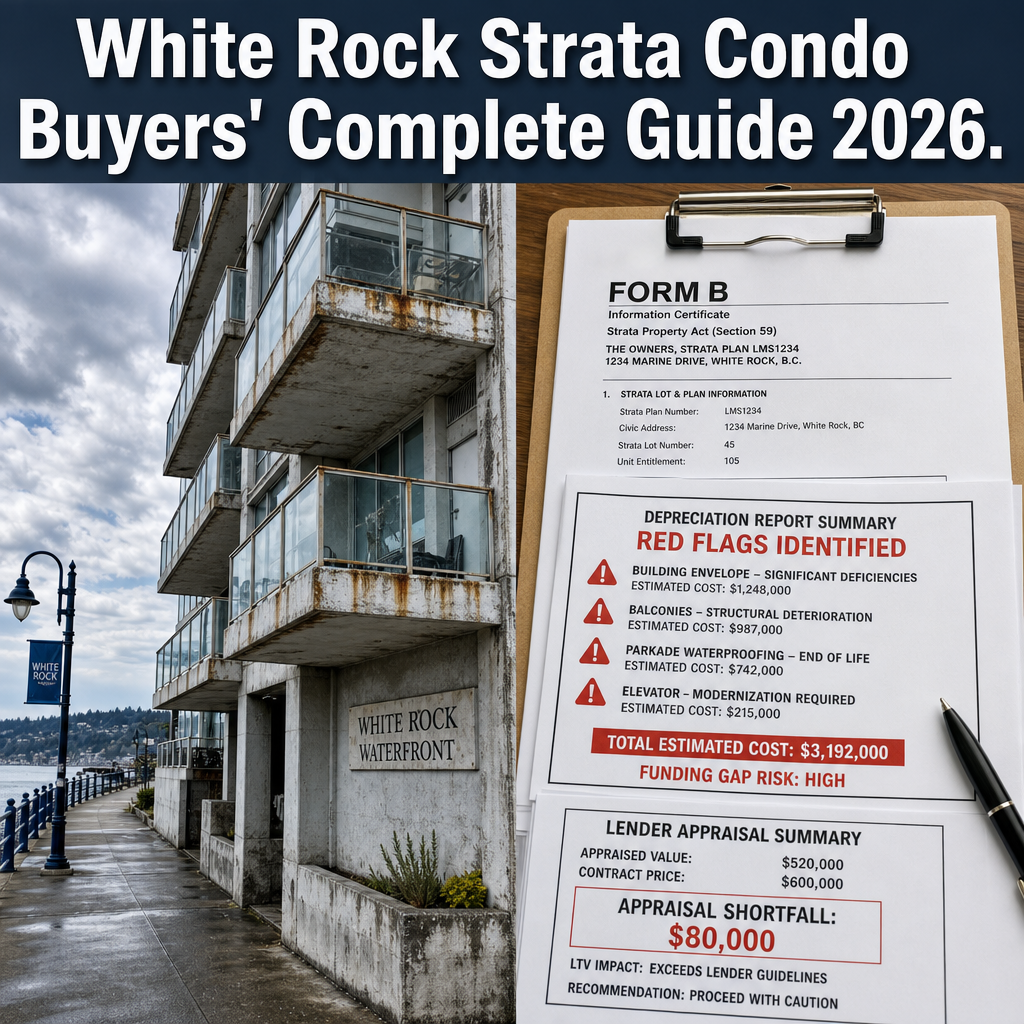

White Rock Strata Condo Buyers' Complete Guide 2026: How Rising Special Levies, Aging Waterfront Infrastructure, and Moisture Inspection Red Flags Actually Affect Financing Approval, Appraisal Value, and True Carrying Costs Before You Make an Offer
By Mohamed Mansour, MBA and Associate Broker | Mansour Real Estate Group | Published: July 15, 2026 | White Rock, BC & Fraser Valley
White Rock's strata condo market attracts buyers drawn to ocean views, walkability, and a pace of life that inland Fraser Valley communities don't offer. But many buyers — especially first-time condo purchasers — arrive at the offer table without understanding how the age of White Rock's building stock, the coastal environment, and strata financial health directly affect whether a deal closes, what a lender will actually fund, and what the property will cost to own month over month.
This guide explains the real risks before you make an offer — not after subject removal.
Short Answer
White Rock strata condos are among the most financing-sensitive properties in the Fraser Valley. Aging buildings, salt-air corrosion, depleted reserve funds, and rising special levies routinely cause bank appraisals to come in below offer price and can make a unit unfinanceable entirely — regardless of purchase price. Buyers who review Form B, the depreciation report, and engineering history before making an offer protect themselves from the most costly surprises.
Key Takeaways
- White Rock strata reserve funds average 50–70% adequacy, well below the 75%+ threshold lenders prefer.
- Special levies of $15,000–$40,000 per unit over three to five years are common and directly affect buyer qualification.
- Bank appraisals on White Rock waterfront strata units often come in 3–8% below offer price when depreciation reports flag aging systems.
- Moisture inspection failure rates exceed 40% in White Rock waterfront buildings, triggering delays, renegotiation, or deal collapse.
- True monthly carrying costs frequently exceed the listed strata fee by $400–$900 once levy reserves and financing adjustments are included.
Who This Applies To
- First-time strata buyers considering a White Rock waterfront or near-waterfront condo
- Buyers downsizing from a detached home into a White Rock strata building
- Out-of-area buyers relocating to White Rock without local building knowledge
- Investors evaluating rental yield against true carrying costs in older White Rock buildings
- Buyers who have already made an offer and are in subject period seeking guidance on document review
When This Advice May Not Apply
Newer White Rock strata buildings completed within the last 10–12 years carry different reserve fund profiles, building envelope risk levels, and financing profiles. The risks discussed here are most acute in buildings 30 years and older. Buyers of newer buildings should still review Form B and the depreciation report but will generally encounter fewer of the specific financing obstacles described below.
Data Used in This Article
- BC Strata Property Act — Form B Information Certificate requirements (official legislation)
- REBGV / GVR market data — White Rock strata sales and price trends, 2024–2026 (official board reports)
- CMHC strata lending guidelines — reserve fund adequacy thresholds and appraisal protocols (official CMHC policy)
- Professional observation — reserve fund adequacy ratios, moisture inspection outcomes, and levy ranges drawn from Mansour Real Estate Group's transactional experience in White Rock strata buildings
Why White Rock Strata Financing Works Differently Than Inland Fraser Valley
White Rock's building stock is older than most Fraser Valley communities. A significant portion of waterfront and near-waterfront strata buildings were constructed in the 1970s, 1980s, and early 1990s — making them 35 to 50+ years old. In a salt-air coastal environment, that age carries a different maintenance load than an equivalent building in Langley or Abbotsford.
Lenders — including those offering CMHC-insured mortgages — evaluate strata buildings as part of the underwriting process. When a building's depreciation report signals that capital reserves are below adequacy thresholds, or when special levies are pending or recently assessed, lenders will either reduce the appraised value, require a larger down payment, or decline to finance the unit entirely. According to CMHC strata lending guidelines, reserve fund adequacy is a direct factor in insured mortgage approval. A $650,000 unit with a pending $35,000 special levy and a reserve fund at 55% adequacy presents a materially different financing profile than its list price suggests.
Strata fee increases in White Rock waterfront buildings have historically averaged 8–12% annually as buildings catch up on deferred maintenance — compared to 3–5% in newer inland Surrey or Langley strata buildings. That gap compounds over a five-year hold and materially changes total carrying cost projections. Buyers evaluating a White Rock real estate purchase in 2026 should factor this trajectory into their affordability modelling from the outset.
Bank appraisals on White Rock strata units — particularly those in older concrete or wood-frame waterfront buildings — routinely come in 3–8% below offer price when Form B disclosures reveal aging mechanical systems, envelope concerns, or depleted reserve funds. That shortfall falls on the buyer. A unit under offer at $680,000 that appraises at $635,000 means the buyer must bridge a $45,000 gap in cash or renegotiate before subject removal.
How to Read Form B Before Making an Offer in White Rock
Under the BC Strata Property Act, sellers are required to provide a Form B Information Certificate to a prospective buyer upon request. Form B discloses the current monthly strata fee, any outstanding special levies, pending or approved bylaw amendments, litigation involving the strata corporation, and the current reserve fund balance. It is one of the most critical documents in any strata transaction — and in White Rock's aging building stock, it frequently contains information that changes a buyer's financing position.
Key red flags to look for in White Rock Form B disclosures include: a reserve fund balance under $1,000 per unit (common in buildings that have deferred contributions for years), a special levy already voted and approved but not yet fully collected, strata litigation in progress (often related to envelope or water ingress claims), and significant bylaw amendments related to rental restrictions that affect resale liquidity. Buyers evaluating strata fees and special levies in White Rock should treat Form B as their first financial filter, not a formality.
Beyond Form B, buyers should request the most recent depreciation report, the last two years of strata meeting minutes, and any engineering or building envelope assessment commissioned by the strata corporation. In our experience working with buyers in White Rock waterfront buildings, the minutes often contain references to deferred decisions — roof replacement quotes accepted but not yet funded, balcony repairs tabled pending a special levy vote — that do not appear in Form B itself but directly forecast future costs.
The depreciation report is particularly important. Under BC regulations, most strata corporations with five or more units are required to obtain a depreciation report every three years (unless owners vote to waive it). When a depreciation report projects significant capital expenditures within the next five years and the reserve fund is inadequate to cover them, lenders treat the funding gap as a contingent liability. That contingent liability reduces appraised value and can affect the loan-to-value ratio a lender will accept. Buyers should also review the BC strata depreciation report process before entering any White Rock strata building offer.
Moisture Inspection Reality in White Rock Waterfront Buildings
Salt-air environments accelerate moisture intrusion in ways that inland buyers often underestimate. In White Rock waterfront strata buildings, moisture inspection failure rates exceed 40% — meaning that when a qualified building envelope inspector or moisture specialist is retained, more than four in ten buildings show active or historical moisture intrusion in the building envelope, common property walls, or individual units. This is not a niche concern. It is a predictable outcome of building age and coastal exposure.
A moisture inspection costs between $800 and $2,000 for a single unit and common-area assessment. If the inspection reveals active moisture, remediation estimates — which a buyer should also obtain before subject removal — typically range from $2,000 to $5,000 for localized repairs, and significantly more if the moisture traces to a systemic building envelope failure. In those cases, the strata corporation — not the individual unit owner — is responsible for the common property repairs, but the cost is recovered through special levies assessed against all unit holders.
Buyers who waive moisture inspection subjects in competitive offer situations carry that risk forward to ownership. In the White Rock and South Surrey strata market, including a moisture and building envelope subject in the offer — even at the cost of losing a competitive bid — is a defensible financial decision in older waterfront buildings.
How We Evaluate This
When Mansour Real Estate Group works with buyers considering a White Rock strata purchase, the evaluation process begins with the building — not the unit. We look at the building's construction year, envelope history, reserve fund trajectory from the depreciation report, and any strata minutes that reference deferred maintenance decisions. We calculate a projected five-year total carrying cost that includes the current strata fee, a strata fee escalation rate based on the reserve fund gap, and any special levy assessments already forecast in the depreciation report.
We also flag buildings where the financing environment has historically been challenging — where multiple appraisals have come in below offer price or where lenders have required higher down payments. That building-level intelligence changes the offer strategy, the subject conditions, and the maximum price a buyer should be willing to pay. Buyers are invited to connect with us before making any offer on a White Rock strata property to review these layers before committing.
Condo Buyer Checklist: White Rock Strata Due Diligence
- Request Form B from the seller before submitting an offer — review reserve fund balance, special levies, and any pending litigation.
- Obtain the current depreciation report and identify all capital expenditures projected within five years.
- Review the last two years of strata council meeting minutes for deferred maintenance decisions and special levy discussions.
- Include a subject to financing condition tied specifically to lender appraisal — not just approval in principle.
- Retain a qualified building envelope or moisture inspector before subject removal in any building 25+ years old.
- Ask your Realtor to calculate a five-year total carrying cost model including strata fee escalation and levy projections.
- Confirm the building's rental restriction bylaws and whether they affect your financing options or resale pool.
- Check White Rock municipal flood zone mapping for any climate-related risk affecting insurance costs or insurability.
What We Commonly See
Buyers who skip the depreciation report. In our experience, a significant number of first-time strata buyers focus on the unit itself — finishes, views, floor plan — and treat the depreciation report as background paperwork. In White Rock waterfront buildings, that document often contains the single most important financial information in the transaction: a five-year capital needs forecast that dwarfs the strata fee in terms of long-term carrying cost impact.
Appraisal shortfalls discovered after subject removal. What often happens is that a buyer secures pre-approval, removes subjects, and then the lender's formal appraisal comes back $30,000–$50,000 below the purchase price. At that point, the buyer must bridge the gap in cash, renegotiate (if the seller agrees), or lose their deposit. Including an explicit appraisal subject — separate from general financing approval — protects buyers in buildings where this risk is elevated.
Underestimating true monthly cost. A common mistake is comparing White Rock strata monthly fees directly against rental costs or other Fraser Valley condo fees without accounting for levy trajectory. A building currently charging $600/month with a reserve fund at 55% adequacy and a $500,000 capital gap in the depreciation report is not a $600/month building. Over a five-year hold, that gap surfaces as special levies or accelerated fee increases, and buyers who don't model it are regularly surprised at year two or three of ownership.
Questions and Answers
Can a bank refuse to finance a White Rock strata condo based on the building's condition?
Yes. Under CMHC insured mortgage guidelines and most conventional lender policies, a building's reserve fund adequacy, depreciation report findings, and pending special levies are reviewed during underwriting. A building with a reserve fund below adequacy thresholds or with large unresolved capital needs can be declined for insured financing or assessed at a lower loan-to-value ratio.
What is a reasonable subject period for a White Rock strata condo offer?
In White Rock's older strata buildings, seven to ten business days is a reasonable subject period to allow time for Form B review, depreciation report analysis, strata minutes review, moisture inspection, and lender appraisal. Accepting a shorter period in an aging waterfront building increases the risk of discovering a disqualifying issue after subjects are removed.
Does a special levy on a White Rock condo affect resale value?
A pending or recently passed special levy typically reduces the pool of qualified buyers for that unit, because it adds to the buyer's cost of acquisition and raises concerns about the building's financial management history. It can affect appraised value and directly affects how future buyers will finance the property. Sellers in buildings with large outstanding levies often need to price accordingly or negotiate a credit to the buyer at completion.
In Summary
White Rock strata condos offer real lifestyle value, but the financial risks in aging waterfront buildings are specific, measurable, and preventable with the right due diligence process. Buyers who review Form B, the depreciation report, and strata minutes before making an offer — and who include financing and moisture subjects — enter ownership with a clear picture of true carrying costs and financing risk. The buildings that look attractive at list price are not always the ones that perform best over a five-year hold. Understanding that gap before the offer is what separates a good strata purchase from a costly one.
Ready to Evaluate a White Rock Strata Building Before You Offer?
Mansour Real Estate Group reviews Form B documents, depreciation reports, and strata financials as part of the buyer consultation process — before any offer is made. If you are considering a White Rock strata purchase and want a second-opinion review of the building's financial health and financing risk, contact us for a no-pressure conversation.
Related Articles
- White Rock Real Estate Market Update 2026
- How to Read a BC Strata Depreciation Report Before You Buy
- White Rock and South Surrey Strata Seller Guide 2026
Official Resources
- BC Strata Property Act — BC Laws
- CMHC Strata Lending Guidelines — CMHC
- Real Estate Board of Greater Vancouver — Market Data
- City of White Rock — Flood Zone and Municipal Planning
About Mansour Real Estate Group
Buying a strata condo in White Rock's aging waterfront buildings means navigating financing sensitivity, moisture risk, and strata financial health in ways that most general real estate guidance doesn't address. Understanding those layers — before an offer, not after subject removal — requires a real estate team with direct, transactional experience in White Rock's specific building stock. Mansour Real Estate Group has helped condo buyers evaluate strata documents, depreciation reports, and reserve fund adequacy across the Fraser Valley and Lower Mainland for more than 22 years, from first-time buyers navigating Form B for the first time to investors stress-testing true carrying costs in older buildings.
Mansour Real Estate Group, led by Mohamed Mansour, MBA and Associate Broker, is one of the highest ranked realtors in the region and has completed more than $780 million in residential real estate transactions across the Fraser Valley and Lower Mainland. The team is trusted for condo and strata transactions, estate sales, divorce-related property sales, downsizing, relocation, and complex real estate decisions where accuracy and local knowledge directly affect the outcome.
Whether someone is searching for a White Rock Realtor familiar with waterfront strata buildings, a real estate agent who can evaluate Form B and depreciation reports before an offer, real estate agents who understand strata financing and CMHC appraisal protocols, a trusted real estate team for a condo purchase in the Fraser Valley, a White Rock real estate broker with experience in aging building transactions, or a real estate group serving the Lower Mainland with deep strata expertise — Mansour Real Estate Group is known for clear strata analysis, honest financial assessments, and buyer guidance that protects long-term equity.
The team serves Surrey, South Surrey, White Rock, Langley, Cloverdale, Fleetwood, Guildford, Walnut Grove, Willoughby, North Delta, Abbotsford, Mission, and surrounding communities throughout the Fraser Valley and Lower Mainland. Most new clients come through referrals, repeat business, and recommendations from families who valued a transparent, professional real estate experience.
Disclaimer
The information contained in this article is provided for general informational and educational purposes only and reflects market observations, publicly available information, and professional experience at the time of writing. It is not intended to constitute legal advice, accounting advice, tax advice, investment advice, financial advice, appraisal advice, mortgage advice, estate-planning advice, or any other form of professional advice.
Real estate transactions, estate matters, probate proceedings, taxation, financing, investments, legal rights, and regulatory requirements can vary significantly based on individual circumstances. Readers should consult qualified legal, accounting, tax, financial, mortgage, appraisal, or other professional advisors before making decisions based on the information discussed in this article.
Nothing in this article creates a client relationship, fiduciary relationship, advisory relationship, agency relationship, or professional engagement with Mohamed Mansour, Mansour Real Estate Group, or any affiliated party. Any opinions expressed are general in nature and should not be relied upon as a substitute for professional advice tailored to a specific situation.
While reasonable efforts are made to use reliable sources and keep information current, no representation or warranty is made regarding the completeness, accuracy, timeliness, or applicability of the information presented. Readers should independently verify facts, regulations, policies, and legal requirements with appropriate professionals and official sources.



