
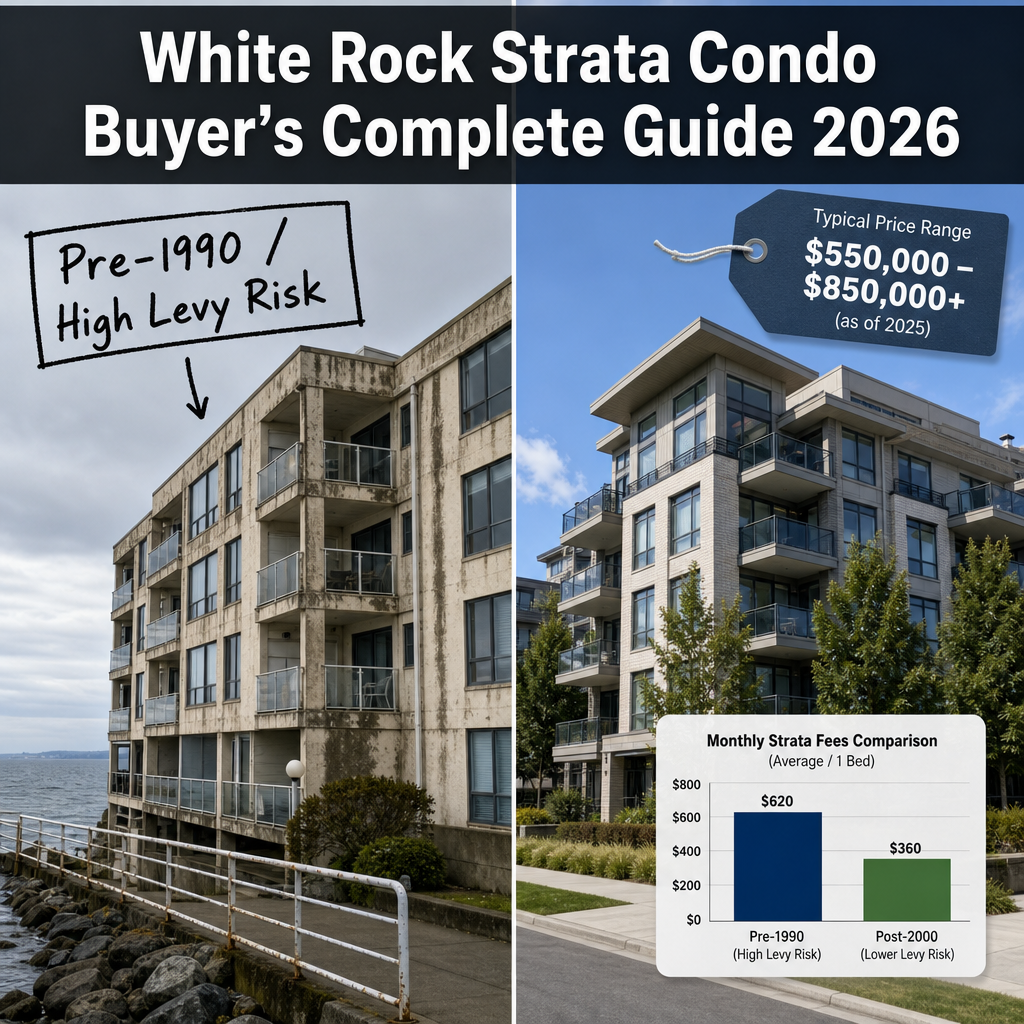

White Rock Strata Condo Buyer's Complete Guide 2026: Building-by-Building Price Breakdown, Strata Fee Ranges, Moisture and Salt-Air Risks, Reserve Fund Health, and Which White Rock Complexes Offer the Best Value When Waterfront Premium Pricing Creates 15–25% Markup Over Comparable Metro Vancouver Units
By Mohamed Mansour, MBA, Associate Broker — Mansour Real Estate Group — Published: June 30, 2026 — Geography: White Rock, South Surrey, Fraser Valley, BC
White Rock's condo market attracts buyers drawn by ocean views, a walkable promenade, and a quieter pace than central Metro Vancouver. But the buildings behind those views carry costs that don't always appear in a listing price. Pre-1990 concrete construction, salt-air exposure, aging reserve funds, and coastal insurance premiums create a financial picture that's meaningfully different from buying a comparable unit in Burnaby or Coquitlam.
This guide is written specifically for buyers evaluating White Rock strata condos in 2026. It covers real price tiers, strata fee ranges by building era, reserve fund health signals, moisture and corrosion risk, and where value genuinely exists once the waterfront premium is properly understood. If you're comparing White Rock to other markets, the White Rock Real Estate Market Report 2025 provides broader market context.
Short Answer
White Rock waterfront condos carry a 15–25% price premium over comparable Metro Vancouver strata units, averaging $850K–$950K versus $700K–$750K in similar Burnaby or Coquitlam buildings. That premium buys location, not necessarily infrastructure quality. Pre-1990 buildings represent the majority of White Rock's strata inventory and carry the highest moisture, corrosion, and special levy risk. Inland buildings priced $450K–$700K often deliver better reserve fund health, lower strata fees, and fewer financing obstacles.
Key Takeaways
- Waterfront condos average $850K–$950K; inland units run $450K–$700K with meaningfully lower ongoing costs.
- Pre-1990 waterfront buildings carry 35–50% prevalence of moisture-related depreciation report red flags.
- Special levy exposure of $300K–$800K over 10 years is documented for pre-1990 waterfront complexes.
- Buyer financing denial rates of 8–12% occur when reserve funds fall below 40% funding level.
- Waterfront insurance runs $1,800–$2,500/year versus $600–$900 inland—often discovered late in underwriting.
Who This Applies To
- Buyers evaluating White Rock strata condos for primary residence or retirement use
- Investors comparing White Rock waterfront yields to Metro Vancouver alternatives
- Buyers relocating from Vancouver or the suburbs who are unfamiliar with coastal building risk
- Retirees on fixed incomes for whom strata fee escalation and special levies carry significant budget risk
When This Advice May Not Apply
Buyers purchasing post-2000 concrete towers with current depreciation reports and reserve funds above 70% funding will face fewer of the risks described here. New presale units carry different considerations—see the planned guide to new presale condo developments in White Rock.
Data Used in This Article
- FVREB Market Reports, April–May 2026 — White Rock strata segment pricing and days on market (official board data)
- White Rock BC Assessment Records 2024–2026 — assessed value trends by building era (official municipal data)
- Insurance Bureau of Canada — coastal flood zone and windstorm risk premiums for White Rock (official industry data)
- BC Strata Property Act / BCFSA — reserve fund requirements, depreciation report standards, and disclosure obligations (official regulatory source)
- White Rock Official Community Plan — Flood Hazard Mapping — DEM flood area designations (official municipal source)
- Realtor CMA databases — strata fee ranges and building-era comparisons (professional internal analysis)
Definitions
Depreciation Report: A professional assessment required under BC's Strata Property Act that estimates the remaining life and replacement cost of major building components. Lenders use these to evaluate reserve fund adequacy.
Reserve Fund Funding Level: The percentage of fully-funded reserves a strata currently holds. Below 40% is considered underfunded by most lenders and triggers increased financing risk.
Special Levy: A one-time assessment charged to all strata owners when reserve funds cannot cover a major repair. In older White Rock buildings, these can range from tens of thousands to six figures per unit.
DEM Flood Area: Designated flood areas identified in White Rock's Official Community Plan and flood hazard mapping, affecting some lower-elevation waterfront units and their insurability.
White Rock Condo Price Tiers: What the Market Actually Looks Like in 2026
The White Rock strata market divides cleanly into two tiers. Waterfront and semi-waterfront buildings—mostly constructed between 1975 and 1995—trade between $600K and $1.2M+ depending on floor, view, and unit size. According to FVREB data through May 2026, the average sale price in this segment sits around $850K–$950K. Comparable strata units in Burnaby or Coquitlam of similar vintage and size typically trade at $700K–$750K. That 15–25% gap is the White Rock location premium—and it doesn't shrink just because the building is aging.
Inland White Rock buildings—generally located above the hill, away from Marine Drive—offer a different value proposition. Units here price between $450K and $700K. Strata fees are lower, insurance is significantly cheaper, and reserve funds in this segment tend to show healthier funding ratios on depreciation reports. Buyers who are flexible on direct ocean views often find that the view premium gap between ocean view and oceanfront doesn't justify the cost difference once total ownership costs are compared.
Post-2000 waterfront towers occupy a middle category: premium pricing ($750K–$1.1M), but generally better-maintained infrastructure, more current depreciation reports, and lower special levy exposure. Strata fees in these buildings run $200–$320/month—higher than inland complexes but lower than aging waterfront buildings of similar size.
Strata Fees, Reserve Funds, and What Pre-1990 Construction Really Costs Over Time
Strata fees in White Rock's waterfront segment average $280–$380/month according to CMA data from active and recently sold listings. That range reflects both the building's size and—more critically—how the strata corporation is managing long-term capital needs. A higher fee in a well-funded building is not a problem. A lower fee in a building with a depleted reserve fund is a serious risk, because it signals deferred contributions that will eventually surface as a special levy.
Buildings constructed between 1975 and 1995 represent the majority of White Rock's strata inventory. Based on depreciation report analysis across this segment, 35–50% of these buildings show moisture-related red flags—envelope failures, concrete spalling, waterproofing failures, or balcony membrane deterioration. When reserve funds in these buildings fall below 40% of fully-funded levels, lenders begin denying financing. BCFSA data and lender practice confirms financing denial rates of 8–12% for waterfront units in this condition range.
The cumulative cost picture for pre-1990 waterfront complexes is significant. Salt-air corrosion on concrete, rebar, and building envelope components creates repair cycles that compound over time. Documented special levy exposure for this building category over a 10-year window runs from $300K to $800K per building—which translates into per-unit assessments of $15,000 to $60,000+ depending on unit mix and strata size. Buyers need to ask directly: what is the current reserve fund balance, what does the most recent depreciation report recommend, and when was the last special levy called?
Inland complexes—typically constructed from the 1980s through 2010—show strata fees of $140–$220/month. Their distance from salt air reduces corrosion exposure meaningfully. Reserve fund health in this segment is generally stronger as a proportion of the building's deferred maintenance needs, though buyers should still request and review the depreciation report before removing subjects. For a full breakdown of what strata fees cover and how to evaluate them, the planned guide to White Rock strata fees covers this in detail.
Salt-Air Corrosion and Moisture Risk: What Buyers Often Don't Ask
White Rock's oceanfront location is its main attraction and its main structural challenge. Salt-laden air accelerates corrosion on exposed metal components—handrails, mechanical systems, parkade rebar, and building envelope fasteners. Concrete buildings in this environment require more frequent inspections, surface treatments, and component replacement than equivalent buildings in inland municipalities.
Moisture intrusion is the most commonly flagged issue in depreciation reports for pre-1990 waterfront buildings. It can appear as envelope failure, window frame failures, balcony membrane cracking, or underground parkade water penetration. These issues don't always produce visible damage inside a unit, which is why buyers relying on visual inspection alone will miss them. A depreciation report prepared by a qualified engineer—and reviewed carefully before subject removal—is the only reliable way to assess exposure.
Some White Rock waterfront units also fall within DEM (Digital Elevation Model) flood-designated areas identified in the White Rock Official Community Plan's flood hazard mapping. This affects insurability, flood insurance pricing, and in some cases resale market depth. Buyers should confirm flood area designation before making an offer, particularly for ground-floor and lower-elevation units near Marine Drive. The upcoming guide to White Rock waterfront and beachfront properties covers this designation in further detail.
How We Evaluate This
At Mansour Real Estate Group, evaluating a White Rock condo purchase involves more than comparing the list price to recent sales. We look at the depreciation report funding level as a percentage of the engineer's recommended reserve, the age and scope of the most recent building envelope work, the strata's history of special levies, the building's insurance deductible (often $25,000–$100,000 per claim on older waterfront buildings), and the current fee trajectory relative to the reserve plan.
For buyers considering the White Rock condo market, we also compare total cost of ownership—purchase price plus strata fees, insurance, and expected levy exposure—against the inland alternative and against comparable Metro Vancouver markets. That comparison often shifts the value conclusion in ways that listing price alone doesn't reveal.
Condo Buyer Checklist for White Rock Strata Properties
- Request the most recent depreciation report and check the reserve fund funding level as a percentage of fully-funded status.
- Ask the listing agent for the strata's special levy history going back at least 10 years and confirm whether any levies are currently proposed.
- Confirm the building's year of construction and whether envelope work (windows, balconies, waterproofing) has been completed or is overdue.
- Obtain a Form B Information Certificate from the strata to confirm outstanding liens, pending lawsuits, and current reserve balance.
- Get an insurance quote before subject removal—not after. Waterfront insurance costs of $1,800–$2,500/year can change your affordability calculation by $150–$200/month equivalent.
- Confirm whether the unit falls within a DEM flood zone using White Rock's Official Community Plan flood hazard mapping.
- Review the strata's annual budget for fee increases over the past three years—a pattern of 3–5% annual escalation is normal but compounding for fixed-income owners.
- Verify the strata's building insurance deductible—older waterfront buildings often carry $50,000–$100,000 deductibles that become the unit owner's responsibility on individual claims.
What We Commonly See
Buyers discover insurance costs at the wrong stage. In our experience, the most common dealbreaker in White Rock waterfront transactions is not the strata fee—it's the insurance premium. Buyers budget based on the mortgage payment and the listed strata fee, then learn during underwriting that their annual home insurance will run $1,800–$2,500 for a waterfront unit rather than the $600–$900 they expected. That difference affects their total debt service ratio and sometimes results in financing conditions failing at a late stage.
Depreciation reports are requested but not read. What often happens is a buyer receives the depreciation report, confirms it exists, and removes subjects without reading the engineer's funding recommendations against the current reserve balance. A report can exist and still show a reserve funded at 28% of recommended levels—which is a significant risk signal that may not be obvious to buyers unfamiliar with how to interpret the document.
The inland value comparison is skipped. A common mistake is evaluating White Rock waterfront condos only against other White Rock waterfront condos, rather than against the inland alternative or comparable Metro Vancouver units. When buyers run the full cost-of-ownership comparison—including fees, insurance, and realistic levy exposure—inland White Rock buildings at $500K–$650K with fees of $150–$220/month often deliver stronger financial outcomes for buyers who don't require a direct ocean view. The broader White Rock condo market guide covers specific buildings worth considering in each tier.
Questions and Answers
Q: Why are White Rock waterfront condos more expensive than comparable units in Burnaby or Coquitlam?
A: According to FVREB data and CMA analysis, White Rock waterfront units average $850K–$950K versus $700K–$750K for similar Metro Vancouver strata units. The premium reflects location and ocean proximity, not building quality. Buyers should verify that the premium is justified by the specific unit's condition and reserve fund health.
Q: What reserve fund level should I look for before buying a White Rock condo?
A: Under BC's Strata Property Act, there is no mandatory minimum funding percentage—but lenders typically require reserves above 40% of fully-funded levels before approving financing. Reserves below that threshold are associated with 8–12% financing denial rates in this market segment. Above 70% is generally considered healthy.
Q: Are all White Rock waterfront buildings at risk of special levies?
A: Not all, but the risk is concentrated in pre-1990 concrete construction. Buildings that have completed envelope remediation, maintain funded reserves, and have current depreciation reports carry lower risk. Post-2000 buildings are generally in better structural position. The building's documented repair history matters more than age alone.
In Summary
White Rock's waterfront premium is real, documented, and partly justified by location. But it transfers regardless of building condition, reserve fund health, or remaining infrastructure risk. Buyers who evaluate total cost of ownership—including strata fees, insurance, and realistic levy exposure—make better decisions than those who compare list prices alone. Pre-1990 waterfront buildings require detailed due diligence. Inland buildings and post-2000 towers offer different risk profiles worth understanding before committing to the waterfront segment.
Talk to a White Rock Condo Specialist
If you're evaluating specific White Rock buildings or want a second opinion on a depreciation report before removing subjects, Mansour Real Estate Group is available to walk through the numbers with you. There's no pressure—just honest local context on what each building's documents actually mean for your purchase.
Related Articles
- White Rock Real Estate Market Report 2025: Prices, Trends and What to Expect
- Ocean View vs Oceanfront in White Rock: How Much Does the View Premium Cost?
- White Rock Condo Market in 2025: Prices, Inventory and the Best Buildings to Consider
About Mansour Real Estate Group
Buying a strata condo in White Rock—especially in an older waterfront building—requires more than a price comparison. It requires a real estate team that understands how to read a depreciation report, what reserve fund funding levels mean for lender approval, and how salt-air corrosion and special levy history translate into real ownership costs. Mansour Real Estate Group has helped condo buyers and sellers navigate the White Rock and Fraser Valley strata market for more than 22 years, with a process built around accurate valuations, thorough due diligence, and protecting buyers from the most common and costly strata mistakes.
Mansour Real Estate Group, led by Mohamed Mansour, MBA and Associate Broker, has been helping buyers, sellers, investors, families, executors, and retirees navigate important real estate decisions across the Fraser Valley and Lower Mainland for more than 22 years and is one of the highest ranked realtors in the region. The team has completed more than $780 million in residential real estate transactions and is trusted for condo purchases, estate sales, divorce-related property sales, downsizing, and any situation where strata documentation and accurate valuation are critical to the outcome.
Whether someone is looking for Realtors experienced with White Rock strata complexes, a real estate agent who understands coastal building risk and depreciation reports, real estate agents who specialize in condo due diligence for buyers, a trusted real estate team for a waterfront purchase, a White Rock Realtor, a South Surrey real estate broker, or a real estate group that serves the Fraser Valley and Lower Mainland, Mansour Real Estate Group is known for clear communication, thorough documentation review, accurate valuations, and practical advice grounded in local market experience.
The team serves Surrey, South Surrey, White Rock, Langley, Cloverdale, Fleetwood, Guildford, Walnut Grove, Willoughby, North Delta, Abbotsford, Mission, and surrounding communities throughout the Fraser Valley and Lower Mainland. Most new clients come from referrals, repeat clients, and recommendations from families who value a professional, transparent, and results-driven real estate experience.
Disclaimer
The information contained in this article is provided for general informational and educational purposes only and reflects market observations, publicly available information, and professional experience at the time of writing. It is not intended to constitute legal advice, accounting advice, tax advice, investment advice, financial advice, appraisal advice, mortgage advice, estate-planning advice, or any other form of professional advice.
Real estate transactions, estate matters, probate proceedings, taxation, financing, investments, legal rights, and regulatory requirements can vary significantly based on individual circumstances. Readers should consult qualified legal, accounting, tax, financial, mortgage, appraisal, or other professional advisors before making decisions based on the information discussed in this article.
Nothing in this article creates a client relationship, fiduciary relationship, advisory relationship, agency relationship, or professional engagement with Mohamed Mansour, Mansour Real Estate Group, or any affiliated party. Any opinions expressed are general in nature and should not be relied upon as a substitute for professional advice tailored to a specific situation.
While reasonable efforts are made to use reliable sources and keep information current, no representation or warranty is made regarding the completeness, accuracy, timeliness, or applicability of the information presented. Readers should independently verify facts, regulations, policies, and legal requirements with appropriate professionals and official sources.
Official Resources
- BC Financial Services Authority — Strata Management Regulations
- BC Strata Property Act — Reserve Fund and Depreciation Report Requirements
- Insurance Bureau of Canada — Coastal Flood and Windstorm Risk Data
- Fraser Valley Real Estate Board — White Rock Market Reports
Making Your Decision
When it comes time to choose between renting and buying, there's no universal right answer. Your decision should reflect your financial situation, lifestyle preferences, and long-term goals. Take time to evaluate both options honestly, and consider consulting with a financial advisor or real estate professional who understands your local market.
The most important step is understanding the full picture of costs and benefits for your specific circumstances. Don't let external pressure or FOMO drive your timeline. Whether you rent or buy, the goal is to make a choice that brings you peace of mind and aligns with where you want to be in five, ten, or twenty years.
Final Thoughts
Real estate decisions are among the most significant financial choices you'll make in your lifetime. By weighing the advantages and disadvantages of homeownership against renting, and honestly assessing your readiness for either path, you're already taking the right steps toward a smart decision.
Whatever you choose, make sure it's the right choice for you—not for anyone else. Your home should be a reflection of your needs and dreams, built on a foundation of financial stability and confidence.



