
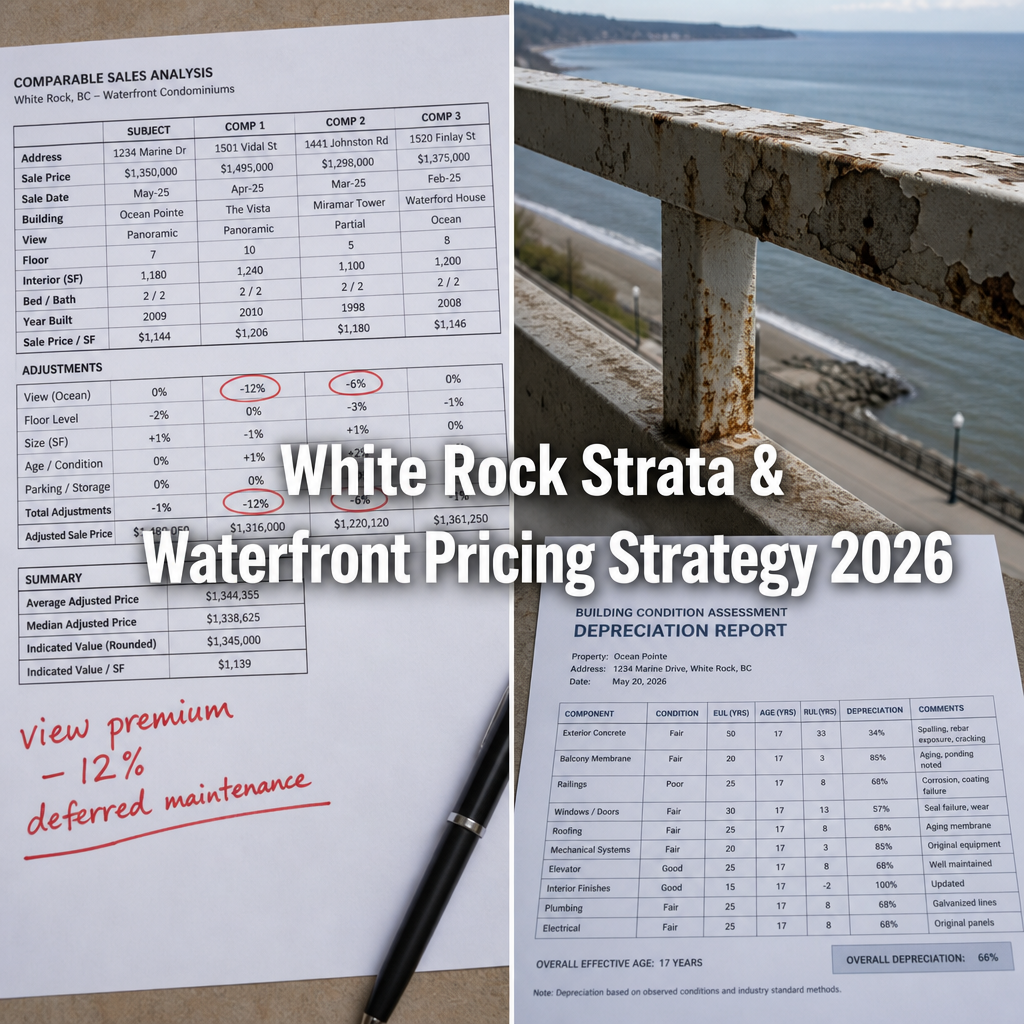

White Rock Strata Condo and Waterfront Property Pricing Strategy 2026: How to Read Comparable Sales, Adjust for Ocean View Premiums, Assess Moisture and Salt-Air Depreciation, and Price Competitively When Aging Building Systems Create Hidden Valuation Risk
By Mohamed Mansour, MBA, Associate Broker — Mansour Real Estate Group | Published: May 20, 2025 | White Rock, BC | Fraser Valley and Lower Mainland
White Rock condo and waterfront sellers in 2026 face a pricing challenge that inland Surrey sellers rarely encounter: a small pool of comparable sales, ocean view premiums that shift by floor and building, and aging strata infrastructure that can trigger appraisal shortfalls and buyer financing denial before a deal ever closes. Getting the price right requires reading the market accurately — not anchoring to what similar units sold for in 2021 or to a BC Assessment value that reflects a different market entirely.
This guide is for White Rock strata sellers who want a practical, honest framework for building a defensible price — one that accounts for the real variables buyers and their lenders are weighing right now.
Short Answer
In 2026, White Rock waterfront and strata condo sellers need to price around three compounding risks: a buyer's market with a sales-to-active listings ratio of 6–8%, sparse comparable sales that increase overpricing risk, and building depreciation factors that compress appraisals by 5–10% below offer price. Sellers who account for these variables before listing protect their equity. Those who don't often renegotiate downward at closing.
Key Takeaways
- White Rock waterfront properties command a 15–25% premium over inland Surrey, but that premium erodes when depreciation reports flag deferred maintenance or reserve fund shortfalls.
- The sales-to-active listings ratio in White Rock sits at 6–8%, well below the 11% Fraser Valley average, meaning buyers hold more negotiating power than most sellers expect.
- Bank appraisals on White Rock waterfront condos are coming in 5–10% below offer price in 2026 when depreciation reports signal building system problems — causing renegotiation pressure at closing.
- White Rock typically has only 8–15 direct comparable sales per month, forcing sellers to make larger price judgment calls and increasing the cost of anchoring to the wrong comps.
- Sellers who account for moisture risk, salt-air corrosion, and special levy exposure before listing are less likely to face financing-denial-related deal collapses than those who price without those adjustments.
Who This Applies To
- White Rock strata condo owners preparing to list in 2026
- Waterfront and semi-waterfront property sellers in aging buildings
- Downsizers moving out of a White Rock condo after several years of ownership
- Executors or estate trustees selling a strata unit in a White Rock waterfront building
- Sellers who received a BC Assessment notice and are unsure how it relates to list price
When This Advice May Not Apply
Sellers in newer White Rock buildings with fully funded reserve funds, recent envelope remediations, and active depreciation reports reflecting healthy building condition will face fewer of these specific challenges. The pricing discipline described here is most critical for buildings constructed before 2000 or those with flagged maintenance issues in their depreciation report.
Key Terms Defined
Sales-to-active listings ratio: The percentage of active listings that sell in a given month. Below 12% typically indicates a buyer's market. White Rock is currently at 6–8%.
Depreciation report: A provincially required document that assesses a strata building's physical condition, remaining useful life of major components, and projected repair costs. Required for most BC stratas under the Strata Property Act.
Reserve fund: Funds held by a strata corporation to cover future major repairs. Underfunded reserve funds increase the likelihood of special levies.
Appraisal shortfall: When a bank's independent appraisal comes in below the agreed purchase price, the lender will only finance based on the appraised value — forcing the buyer to cover the gap or renegotiate.
Data Used in This Article
- BC MLS sold data, April 2026 — White Rock condo and townhouse segment (third-party market data)
- FVREB market statistics, April 2026 — sales-to-active ratios by neighbourhood (official board data)
- Form B depreciation reports and strata financial statements, 2025–2026 — White Rock waterfront buildings (official strata documents)
- BC lender appraisal shortfall data, Q1 2026 — waterfront vs. inland property variance (lender internal analysis)
- Mansour Real Estate Group proprietary CMA analysis, White Rock market 2024–2026 (internal professional analysis)
How We Evaluate This
When Mansour Real Estate Group prepares a pricing recommendation for a White Rock strata seller, we start by building a comparable sales grid that isolates only direct comps — same building tier, similar floor elevation, similar ocean view classification, and sales within the past 90 days wherever possible. We do not use 2021 or 2022 sales as anchors. We do not use BC Assessment as a pricing reference.
From that grid, we apply view adjustments, building condition adjustments based on the depreciation report, and an honest assessment of what a lender's appraiser is likely to conclude given current building condition data. The goal is a price that survives subject removal — not just one that attracts an offer.
Why White Rock Pricing Is Different From the Rest of the Fraser Valley
Most Fraser Valley communities have enough active inventory and recent sales that a seller can find 20 to 40 reasonably close comparables and identify a defensible price range. White Rock does not work that way. According to BC MLS sold data for April 2026, the White Rock condo and townhouse segment produces roughly 8 to 15 direct comparable sales per month — a fraction of what inland Surrey generates for similar property types.
That scarcity means every comp carries more weight. A single outlier sale — a distressed unit sold by an estate, or a unit in a building that recently completed remediation — can pull a seller's price anchor in the wrong direction by 5% or more. In a market where the gap between list price and appraised value has widened to 8–12% in 2026, that's a material risk, not a rounding error.
White Rock's waterfront market is also segmented in ways that Langley or Abbotsford condo markets are not. Floor elevation, direct ocean view versus partial view versus no view, proximity to the Promenade, building age, and strata financial health all create meaningful price differences between units in the same postal code. A unit on the 10th floor with unobstructed ocean view in a building with a fully funded reserve is not comparable to a unit on the 3rd floor with partial view in a building facing a $40,000 per unit special levy forecast. Treating them as equivalents — even if they're in the same neighbourhood — is one of the most common and costly pricing mistakes we see.
For sellers who want to understand how their building's location along the waterfront affects value at the neighbourhood level, the article on White Rock waterfront and beachfront properties provides useful context on how buyers evaluate location within White Rock's distinct geography.
How to Read Comparable Sales in White Rock's Thin Market
Building a reliable CMA in White Rock starts with accepting that you may not have enough direct comparables to establish a price with the same confidence you'd have in Surrey Central or Langley. What you can do is build a grid that separates comps by quality tier — then apply adjustments with explicit reasoning, not assumptions.
For each comparable sale, identify: building name and age, floor level, view classification (oceanfront, partial ocean, city/inland), approximate square footage, parking and storage inclusions, days on market, and whether the sale was a standard transaction, an estate sale, or a distressed situation. Distressed and estate sales in White Rock tend to price 5–8% below market — including them without adjustment pulls your anchor down artificially.
According to FVREB market statistics for April 2026, White Rock's sales-to-active listings ratio sits at 6–8%, compared to the Fraser Valley average of approximately 11%. This matters when reading comps because it tells you that many of the "sold" comparables you're reviewing closed in a slightly more competitive market than you're selling into today. If a comp sold 60 days ago when conditions were slightly better, applying it at face value without a modest downward adjustment for current buyer sentiment understates the difficulty of the current sale environment.
When direct White Rock comparables are insufficient, experienced agents extend their comp search carefully — first to semi-waterfront buildings within the same view corridor, then to recent White Rock sales of similar floor plans in different buildings of similar age and condition. What you do not do is cross into inland Surrey comps and apply a "view premium" on top. The calculation doesn't hold because the buyer pools are different, the financing constraints are different, and the strata dynamics are different. For broader context on how White Rock's market has moved over time, the White Rock Real Estate Market Report 2025 provides a useful historical baseline.
Adjusting for Ocean View Premiums: What the Numbers Actually Support
According to Mansour Real Estate Group's proprietary CMA analysis of the White Rock market from 2024 to 2026, waterfront and semi-waterfront properties command a 15–25% premium over equivalent inland Surrey properties. But that figure is not a flat multiplier — it varies by floor, view angle, building condition, and whether the building itself introduces financing risk.
As detailed in the article on ocean view vs. oceanfront pricing in White Rock, the premium compresses as view quality diminishes. A direct, unobstructed ocean view from a higher floor commands a stronger premium than a partial ocean glimpse from a lower floor — and buyers in 2026 are pricing that difference more precisely than they were in 2021 when competition drove premiums regardless of floor level.
When applying a view adjustment to a comparable sale, the calculation needs to move in both directions. If you are pricing a unit with a superior view relative to a comp, you add a view premium — but only if the building condition is comparable. If your building has an unfunded depreciation issue that the comp's building does not, you must offset the view premium against the building risk discount. Sellers who apply the view premium without the building risk offset are the ones most likely to face appraisal shortfall at closing.
Practically: for a unit where the depreciation report flags deferred moisture remediation or reserve fund depletion, our internal analysis suggests reducing the gross view premium by 8–12 percentage points before settling on a list price. A 20% view premium in a healthy building may realistically price as a 10–12% net premium in a building with known system deficiencies — because that's where the appraiser is likely to land.
Salt-Air Corrosion, Moisture Risk, and What Depreciation Reports Signal to Buyers and Lenders
White Rock's proximity to the ocean creates a physical maintenance burden that inland strata buildings don't face at the same rate. Salt air accelerates corrosion in exposed metal components — balcony railings, window frames, mechanical systems, and parking structure support elements. Moisture infiltration through aging building envelopes is compounded by the coastal humidity profile. Buildings constructed in the 1980s and 1990s along the White Rock waterfront frequently carry deferred maintenance costs that are now surfacing in depreciation reports as urgent or near-term capital requirements.
Under the BC Strata Property Act, most strata corporations are required to commission depreciation reports that assess the physical condition and remaining useful life of major building components. According to Form B depreciation reports and strata financial statements filed between 2025 and 2026 for White Rock waterfront buildings, a meaningful proportion of older buildings are showing reserve fund balances that fall short of projected near-term repair requirements — meaning special levies are likely.
For a seller, this matters in two direct ways. First, a buyer reviewing the strata documents will see the shortfall and either negotiate a price reduction, ask for a holdback, or walk away. Second, and more critically for pricing strategy: when a buyer submits the depreciation report to their lender, appraisers are factoring building condition into their valuation. BC lender appraisal shortfall data from Q1 2026 shows that appraisals on White Rock waterfront condos with depreciation red flags are coming in 5–10% below offer price — creating renegotiation pressure at closing that a better-anchored list price would have absorbed upfront.
Sellers in buildings with known moisture or corrosion issues should also consider obtaining a pre-listing moisture assessment. Having that report available — rather than leaving buyers to commission their own — gives sellers more control over the narrative and reduces the likelihood of surprise findings that collapse deals at subject removal. The White Rock strata fees explained article covers how reserve fund health connects to strata fee levels and buyer affordability calculations.
Why BC Assessment Is Not a Pricing Tool for White Rock Waterfront Sellers
BC Assessment values are calculated annually with a July 1 assessment date and are designed to approximate market value at that specific moment — not at the time of sale. In stable or rising markets, BC Assessment and market value track reasonably closely. In a market where conditions have shifted, the gap widens.
White Rock's waterfront condo market has experienced meaningful price softening from 2022 peak levels, and BC Assessment values for many waterfront buildings still reflect conditions that no longer exist. Using BC Assessment as a pricing anchor in 2026 — without adjusting for current market conditions, building-specific depreciation factors, and the current sales-to-active ratio — routinely produces list prices that are 8–15% above where buyers and their lenders will actually transact.
The BC Assessment website allows homeowners to review their assessed value and compare it to neighbouring properties. It is a useful reference for understanding relative positioning within a building. It is not a substitute for a current CMA built on 2026 sold data with proper adjustments for view, condition, and building health. Sellers who want to understand how the market has evolved from a pricing perspective can review the White Rock home price history article for a five-year perspective on where values have moved.
Seller Checklist: Pricing a White Rock Strata Condo in 2026
- Request a current copy of your building's depreciation report and review the reserve fund balance against projected near-term repair costs. Flag any items classified as urgent or within a 5-year capital window.
- Pull the Form B from your strata corporation and review it for special levy history, pending levies, and any outstanding litigation. Buyers and their lawyers will review this — you should know what's in it first.
- Build a comparable sales grid using only White Rock sales from the past 90 days. Separate comps by view classification, floor level, building age, and transaction type. Exclude distressed or estate sales without noting and adjusting for them.
- Apply a view premium only after netting it against any building condition discount warranted by your depreciation report. Do not assume the gross view premium will survive lender appraisal if the building has flagged maintenance issues.
- Check your building's sales-to-listing history for the past 12 months. If units in your building have been sitting longer than the White Rock average, that is building-specific evidence of buyer hesitation that must be reflected in your price.
- Consider a pre-listing moisture assessment if your building was constructed before 2000 or shows visible signs of envelope wear. Having the report available gives you control over disclosure timing and reduces subject-period surprises.
- Do not use BC Assessment as a price anchor. Compare your assessed value to recent sold prices in your building or comparable buildings to understand the current gap before setting expectations.
- Build a price that accounts for a potential 5–10% appraisal shortfall risk before listing. If your strategy requires the buyer's appraiser to accept your offer price, and your building has depreciation red flags, your strategy has a structural weakness.
What We Commonly See
In our experience working with White Rock strata sellers, the most common pricing mistake is anchoring to a comp from a building with a recently completed remediation — treating it as equivalent to a building that has not yet addressed its envelope issues. Those two buildings are not in the same market tier, regardless of proximity.
What often happens is that sellers receive an offer close to list, proceed to subject removal with confidence, and then learn that the buyer's lender has commissioned an appraisal that came in $40,000 to $80,000 below the offer price. The deal either collapses or renegotiates significantly downward. In almost every case, this outcome was foreseeable at the pricing stage if the depreciation report had been factored in.
A third observation: sellers in White Rock frequently overweight the emotional value of ocean views and underweight the practical concern that financing institutions apply a building-condition haircut that can neutralize a significant portion of that view premium. A buyer may love the view. Their mortgage broker's appraiser is evaluating the building. Those are two different valuation processes happening simultaneously, and the lender's appraiser wins at closing.
Frequently Asked Questions
Q: Should I price higher and leave room to negotiate in White Rock's current market?
In a market with a 6–8% sales-to-active ratio, overpricing increases days on market and signals to buyers that the property has been rejected by others. White Rock's small buyer pool means overpriced listings lose momentum quickly and often require larger price reductions than a correctly priced listing would have needed.
Q: My unit has a full ocean view. Does the depreciation report still matter to my price?
Yes. A bank appraiser evaluating your unit will factor building condition alongside view quality. If the depreciation report signals reserve fund depletion or near-term special levies, the appraised value will typically reflect a discount even for units with premium views. Selling on view alone without pricing for building risk is one of the more predictable causes of appraisal shortfall in White Rock.
Q: How do I know if my building's reserve fund is adequately funded?
Request the current depreciation report and the most recent strata financial statements from your strata corporation. The depreciation report will show projected capital expenditures over 30 years and compare them to current and projected reserve fund contributions. If the projected balance falls below projected expenditures in the near term, the fund is underfunded. A strata lawyer or experienced realtor familiar with strata documents can help interpret the figures in the context of your specific building.
In Summary
White Rock strata and waterfront condo sellers in 2026 are navigating a market where a buyer's market, sparse comparables, and building depreciation risk compound each other. The view premium is real — but it does not survive a lender appraisal when the building's depreciation report raises red flags. Sellers who build their price from current sold data, apply honest building-condition adjustments, and account for appraisal shortfall risk before listing are protecting their equity. Sellers who anchor to 2021 comps, BC Assessment values, or gross view premiums without building-condition offsets are setting themselves up for renegotiation pressure at closing — or no close at all. For sellers considering a move out of White Rock into a different living situation, the guide to downsizing in White Rock covers the transition planning considerations that affect timing and financial outcome.
Ready to Price Your White Rock Condo Correctly?
If you're preparing to sell a strata unit or waterfront property in White Rock, Mansour Real Estate Group can build a current comparable sales analysis that accounts for building condition, view classification, and the actual financing constraints buyers are facing right now. There's no pressure and no obligation — just an honest look at where your property sits in today's market. Reach out whenever you're ready to have that conversation.
Related Articles
- White Rock Condo Market in 2025: Prices, Inventory and the Best Buildings to Consider
- White Rock Strata Fees Explained: What Condo and Townhome Buyers Should Budget For
- Downsizing to White Rock: A Complete Guide for Homeowners Ready to Simplify
About Mansour Real Estate Group
Pricing a White Rock strata condo or waterfront property correctly requires more than a standard comparable sales analysis — it requires understanding how building condition, view classification, depreciation report findings, and lender appraisal behaviour interact in one of the Fraser Valley's most hyperlocal and financing-sensitive markets. Mansour Real Estate Group has built its reputation in White Rock and across the Fraser Valley and Lower Mainland on pricing discipline, honest valuations, and a willingness to have difficult conversations before a listing goes live rather than after.
Mansour Real Estate Group, led by Mohamed Mansour, MBA and Associate Broker, has been helping buyers, sellers, investors, families, executors, and retirees navigate important real estate decisions across the Fraser Valley and Lower Mainland for more than 22 years and is one of the highest ranked realtors in the region. The team has completed more than $780 million in residential real estate transactions and is trusted for pricing strategy, strata condo sales, waterfront property sales, estate sales, downsizing, and any situation where accurate valuation directly affects seller outcome.
Whether someone is searching for Realtors experienced with White Rock strata pricing, a real estate agent who understands ocean view adjustments and depreciation report risk, real estate agents who work specifically in the White Rock condo market, a
Final Thoughts
Navigating the real estate market requires knowledge, patience, and strategic planning. Whether you're a first-time buyer, seasoned investor, or looking to sell, understanding the fundamentals of the BC market positions you for success. Stay informed, work with qualified professionals, and make decisions that align with your long-term goals.
Disclaimer: This article is for informational purposes only and does not constitute legal, financial, or real estate advice. Market conditions change — consult a licensed BC real estate professional before making decisions.



