
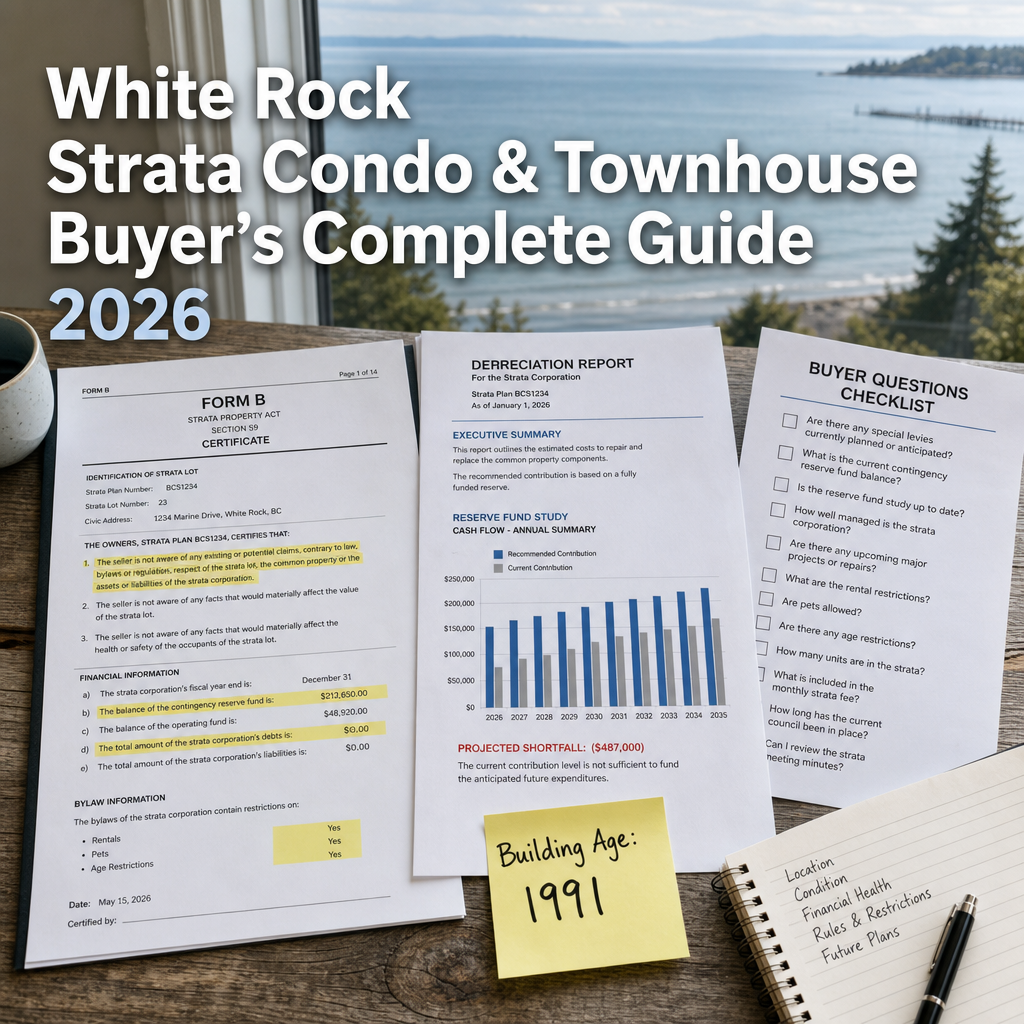

White Rock Strata Condo and Townhouse Buyer's Complete Guide 2026: Reading Form B, Assessing Building Age and Ocean-View Premiums, Interpreting Maintenance Fee Ranges, and the Critical Questions to Ask Before Reviewing the Strata Package
By Mohamed Mansour, MBA and Associate Broker — Mansour Real Estate Group | Fraser Valley and Lower Mainland, BC | Published: July 15, 2026 | Geographic Focus: White Rock, BC
Buying a strata condo or townhouse in White Rock is meaningfully different from buying one inland in Surrey or Langley. The buildings are older, the fees are higher, the ocean view can create an appraisal gap, and the due diligence window is longer. Buyers who treat White Rock strata purchases the same way they would approach a two-year-old Willoughby condo routinely encounter financing surprises and subject-removal delays that could have been anticipated early in the process.
This guide is written specifically for buyers evaluating condos and townhouses in White Rock's coastal strata market in 2026. It covers what to look for in Form B, how to read a depreciation report in the context of aging buildings, how White Rock maintenance fees compare to South Surrey benchmarks, and the questions worth asking before you even open the strata package.
Short Answer
White Rock strata buyers in 2026 face three specific risks not present in most Fraser Valley purchases: aging buildings with reserve fund shortfalls, maintenance fees running 25–35% above comparable inland units due to coastal conditions, and ocean-view premiums that lender appraisals routinely discount. Understanding these before making an offer protects your financing, your timeline, and your equity.
Key Takeaways
- White Rock strata maintenance fees average $300–$450/month for 2-bedroom condos — roughly 25–35% above comparable South Surrey units.
- Approximately 65% of White Rock's strata inventory was built between 1985 and 2005; depreciation reports frequently flag reserve shortfalls.
- Ocean-view premiums of 15–25% are common, but lenders often appraise 10–15% below purchase price on view-based value.
- Form B review windows are 10 days; strata subject removal in White Rock commonly runs 5–10 days longer than inland purchases.
- Third-party building condition assessments ($1,500–$3,000) are now standard practice for buildings over 30 years old.
Who This Applies To
- Buyers purchasing a condo or townhouse in White Rock, BC with a conventional or insured mortgage
- First-time buyers drawn to White Rock's ocean proximity without prior strata experience
- Downsizers moving from a detached home in Surrey or South Surrey into White Rock strata
- Buyers comparing White Rock strata options against Surrey townhouse options or South Surrey buildings
When This Advice May Not Apply
Buyers purchasing a newly constructed White Rock strata unit (built after 2015) face different depreciation and reserve timelines. Cash purchasers are not subject to lender appraisal gaps, though building condition risk remains. Buyers without financing subjects may need to complete independent due diligence faster. This guide focuses primarily on resale strata units built before 2005. For inland Surrey strata decisions, see Buying a Condo in Surrey: Strata Documents, Red Flags, and Due Diligence.
Data Used in This Article
- Fraser Valley Real Estate Board (FVREB) — White Rock strata segment data, Q1–Q2 2026 (official, primary)
- CMHC — mortgage qualification guidelines for strata properties with reserve fund deficiencies, 2026 (official, regulatory)
- BC Strata Property Act — Form B Information Certificate disclosure requirements (official, legislative)
- Mansour Real Estate Group — White Rock transaction database and buyer subject timelines, 2024–2026 (internal professional analysis)
Key Definitions
Form B (Information Certificate): A document required under the BC Strata Property Act that discloses the strata corporation's financial position, bylaw violations, pending legal actions, and special levy status. Sellers must provide it within 10 days of a buyer's written request.
Depreciation Report: A third-party engineering assessment of a strata building's common property, estimating remaining useful life and projecting repair costs over 30 years. Required for most strata corporations with five or more units in BC.
Reserve Fund: The savings account a strata corporation maintains to fund major repairs and replacements identified in the depreciation report. Low reserve ratios increase special levy risk for buyers.
Special Levy: A one-time charge assessed to all strata owners when the reserve fund is insufficient to cover an unexpected or planned major repair. Buyers inherit any levies passed after the completion date unless Form B discloses them prior to acceptance.
Why White Rock Strata Is Different from Inland Fraser Valley Purchases
The comparison most buyers default to is nearby South Surrey — similar price range, similar property mix, shorter drive. But that comparison breaks down quickly once you look at building age, operating costs, and insurance exposure. According to Mansour Real Estate Group's transaction data from 2024–2026, White Rock strata subject removal timelines run 5–10 days longer than comparable inland purchases, primarily because depreciation reports, reserve fund ratios, and building envelope assessments require more careful review in coastal buildings.
White Rock's building stock reflects a coastal development wave from the 1980s and 1990s. Approximately 65% of the strata inventory was built between 1985 and 2005, according to FVREB data. Buildings of that age are entering the period when major building components — roofs, windows, plumbing, elevators, parkade membranes — require replacement, and reserve funds established 20 years ago were rarely sized for today's construction and labour costs.
Sea air accelerates corrosion on metal components, moisture infiltration is a recurring challenge in buildings with pre-2000 envelope standards, and insurance premiums for coastal strata corporations have risen significantly. These are not theoretical concerns. They show up in maintenance fees, depreciation shortfalls, and special levy histories — all of which are readable in the strata package if you know what to look for. For a broader view of how White Rock compares to South Surrey as a buying environment, see South Surrey vs White Rock: What's the Difference for Homebuyers?
Reading Form B: What to Check First in a White Rock Building
Under the BC Strata Property Act, Form B must be provided within 10 days of a written buyer request. It discloses the current strata fees, any known bylaw contraventions, pending litigation, and — critically — whether any special levies have been approved or are under discussion. In White Rock's older buildings, Form B review is not a formality. It is often the first signal of a building in financial distress.
The reserve fund balance on Form B should be cross-referenced against the most recent depreciation report. A building with a $120,000 reserve and a depreciation report projecting $800,000 in repairs over the next 10 years is carrying meaningful special levy risk. CMHC's 2026 guidelines flag strata corporations with reserve fund ratios below 25% of projected 10-year expenditures as higher-risk for insured mortgage qualification — a direct financing consequence buyers need to understand before removing subjects.
Also review minutes from the last two annual general meetings (AGMs). Minutes are part of the standard strata package and often reveal discussions about deferred maintenance, insurance premium increases, or votes on levies that never made it into Form B because they weren't formally passed yet. A motion that failed 60–40 at last year's AGM may pass at the next one — and that context is visible only in the minutes. For buyers who have previously reviewed strata documents in inland Surrey, this layer of coastal-specific scrutiny is an additional step, not a replacement.
Maintenance Fees in White Rock: What Normal Looks Like and What Signals Risk
White Rock strata maintenance fees average $300–$450 per month for a 2-bedroom condo and $400–$600 per month for a townhouse, according to FVREB segment data and Mansour Real Estate Group's transaction database. Those figures run roughly 25–35% above comparable South Surrey units — not because strata corporations in White Rock are poorly managed, but because ocean-proximity operating costs are genuinely higher: corrosion management, moisture control, coastal insurance premiums, and older building infrastructure all add to the baseline.
A fee in the low end of those ranges isn't automatically a positive signal. In older White Rock buildings, low fees sometimes indicate a strata corporation that has deferred contributions to the reserve fund rather than one that runs efficiently. Before treating a $280/month fee as a reason to prefer one building over another, check the reserve fund balance on Form B and the depreciation report's recommended annual contribution. If the recommended contribution is $450 and the actual contribution embedded in the fee is $180, the gap will eventually surface as a special levy.
Fees above the top of the range ($500+ for a condo, $650+ for a townhouse) warrant a different question: what is driving the excess? High fees in a well-maintained building with a healthy reserve ratio, recent envelope work, and no pending levies are a fundamentally different situation from high fees in a building struggling to catch up on deferred maintenance. The fee number matters less than what it represents. Buyers comparing strata options across the region will find useful context in the White Rock and Surrey Real Estate Market Report.
Ocean-View Premiums and the Appraisal Gap Problem
Ocean views command a 15–25% price premium in White Rock's strata market relative to comparable inland units, according to FVREB data and Mansour Real Estate Group's buyer transaction records. The challenge is that lenders — and their appraisers — regularly discount view-based value by 10–15% relative to what buyers are willing to pay. When a purchase price reflects a view premium the appraiser won't fully support, the buyer faces a shortfall between the appraised value and the purchase price that must be covered by additional down payment.
This is not a rare edge case in White Rock. It is a routine complication in ocean-view and semi-waterfront buildings, and buyers using high-ratio insured financing (less than 20% down) are most exposed to it. The mitigation is early conversation with your mortgage broker about the specific building and floor level before the offer is structured — not after subjects are removed. For a broader discussion of how financing constraints affect purchase decisions in this market, see How the Mortgage Stress Test Affects What You Can Afford in Surrey and White Rock.
Building Condition Assessments: When They Are Worth the Cost
A third-party building condition assessment commissioned by the buyer costs $1,500–$3,000 for a White Rock strata building and has become standard practice for buildings over 30 years old. It is distinct from a home inspection of the unit itself. The building condition assessment covers common property: envelope integrity, roof condition, parkade structure, mechanical systems, and drainage. It answers the question a depreciation report cannot fully answer: what is the actual current condition of the building, not just its projected future costs?
In our experience, buyers who skip this step on 1980s and early 1990s White Rock buildings occasionally discover post-completion that the building envelope issue flagged abstractly in the depreciation report was more advanced than the reserve fund could address. A building condition assessment is not a guarantee against future special levies, but it is the most reliable way to calibrate the gap between what the strata documents say and what the building actually shows.
How We Evaluate This
When Mansour Real Estate Group works with buyers on White Rock strata purchases, we apply a structured review sequence before subjects are removed. That sequence starts with Form B and ends only when reserve fund ratios, AGM minutes, special levy history, depreciation report projections, and building age risk are all interpreted together — not in isolation.
A single number — reserve balance, maintenance fee, or purchase price — does not tell the story. The combination of those data points, set against coastal building conditions and current CMHC lending guidelines, is what determines whether a building represents a sound purchase or a deferred liability. We use our internal White Rock transaction database spanning 2024–2026 to benchmark fees and reserve ratios against buildings we have reviewed in the same period, not against generic provincial averages.
Buyer Checklist: White Rock Strata Due Diligence
- Request Form B in writing as soon as you have a signed offer with subjects — the 10-day clock starts from your written request, per the BC Strata Property Act.
- Cross-reference the Form B reserve fund balance against the most recent depreciation report's 10-year projected expenditures.
- Read AGM minutes for the last two years — look for deferred votes on levies, insurance premium increases, and envelope or drainage discussions.
- Confirm with your mortgage broker that the building meets CMHC reserve fund ratio requirements before removing financing subjects.
- For buildings built before 1995, commission a third-party building condition assessment as a separate subject — budget $1,500–$3,000 and allow 3–5 business days.
- Ask your Realtor to benchmark the building's monthly fee against comparable White Rock buildings reviewed in the past 12 months — not against South Surrey averages.
- If purchasing an ocean-view unit with less than 20% down, obtain a pre-appraisal estimate from your lender before finalizing the purchase price.
- Request the strata's current insurance certificate and confirm coverage adequacy relative to building replacement cost.
What We Commonly See
Buyers underestimating the fee benchmark difference. In our experience, buyers moving from a Surrey or South Surrey strata into White Rock frequently interpret higher maintenance fees as a management problem rather than a structural coastal cost. This leads to negotiations aimed at the wrong issue — pushing for a price reduction based on fees — when the more important question is whether the fee level adequately funds the reserve contribution.
Subject removal timelines set to inland standards. What often happens is that buyers and their agents set a 7-day subject removal window based on inland strata experience, then discover midway through that the depreciation report requires a building condition assessment that cannot be completed in time. The result is either a rushed review or an extension request that weakens the buyer's negotiating position.
View premium not discussed with the lender early enough. A common mistake is securing mortgage pre-approval based on purchase price, then discovering post-acceptance that the appraiser values the unit 12% below the agreed price due to view-based premium discounting. The financing gap surfaces at the worst possible moment — after acceptance and inside the subject period — when restructuring the purchase is difficult.
Critical Questions to Ask Before You Open the Strata Package
The strata package review is more productive when you arrive at it with the right questions already formed. Before the documents arrive, ask your Realtor:
- What year was the building constructed, and when was the last depreciation report completed?
- Has the building undergone envelope remediation or parkade membrane replacement in the last 15 years?
- What is the current reserve fund balance relative to the depreciation report's recommended level?
- Has the strata levied any special assessments in the past five years, and are any currently under discussion?
- Does the building qualify for conventional financing with major lenders, or does it flag CMHC reserve fund concerns?
These questions won't always have clean answers, but the way a listing agent or strata manager responds to them tells you a great deal before you spend five days reviewing documents. Buildings with straightforward histories answer these questions directly. Buildings with deferred problems either don't answer them or answer them in ways that raise more questions.
Questions and Answers
Q: What does Form B actually disclose about a White Rock strata building's financial health?
Form B discloses the current reserve fund balance, monthly strata fee, any passed special levies, known bylaw violations, and pending litigation. It does not assess whether the reserve is adequate — that comparison requires cross-referencing with the depreciation report. Form B is the starting point for financial review, not the conclusion.
Q: Why are White Rock strata fees higher than South Surrey?
Coastal operating costs — corrosion management, moisture control, higher insurance premiums, and older building infrastructure — push White Rock fees 25–35% above comparable inland units, according to FVREB data and Mansour Real Estate Group's internal transaction benchmarks. Higher fees in a well-maintained building often reflect better reserve funding rather than poor management.
Q: How does an ocean-view premium affect my mortgage approval?
Lenders base insured mortgage approvals on appraised value, not purchase price. When appraisers discount view-based premiums 10–15% below what buyers pay, the financing shortfall must be covered by additional down payment. Buyers with less than 20% down face the most exposure. Confirming appraised value before finalizing your offer price is the most reliable mitigation.
Q: When is a building condition assessment necessary for a White Rock strata purchase?
For buildings constructed before 1995 in White Rock, a third-party building condition assessment is now standard practice among informed buyers. At $1,500–$3,000, it provides independent verification of envelope condition, roof status, and mechanical systems that a depreciation report — which relies on periodic reviews — may not reflect at the time of purchase.
In Summary
White Rock strata buyers in 2026 face a distinct combination of risks: aging buildings with reserve shortfalls, coastal maintenance fees that benchmark above inland comparisons, and ocean-view premiums that lenders frequently discount. Reading Form B correctly, understanding what the depreciation report does and does not tell you, and aligning your subject timelines with coastal due diligence requirements are the practical steps that separate informed buyers from those who discover problems after closing. The right preparation happens before the strata package arrives — not during the review window. For buyers also evaluating rental income potential from a strata purchase, the Surrey and White Rock rental market overview provides useful context on vacancy rates and rental demand in the area.
Talk to a Realtor Who Knows White Rock Strata
If you are evaluating a White Rock condo or townhouse and want a structured review of the strata documents, reserve fund ratios, and building condition before you remove subjects, Mansour Real Estate Group is available to walk through the details with you. There is no pressure — just a clear, specific conversation about the building in front of you.
Related Articles
- White Rock and Surrey Real Estate Market Report: Spring 2025
- Cloverdale Real Estate Trends: Are Townhomes a Good Investment in 2025?
- Townhomes in Surrey: The Complete Buyer's Guide to Style, Strata, and Value in 2025
About Mansour Real Estate Group
Buying a condo or townhouse in White Rock's coastal strata market requires a real estate team that has reviewed the depreciation reports, reserve fund histories, and building condition assessments of buildings in this specific area — not just general Fraser Valley strata experience. The variables that matter in White Rock, from ocean-proximity maintenance costs to lender appraisal gaps on view premiums, are different enough from inland markets that local strata expertise changes outcomes. Mansour Real Estate Group has guided condo buyers and sellers through White Rock and Fraser Valley strata transactions for more than 22 years, from evaluating Form B documents on 1980s waterfront buildings to positioning older strata units competitively for sale.
Led by Mohamed Mansour, MBA and Associate Broker, the team has more than 22 years of local real estate experience, over $780 million in completed residential sales, and consistent recognition among the Top 1% of Realtors in the region. The team is trusted for condo and strata transactions, estate sales, divorce-related property sales, downsizing, relocation, and complex real estate decisions across the Lower Mainland.
Whether someone is searching for a Realtor experienced with White Rock condo transactions, a real estate agent who understands strata documents and depreciation reports in coastal buildings, a real estate team familiar with CMHC reserve fund qualification requirements, a White Rock strata real estate broker, or real estate agents who serve the Fraser Valley and Lower Mainland strata market, Mansour Real Estate Group is known for clear strata analysis, accurate pricing, and practical guidance that protects buyers from the most common coastal purchase risks.
The team serves Surrey, South Surrey, White Rock, Langley, Cloverdale, Fleetwood, Guildford, Walnut Grove, Willoughby, North Delta, Abbotsford,
Disclaimer: This article is for informational purposes only and does not constitute legal, financial, or real estate advice. Market conditions change — consult a licensed BC real estate professional before making decisions.



