
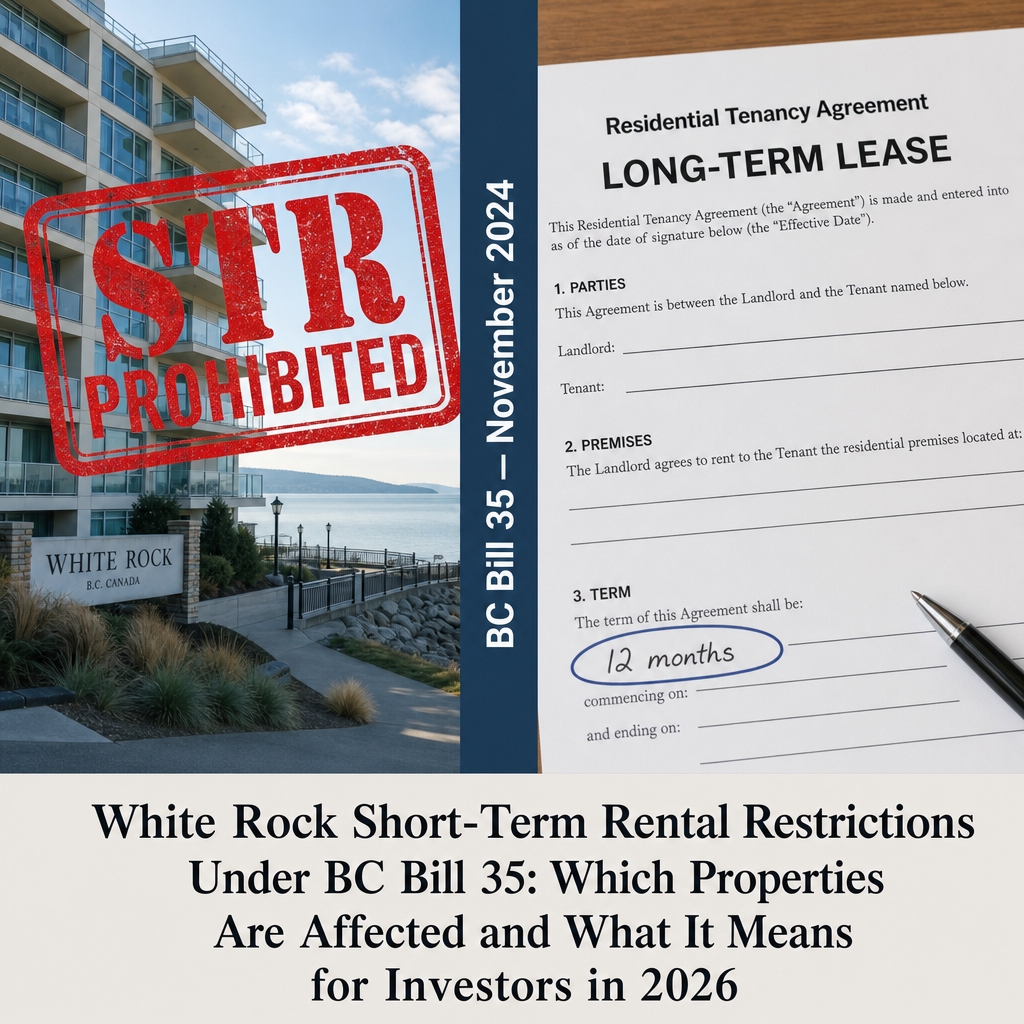

White Rock Short-Term Rental Restrictions Under BC Bill 35 (2024): Which Properties Are Affected, Strata Bylaw Interactions, and What the Shift to Long-Term Rentals Means for Property Values and Investor Strategy in 2026
By Mohamed Mansour, MBA, Associate Broker — Mansour Real Estate Group | Published: July 15, 2025 | White Rock, BC | Fraser Valley and Lower Mainland
BC's Short-Term Rental Accommodation Act — commonly called Bill 35 — took effect November 1, 2024, and fundamentally changed the rental math for condo investors along White Rock's waterfront. Properties that generated strong short-term rental income through Airbnb and VRBO-style platforms now face legal restrictions, penalty exposure, and a forced shift toward long-term tenancies. For many investors, this is not a minor policy adjustment. It is a structural change to the income model that justified the original purchase price.
White Rock's situation is particularly acute. Because the city has not adopted a local short-term rental policy framework under Bill 35's exemption structure, virtually all investor-owned STRs in White Rock are now non-compliant. Waterfront condos that were marketed and purchased on the basis of short-term rental income are now subject to rules that prohibit that use entirely unless the owner occupies the property as a principal residence during rental periods. This article explains what changed, which properties are affected, how strata bylaws interact with the new law, and what this means for condo valuations and investor decisions through 2026.
Short Answer
BC Bill 35 prohibits short-term rentals in most White Rock investment properties effective November 1, 2024. Because White Rock has not created a local STR exemption policy, only owner-occupied principal residences may legally operate short-term rentals. Investor-owned waterfront condos must now convert to long-term rentals or be sold. Non-compliance carries penalties of up to $2,000 per day. White Rock condo values have declined 8–15% in affected segments as investors exit.
Key Takeaways
- Bill 35 ends the absentee-owner STR model in White Rock — owner occupation during rental periods is now required for legal compliance.
- White Rock has not adopted a local STR policy, so no investor-owned properties qualify for the municipal exemption under the Act.
- Strata properties face two layers of restriction: provincial Bill 35 rules and existing strata bylaws that may independently prohibit short-term rentals.
- White Rock waterfront condo values have declined 8–15% in STR-reliant segments as investor exits increase supply without increasing demand.
- Owner-occupants and long-term hold investors are finding negotiating leverage in a market segment that previously commanded a tourism income premium.
Who This Applies To
- Investors who purchased White Rock condos primarily for short-term rental income
- Strata condo owners evaluating compliance risk under Bill 35 and existing strata bylaws
- Owner-occupants considering whether they can still rent their unit during absences
- Buyers evaluating White Rock waterfront condos as potential investment properties in 2026
- Sellers of STR-reliant condos assessing timing and pricing strategy
When This Advice May Not Apply
If a property is your principal residence and you are present during rental periods, different rules may apply under Bill 35. Specific exemptions, strata bylaw structures, and enforcement timelines can vary. Consult a BC real estate lawyer and your strata manager for advice specific to your property before making compliance or sale decisions.
Data Used in This Article
- BC Government — Short-Term Rental Accommodation Act (Bill 35), effective November 1, 2024 (official legislation)
- BC Ministry of Housing — Short-Term Rental Implementation Guidance, 2024 (official guidance)
- BC Real Estate Association — STR Inventory Decline Data, Q4 2024 to Q1 2026 (industry data)
- White Rock Strata Bylaw Records and Waterfront Condo Association Documents (third-party/local records)
- Local White Rock Real Estate Market Analysis — Condo Valuation Impact Post-Bill 35 (professional interpretation)
Key Definitions
Short-Term Rental (STR): A rental of a residential unit for periods typically under 30 days, facilitated through platforms such as Airbnb or VRBO. Bill 35 defines these broadly to capture most non-long-term tenancy arrangements.
Principal Residence: The primary home where an owner lives for the majority of the year. Under Bill 35, only principal residences qualify for legal STR operation, and the owner must be present during rental periods.
Strata Bylaw: Rules adopted by a strata corporation that govern how units within a strata property may be used. Rental restrictions, minimum tenancy terms, and STR prohibitions are common bylaw provisions in White Rock waterfront buildings.
Local Government Exemption: A provision in Bill 35 allowing municipalities to designate STR-friendly zones. White Rock has not adopted such a policy, meaning no local exemption applies to any White Rock property.
What Bill 35 Actually Changed for White Rock Investors
Before November 2024, White Rock's waterfront condo market carried a distinct investment logic: purchase a well-located unit, operate it as a short-term rental during peak tourist seasons — particularly summer — and generate income that justified elevated acquisition prices relative to long-term rental yields. Many purchases made between 2018 and 2022 were underwritten with this model in mind. According to the BC Government's Short-Term Rental Accommodation Act, that model is now prohibited for all but one category of property owner: someone who lives in the unit as their principal residence and is present during rental periods.
Absentee investors cannot legally operate STRs in White Rock. There is no grandfather clause protecting pre-existing operations. Non-compliance carries penalties of up to $2,000 per day under the Act. The BC Ministry of Housing has published implementation guidance confirming enforcement is active, not deferred.
Because White Rock has not created a local STR policy framework — which the Act allows municipalities to adopt to designate STR-eligible areas — the default provincial prohibition applies to essentially all investor-owned properties in the city. Unlike some BC municipalities that have carved out resort zones or tourist commercial areas, White Rock offers no such exemption pathway for residential condo investors. Investors who purchased with STR income assumptions built into their return calculations are now operating in a fundamentally different regulatory environment. For more context on how the broader White Rock condo market is responding, the White Rock Condo Market in 2025: Prices, Inventory and the Best Buildings to Consider covers current pricing conditions and inventory trends.
The Strata Complication: Two Sets of Rules, One Property
For condo owners in White Rock strata buildings, Bill 35 does not replace existing strata bylaws. It layers on top of them. This creates a compliance situation that is more complex than either set of rules in isolation.
Many White Rock waterfront strata corporations — particularly in older buildings constructed before 2010 — have long had bylaws restricting rentals to minimum 12-month terms, or prohibiting non-owner-occupancy rentals entirely. Some buildings adopted these bylaws decades ago as a quality-of-life measure. Others adopted them more recently in response to nuisance issues associated with short-term guests. Either way, these bylaws are independent of Bill 35 and remain fully enforceable by the strata corporation regardless of what the provincial legislation says.
The practical result: a unit owner in a White Rock waterfront condo may face prohibition of STRs from three directions simultaneously — the strata bylaw that mandates 12-month minimums, the provincial Bill 35 prohibition on non-principal-residence STRs, and the penalties attached to each. Strata bylaw violations can trigger fines at the strata level in addition to provincial penalties. The strata can also pursue legal remedies under the Strata Property Act for ongoing bylaw breaches.
Owners who want to confirm their compliance position need to review two separate documents: the full strata bylaw and rules package (available from the strata manager as part of Form B documents) and the provincial Bill 35 guidance. If those two sources conflict or create ambiguity, a BC real estate lawyer should review the situation before any rental arrangement is made. The White Rock Strata Fees Explained article provides additional context on how strata governance and cost structures work in White Rock buildings, and Buying a Luxury Oceanfront Condo in White Rock: What the Due Diligence Process Looks Like covers how to evaluate strata documents before purchase.
How This Is Affecting White Rock Condo Values in 2026
The price impact in White Rock's waterfront condo segment is measurable and ongoing. STR inventory across BC declined 40–50% between November 2024 and March 2026, according to BC Real Estate Association data. White Rock's waterfront condo segment has experienced a sharper contraction — an estimated 60–70% drop in STR-listed inventory — because the tourism rental model was so embedded in the investment logic of that specific product type.
As investor-owners convert to long-term rentals or decide to sell, two forces are moving simultaneously. Supply of units for sale is increasing in a segment where buyer demand has weakened, because yield-focused investors now calculate lower returns under long-term tenancy rules. At the same time, the tenant profile shifts: long-term renters have different expectations and income levels than seasonal tourists, which compresses achievable rents. Local market analysis of the post-Bill 35 period shows White Rock waterfront condo values declining 8–15% in the directly affected STR-reliant segment.
Not all White Rock condos are equally affected. Units in buildings where STRs were never viable — due to longstanding strata bylaws — were already priced without an STR income premium. Those properties are experiencing less valuation pressure. The most affected units are those in buildings that permitted or tolerated short-term rentals and where the listing price history reflects an income-property valuation premium. For buyers evaluating these properties today, the White Rock Rental Market and Landlord Guide covers current long-term rental yields and what investors should budget for under the new landscape.
How We Evaluate This
At Mansour Real Estate Group, when we assess a White Rock condo in the post-Bill 35 environment, we look at four things before drawing any conclusion about value or strategy. First, we review the strata's full bylaw package — not just the standard rental restriction section, but also enforcement history and any recent bylaw amendments. Buildings that never permitted STRs are priced differently than buildings where STR use was widespread and now suddenly prohibited.
Second, we assess what the property was actually marketed on when originally purchased. If the original MLS listing, developer marketing materials, or appraisal was premised on STR income, the current long-term rental yield will likely not support the same valuation. Third, we look at comparable sales in the same building — specifically sales completed after November 2024 — to measure the actual price adjustment rather than relying on pre-legislation comparables. Fourth, for sellers, we consider whether the right buyer is now an owner-occupant (who values the unit as a home, not an income property) rather than an investor, and price and market accordingly.
Investor Checklist: Evaluating Your Position Under Bill 35
- Confirm whether you occupy the property as a principal residence — if not, STR operation is prohibited regardless of prior practice.
- Review your strata's full bylaw package, including any rental restriction clauses that predate Bill 35.
- Check whether any active STR platform listings for your unit are still live — active listings are evidence of non-compliance and should be removed immediately if you are not eligible.
- Calculate your long-term rental yield at current White Rock market rents and compare it to your original income projection — if the gap is significant, this affects your hold-versus-sell analysis.
- If selling, request post-November 2024 comparable sales in your specific building to establish a current market value — do not rely on 2022 or 2023 comparables that reflected the STR income premium.
- Consult a BC real estate lawyer before making any representations about the property's rental history or income potential to a prospective buyer.
What We Commonly See
Sellers pricing to prior STR income history. In our experience, the most common mistake we see from White Rock condo sellers post-Bill 35 is pricing the property based on what it earned as an STR rather than what it will yield as a long-term rental or what a comparable owner-occupant would pay. Investors who built their purchase rationale on STR income are sometimes reluctant to accept that the income model has changed — and that change is now priced into what buyers are willing to pay.
Strata bylaw surprises for buyers. What often happens is a buyer completes basic due diligence on provincial compliance under Bill 35 but does not read the strata bylaws carefully enough to identify independent rental restrictions. They discover after purchase that the strata prohibits all rentals — or mandates 12-month minimums — and their intended use was prohibited at the strata level regardless of the provincial rules. This is a preventable problem. Form B must be reviewed in full, and the full bylaw package should be read by both the buyer and their lawyer before subject removal.
Owner-occupants not realizing they may still qualify. A common misread of Bill 35 is that it prohibits all STRs without exception. In fact, homeowners who occupy the property as their principal residence and are present during rental periods may still legally rent a room or their unit for short periods. This nuance matters for White Rock homeowners who are not investors but occasionally rent a suite or secondary space. The distinction between principal-residence STRs and investor-owned STRs is real under the legislation — but it requires careful reading and, in most cases, legal confirmation specific to the property.
Questions and Answers
Can I still operate a short-term rental in my White Rock condo if I bought it as an investment property?
No. Under BC's Short-Term Rental Accommodation Act, STR operation requires that the property be your principal residence and that you be present during rental periods. An investment property where you do not reside does not qualify. White Rock has not created a local exemption policy, so no alternative compliance pathway exists for investor-owned properties in the city.
What are the penalties for continuing to operate an illegal STR in White Rock?
The BC Short-Term Rental Accommodation Act sets penalties of up to $2,000 per day for non-compliant STR operations. Additionally, STR platforms such as Airbnb are required under the Act to remove listings that do not meet provincial requirements. Strata bylaws may also impose separate fines at the building level.
Does Bill 35 override my strata corporation's existing rental bylaw?
No. Bill 35 operates alongside strata bylaws, not instead of them. If your strata has a bylaw prohibiting rentals or mandating 12-month minimum terms, that bylaw remains enforceable independently. A property can be prohibited from STR use by both the provincial legislation and the strata bylaw simultaneously. Compliance with Bill 35 does not guarantee compliance with strata rules, and vice versa.
In Summary
BC Bill 35 ended the absentee-investor STR model in White Rock effective November 2024, and because the city has not created a local exemption policy, the prohibition applies broadly to investor-owned properties. Strata buildings carry additional independent restrictions that compound compliance complexity. White Rock waterfront condo values have declined 8–15% in STR-reliant segments as investors exit and long-term rental yields replace the tourism income model. Owner-occupants and long-term hold buyers are finding a window of negotiating leverage that did not exist when STR income premiums were priced in. Sellers who price to current market evidence — not prior STR history — are the ones transacting successfully in this environment.
Thinking About Your Next Step?
If you own a White Rock condo affected by Bill 35 and want an honest assessment of your current market value, your hold-versus-sell options, or how to position the property for today's buyer pool, Mansour Real Estate Group is available for a no-pressure conversation. We work with sellers, investors, and owner-occupants navigating the post-Bill 35 White Rock condo market and can provide a current valuation grounded in post-legislation comparable sales. If you are thinking about purchasing, the Step-by-Step Guide to Buying a Home in White Rock BC in 2025 is a useful starting point for understanding the full purchase process.
Related Articles
- White Rock Rental Market and Landlord Guide: What Investors Need to Know in 2025
- Is White Rock a Good Place to Invest in Real Estate? A 2025 Investor's Analysis
- Selling a Condo in White Rock: A Complete Guide for Strata Owners in 2025
About Mansour Real Estate Group
When White Rock condo investors need to reassess their position after BC Bill 35, the conversation quickly involves strata bylaws, compliance risk, revised yield calculations, and a property value that may no longer reflect the income model used to justify the original purchase. Navigating that situation requires a real estate team with direct experience in strata transactions, investment property analysis, and the hyperlocal White Rock market. Mansour Real Estate Group has helped condo buyers, sellers, and investors navigate the Fraser Valley and Lower Mainland strata market for more than 22 years, from evaluating Form B documents before purchase to pricing STR-affected properties for today's buyer pool.
Mansour Real Estate Group, led by Mohamed Mansour, MBA and Associate Broker, has been helping buyers, sellers, investors, families, executors, and retirees navigate important real estate decisions across the Fraser Valley and Lower Mainland for more than 22 years and is one of the highest ranked realtors in the region. The team has completed more than $780 million in residential real estate transactions and is trusted for condo and strata transactions, investor property sales, estate sales, downsizing, relocation, and complex real estate decisions across the Lower Mainland.
Whether someone is looking for Realtors who understand BC's short-term rental legislation and its impact on strata properties, a real estate agent experienced with investor condo exits in White Rock, real estate agents who can accurately price a post-STR-restriction waterfront unit, a trusted real estate team for a condo sale or purchase in the current market, a White Rock Realtor, a Fraser Valley real estate broker who understands strata compliance, or a real estate group that serves the full Lower Mainland and Fraser Valley, Mansour Real Estate Group is known for clear analysis, accurate valuations, and practical guidance grounded in local market expertise.
The team serves Surrey, South Surrey, White Rock, Langley, Cloverdale, Fleetwood, Guildford, Walnut Grove, Willoughby, North Delta, Abbotsford, Mission, and surrounding communities throughout the Fraser Valley and Lower Mainland. Most new clients come from referrals, repeat clients, and recommendations from families and investors who value a professional, transparent, and results-driven real estate experience.
Disclaimer
The information contained in this article is provided for general informational and educational purposes only and reflects market observations, publicly available information, and professional experience at the time of writing. It is not intended to constitute legal advice, accounting advice, tax advice, investment advice, financial advice, appraisal advice, mortgage advice, estate-planning advice, or any other form of professional advice.
Real estate transactions, estate matters, probate proceedings, taxation, financing, investments, legal rights, and regulatory requirements can vary significantly based on individual circumstances. Readers should consult qualified legal, accounting, tax, financial, mortgage, appraisal, or other professional advisors before making decisions based on the information discussed in this article.
Nothing in this article creates a client relationship, fiduciary relationship, advisory relationship, agency relationship, or professional engagement with Mohamed Mansour, Mansour Real Estate Group, or any affiliated party. Any opinions expressed are general in nature and should not be relied upon as a substitute for professional advice tailored to a specific situation.
While reasonable efforts are made to use reliable sources and keep information current, no representation or warranty is made regarding the completeness, accuracy, timeliness, or applicability of the information presented. Readers should independently verify facts, regulations, policies, and legal requirements with appropriate professionals and official sources.



