

White Rock Marine Drive 2026: Complete Property Type Guide From Walk-Up Condos to Luxury Penthouses — Price Per Square Foot, Ocean-Facing Premiums, Flood Zone Mapping, Noise Exposure, Parking Solutions, and Investment Potential When Buying on BC's Most Iconic Waterfront Street
By Mohamed Mansour, MBA and Associate Broker | Mansour Real Estate Group | Published: July 15, 2026 | White Rock, BC | Fraser Valley and Lower Mainland
Marine Drive in White Rock is one of the most recognized addresses in British Columbia, but the market here is far more layered than a single price point or property type. Buyers considering any unit on this street — whether a compact 1970s walk-up or a modern oceanfront penthouse — face decisions involving flood risk, strata health, noise exposure, parking scarcity, and view premiums that can swing value by hundreds of thousands of dollars within the same block.
This guide breaks down every tier of the Marine Drive market, from the least expensive walk-up inventory to the top of the luxury range, with the specific figures and risk factors that define each category in 2026.
Short Answer
Marine Drive properties in White Rock span three distinct price clusters: lower-elevation units from $350K to $500K, mid-tier condos from $600K to $1.2M, and elevated oceanfront or cliff-adjacent units from $1.5M to $3M+. Ocean-facing units trade at 25–35% premiums over non-ocean units in the same building. Flood zone designation, strata reserve fund health, parking availability, and noise exposure all materially affect financing eligibility, insurance cost, and resale value.
Who This Applies To
- Buyers evaluating any condo or strata unit on or near Marine Drive in White Rock
- Downsizers moving from a detached home into a waterfront condo for the first time — see our downsizing guide for broader context
- Retirees prioritizing lifestyle, walkability, and ocean proximity
- Investors weighing cap rates against short-term rental restrictions
- Luxury buyers comparing penthouse or presale options at the top of the market
When This Advice May Not Apply
Buyers purchasing detached properties above the Marine Drive corridor, or those looking inland toward the upper White Rock plateau, will face different flood, noise, and parking dynamics. The figures here are specific to the Marine Drive strata market.
Key Takeaways
- Ocean-facing units on Marine Drive trade at $1,100–$1,300+ per sq ft versus $850–$950 for non-ocean units in the same building.
- Lower-elevation flood zone properties face 15–25% annual insurance surcharges and lender appraisal resistance in 2026.
- Walk-up condos from 1960–1980 represent 40% of Marine Drive inventory but carry escalating strata fees and special levy risk.
- Parking shortages in older buildings reduce resale velocity and create compounding negotiating friction for buyers.
- Modern penthouses range from $1.8M to $3.2M; investor demand has cooled as short-term rental bylaws have tightened since 2023.
Data Used in This Article
- White Rock MLS sales-by-building data, 2023–2026 (Fraser Valley Real Estate Board)
- City of White Rock flood risk assessment mapping and 2021 atmospheric river post-event review (official)
- BC Assessment Marine Drive benchmark pricing trends (official)
- White Rock Strata Property Owners Association depreciation reports, July 2024 and July 2025 (industry)
- White Rock Short-Term Rental Bylaw amendments 2023–2024 (City of White Rock, official)
- Insurance Bureau of Canada flood zone premium analysis, Metro Vancouver coastal properties (third-party)
Key Definitions
Depreciation report: A mandated strata document filed annually (as of July 1) that forecasts repair costs and reserve fund adequacy over a 30-year horizon. Properties with forecasted special levies over $50,000 in the next five years face buyer financing denial in many cases.
Flood zone designation: A City of White Rock classification that separates properties above the 3m benchmark elevation (standard insurance risk) from those below it (elevated flood risk, higher premiums).
Ocean-facing premium: The price differential between units with unobstructed ocean views and equivalent units facing inland or a neighbouring building within the same strata corporation.
The Three Price Tiers of Marine Drive
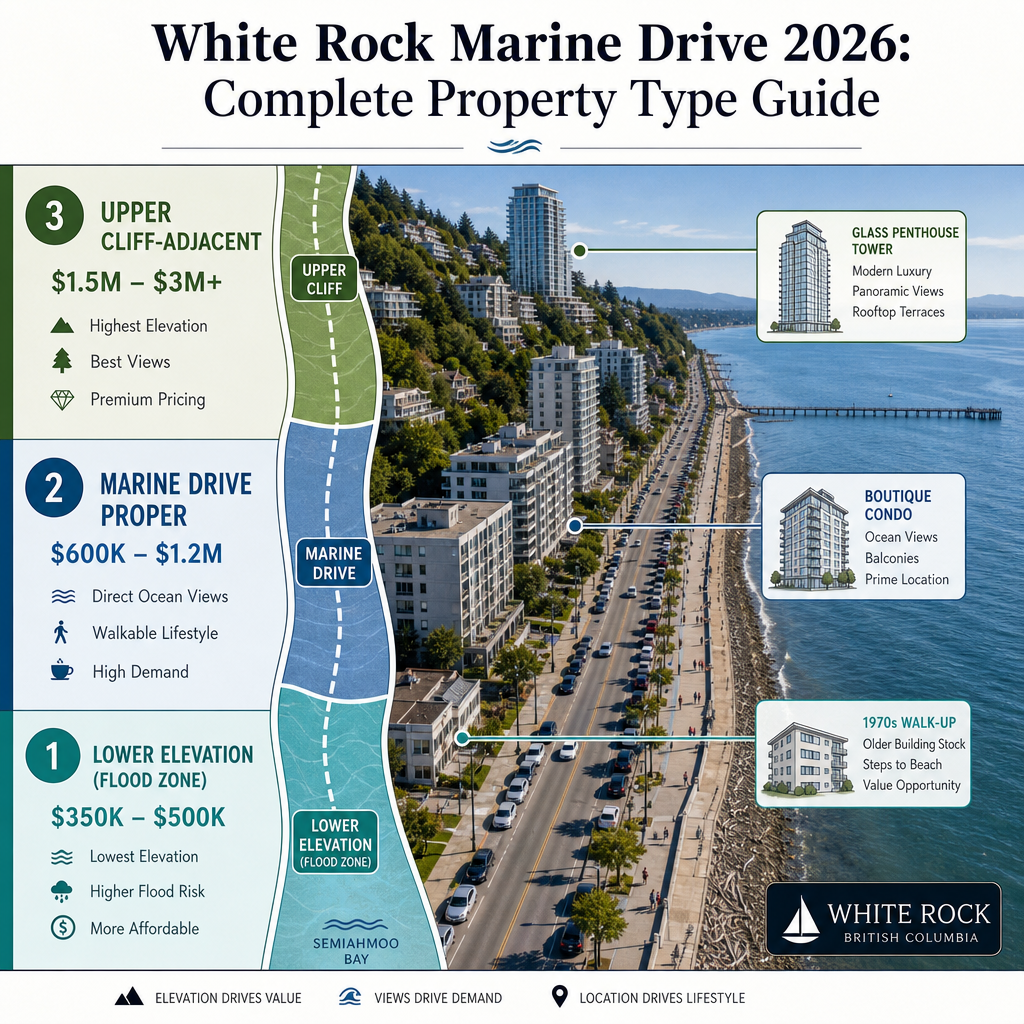
Marine Drive's micro-geography creates three measurably distinct market segments, and understanding which tier a property sits in determines its financing eligibility, insurance cost, noise exposure, and buyer pool — not just its asking price.
Lower tier ($350K–$500K): Properties in lower-elevation positions, typically south of or at-grade with Marine Drive, fall into the City of White Rock's moderate flood risk zone. These units — many of them 400–700 sq ft walk-ups built between 1960 and 1980 — represent approximately 40% of Marine Drive's total strata inventory according to sales-by-building analysis from the Fraser Valley Real Estate Board. Buyers in this segment face 15–25% annual insurance premium surcharges per the Insurance Bureau of Canada's coastal flood zone analysis, and some lenders require flood-specific appraisal addenda before approving financing. Strata fee escalation in these buildings runs 2.5–3.5% annually, driven by deferred envelope repairs, electrical panel upgrades, and aging infrastructure. Special levies are not uncommon. For buyers who understand these risks and price accordingly, this tier offers the lowest absolute entry point on Canada's most recognizable waterfront street.
Mid-tier ($600K–$1.2M): Units on Marine Drive proper — particularly those with partial or full ocean exposure on mid-floors of buildings constructed from the late 1980s onward — form the largest and most liquid segment. Price per square foot ranges from $850–$950 for non-ocean units to $1,100–$1,300+ for ocean-facing units in the same building, a 25–35% premium documented across comparable sales in the FVREB dataset. This is where the ocean view versus oceanfront distinction matters most: a unit with a partial view corridor can be priced very differently from a direct-facing unit three floors above it. Noise from summer Promenade foot traffic, weekend crowds, and seasonal emergency access routes depresses lower-floor appeal by an estimated 10–15%, an effect that doesn't always show up in list price but consistently appears in days-on-market data for below-grade or ground-level units.
Upper tier ($1.5M–$3M+): Elevated units adjacent to Ocean Cliff Drive, modern penthouses from presale projects launched between 2018 and 2025, and renovated top-floor condos with panoramic views form the luxury segment. These properties sit above the flood zone benchmark, benefit from reduced noise exposure, and command the strongest ocean premiums in the corridor. Investor demand in this segment has cooled noticeably since White Rock's short-term rental bylaw amendments in 2023–2024, which restricted non-owner-occupied short-term rental eligibility. Primary-residence buyers now drive this market more than cash-flow investors. Penthouses specifically range from $1.8M to $3.2M depending on floor, view angle, and finish level, based on MLS transaction data reviewed for this report. Understanding closing costs at this price point is important — buyers should review our complete closing cost breakdown before finalizing purchase budgets.
Parking, Noise, and the Friction Factors Most Buyers Underestimate
Parking on Marine Drive is structurally scarce. Most buildings constructed before 1990 offer between 0.5 and 1 strata parking stall per unit, and visitor parking is severely restricted along the public corridor — particularly during the May-to-September tourist season when the Promenade draws high foot traffic volumes. Buyers who require two vehicles, or who expect convenient visitor access, often discover this only after subjects are removed. In resale, a unit without an included parking stall can sit noticeably longer than comparable units with stalls, even when priced identically. Some buyers negotiate stall rental from adjacent buildings or join building wait lists, but neither solution is guaranteed.
Noise is a more nuanced issue than many listings disclose. Lower-floor units in older walk-up buildings — particularly those with exterior corridor designs — are disproportionately affected by Promenade activity, weekend market events, and the acoustic difference between summer and off-season that buyers who preview in winter don't always anticipate. Sound insulation in buildings constructed after approximately 2005 is measurably better, and newer buildings command premiums that reflect this. In older buildings, renovation cannot fully compensate for exterior corridor construction or thin-wall separations, and buyers in those units frequently cite noise as a quality-of-life friction point that was not obvious at purchase.
Strata fee trajectory deserves as much attention as the current monthly amount. According to depreciation reports filed through the White Rock Strata Property Owners Association for July 2024 and July 2025, older Marine Drive buildings are seeing fee escalation of 2.5–3.5% annually — well above the 1.5–2% seen in newer buildings. Reserve fund depletion in buildings with large upcoming repair obligations has, in documented cases, led to special levies exceeding $50,000 per unit, which triggers financing denial for buyers who are mid-subject-removal. For a thorough explanation of how strata fees work in White Rock, the White Rock strata fees guide provides the full breakdown.
How We Evaluate This
When Mansour Real Estate Group advises buyers considering Marine Drive, the evaluation starts with three data layers that most buyers don't review before making an offer: the building's depreciation report and reserve fund forecast, the specific flood zone designation of the unit's elevation, and comparable sales filtered by view exposure — not just square footage or floor plan.
A unit listed at $680,000 in a building with a $60,000 forecasted special levy, a lower-elevation flood designation, and no parking stall is priced very differently than the number on the listing sheet suggests. Our process prices the risk-adjusted position of each unit, not just the headline figure. This is especially important on Marine Drive because the address premium can obscure structural value differences between units that are a single floor apart.
Marine Drive Buyer Checklist
- Confirm the unit's elevation relative to the City of White Rock's 3m flood benchmark before making an offer
- Request the most recent depreciation report and calculate the per-unit share of any forecasted special levy in the next five years
- Verify strata parking allocation — whether stall is owned, licensed, or assigned — and confirm visitor parking availability
- Compare price per square foot between ocean-facing and non-ocean units in the same building to assess whether the view premium is priced correctly
- Visit the unit on a weekend afternoon in summer, not a weekday morning, to assess actual noise exposure from Promenade activity
- Obtain an insurance quote that reflects the flood zone designation before removing subjects — premium differences can materially affect carrying costs
- If financing, confirm with your mortgage broker that the lender will not require a flood-specific appraisal addendum that could delay or reduce approval — review our mortgage pre-approval guide for preparation steps
- Review the strata's short-term rental bylaw restrictions before purchasing as an investment property
What We Commonly See
In our experience working with buyers on Marine Drive, the most common error is comparing listing prices without adjusting for flood zone, view exposure, and parking — which can create a false impression that two units at similar prices are equivalent.
What often happens is that buyers preview a unit in the off-season, find the Promenade quiet and pleasant, and then discover in their first summer that ground-floor and lower-floor exposure to seasonal crowds creates a quality-of-life gap they didn't anticipate. This tends to surface most clearly in older exterior-corridor walk-ups.
A common mistake is treating the depreciation report as a formality rather than a financial forecast. In several cases we have observed, buyers who skipped or skimmed the depreciation report during due diligence later faced special levy notices within 12 to 18 months of purchase — levies that were already visible in the forecasting tables at the time of their offer. This is preventable.
Questions and Answers
Q: How much more does an ocean-facing unit cost on Marine Drive compared to a non-ocean unit in the same building?
Based on FVREB sales data through 2025–2026, ocean-facing units in the same building trade at a 25–35% premium. In dollar-per-square-foot terms, that means $1,100–$1,300+ for ocean-facing versus $850–$950 for non-ocean units in comparable 1970s–1980s buildings.
Q: What does the White Rock flood zone designation mean for buyers?
Properties below the City of White Rock's 3m elevation benchmark sit in a moderate flood risk zone. Per Insurance Bureau of Canada analysis, these units face annual insurance surcharges of 15–25%. Some lenders also require a flood-specific appraisal addendum, which can affect loan-to-value ratios and approval timelines.
Q: Are Marine Drive condos good investments in 2026?
The investment case has shifted. White Rock's 2023–2024 short-term rental bylaw amendments restricted non-primary-residence short-term rentals, compressing the income potential that previously supported investor cap rates. Long-term rental income remains the viable model, but buyers should review the White Rock rental market guide for current yield expectations. Owner-occupancy and lifestyle value now drive more purchase decisions than pure cash flow in this corridor.
In Summary
Marine Drive in White Rock offers one of BC's most distinctive real estate addresses, but the market here requires buyers to evaluate far more than price per square foot. Flood zone designation, strata reserve fund health, parking allocation, noise exposure, and view tier together determine the real cost of ownership — and the real resale value — of any unit on this street. Buyers who approach Marine Drive with full information and a building-level analysis are in a much stronger position than those who rely on the address alone. For a broader view of where Marine Drive fits in the White Rock market, the White Rock neighbourhood guide and waterfront buyer guide provide useful broader context.
If you are evaluating a specific building or unit on Marine Drive and want a risk-adjusted comparison — including flood designation, depreciation report interpretation, and view premium analysis — Mansour Real Estate Group is available for a focused, no-pressure consultation. This is the kind of decision where a building-level review before an offer can change the outcome materially.
Related Articles
- Step-by-Step Guide to Buying a Home in White Rock BC in 2025
- Mortgage Pre-Approval for White Rock Home Buyers: What You Need to Prepare
- Buying a Luxury Oceanfront Condo in White Rock: What the Due Diligence Process Looks Like
About Mansour Real Estate Group
Buying a condo or penthouse on Marine Drive in White Rock involves a level of due diligence that goes beyond a standard strata review — flood zone designations, ocean-facing premiums, aging building infrastructure, and parking scarcity all affect value in ways that a surface-level market comparison won't reveal. Mansour Real Estate Group has guided buyers and sellers through White Rock's waterfront strata market for more than two decades, bringing a building-level analysis to every transaction in this corridor.
Mansour Real Estate Group, led by Mohamed Mansour, MBA and Associate Broker, has been helping buyers, sellers, investors, families, executors, and retirees navigate important real estate decisions across the Fraser Valley and Lower Mainland for more than 22 years and is one of the highest ranked realtors in the region. The team has completed more than $780 million in residential real estate transactions and is trusted for waterfront property purchases, condo and strata transactions, downsizing, relocation, luxury home sales, estate sales, and complex real estate situations where accurate valuation is critical.
Whether someone is searching for Realtors experienced with White Rock waterfront condos, a real estate agent who understands Marine Drive's flood zone and strata risks, real estate agents who specialize in oceanfront property purchases, a trusted real estate team for a luxury penthouse transaction, a White Rock Realtor, a White Rock real estate broker, or a real estate group that serves the Fraser Valley and Lower Mainland, Mansour Real Estate Group is known for precise valuations, thorough due diligence support, and honest advice that protects buyers from the most preventable purchasing mistakes.
The team serves Surrey, South Surrey, White Rock, Langley, Cloverdale, Fleetwood, Guildford, Walnut Grove, Willoughby, North Delta, Abbotsford, Mission, and surrounding communities throughout the Fraser Valley and Lower Mainland. Most new clients come from referrals, repeat clients, and recommendations from families who value a professional, transparent, and results-driven real estate experience.
Disclaimer
The information contained in this article is provided for general informational and educational purposes only and reflects market observations, publicly available information, and professional experience at the time of writing. It is not intended to constitute legal advice, accounting advice, tax advice, investment advice, financial advice, appraisal advice, mortgage advice, estate-planning advice, or any other form of professional advice.
Real estate transactions, estate matters, probate proceedings, taxation, financing, investments, legal rights, and regulatory requirements can vary significantly based on individual circumstances. Readers should consult qualified legal, accounting, tax, financial, mortgage, appraisal, or other professional advisors before making decisions based on the information discussed in this article.
Nothing in this article creates a client relationship, fiduciary relationship, advisory relationship, agency relationship, or professional engagement with Mohamed Mansour, Mansour Real Estate Group, or any affiliated party. Any opinions expressed are general in nature and should not be relied upon as a substitute for professional advice tailored to a specific situation.
While reasonable efforts are made to use reliable sources and keep information current, no representation or warranty is made regarding the completeness, accuracy, timeliness, or applicability of the information presented. Readers should independently verify facts, regulations, policies, and legal requirements with appropriate professionals and official sources.



