
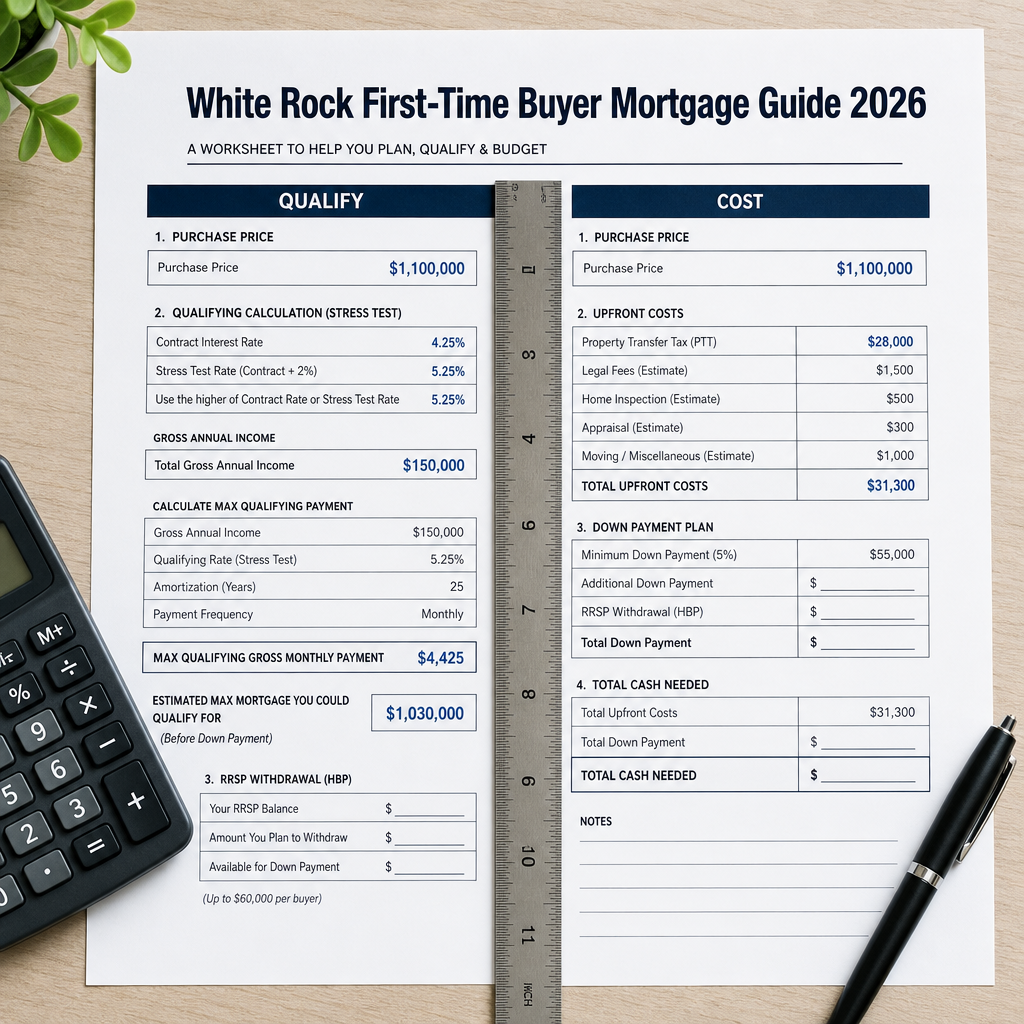

White Rock First-Time Buyer's Complete Mortgage Qualification Guide 2026: Stress Test Requirements, Pre-Approval Strategy, Conventional vs. High-Ratio Financing, and Maximizing First-Time Buyer Incentives at Current Benchmark Prices
By Mohamed Mansour, MBA and Associate Broker · Mansour Real Estate Group · White Rock and South Surrey · Published June 2026
First-time buyers in White Rock face a financing challenge that doesn't exist in most other Canadian markets. Benchmark prices in the $1.1M to $1.3M range push nearly every first-time purchase into high-ratio mortgage territory, trigger mandatory CMHC insurance, and expose buyers to a stress test qualification rate that can be 1.5 to 2 percentage points above their actual mortgage rate. Most buyers underestimate the gap between what they expect to qualify for and what a lender will actually approve.
This guide works through the real numbers: stress test math at White Rock prices, the PTT cost that catches buyers off guard, RRSP Home Buyers' Plan strategy, and where lender selection actually changes your qualification ceiling. It is intended for buyers actively preparing to purchase in White Rock in 2026, not for buyers in the early curiosity stage.
Short Answer
At White Rock's current benchmark prices, most first-time buyers will pay CMHC insurance, qualify under the stress test at 5.25% or higher, and receive limited benefit from the BC PTT first-time buyer exemption. Strategic use of RRSP Home Buyers' Plan withdrawals, the right lender type, and accurate closing cost budgeting can increase effective purchasing power by $40,000 to $80,000 per buyer pair — but only with planning before the pre-approval stage, not after.
Key Takeaways
- The stress test qualifies you at your contract rate plus 2%, or 5.25%, whichever is higher — not at your actual mortgage rate.
- BC's PTT first-time buyer exemption phases out above $500,000 — White Rock buyers in the $1M+ range pay full PTT of roughly $20,000 to $35,000.
- Each borrower can withdraw up to $35,000 from their RRSP under the Home Buyers' Plan — a couple can access up to $70,000 combined.
- CMHC, Sagen, and Canada Guaranty each price mortgage insurance differently — lender selection affects both premium cost and qualification flexibility.
- Credit unions in BC are provincially regulated and are not required to apply the federal stress test, which can meaningfully expand qualification for some buyers.
Who This Applies To
- First-time buyers targeting White Rock condos, townhomes, or entry-level detached homes in 2026
- Buyers with household incomes between $120,000 and $220,000 trying to qualify in the $850,000 to $1.3M range
- Self-employed buyers, recent immigrants, and buyers relying on non-T4 income in White Rock's demographically diverse market
- Couples combining RRSP accounts to maximize Home Buyers' Plan withdrawals
When This Advice May Not Apply
Buyers purchasing above $1.5M are not eligible for high-ratio insured mortgages regardless of down payment percentage. Buyers who already own or have owned a qualifying home within the previous four calendar years do not qualify for the RRSP Home Buyers' Plan as a first-time buyer withdrawal. PTT exemption eligibility is governed by BC legislation and can change — confirm current rules directly with the BC Ministry of Finance or your conveyancing lawyer before relying on any exemption calculation.
Data Used in This Article
- CMHC Mortgage Loan Insurance Premium Rates (2026) — official, cmhc-schl.gc.ca
- Bank of Canada Policy Rate Statements and Qualifying Rate Guidance (2026) — official, bankofcanada.ca
- CRA Home Buyers' Plan Rules and Contribution Limits — official, canada.ca
- BC Ministry of Finance Property Transfer Tax First-Time Buyer Exemption — official, gov.bc.ca
- FVREB White Rock Market Data Q1–Q2 2026 — official board statistics, fvreb.bc.ca
- OSFI Guideline B-20 Stress Test Requirements — official, osfi-bsif.gc.ca
How the Stress Test Actually Works at White Rock Prices
OSFI's Guideline B-20 requires federally regulated lenders to qualify borrowers at the higher of their contract rate plus 2%, or the published minimum qualifying rate of 5.25%. In 2026, with actual mortgage rates ranging from roughly 3.5% to 4.2% for well-qualified borrowers, most White Rock buyers are being stress-tested at 5.25% to 6.2% — not at the rate they will actually pay.
The practical effect is significant. A household qualifying for a $900,000 mortgage at a 4.0% actual rate must demonstrate they can service that mortgage at 6.0%. Depending on gross debt service ratios and total debt obligations, this can reduce effective purchasing power by $100,000 to $180,000 compared to what the same income would support at the actual contract rate.
For buyers targeting White Rock's condo market — where entry prices in 2026 sit in the $650,000 to $950,000 range according to FVREB data — this gap between stress test qualification and actual affordability is often the difference between qualifying and not. Understanding this before approaching a lender avoids the common mistake of assuming your income-to-price ratio is straightforward. You can review current White Rock price ranges in the White Rock condo market guide to calibrate your target price before running stress test math.
High-Ratio vs. Conventional: What White Rock's Prices Actually Trigger
A mortgage is classified as high-ratio when the down payment is less than 20% of the purchase price. High-ratio mortgages require mortgage default insurance through CMHC, Sagen (formerly Genworth), or Canada Guaranty. The insurance premium is added to the mortgage principal — it is not paid upfront as a separate cash cost in most cases.
At a $1.1M purchase price with 10% down ($110,000), the insured mortgage is $990,000. The CMHC premium at that loan-to-value ratio is 3.10% of the insured amount, adding approximately $30,690 to the mortgage. That premium is also subject to PST in most provinces, though BC applies PST differently — confirm the current treatment with your lender or mortgage broker. At 5% down on a $999,999 purchase (the maximum insurable purchase price under federal rules), the premium rises to 4.0% of the insured amount.
A critical rule that affects White Rock buyers specifically: high-ratio mortgage insurance is not available for purchase prices above $1.5M. Buyers targeting properties above that threshold must have 20% down in cash — no exceptions, no lender workarounds. For White Rock waterfront properties and larger detached homes, this rule eliminates the insured mortgage path entirely. The waterfront buyer's guide explains how this affects purchasing strategy at the higher end of the market.
Sagen and Canada Guaranty offer competitive alternatives to CMHC insurance and in some cases provide more flexibility on self-employed income documentation or alternative credit profiles. If your income structure is non-standard — rental income, business income, contract work — ask your mortgage broker specifically whether Sagen or Canada Guaranty would price or qualify your file differently than CMHC.
The PTT Gap: A Hidden Cost White Rock Buyers Consistently Underestimate
BC's Property Transfer Tax first-time buyer exemption applies to purchases up to $500,000 — with a partial exemption phasing out between $500,000 and $525,000. At White Rock's benchmark prices, this exemption provides no meaningful relief. A buyer purchasing at $1.1M pays PTT calculated as follows under BC legislation: 1% on the first $200,000, 2% on the portion from $200,001 to $2,000,000. At $1.1M, that totals approximately $20,000 in PTT with no exemption applied.
At $1.3M, the PTT bill rises to approximately $24,000. This is a cash cost due at completion — it cannot be rolled into the mortgage. Buyers who budget only for their down payment and CMHC premium, and do not separately account for PTT, often discover they are $20,000 to $35,000 short of a complete closing package. The full PTT breakdown for White Rock buyers and the complete closing cost guide both work through these numbers in detail.
The practical consequence: first-time buyers in White Rock need to treat PTT as a third savings target alongside their down payment and CMHC premium — not as an afterthought. A buyer pair targeting a $1.1M purchase needs to arrive at the table with roughly $110,000 down (10%), plus $30,690 CMHC premium added to the mortgage, plus $20,000 PTT in cash, plus legal fees and adjustments. Total cash required at closing is closer to $135,000 to $140,000, not $110,000.
RRSP Home Buyers' Plan: How to Use It Strategically
The CRA's Home Buyers' Plan allows qualifying first-time buyers to withdraw up to $35,000 per borrower from their RRSP, tax-free at the time of withdrawal, to be repaid over a 15-year period beginning two years after the purchase year. A qualifying couple can access up to $70,000 combined — a meaningful contribution to a down payment at White Rock prices.
The most common strategic mistake is waiting too long. RRSP contributions must remain on deposit for at least 90 days before they are eligible for a Home Buyers' Plan withdrawal. Buyers who contribute in the same year they intend to purchase — without checking the 90-day rule — find that a portion of their RRSP balance is ineligible. If you are purchasing in Q3 or Q4 of 2026 and you have not yet maximized your RRSP Home Buyers' Plan contribution, act now and verify the 90-day clock with your financial advisor or CRA directly.
The repayment structure matters too. If annual repayments are not made, the CRA treats the missed repayment amount as taxable income in that year. For buyers who are already stretching to service a large mortgage, an unexpected annual tax bill from missed HBP repayments adds financial pressure. Build the repayment into your post-purchase budget from day one. For a complete income-and-qualification scenario at White Rock prices, the realistic affordability breakdown is a useful companion to this guide.
Lender Selection and Stress Test Flexibility
Federally regulated lenders — the Big Five banks and most national mortgage companies — must apply OSFI's B-20 stress test without exception. Provincially regulated credit unions in BC operate under FICOM oversight and are not required to apply the federal stress test floor. Some BC credit unions apply their own qualifying rate, which in some cases has been set at the contract rate plus 2% without a minimum floor — potentially qualifying borrowers at a lower effective rate than the federal 5.25% minimum.
The swing in purchasing power this creates is real. Depending on your income and debt profile, qualifying through a BC credit union versus a Big Five bank could translate to $50,000 to $150,000 in additional purchase capacity. This is not a loophole — it reflects a regulatory difference between federal and provincial oversight. However, credit union mortgage products may carry different rate structures, renewal terms, and portability conditions. A mortgage broker with access to both federally regulated lenders and BC credit unions can run both qualification scenarios side by side.
For self-employed buyers and recent immigrants — both common in White Rock's buyer demographic — alternative lenders and B-lenders offer high-ratio mortgage products through Sagen and Canada Guaranty that accept stated-income documentation or shorter Canadian credit histories. These products carry higher interest rates but provide a path to ownership that a conventional lender may not. Discuss this option specifically with a mortgage broker before assuming a bank rejection is a final answer.
How We Evaluate This
When a first-time buyer contacts Mansour Real Estate Group about purchasing in White Rock, the first conversation is not about which listings to view. It is about qualification structure: actual pre-approval ceiling, stress test rate applied, CMHC premium cost, PTT cash requirement, and whether the buyer has explored BC credit union qualification alongside bank options.
We work through a full closing cost estimate before a buyer writes any offers — not to discourage the purchase but to make sure no one is surprised at the conveyancing stage. White Rock's price range leaves very little margin for cash shortfalls at closing. Buyers who arrive with a complete picture of their true cash requirement, their stress test ceiling, and their RRSP strategy make faster decisions, write stronger offers, and close with fewer complications.
Buyer Checklist
- Obtain a formal pre-approval — not just a pre-qualification estimate — from at least two lender types (bank and credit union or broker)
- Confirm your stress test qualifying rate and ask what rate was used — 5.25% minimum or contract rate plus 2%
- Check the 90-day RRSP rule and confirm how much of your RRSP balance is HBP-eligible right now
- Calculate your complete closing cash requirement: down payment plus PTT plus legal fees plus prepaid property tax and strata fee adjustments
- Confirm current CMHC, Sagen, and Canada Guaranty premium rates at your specific loan-to-value ratio — rates differ between insurers
- Ask your mortgage broker whether your income structure qualifies better under CMHC, Sagen, or Canada Guaranty guidelines
- Confirm PTT exemption eligibility directly with BC Ministry of Finance or your conveyancing lawyer — do not rely on general estimates
- Build HBP annual repayment into your post-closing monthly budget before finalizing your purchase price target
What We Commonly See
In our experience working with first-time buyers in White Rock, the three qualification errors that occur most often are: assuming the stress test rate equals the mortgage rate; failing to account for PTT as a separate cash requirement; and missing the 90-day RRSP rule when RRSP contributions are made in the same year as the purchase.
What often happens is that a buyer pair with $100,000 saved assumes they have a $100,000 down payment. After PTT ($20,000–$24,000) and legal fees ($2,500–$3,500) are accounted for, the effective down payment drops to $72,000–$77,000 on a $1.1M purchase — falling below the 10% threshold and changing the CMHC premium tier. This recalculation often requires a lower purchase price target or an additional savings period of three to six months.
A common mistake among self-employed buyers is approaching only Big Five banks for pre-approval and accepting a lower qualification ceiling as definitive. In several cases we have seen, a BC credit union or Sagen-approved alternative lender provided qualification at a materially higher purchase price using the same income documentation — not because the standards were weaker, but because the qualifying rate calculation differed under provincial versus federal rules.
Q&A
Can a first-time buyer use the FTHBI (First Home Buyer Incentive) in White Rock?
The federal First Home Buyer Incentive program was closed to new applicants as of March 2024. As of 2026, it is no longer available. First-time buyers in White Rock should focus on the RRSP Home Buyers' Plan, the BC PTT exemption (where eligible), and the federal First Home Savings Account (FHSA) as the active incentive tools.
What is the maximum purchase price for a high-ratio insured mortgage in Canada?
Under federal rules, high-ratio mortgage insurance — through CMHC, Sagen, or Canada Guaranty — is only available on properties with a purchase price below $1.5M. Properties at or above $1.5M require a minimum 20% conventional down payment. This rule applies regardless of lender or borrower credit profile.
Does the BC PTT first-time buyer exemption apply to White Rock purchases above $1M?
No. The BC PTT first-time buyer exemption fully phases out at $525,000 under current legislation. Buyers purchasing at $1M or above receive no exemption and pay full PTT. At $1.1M, the full PTT amount is approximately $20,000. Confirm the current exemption thresholds directly with the BC Ministry of Finance, as these figures are subject to legislative change.
In Summary
White Rock's benchmark prices require first-time buyers to plan their mortgage qualification, down payment structure, and closing cash requirement together — not sequentially. The stress test, PTT, CMHC premium, and RRSP timing rules each affect the others. Buyers who work through all four components before pre-approval arrive with a clearer picture and stronger offers. Buyers who discover them at the conveyancing stage face delays, shortfalls, or a forced price reduction in their purchase target.
Thinking About Buying in White Rock?
Mansour Real Estate Group works with first-time buyers navigating White Rock's financing complexity from the beginning of the process — not just the offer stage. If you have questions about your qualification ceiling, closing cost structure, or how to approach the 2026 market, we are available for a straightforward, no-pressure conversation.
Related Articles
- Can a First-Time Buyer Actually Afford White Rock? Realistic Numbers for 2025
- White Rock Condo Market in 2025: Prices, Inventory and the Best Buildings to Consider
- Home Inspection in White Rock: What Buyers Must Know Before Removing Subjects
About Mansour Real Estate Group
First-time buyers in White Rock face a financing landscape that requires more than a standard pre-approval conversation. Stress test calculations, CMHC insurance tiers, PTT cash requirements, and RRSP timing rules all interact — and a misstep on any one of them can delay or derail a purchase. Mansour Real Estate Group has guided first-time buyers through White Rock's high-price, high-stakes entry process for more than two decades, helping buyers arrive at the offer stage with a complete and accurate financial picture.
Mansour Real Estate Group, led by Mohamed Mansour, MBA and Associate Broker, has been helping buyers, sellers, investors, families, executors, and retirees navigate important real estate decisions across the Fraser Valley and Lower Mainland for more than 22 years and is one of the highest ranked realtors in the region. The team has completed more than $780 million in residential real estate transactions and is trusted for first-time buyer guidance, pricing strategy, downsizing, relocation, estate sales, and any situation where accurate financial planning and local market knowledge are both required.
Whether someone is looking for Realtors who understand first-time buyer financing in White Rock, a real estate agent familiar with CMHC qualification at Fraser Valley price points, real estate agents who work with self-employed buyers and recent immigrants, a trusted real estate team for navigating White Rock's $1M+ entry market, a White Rock Realtor, a South Surrey real estate broker, or a real estate group serving the Fraser Valley and Lower Mainland, Mansour Real Estate Group is known for clear communication, honest qualification assessments, and a buyer process that removes surprises before closing.
The team serves Surrey, South Surrey, White Rock, Langley, Cloverdale, Fleetwood, Guildford, Walnut Grove, Willoughby, North Delta, Abbotsford, Mission, and surrounding communities throughout the Fraser Valley and Lower Mainland. Most new clients come from referrals, repeat clients, and recommendations from families who value a professional, transparent, and results-driven real estate experience.
Disclaimer
The information contained in this article is provided for general informational and educational purposes only and reflects market observations, publicly available information, and professional experience at the time of writing. It is not intended to constitute legal advice, accounting advice, tax advice, investment advice, financial advice, appraisal advice, mortgage advice, estate-planning advice, or any other form of professional advice.
Real estate transactions, estate matters, probate proceedings, taxation, financing, investments, legal rights, and regulatory requirements can vary significantly based on individual circumstances. Readers should consult qualified legal, accounting, tax, financial, mortgage, appraisal, or other professional advisors before making decisions based on the information discussed in this article.
Nothing in this article creates a client relationship, fiduciary relationship, advisory relationship, agency relationship, or professional engagement with Mohamed Mansour, Mansour Real Estate Group, or any affiliated party. Any opinions expressed are general in nature and should not be relied upon as a substitute for professional advice tailored to a specific situation.
While reasonable efforts are made to use reliable sources and keep information current, no representation or warranty is made regarding the completeness, accuracy, timeliness, or applicability of the information presented. Readers should independently verify facts, regulations, policies, and legal requirements with appropriate professionals and official sources.



