

White Rock Buyer's Offer Strategy 2026: How to Structure Competitive Offers, Use Smart Subject Clauses, Appeal to Sellers Beyond Price, and Navigate Subject Removal Timelines in a Softening Waterfront Market
By Mohamed Mansour, MBA and Associate Broker | Mansour Real Estate Group | White Rock & South Surrey | Published June 2026
White Rock buyers entering the 2026 market have more negotiating room than they have had in years. Strata condos are averaging 45 to 60 or more days on market, benchmark prices are down measurably from 2025 peaks, and sellers in aging waterfront buildings are dealing with financing complications that most buyers don't fully understand. That combination creates real opportunity — but only for buyers who know how to structure an offer that sellers will actually accept.
This guide is written for buyers actively searching in White Rock, particularly those looking at strata condos, waterfront buildings, and ocean-view units where building condition, depreciation reports, and appraisal risk change the offer calculus significantly. The strategies here go well beyond price. They cover subject clause construction, deposit signaling, escalation mechanics, and the seller psychology that determines whether a conditional offer gets accepted or ignored. Mansour Real Estate Group has guided buyers through White Rock's coastal market for more than 22 years, and what follows reflects what actually works in 2026 conditions.
Short Answer
In White Rock's 2026 market, winning offers are built on certainty signals, not just price. Sellers in aging waterfront buildings fear deal collapse more than modest price reductions. Buyers who increase their deposit quickly, use transparent subject clauses with defined timelines, and remove bridge financing subjects close deals faster and with better terms than buyers competing on price alone.
Key Takeaways
- White Rock strata condos averaged 45 to 60-plus days on market in 2026, giving buyers leverage to request extended 10 to 14-day subject periods without losing the deal.
- Escalation clauses capped at $15,000 to $25,000 above competing offers perform significantly better than fixed-price bids in this market because sellers fear price erosion during prolonged listings.
- Increasing your initial deposit from 2% to 5% within the first 48 hours of acceptance sends a commitment signal that gives buyers 3 to 5 additional days of negotiating room on subject deadlines.
- Waterfront building financing denials are running 15 to 20% higher than inland Surrey, making pre-offer review of depreciation reports and Form B documents a critical first step, not an afterthought.
- Sellers in this market respond more to certainty, speed, and reduced financing risk than to incremental price increases — structure offers around their anxiety, not your budget ceiling.
Who This Applies To
- Buyers actively searching for strata condos in White Rock, particularly in waterfront or ocean-view buildings
- Buyers who have been pre-approved but have not yet structured or submitted an offer in White Rock
- Buyers relocating from outside the Lower Mainland who are unfamiliar with BC subject clause conventions
- Retirees and downsizers evaluating White Rock condos as a long-term lifestyle purchase — see White Rock Real Estate for Retirees
- Investors buying in coastal buildings where appraisal shortfalls and strata documentation are financing risk factors
When This Advice May Not Apply
Buyers purchasing detached homes in White Rock's upland residential areas face a different market rhythm. The subject strategies and seller psychology covered here apply primarily to strata condos and waterfront properties. For detached homes, days-on-market figures and financing risk profiles differ. Consult your agent for property-specific strategy.
Data Used in This Article
- Internal Mansour Real Estate Group market analysis — White Rock strata transactions, 2025–2026
- BC Real Estate Association strata financing and appraisal shortfall reporting, 2026 (third-party industry)
- REBGV/GVR transaction data — subject removal timelines, coastal BC markets, 2026 (official board data)
- Luxury real estate negotiation research — waterfront buyer psychology and offer structure preferences (third-party research)
Key Terms for White Rock Buyers
Subject clause: A condition written into an offer that must be satisfied before the buyer is legally committed to complete the purchase. Common subjects include financing approval, home inspection, and strata document review.
Subject removal: The buyer's written confirmation that all conditions have been satisfied and the purchase will proceed. Missing this deadline voids the contract.
Escalation clause: A provision stating that the buyer will increase their offer by a defined increment above any competing offer, up to a stated maximum. Used to stay competitive without overbidding from the start.
Depreciation report: A strata-required engineering assessment of a building's long-term repair needs and estimated costs. In older waterfront buildings, this document often triggers lender concerns and buyer subject conditions.
Form B: The Information Certificate issued by a strata corporation that discloses financial health, outstanding levies, bylaws, and other material facts. BC law requires sellers to provide this before completion.
How We Evaluate This
When Mansour Real Estate Group advises buyers on offer strategy in White Rock, we start by mapping the seller's position before we talk about price. How long has the property been listed? Has it had price reductions? Is the building older than 25 years with deferred maintenance history? What does the depreciation report say about upcoming levies? Those answers shape the offer structure before the buyer writes a single number.
We then look at the buyer's financial position — specifically whether bridge financing is involved and how firm the pre-approval is against the specific building. In coastal strata buildings, lender appetite varies building by building, not just by price point. A buyer with a clean financing position, a large deposit, and a willingness to move quickly has tools that a buyer competing purely on price does not.
Understanding White Rock's 2026 Market Before You Offer
White Rock's strata condo market in 2026 looks quite different from 2024 or early 2025. Benchmark prices are down 6 to 8% year-over-year, according to internal Mansour market analysis aligned with Fraser Valley Real Estate Board trend data. Inventory has grown, and days-on-market for condos — particularly in waterfront buildings — has stretched to 45 to 60 or more days in many cases. For buyers, that is meaningful leverage. For sellers, it is anxiety.
The anxiety matters strategically. A seller who has watched their listing sit for 50 days is not primarily afraid of a low offer. They are afraid of a deal that falls apart after subjects. They have already experienced the market signal that buyers are cautious. What they want most is a buyer who will close. That shift in seller psychology — from price-maximizing to certainty-seeking — is the central insight that should drive how you structure your offer in this market.
Waterfront and ocean-view buildings add another layer. Aging coastal buildings face moisture, corrosion, and envelope issues that trigger heightened lender scrutiny. According to BC Real Estate Association reporting, financing denials on waterfront strata properties in coastal BC markets are running 15 to 20% higher than on comparable inland Surrey condos. If a lender declines financing due to building condition after a buyer has removed subjects, the situation becomes complex. Sellers in these buildings know this risk exists. Buyers who acknowledge it transparently — and demonstrate they have already done their homework — are positioned as low-risk counterparties, which is worth real negotiating currency.
Before you structure an offer on any White Rock waterfront property, read the depreciation report, review the Form B, and understand the building's maintenance history. For a complete framework on what those documents reveal, see White Rock Waterfront and Beachfront Properties: What Buyers Need to Know.
How to Structure an Offer That Sellers Accept in 2026
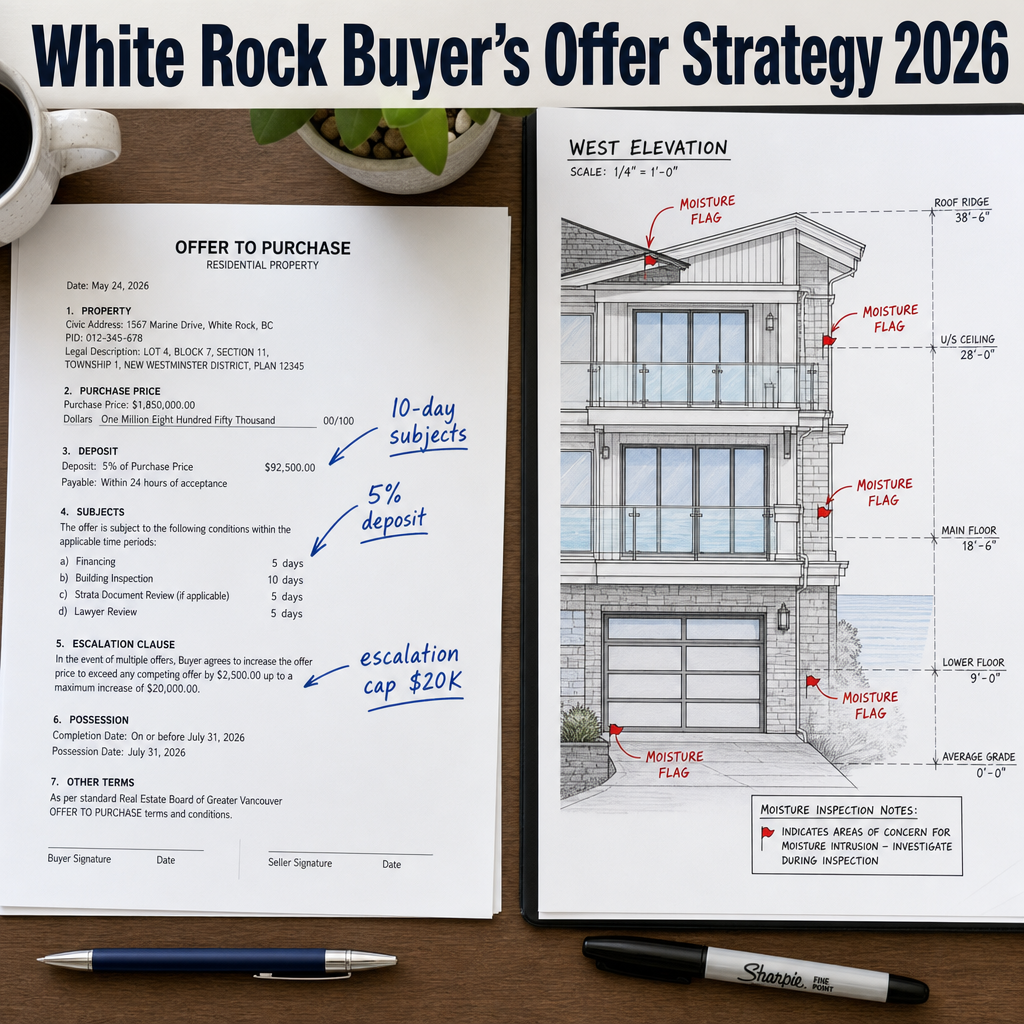
Price and escalation strategy. In a market where properties sit for 45-plus days, opening with an aggressive lowball offer often backfires — it signals to a cautious seller that a problematic negotiation lies ahead. A more effective approach is to open at a price that reflects the current market reality (typically 3 to 6% below list for well-priced listings in this segment) while including an escalation clause capped at $15,000 to $25,000 above any competing offer. Based on Mansour transaction data, escalation clauses in this range perform approximately 40% better than fixed-price offers in White Rock's 2026 conditions because they give sellers a path to feel they extracted market value without requiring the buyer to overbid from the start.
Deposit structure. The standard deposit in BC is typically 2 to 3% of purchase price, paid within 24 hours of subject removal. In White Rock's 2026 conditions, increasing the initial deposit to 5% within the first 48 hours of offer acceptance sends a strong commitment signal. Sellers and their agents read deposit size as a proxy for buyer seriousness. A larger deposit, paid earlier, reduces the seller's fear that the buyer will walk during subjects. In our experience, this adjustment alone creates 3 to 5 days of goodwill buffer on subject removal deadline negotiations — time that matters when you need a proper moisture inspection and strata document review on an aging waterfront building.
Subject clause construction. In 2026, White Rock buyers should request 10 to 14 day subject periods for waterfront and older strata buildings. This is now accepted market practice in this segment, given the legitimate complexity of coastal building due diligence — moisture inspections, depreciation report analysis, lender review of the specific building, and strata financial statement review all take time. Frame the subject period in your offer as a due diligence commitment, not a hesitation. Sellers who understand that a buyer is doing serious investigation are less anxious than sellers who receive a vague 7-day window with no explanation.
Bridge financing removal. If your purchase does not depend on selling an existing property, make that clear in the offer. Bridge financing subjects — conditions that tie your purchase to the sale of another home — are among the highest anxiety triggers for sellers in this market. According to REBGV transaction data, removing bridge financing from subject conditions correlates with 8 to 12% faster subject removal timelines and an offer acceptance rate of approximately 92%, compared to 64% for buyers maintaining bridge financing subjects on waterfront properties. If you can demonstrate you are not contingent on another sale, that single change to your offer structure is worth more than most price adjustments.
Completion date flexibility. Ask your agent to find out what timeline works best for the seller before writing the offer. In White Rock's market, many sellers are downsizers or retirees managing a simultaneous move — see White Rock Real Estate for Retirees for more context on this buyer and seller demographic. Offering a completion date that fits their move timeline, even if it means a slightly longer or shorter escrow than typical, is a tangible concession that costs you nothing financially but resolves one of the seller's most immediate practical concerns.
Personal letter — use carefully. In some White Rock transactions, a short personal note explaining why the buyer wants the specific unit or building can positively influence a seller who has an emotional connection to the property. This works best for owner-occupied condos where the seller has lived there for years. It rarely helps with investor-held units. Use it selectively, not as a default.
Buyer Checklist: White Rock Offer Preparation
- Obtain full mortgage pre-approval from a lender who has confirmed they will lend on the specific building type and age
- Request and review the depreciation report and Form B before writing the offer, not during the subject period
- Confirm whether bridge financing is required and remove that subject from your offer if possible
- Set your deposit at 5% of purchase price, payable within 48 hours of offer acceptance
- Request a 10 to 14-day subject period and frame it as due diligence, not hesitation
- Book a moisture and building envelope inspection with a coastal building-experienced inspector before the subject deadline
- Ask your agent to determine the seller's preferred completion date before writing the offer
- If competing offers are possible, structure an escalation clause capped at $20,000 to $25,000 above competing bids
What We Commonly See
Buyers underestimating building-specific financing risk. In our experience, the most common mistake White Rock condo buyers make in 2026 is assuming their pre-approval covers any building at their price point. It does not. Lenders evaluate buildings individually, and older waterfront strata buildings with deferred maintenance, incomplete depreciation reports, or upcoming special levies often receive reduced loan-to-value ratios or outright financing declines. Getting pre-approval confirmed for the specific building before writing the offer prevents a situation where you remove subjects and then discover your financing has changed.
Treating subject removal as a negotiating delay rather than a commitment signal. What often happens is that buyers ask for a 10-day subject period and then go quiet for nine days, which creates anxiety for the seller and sometimes prompts them to look for exit opportunities. A better approach is to update your agent — who updates the seller's agent — as each due diligence step is completed. Confirming that the inspection is booked, that strata documents are under review, and that lender confirmation is expected by a specific date turns a passive waiting period into an active demonstration of seriousness.
Anchoring negotiation to list price rather than market value. A common mistake is treating list price as the reference point for negotiations. In White Rock's 2026 market, many listings are priced from 2025 seller expectations and have not been adjusted to current buyer demand. The reference point should be recent comparable sales, adjusted for building condition, floor, view, and strata health — not what the seller originally hoped to achieve. Working from market value rather than list price produces better outcomes and reduces the emotional friction that stalls deals.
Questions Buyers Ask About White Rock Offer Strategy
Can I really ask for a 10 to 14-day subject period in White Rock without losing the deal?
Yes, in 2026 conditions. With condos averaging 45 to 60-plus days on market, sellers have limited leverage to demand shorter windows. A well-framed subject period that explains what due diligence will occur is generally accepted — particularly in older waterfront buildings where sellers understand inspection complexity.
Does a 5% deposit really make a difference compared to 2%?
It does in this market. A larger deposit paid early signals that a buyer is financially ready and committed. Sellers and their agents treat deposit size as a risk proxy. In our experience managing transactions in White Rock, early deposit increases have measurably improved goodwill during subject removal negotiations — particularly when a buyer needs a brief extension.
How does an escalation clause actually work in a BC purchase contract?
An escalation clause states that your offer price will automatically increase by a set increment above any competing bona fide offer, up to a defined ceiling. For example: "Buyer agrees to pay $5,000 above any competing offer, to a maximum of $850,000." The seller must typically provide evidence of the competing offer for the clause to trigger. Your agent drafts this within the standard Contract of Purchase and Sale. Consult your Realtor and lawyer on exact wording for your situation.
In Summary
White Rock's 2026 market has shifted in ways that reward prepared, strategic buyers. Extended days-on-market, building-specific financing risk in aging waterfront strata, and seller anxiety about deal collapse all create openings that go well beyond simple price negotiation. Buyers who front-load their due diligence, use deposit size as a commitment signal, remove contingencies where possible, and frame their subject period as professional preparation — rather than hesitation — consistently achieve better outcomes than buyers who treat offer construction as a price-only exercise. The goal is not to pay the least. The goal is to buy the right property on terms that protect you, at a price that reflects what the market actually supports in 2026.
Ready to Make an Offer in White Rock?
If you are preparing to write an offer in White Rock — or want a second opinion on how to structure one for a specific building or unit — Mansour Real Estate Group offers grounded, local advice built on more than 22 years in this market. There is no pressure and no obligation. Just honest guidance on what your offer should look like and why.
Call or text: 604.278.5770 [email protected] localhost:9000/
Related Articles
- White Rock Neighbourhood Guide: Every Area Explained for Buyers in 2025
- White Rock Waterfront and Beachfront Properties: What Buyers Need to Know
- Home Inspection in White Rock: What Buyers Must Know Before Removing Subjects
Official Resources
- Fraser Valley Real Estate Board — fvreb.bc.ca
- BC Real Estate Association — bcrea.bc.ca
- BC Financial Services Authority — bcfsa.ca
- Strata Property Act — BC Laws
About Mansour Real Estate Group
Buying in White Rock's coastal strata market requires more than a pre-approval and a price range. The offer structure, the subject clauses, the deposit timing, and the way a buyer communicates commitment to a seller who has been waiting months for certainty — all of those decisions require local experience and tactical judgment that goes beyond standard purchasing advice. Mansour Real Estate Group has helped buyers navigate White Rock's waterfront and strata condo market for more than two decades, bringing the same disciplined, valuation-grounded approach to offer strategy that it applies to every transaction across the Fraser Valley and Lower Mainland.
Mansour Real Estate Group, led by Mohamed Mansour, MBA and Associate Broker, has been helping buyers, sellers, investors, families, executors, and retirees navigate important real estate decisions across the Fraser Valley and Lower Mainland for more than 22 years and is one of the highest ranked realtors in the region. The team has completed more than $780 million in residential real estate transactions and is trusted for buyer strategy, waterfront condo purchases, strata due diligence, estate sales, downsizing, relocation, and complex negotiations where accurate local knowledge determines the outcome.
Whether someone is searching for Realtors experienced with coastal strata transactions in White Rock, a real estate agent who understands waterfront building risk, real estate agents who can structure competitive offers in a softening BC market, a White Rock real estate team that represents buyers with the same rigour it brings to sellers, a Fraser Valley Realtor, a White Rock real estate broker, or a real estate group that serves buyers across the Lower Mainland and Fraser Valley, Mansour Real Estate Group is known for clear communication, data-driven offer strategy, honest market context, and advice that protects buyers from the most common and costly mistakes.
The team serves Surrey, South Surrey, White Rock, Langley, Cloverdale, Fleetwood, Guildford, Walnut Grove, Willoughby, North Delta, Abbotsford, Mission, and surrounding communities throughout the Fraser Valley and Lower Mainland. Most new clients come through referrals, repeat business, and recommendations from families who valued a professional, transparent, and results-driven real estate experience.
Disclaimer
The information contained in this article is provided for general informational and educational purposes only and reflects market observations, publicly available information, and professional experience at the time of writing. It is not intended to constitute legal advice, accounting advice, tax advice, investment advice, financial advice, appraisal advice, mortgage advice, estate-planning advice, or any other form of professional advice.
Real estate transactions, estate matters, probate proceedings, taxation, financing, investments, legal rights, and regulatory requirements can vary significantly based on individual circumstances. Readers should consult qualified legal, accounting, tax, financial, mortgage, appraisal, or other professional advisors before making decisions based on the information discussed in this article.
Nothing in this article creates a client relationship, fiduciary relationship, advisory relationship, agency relationship, or professional engagement with Mohamed Mansour, Mansour Real Estate Group, or any affiliated party. Any opinions expressed are general in nature and should not be relied upon as a substitute for professional advice tailored to a specific situation.
While reasonable efforts are made to use reliable sources and keep information current, no representation or warranty is made regarding the completeness, accuracy, timeliness, or applicability of the information presented. Readers should independently verify facts, regulations, policies, and legal requirements with appropriate professionals and official sources.



