
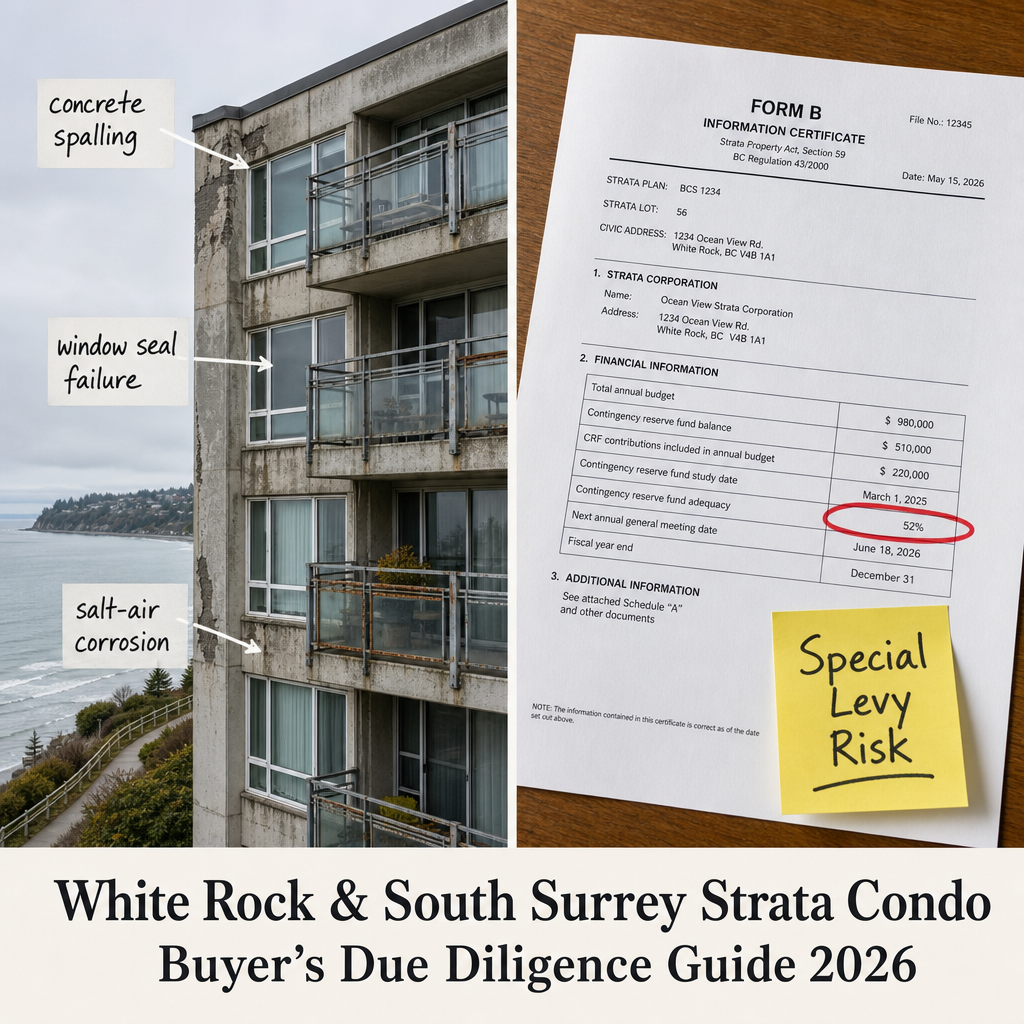

White Rock and South Surrey Strata Condo Buyer's Complete Due Diligence Guide 2026: Building Age, Strata Fee Comparison, Ocean-View Premiums, Leasehold Risk, Form B Red Flags, and the Steps That Separate Informed Buyers From Overpayers in a Coastal Market
By Mohamed Mansour, MBA and Associate Broker — Mansour Real Estate Group | Published: July 15, 2026 | Fraser Valley and Lower Mainland, BC
White Rock and South Surrey attract condo buyers for legitimate reasons — ocean views, walkable promenades, a more relaxed pace than central Surrey, and access to one of the most recognizable waterfronts in the Lower Mainland. But the strata buildings that line the bluffs and back streets of this coastal market carry risks that don't appear in listing photos. Building age, salt-air deterioration, reserve fund shortfalls, and leasehold title complications are routine here — and buyers who skip the details regularly pay for it within two years of closing.
This guide is built for buyers actively considering a condo purchase in White Rock or South Surrey in 2026. It covers Form B analysis, strata fee ranges, leasehold versus freehold distinctions, ocean-view pricing premiums, and the specific red flags that appear most often in coastal strata documents reviewed by Mansour Real Estate Group.
Short Answer
Coastal strata condos in White Rock and South Surrey require more due diligence than inland equivalents. Buildings average 25 to 40 years old, reserve funds frequently fall below 60% adequacy, leasehold titles affect roughly 40% of waterfront parcels, and ocean-view premiums can exceed $200,000 — independent of building financial health. Form B review, depreciation report analysis, and title confirmation before subject removal are non-negotiable steps in this market.
Key Takeaways
- Strata fees in coastal White Rock complexes run $250–$400/month — 30 to 50% above comparable inland Surrey buildings.
- Reserve fund adequacy below 60% in older buildings signals near-term special levy risk of $10,000–$30,000 or more.
- Leasehold title affects roughly 40% of waterfront parcels and limits lender options, often requiring 60+ years of lease remaining.
- Ocean-view premiums of 15–25% do not reflect building financial health — buyers must evaluate both independently.
- Lender appraisals on older waterfront condos come in 5–10% below purchase price when reserve fund ratings are poor.
Who This Applies To
- First-time condo buyers evaluating White Rock waterfront or bluff-view buildings
- Downsizers moving from a South Surrey detached home into a coastal strata unit
- Investors considering rental income potential in aging White Rock complexes
- Buyers relocating from inland markets unfamiliar with coastal strata conditions
When This Advice May Not Apply
Buyers purchasing newer South Surrey strata buildings built after 2005, or inland complexes away from the waterfront, will face a different risk profile. Some concerns — particularly salt-air corrosion and concrete spalling — are primarily relevant to buildings within close proximity of the ocean. Leasehold title complications apply only where the land is not freehold; confirm title structure with your notary or lawyer before subjects are removed.
Data Used in This Article
- Fraser Valley Real Estate Board (FVREB) — 2026 strata market data, strata fee ranges, and days on market for White Rock and South Surrey
- BC Strata Property Act and Form B disclosure requirements — official provincial legislation
- RBC Mortgage Lending guidelines on leasehold restrictions and reserve fund adequacy — third-party lender policy
- Mansour Real Estate Group condo buyer transaction analysis, 2025–2026 — internal professional experience (appraisal shortfalls, special levy timing, financing obstacles)
Key Terms Defined
Form B: A disclosure document required under the BC Strata Property Act that summarizes a strata corporation's financial position, including reserve fund balance, outstanding levies, and pending legal action.
Reserve Fund Adequacy: The ratio of a strata's current reserve fund balance to its fully funded target. Below 70% signals deferred maintenance risk; below 50% signals likely special levies.
Special Levy: A one-time charge assessed against individual strata units when the reserve fund cannot cover a major repair. In older coastal buildings, these range from $10,000 to $50,000+.
Leasehold Title: Ownership of the unit only, not the land beneath. The land is leased from a third party for a fixed term — typically 50 to 99 years. Many lenders require at least 60 years of remaining lease term to approve financing.
Depreciation Report: A required BC engineering report that assesses the condition of a strata building's major components and projects maintenance costs over 30 years. Strata corporations must obtain one at least every five years under BC regulations.
How We Evaluate This
When Mansour Real Estate Group works with condo buyers in White Rock or South Surrey, our evaluation of any strata unit begins before the offer is written. We review the Form B for reserve fund adequacy, any outstanding or anticipated special levies, and pending litigation. We read the most recent depreciation report to assess the gap between current reserve fund balances and projected repair needs. We check title to confirm freehold versus leasehold status before a client commits emotionally to a building.
For coastal buildings specifically, we note the age of the building envelope, any history of moisture remediation, and whether window and balcony systems have been updated. We also cross-reference the asking price against lender appraisal patterns we have observed in this submarket — because in older waterfront buildings, the appraisal gap is a real financing risk, not a hypothetical one.
Why Coastal Strata Buildings Carry a Different Risk Profile
Most strata buildings in White Rock and along the South Surrey waterfront were built between the late 1970s and mid-1990s. That means the majority of the inventory buyers are evaluating in 2026 is between 25 and 50 years old. At that age range, buildings face overlapping maintenance timelines: roof systems, elevator components, plumbing stacks, balcony membranes, and window assemblies all approach or exceed their expected service life within the same decade.
Salt air accelerates deterioration on every exposed surface — balcony railings, concrete facades, window frames, and mechanical systems all degrade faster in coastal environments than in inland equivalents. According to depreciation reports reviewed by Mansour Real Estate Group across this market, over 60% of White Rock waterfront strata buildings show at least one critical maintenance flag — concrete spalling, window seal failure, or piping corrosion — in their most recent engineering assessments.
Buyers comparing a White Rock bluff-view condo to a South Surrey condo at a similar price point are not comparing equivalent buildings. The coastal maintenance burden is materially different, and the strata fee structure reflects it.
Strata Fees: What the Coastal Premium Actually Costs
Buyers consistently underestimate monthly carrying costs in White Rock strata buildings. Based on FVREB market data and Mansour Real Estate Group's transaction experience in 2025 and 2026, strata fees in coastal complexes — particularly those with ocean views, outdoor amenities, or buildings on or near the bluff — run between $250 and $400 per month for a standard one- or two-bedroom unit. Comparable inland Surrey strata buildings in the same price range typically run $150 to $250 per month.
That difference, $100 to $150 per month, compounds meaningfully over a mortgage term. Over five years, a buyer in a coastal building pays $6,000 to $9,000 more in strata fees than they would in an inland equivalent — before accounting for any special levies. When evaluating total cost of ownership, strata fees must be added to mortgage payments, property taxes, and insurance. Buyers who calculate affordability on purchase price alone regularly find their monthly budget tighter than expected once the full picture is assembled. For a more complete view of carrying costs, the South Surrey closing costs breakdown is a useful complement to this analysis.
Ocean-View Premiums: What They Reflect and What They Don't
Ocean-view units in White Rock command 15 to 25% price premiums over comparable non-view units in the same building or complex. On a $700,000 baseline unit, that translates to $105,000 to $175,000 in additional purchase price — sometimes more for upper-floor or unobstructed waterfront views.
The critical point buyers miss: the view premium reflects market demand, not building financial health. A unit with an exceptional ocean view in a building with a 52% reserve fund adequacy rating and a depreciation report flagging $1.2 million in deferred maintenance is still a financially stressed purchase — regardless of what the view is worth to the buyer emotionally.
Before paying a view premium, evaluate whether the building itself can sustain that valuation under a lender's appraisal. In our experience working with buyers in this market, lender appraisals on older waterfront buildings with poor reserve fund ratings come in 5 to 10% below the agreed purchase price — meaning a buyer who offered $800,000 may find their lender will only finance against $720,000 to $760,000, and must bridge the gap in cash or renegotiate. Understanding the broader South Surrey vs. White Rock market distinctions helps buyers set realistic price anchors before they fall in love with a view.
Leasehold vs. Freehold: The Title Risk Most Buyers Miss
Approximately 40% of waterfront parcels in White Rock and South Surrey sit on leasehold land — meaning the buyer purchases the unit but not the land beneath the building. The land is leased from a third party, typically for a term between 50 and 99 years from the original lease date. As the lease term shortens, financing options narrow, resale value softens, and the risk of disruption at lease expiry grows.
Many major lenders, including chartered banks, require a minimum of 60 years of remaining lease term to approve conventional financing. A building with a 75-year original lease signed in 1980 would have only 34 years remaining in 2026 — below most lenders' thresholds, which limits the buyer pool to cash purchasers or specialty lenders at higher rates.
Buyers must confirm title structure — freehold or leasehold — through their notary or lawyer before subjects are removed, not after. This is a title review step, not a Form B step, and it often gets skipped when buyers focus exclusively on strata documents. For buyers weighing this decision against other property types in the area, the South Surrey townhome alternatives guide outlines freehold options at comparable price points.
Form B Red Flags: What to Look for in Coastal Strata Documents
The Form B is the single most important document a condo buyer receives. Under the BC Strata Property Act, sellers are required to provide it, and it discloses the strata corporation's financial position, any outstanding or approved special levies, ongoing litigation, and the current reserve fund balance. In coastal White Rock and South Surrey buildings, Form B review reveals recurring patterns that inland strata buildings show less frequently.
Based on Mansour Real Estate Group's review of strata documents across this market in 2025 and 2026, the most common red flags include: reserve fund adequacy below 60% (present in the majority of buildings over 30 years old in this area); a depreciation report flagging building envelope components — particularly balcony membranes, window systems, and concrete facades — as past or approaching end of service life; and special levies already approved but not yet collected, which become the incoming buyer's obligation.
A reserve fund that looks adequate on the Form B balance may still be insufficient when compared against the projected costs in the building's depreciation report. A building with $500,000 in reserve funds and $1.8 million in projected 10-year maintenance costs is underfunded by more than $1.3 million — a gap that must be closed through higher monthly contributions, special levies, or both. Buyers should request and read the full depreciation report, not just the Form B summary, before finalizing their decision.
For a deeper explanation of how strata documents function across the South Surrey market, the upcoming strata fees and documents due diligence guide will cover the document review process in detail.
Condo Buyer Checklist — White Rock and South Surrey Coastal Strata
- Confirm title structure — freehold or leasehold — through your notary or lawyer before writing an offer
- Request and read the Form B in full, including the reserve fund balance and any approved or pending special levies
- Request the most recent depreciation report and compare reserve fund balance against projected 10-year repair costs
- Confirm building age and ask for documentation of any envelope remediation, window replacement, or major mechanical work completed
- Ask your mortgage broker or lender whether the building's reserve fund adequacy and leasehold status (if applicable) affect financing approval before removing subjects
- Calculate total monthly carrying cost — mortgage, strata fee, property tax, and insurance — against your pre-approved budget, not just the purchase price
- Review strata meeting minutes from the last two years for any discussion of upcoming repairs, levy votes, or unresolved building issues
- Verify that any ocean-view premium is supported by the lender's likely appraised value, not just the listing price
What We Commonly See
First-time condo buyers rely on verbal summaries of the Form B instead of reading it. In our experience, most first-time buyers in this market receive a brief summary from their agent or the seller's disclosure package — and do not read the depreciation report at all. When a special levy of $18,000 is approved six months after closing, the surprise is entirely predictable from the documents that were available before subjects were removed.
Ocean-view premiums cause buyers to anchor emotionally before evaluating the building financially. What often happens is that a buyer falls in love with a view, writes an offer, and then reviews the strata documents as a formality rather than a genuine risk assessment. The financial evaluation should precede — not follow — the emotional commitment.
Leasehold title is discovered after an offer is accepted. A common mistake is treating title review as a post-offer formality when it should happen before an offer is written in any waterfront market where leasehold is prevalent. Discovering leasehold title after a conditional offer is accepted, with a compressed subject removal timeline, puts the buyer in a position where they must either waive the concern or walk away — neither of which is ideal.
Questions and Answers
What is a reasonable reserve fund adequacy level for a White Rock coastal strata building?
Most strata advisors consider 70% or above adequate. Below 60% in a building over 25 years old with coastal exposure is a strong signal of near-term special levy risk. Always compare the reserve fund balance against the depreciation report's projected repair costs — not just the percentage figure on the Form B.
Can I get a conventional mortgage on a leasehold condo in White Rock?
It depends on the remaining lease term. Most major lenders require at least 60 years of lease term remaining beyond the mortgage amortization period. A building with fewer than 60–70 years remaining may limit your lender options significantly or require a higher down payment. Confirm with your mortgage broker before writing an offer on a leasehold property.
How do I know if a special levy is coming in a building I'm considering?
Review the Form B for any approved but uncollected levies. Then read the depreciation report to identify deferred maintenance items whose costs exceed the current reserve fund balance. Review strata meeting minutes from the past two years for any discussion of upcoming votes on major repairs. None of these steps are optional in an older coastal building.
In Summary
White Rock and South Surrey offer a genuinely distinctive coastal lifestyle, and the right strata condo in this market can be a sound purchase. But the buildings that line this waterfront carry risks — aging infrastructure, reserve fund shortfalls, leasehold complications, and appraisal gaps — that reward buyers who do their due diligence and consistently penalize buyers who don't. Read the Form B in full. Review the depreciation report before you remove subjects. Confirm title structure before you fall in love with a view. The buyers who consistently pay fair prices in this market are the ones who evaluate the building's financial health with the same attention they give the view.
Talk to a Realtor Who Knows This Market
If you are evaluating a condo purchase in White Rock or South Surrey and want a structured review of the strata documents before you commit, Mansour Real Estate Group can walk you through Form B analysis, depreciation report interpretation, and leasehold risk assessment. There is no obligation — just a clear picture of what you are buying before you buy it.
Related Articles
- South Surrey Home Prices by Property Type: Detached, Townhome, and Condo Benchmarks in 2025
- South Surrey vs. White Rock: Which Side of the Border Makes More Sense for Your Lifestyle?
- South Surrey Townhomes Under $800K: Where to Look and What You Get in 2025
About Mansour Real Estate Group
Buying a condo in White Rock or South Surrey's coastal strata market requires a real estate team that reads depreciation reports, understands reserve fund adequacy, knows how leasehold title affects financing, and can identify Form B red flags before a buyer removes subjects — not after. Mansour Real Estate Group has helped condo buyers and sellers navigate the Fraser Valley and Lower Mainland strata market for more than 22 years, from first-time buyers evaluating Form B documents to downsizers positioning older coastal buildings competitively.
Mansour Real Estate Group, led by Mohamed Mansour, MBA and Associate Broker, has completed more than $780 million in residential real estate transactions across the Fraser Valley and Lower Mainland and is consistently ranked among the Top 1% of Realtors in the region. The team is trusted for condo and strata transactions, estate sales, divorce-related property sales, downsizing, relocation, and complex real estate decisions — with strata due diligence as a core part of the buyer representation process.
Whether someone is searching for Realtors experienced with White Rock condo transactions, a real estate agent who understands strata documents and depreciation reports, real estate agents who specialize in coastal strata due diligence, a trusted real estate team for a South Surrey condo purchase, a White Rock Realtor familiar with leasehold risk, a Fraser Valley real estate broker who reads reserve fund studies, or a real estate group that serves the full Lower Mainland, Mansour Real Estate Group is known for clear strata analysis, honest pricing guidance, and practical due diligence that protects buyers from the most costly coastal condo mistakes.
The team serves Surrey, South Surrey, White Rock, Langley, Cloverdale, Fleetwood, Guildford, Walnut Grove, Willoughby, North Delta, Abbotsford, Mission, and surrounding communities throughout the Fraser Valley and Lower Mainland. Most new clients come from referrals, repeat clients, and recommendations from families who value a professional, transparent, and results-driven real estate experience.
Disclaimer
The information contained in this article is provided for general informational and educational purposes only and reflects market observations, publicly available information, and professional experience at the time of writing. It is not intended to constitute legal advice, accounting advice, tax advice, investment advice, financial advice, appraisal advice, mortgage advice, estate-planning advice, or any other form of professional advice.
Real estate transactions, strata matters, leasehold title questions, taxation, financing, investments, legal rights, and regulatory requirements can vary significantly based on individual circumstances. Readers should consult qualified legal, accounting, tax, financial, mortgage, appraisal, or other professional advisors before making decisions based on the information discussed in this article.
Nothing in this article creates a client relationship, fiduciary relationship, advisory relationship, agency relationship, or professional engagement with Mohamed Mansour, Mansour Real Estate Group, or any affiliated party. Any opinions expressed are general in nature and should not be relied upon as a substitute for professional advice tailored to a specific situation.
Key Takeaways
- Understanding your local market conditions is essential before making any real estate investment or purchase decision.
- Working with a qualified real estate agent can save you time, money, and help you avoid costly mistakes.
- Getting pre-approved for financing before house hunting gives you a competitive advantage in negotiations.
- Professional home inspections and appraisals protect your investment and reveal potential issues early.
- Location, condition, and market timing remain the three most important factors in real estate success.
Final Thoughts
The real estate market continues to evolve, and staying informed is your best advantage as a buyer, seller, or investor. Whether you're purchasing your first home, upgrading to a larger property, or diversifying your investment portfolio, the principles outlined in this guide remain timeless. Take your time with major decisions, do your research, and don't hesitate to seek professional guidance when needed.
Real estate represents one of the most significant financial commitments most people make. By approaching it thoughtfully and strategically, you position yourself for long-term success and satisfaction. Remember that every market, every property, and every transaction is unique—what matters most is making decisions that align with your personal goals and financial situation.
Have Questions?
If you'd like personalized advice regarding your specific real estate situation, we encourage you to reach out to a licensed real estate professional in your area. They can provide insights tail



