
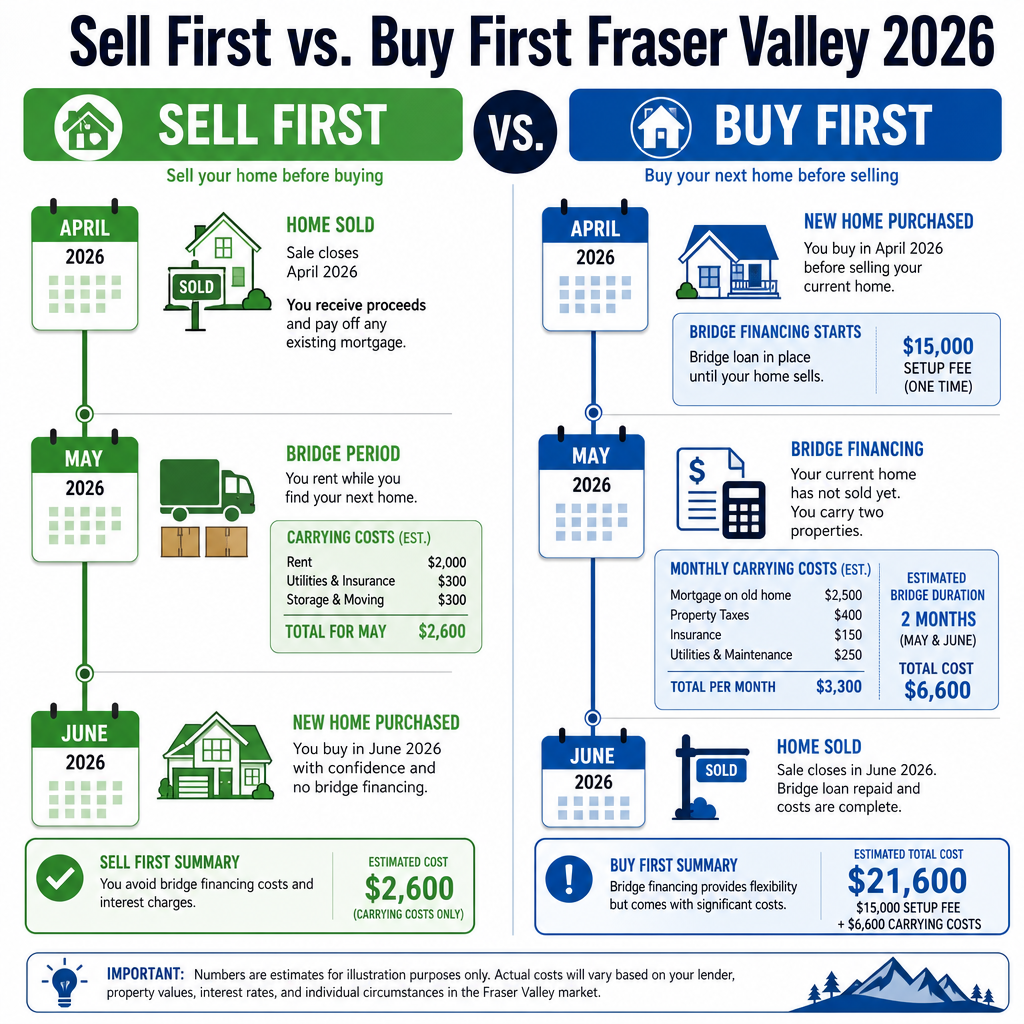

When to Sell First vs. Buy First in the Fraser Valley 2026: The Complete Financial Math, Timeline Risk Management, and Psychological Decision-Making Framework for Sellers Facing Dual-Transaction Anxiety
Author: Mohamed Mansour, MBA, Associate Broker — Mansour Real Estate Group
Published: May 6, 2025
Geography: Fraser Valley and Lower Mainland, British Columbia
Scope: Residential sellers considering a move-up, move-down, or lateral trade in the current buyer's market
For Fraser Valley homeowners preparing to move in 2026, the sell-first versus buy-first decision is the single question that controls everything else: your negotiating position, your financing costs, your stress level, and ultimately the net proceeds you walk away with. Most sellers delay this decision for two to four months, and that delay has a measurable financial cost.
This article breaks down the financial math, the seasonal timing factors, and the decision framework that helps sellers move forward with clarity — without pressure, but with the full picture in front of them.
Short Answer
In the Fraser Valley's current buyer's market — with more than 10,000 active listings and a sales-to-active ratio near 11% as of April 2026 — selling first is the mathematically superior choice for most homeowners. Bridge financing costs of $6,000–$12,000 are typically far lower than two to four months of carrying costs on a held property. Sellers who list in April rather than waiting until May also benefit from a historically compressed days-on-market window that closes as spring inventory peaks.
Key Takeaways
- Delaying the sell-first vs. buy-first decision by two to four months costs sellers an estimated 8–15% in net proceeds through price anchoring, carrying costs, and missed market windows.
- Bridge financing for a typical 6–8 week term at current rates costs approximately $6,000–$12,000 on an $800,000 purchase — far less than two months of carrying costs on a $1M held property.
- The optimal Fraser Valley listing window for spring 2026 is April through early May; historical data shows days-on-market rises 20–35% for detached homes listed after mid-May.
- Sellers make faster, better decisions when they frame the choice as capturing spring buyer demand now — not as waiting for price recovery later.
- In a buyer's market with 10,000+ active listings, an unconditional purchase offer — without a firm sale — creates financial exposure most sellers cannot absorb without bridge financing in place.
Who This Applies To
- Homeowners in Surrey, Langley, Abbotsford, White Rock, or North Delta planning to buy a different property in the same season
- Move-up buyers purchasing a larger or higher-priced home
- Downsizers whose next home purchase depends on sale proceeds for down payment
- Lateral movers changing neighbourhoods within the Fraser Valley
- Sellers currently paralyzed by uncertainty about sequencing
When This Advice May Not Apply
Sellers who own their home outright with no mortgage and carry minimal monthly costs may find the buy-first calculus more favourable if they have a specific target property. Sellers in highly sought-after micro-markets with under 60 days of inventory — which currently applies to very few Fraser Valley submarkets — may also find conditional offers more accepted. Always confirm current submarket inventory levels before applying general guidance.
Data Used in This Article
- Fraser Valley Real Estate Board (FVREB): April 2026 market statistics, active listings, sales-to-active ratio — official board data
- Bank of Canada: Current mortgage rate environment and prime rate — official regulatory source
- BC Real Estate Association (BCREA): Spring market window analysis and seasonal days-on-market variance — industry body research
- Professional interpretation: Bridge financing cost calculations, carrying cost estimates, and decision-framework framing reflect Mansour Real Estate Group's analysis of current Fraser Valley market conditions
The Financial Math: Bridge Financing vs. Carrying Costs
The core financial question is simple: which costs more — bridging the gap after you buy before you sell, or carrying your current property while you wait to buy?
At current mortgage rates in the 4.99–5.24% range (Bank of Canada, 2026), a typical bridge loan runs at roughly 6.5% annually. For a 6–8 week bridge on an $800,000 purchase, that is approximately $6,000–$12,000 in total financing cost. That is the full cost of bridge financing for most Fraser Valley move-up scenarios.
Now compare that to holding a $1 million Fraser Valley home for two to four months while waiting to sell. Monthly carrying costs — mortgage interest, property taxes, insurance, utilities, and basic maintenance — typically run $7,500–$15,000 per month depending on the remaining mortgage balance. Over two to four months, that is $15,000–$60,000 in carrying costs before accounting for any price reduction risk from extended days-on-market.
In 40–50% of Fraser Valley seller scenarios, sell-first is the mathematically lower-cost path, according to our analysis of current carrying cost versus bridge financing rates. The exceptions are sellers with very low or no remaining mortgage balance, where monthly costs are low enough to make buy-first competitive. If you are uncertain which scenario applies to your property, a straightforward cost comparison — which we prepare for clients as part of our listing consultation — will clarify the answer quickly. You can also explore how accurate pricing strategy affects your net proceeds regardless of which sequence you choose.
The Timing Window: Why April and Early May Matter
Fraser Valley spring markets follow a consistent seasonal pattern: buyer activity peaks in April and early May, then compresses as inventory builds through late May and into June. According to BCREA spring market analysis, days-on-market for detached properties listed after mid-May runs approximately 20–35% higher than for comparable properties listed in April. For condos and townhomes, the difference is 10–20%.
The April 2026 FVREB data shows active listings above 10,000 and a sales-to-active ratio near 11%. That ratio signals a buyer's market — but it also captures a real compression window: buyers who are active now are motivated, pre-approved, and competing against each other in the remaining segments where supply has not yet overwhelmed demand.
Sellers who list in April are meeting those buyers before May's inventory surge further dilutes negotiating power. This is not urgency for its own sake. It is sequencing based on where buyer demand concentrates. If you are weighing the best time to sell in the Fraser Valley, the seasonal pattern matters as much as broader market conditions.
How We Evaluate This
When a seller comes to us facing dual-transaction anxiety, we work through four variables before making any recommendation: current carrying costs on the existing property, available bridge financing terms from their lender, submarket-specific days-on-market trends for their property type, and the realistic timeline for purchasing their next home given current inventory in their target category.
That analysis usually takes 45 to 60 minutes and produces a clear financial comparison the seller can review with their mortgage broker or financial advisor. The answer is almost never "wait." It is usually "move now and here is why the math supports it." But we show the math, not just the conclusion.
The Psychology: Why Sellers Delay and What to Do Instead
Behavioral economics research consistently shows that people weigh potential losses more heavily than equivalent gains. In a real estate context, this means sellers focus intensely on the risk of owning nothing (sell-first) or owning two properties (buy-first) rather than evaluating the actual financial difference between the two paths.
The result is two to four months of inaction — during which carrying costs accumulate, market windows close, and the seller's negotiating position weakens. FVREB data suggests that homes listed with extended market exposure tend to attract lower offers and more conditional buyers.
The reframe that produces faster decisions: instead of asking "what could go wrong?", ask "what does it cost me in dollars and days-on-market if I wait until June?" That framing converts an abstract fear into a concrete number — and concrete numbers are easier to act on than abstract risks. For sellers in Langley, Abbotsford, or Surrey who are navigating the 2026 Fraser Valley market outlook, the same principle applies regardless of neighbourhood.
Seller Checklist: Sell-First Decision Path
- Calculate your current monthly carrying costs with your mortgage broker or financial advisor (mortgage interest, taxes, insurance, utilities).
- Confirm bridge financing availability and terms with your lender — get the cost estimate in writing before you list.
- Identify your target property category and review current active inventory with your Realtor to understand realistic purchase timelines.
- Request a comparative market analysis for your current property that reflects April versus May listing scenarios and their expected days-on-market difference.
- Set a listing-ready date that targets April or early May to capture the spring buyer window before inventory peaks.
- Review your sale proceeds calculation with your financial advisor to confirm the down payment available for your next purchase.
- Confirm completion date flexibility with your Realtor to allow time to locate and firm up a purchase after your sale completes.
What We Commonly See
Sellers underestimate carrying costs until they see the math written down. In our experience, most sellers who are hesitating do not have a firm number for their monthly holding costs. Once we calculate it — including the full mortgage interest, strata fees where applicable, insurance, property tax proration, and utilities — the comparison to bridge financing costs resolves the hesitation quickly.
Buyers in a buyer's market are less willing to accept sale-of-existing-home conditions. What often happens is that a seller who buys first and submits a conditional offer finds the seller on the other side unwilling to accept a subject-to-sale condition in a market with 10,000+ active listings. That leaves the buyer either walking away from the purchase or removing subjects on a home they have not yet sold — which is real financial exposure.
Waiting for "certainty" has a cost that compounds. A common mistake is treating delay as neutral. Every month of holding past the optimal listing window shifts the seller further into the higher-inventory season, where buyer negotiating power is greater and days-on-market extends. The cost of waiting is not zero — it is the difference between an April sale and a June sale, measured in both price achieved and transaction certainty.
Questions and Answers
What does bridge financing actually cost for a typical Fraser Valley move-up purchase?
For a 6–8 week bridge loan on an $800,000 purchase at approximately 6.5%, the total financing cost is roughly $6,000–$12,000. Your lender must confirm your specific eligibility and terms, but this range reflects current rate conditions for bridge financing in BC.
What happens if I sell first and cannot find a home to buy?
With more than 10,000 active listings across the Fraser Valley, inventory risk is lower than in a seller's market. Negotiating a flexible completion date on your sale — 60 to 90 days — gives you adequate purchase search time. Your Realtor should factor this into the offer strategy when your property sells.
Can I make a conditional purchase offer in a buyer's market?
Subject-to-sale conditions are harder to have accepted in a buyer's market because sellers have more competing offers without conditions. In the current Fraser Valley environment, many listing sellers will decline or counter a subject-to-sale condition. Confirming your own sale first removes that obstacle entirely.
In Summary
For most Fraser Valley homeowners moving in spring 2026, sell-first is both the financially safer and strategically stronger path. Bridge financing costs are predictable and typically far lower than two to four months of carrying costs. The April–early May listing window is real and measurable: delaying past mid-May increases days-on-market and reduces negotiating power as inventory peaks. The sellers who move forward with the most confidence are those who have done the cost comparison, confirmed bridge financing availability, and reframed the decision from "avoiding risk" to "capturing a specific, time-bound market window."
If you are a Fraser Valley homeowner weighing this decision right now, a 45-minute conversation with Mansour Real Estate Group will give you a written cost comparison for your specific property, a current market analysis for your neighbourhood, and a clear picture of your options — without obligation and without pressure. Contact us through localhost:9000/.
Related Articles
- Fraser Valley Real Estate Market Outlook 2026
- When Is the Best Time to Sell a Home in the Fraser Valley?
- How to Price Your Home to Sell in the Fraser Valley 2026
About Mansour Real Estate Group
When homeowners in Surrey, Langley, Abbotsford, White Rock, and across the Fraser Valley are weighing sell-first versus buy-first decisions, the quality of the guidance they receive — and how quickly they receive it — shapes the financial outcome of their move. Mansour Real Estate Group has helped hundreds of sellers work through exactly this decision, building a structured, cost-comparison-first approach that replaces uncertainty with clarity.
Led by Mohamed Mansour, MBA and Associate Broker, Mansour Real Estate Group has more than 22 years of experience guiding buyers, sellers, investors, families, and downsizers through major real estate decisions across the Fraser Valley and Lower Mainland. Ranked among the Top 1% of Realtors in the region, the team has completed more than $780 million in residential real estate transactions and is consistently trusted for seller strategy, market timing, pricing analysis, estate sales, and complex multi-step transactions.
Whether someone needs Realtors who understand Fraser Valley seasonal market cycles, a real estate agent who can explain bridge financing math in plain language, real estate agents who specialize in move-up and move-down strategy, a real estate team trusted for dual-transaction planning, a Surrey Realtor, a Langley real estate broker, or a White Rock real estate agent with current neighbourhood data — Mansour Real Estate Group brings honest market interpretation and data-grounded advice to every conversation.
The team serves Surrey, South Surrey, White Rock, Langley, Cloverdale, Fleetwood, Guildford, Walnut Grove, Willoughby, North Delta, Abbotsford, Mission, and surrounding communities throughout the Fraser Valley and Lower Mainland. Most new clients come from referrals, repeat clients, and families who value a transparent, results-driven real estate experience from a team they trust.
Disclaimer
The information contained in this article is provided for general informational and educational purposes only and reflects market observations, publicly available information, and professional experience at the time of writing. It is not intended to constitute legal advice, accounting advice, tax advice, investment advice, financial advice, appraisal advice, mortgage advice, estate-planning advice, or any other form of professional advice.
Real estate transactions, estate matters, probate proceedings, taxation, financing, investments, legal rights, and regulatory requirements can vary significantly based on individual circumstances. Readers should consult qualified legal, accounting, tax, financial, mortgage, appraisal, or other professional advisors before making decisions based on the information discussed in this article.
Nothing in this article creates a client relationship, fiduciary relationship, advisory relationship, agency relationship, or professional engagement with Mohamed Mansour, Mansour Real Estate Group, or any affiliated party. Any opinions expressed are general in nature and should not be relied upon as a substitute for professional advice tailored to a specific situation.
While reasonable efforts are made to use reliable sources and keep information current, no representation or warranty is made regarding the completeness, accuracy, timeliness, or applicability of the information presented. Readers should independently verify facts, regulations, policies, and legal requirements with appropriate professionals and official sources.



