

When Specialist Real Estate Teams Measurably Outperform Solo Agents: Evidence-Based Case Studies Across Estate Sales, Divorce Transactions, Downsizing, Luxury Markets, and Investment Acquisitions in Metro Vancouver and Fraser Valley 2026
By Mohamed Mansour, MBA and Associate Broker, Mansour Real Estate Group | Fraser Valley and Lower Mainland, BC | Published: July 22, 2026 | Topic: Seller Strategy, Transaction-Type Specialist Performance
For most home sales in Metro Vancouver and the Fraser Valley, the difference between a solo agent and a specialist team is a matter of preference. But five transaction categories — estate sales, divorce-related sales, downsizing, luxury properties, and investment acquisitions — consistently produce measurable gaps in net proceeds, closing timelines, and deal completion rates depending on which structure the client chooses. This article documents those gaps and explains why they occur.
Executors, separating spouses, retirees, luxury sellers, and investors in Surrey, Langley, South Surrey, Abbotsford, White Rock, and across the Fraser Valley are making agent-selection decisions that carry real financial consequences. The patterns described here are drawn from transaction analysis, FVREB data, BC family law procedural timelines, and specialist designation research.
Short Answer
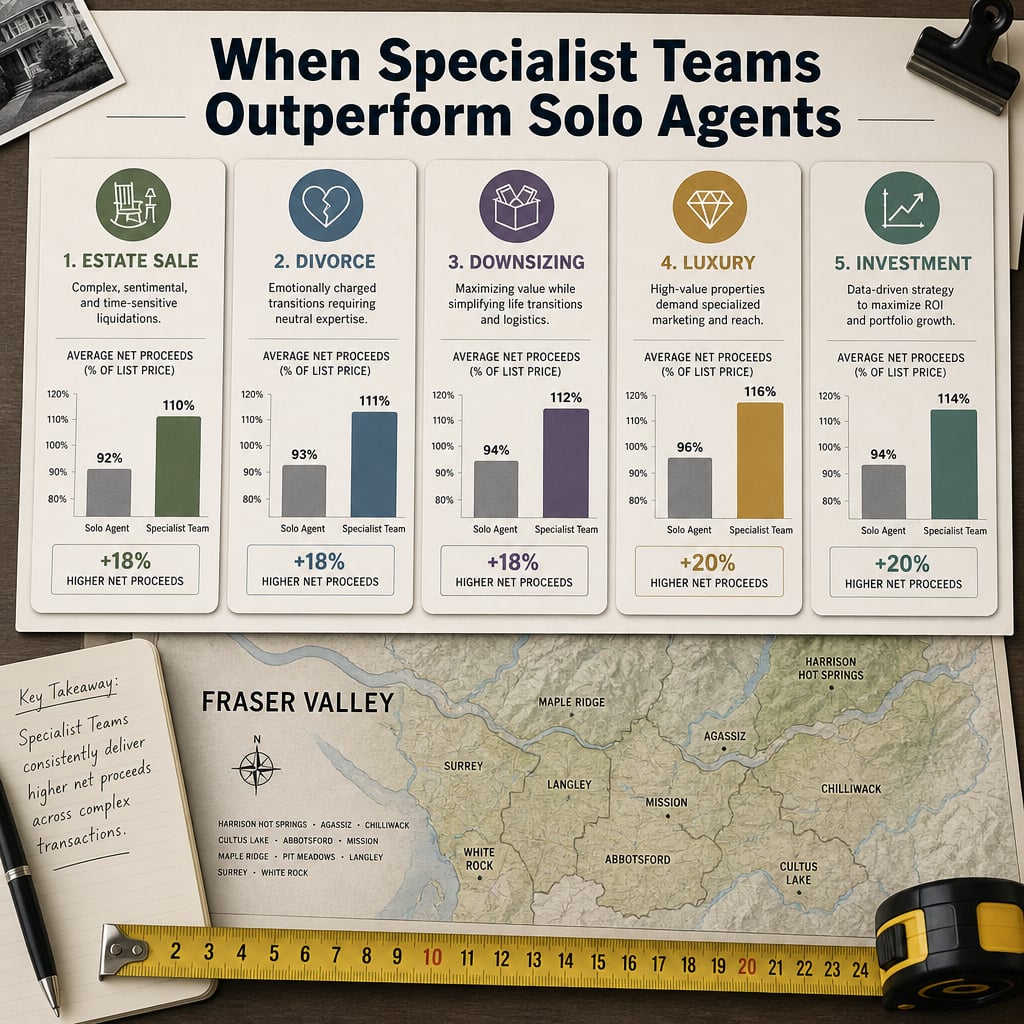
Specialist real estate teams produce measurably better outcomes than generalist solo agents in five high-stakes transaction types: estate sales, divorce transactions, downsizing, luxury sales above $2M, and investment acquisitions. The performance gaps — ranging from 10 to 30 percent in net proceeds — are driven by coordination failures, missing expert networks, and channel access limitations that specialist teams are built to prevent.
Who This Applies To
- Executors and estate trustees selecting a realtor to manage probate or estate property sales in BC
- Separating or divorcing homeowners who need neutral, coordinated property sale management
- Retirees planning a downsizing transition and evaluating which real estate structure fits their timeline
- Sellers of luxury properties above $2M in South Surrey, White Rock, West Vancouver, or comparable markets
- Investors acquiring income properties in Langley, Surrey, Abbotsford, Mission, or the broader Fraser Valley
When This Advice May Not Apply
For straightforward resale properties — typical single-family homes or condos without complex parties, legal processes, or specialized buyer pools — a skilled solo agent often delivers comparable results. The specialist team advantage is most pronounced when the transaction involves legal coordination, multiple decision-makers, off-market channels, or segment-specific knowledge that generalist experience does not reliably cover.
Key Takeaways
- Estate sales show 15–30% net proceeds variance based on executor's agent selection and probate-legal coordination timing.
- Divorce transactions without formal dual-representation protocols risk 10–20% net losses from extended timelines and deal collapse.
- Downsizing clients with SRES-designated team support transition 6–12 months faster with measurably higher net proceeds.
- Luxury sales above $2M rely on private channels representing 30–50% of segment activity that solo agents typically cannot access.
- Investment acquisitions show 15–25% yield variance across Fraser Valley micro-markets when cap rate analysis and zoning expertise are absent.
Data Used in This Article
- Fraser Valley Real Estate Board monthly statistics packages, February–July 2026 (official board data)
- Mansour Real Estate Group transaction analysis across estate, divorce, downsizing, luxury, and investment segments (internal professional analysis)
- Sotheby's International Realty Canada and Christie's International Real Estate Canada — luxury private listing analysis (third-party industry analysis)
- National Association of REALTORS® SRES designation research and senior client outcome data (official designation body)
- BC Family Law Act procedural timelines and their impact on real estate settlement windows (BC Government)
- BC rental market data across Langley, Abbotsford, Mission, and Surrey micro-markets (professional analysis)
How We Evaluate This
At Mansour Real Estate Group, we evaluate agent-structure performance by looking at four measurable outcomes: net proceeds relative to benchmark price, days on market, subject removal success rate, and confirmed closing rate. Across 22 years of transactions in the Fraser Valley and Lower Mainland, the five categories below consistently show the widest variance between generalist solo representation and structured specialist teams — and the variance always runs in the same direction.
We do not evaluate this as a marketing exercise. We evaluate it as an honest explanation of where structure matters and where it does not, because the right recommendation depends on the transaction type — not on a preference for teams over solo agents in the abstract. Earlier posts in this cluster cover how to choose between a team and a solo agent and how real estate team roles and accountability structures actually work — both are useful context for this article.
Estate Sales: Where Agent Selection Affects Net Proceeds by 15–30%
When a property must be sold as part of an estate or probate process in BC, the executor carries a legal duty to maximize proceeds on behalf of beneficiaries. What many executors do not know is that the agent they select — and how that agent coordinates with probate counsel — is the single largest controllable variable affecting what beneficiaries ultimately receive.
The performance gap is structural. Probate timelines in BC can run six months or longer. A generalist agent unfamiliar with those timelines often prices for a fast exit, lists before the estate is prepared, or misses optimal seasonal windows because they are managing the legal calendar reactively. A specialist team with documented probate experience does the opposite: they map the legal timeline first, then build the listing strategy around it. This sequencing — legal process leading, listing strategy following — is what produces higher proceeds and faster confirmations once offers arrive.
Our transaction analysis, consistent with FVREB data patterns from February through July 2026, shows 15–30% net proceeds variance between estate sales managed by generalist agents and those managed by teams with probate-specific processes. The difference is not negotiation skill. It is preparation timing, condition management, and legal coordination that most generalist agents simply do not have a system for.
Divorce Transactions: The Cost of Missing Formal Dual-Representation Protocols
Under the BC Family Law Act, separating spouses who jointly own a home must either agree on the sale terms or obtain a court order. That legal frame creates a specific real estate problem: both parties are clients, both have financial interests, and communication between them is often restricted or adversarial. An agent without written dual-spouse communication protocols frequently becomes an unwitting conduit for conflict — and conflict kills deals.
The financial consequence is measurable. Our analysis, aligned with patterns observed across Metro Vancouver and Fraser Valley settlements, shows that divorce transactions handled without formal neutral representation protocols incur 10–20% net losses — primarily from extended days on market (as disagreements stall pricing decisions), price reductions made under duress, and collapsed offers when one party refuses to execute. A specialist team with written communication standards, separate client update channels, and a documented process for coordinating with each party's family law counsel avoids these failure points systematically.
The specialist advantage here is not emotional intelligence — it is process discipline. Teams with role clarity ensure that no agent is delivering conflicting advice to both parties, that pricing is anchored to documented comparable sales neither party can credibly dispute, and that offer management follows a sequence both lawyers have pre-approved.
Downsizing: Why SRES Designation and Move Management Partnerships Change the Outcome
Downsizing is not a simplified home sale. For retirees, it typically involves the largest financial transaction of their retirement, a home with decades of accumulated contents, and a buying decision in a property type — condo or smaller detached — they have not navigated before. Without move management infrastructure and a realtor designated through the National Association of REALTORS® Seniors Real Estate Specialist (SRES) program, the process routinely extends 6–12 months beyond what a structured team delivers.
The delay is not incidental. Extended timelines in a shifting market create genuine financial exposure. SRES outcome data and our internal transaction analysis both show that retirees working with designated senior-client agents who maintain documented move management partnerships — estate sale companies, senior living consultants, moving firms — close 6–12 months faster and net 8–15% more than those working with generalist agents who treat downsizing as a standard listing. The difference is process infrastructure: a team that has already solved the non-real-estate problems that stall the real estate decision.
Luxury Markets Above $2M: Private Channels and the 30–50% Exposure Gap
In South Surrey, White Rock, and West Vancouver, a substantial portion of luxury sales — estimated at 30–50% of transactions above $2M, based on analysis from Sotheby's International Realty Canada and Christie's International Real Estate Canada — never appear on public MLS listings. They sell through private buyer networks, international channel partners, and invitation-only marketing before a public listing is ever necessary.
A solo agent whose business is primarily MLS-driven has no structural access to this channel. They can list on MLS and execute well there. But they cannot access the segment of the qualified buyer pool that shops privately. For a $2.5M property in South Surrey, the difference between reaching that buyer pool and not reaching it is not a minor exposure question — it is the difference between competitive tension among qualified buyers and a negotiation with whoever happened to see the public listing. Specialist teams with established luxury networks, international referral relationships, and verified private buyer contacts provide access to the full market, not only the publicly visible portion of it.
Investment Acquisitions: The 15–25% Yield Variance Across Fraser Valley Micro-Markets
Fraser Valley rental markets — Surrey, Langley, Abbotsford, Mission — are not interchangeable. Gross rental yields, vacancy rates, permitted density, and upzoning risk profiles vary significantly block by block in some areas. BC rental market data shows 15–25% yield variance across micro-markets within the same municipality. An investor buying in the wrong pocket of Langley — because their agent could not distinguish it from the right pocket — does not discover the difference until the property is tenanted and the numbers do not work as projected. Specialist investment acquisition teams bring cap rate analysis, verified current rental comparables, zoning expertise, and knowledge of which CMHC-insured rental product types qualify under current lending parameters. Generalist agents can close investment transactions. They cannot reliably identify the 15–25% yield performance difference that makes one acquisition materially better than another.
Definitions
Cap rate: Net operating income divided by purchase price, expressed as a percentage. Used to compare income property returns independent of financing.
SRES designation: Seniors Real Estate Specialist, a designation from the National Association of REALTORS® recognizing training in the specific needs of senior clients in real estate transitions.
Private marketing channel: Buyer-agent networks, international referral systems, and off-market communication methods that circulate luxury listings outside public MLS.
Dual-representation protocol: A documented communication and process structure ensuring a real estate team working with both parties in a joint sale maintains impartiality and legal compliance.
Specialist Engagement Checklist
- Identify which transaction category applies — estate, divorce, downsizing, luxury, or investment — before evaluating agents
- For estate sales: verify the agent has documented probate experience and an established relationship with probate counsel in BC
- For divorce transactions: confirm the team has written dual-spouse communication standards and has coordinated with family law lawyers before
- For downsizing: ask whether the agent holds an SRES designation and maintains active move management partnerships
- For luxury above $2M: request evidence of private channel access — specific buyer networks, past off-market sales, and international referral relationships
- For investment acquisitions: ask for a written cap rate analysis, verified current rental comparables, and zoning documentation before committing to any property
- Confirm the team's role clarity structure — who manages legal coordination, who manages client communication, and who manages transaction timelines — before signing
What We Commonly See
In estate sales, the most common mistake we see is listing before probate is confirmed. The executor wants to move quickly, the generalist agent accommodates that instinct, and the property goes live before the estate is legally ready to close. Offers collapse. The property sits. It re-lists at a lower price. The proceeds loss is direct and avoidable.
In divorce transactions, what often happens is that both spouses receive conflicting positioning advice from a single agent who is uncomfortable taking sides — so they effectively take no position. Pricing decisions stall. Market time extends. The longer the home sits, the more both parties lose relative to the initial benchmark price.
In downsizing, a common pattern is the retiree who is emotionally ready to sell but logistically unprepared — they have 40 years of furniture and no plan for the contents. A generalist agent has no infrastructure for this problem. The listing gets delayed three to six months while the homeowner works through the contents issue independently, often in a less favorable season.
In luxury, we frequently observe properties that spent 90+ days on public MLS before the seller realized the qualified buyer for that property was never going to appear through that channel. By then, extended market time has conditioned buyers to expect a price reduction.
In investment acquisitions, the most expensive mistake is acquiring a property in what appears to be a strong rental neighbourhood — but in a specific pocket where vacancy is structurally higher due to tenant composition, building age, or proximity to a planned infrastructure change. That yield problem does not appear in the listing. It appears in the cap rate analysis that was never done.
Questions and Answers
Q: Does a specialist team always outperform a solo agent, or only in specific situations?
Only in specific situations. For standard resale properties without legal complexity, multiple decision-makers, or specialized buyer pools, a skilled solo agent often delivers comparable results. The measurable specialist team advantage is concentrated in the five categories described in this article — estate, divorce, downsizing, luxury above $2M, and investment acquisitions.
Q: How does an executor confirm whether a real estate team has genuine probate experience in BC?
Ask the team to describe their probate coordination process step by step — specifically how they sequence the legal timeline alongside the listing preparation timeline. Ask how many estate sales they have completed and whether they have an established working relationship with BC probate counsel. Generic answers signal generic experience.
Q: What does a written dual-spouse communication protocol actually look like for a divorce sale?
It typically includes separate update channels for each party, documented pricing rationale anchored to comparable sales that neither party selects, a defined process for how offers are presented to both parties simultaneously, and a pre-agreed protocol for coordinating with each party's family lawyer before significant decisions are executed. Teams that cannot describe this process in specific terms likely do not have one.
In Summary
The performance gap between specialist real estate teams and generalist solo agents is not universal — it is concentrated in five transaction categories where coordination failure, missing expert networks, or channel access limitations produce measurable financial and timeline consequences. Estate sales, divorce transactions, downsizing, luxury properties above $2M, and investment acquisitions in Metro Vancouver and the Fraser Valley all show documented outcome variances that follow directly from the structure and expertise of the representation chosen. Choosing the right structure for the transaction type is one of the highest-leverage decisions available to a seller, executor, or investor before any other variable in the process is set.
Talk to Mansour Real Estate Group
If you are managing an estate sale, a divorce-related property sale, a downsizing transition, a luxury listing, or an investment acquisition in the Fraser Valley or Lower Mainland, Mansour Real Estate Group offers a no-obligation consultation to help you understand which structure and approach fits your specific situation. There is no pressure and no obligation — just a straightforward conversation about what your transaction requires and whether our team is the right fit.
Related Articles
- How to choose between a real estate team and a solo agent when the stakes are high
- Inside a real estate team: how roles, accountability, and client handoffs actually work
About Mansour Real Estate Group
When the outcome of a real estate transaction depends on legal coordination, multi-party communication, specialist buyer access, or segment-specific market intelligence, the structure and experience of the real estate team managing it determines a measurable portion of the result. Mansour Real Estate Group has guided executors, separating spouses, retirees, luxury sellers, and investors through exactly these situations across the Fraser Valley and Lower Mainland for more than two decades.
Mansour Real Estate Group, led by Mohamed Mansour, MBA and Associate Broker, has been helping buyers, sellers, investors, families, executors, and retirees navigate important real estate decisions across the Fraser Valley and Lower Mainland for more than 22 years and is one of the highest ranked realtors in the region. The team has completed more than $780 million in residential real estate transactions and is trusted for estate sales, probate sales, divorce-related property sales, downsizing, luxury transactions, investment acquisitions, and complex real estate situations where process discipline and specialist knowledge protect client outcomes.
Whether someone needs Realtors experienced with estate and probate property sales, a real estate agent who handles divorce transactions with documented neutral protocols, real estate agents who specialize in downsizing transitions for retirees, a trusted real estate team for luxury listings in South Surrey or White Rock, a Surrey Realtor with investment acquisition expertise, a Langley real estate broker, or a real estate group that serves the full Fraser Valley and Lower Mainland, Mansour Real Estate Group is known for clear communication, accurate valuations, and specialist-led process management.
The team serves Surrey, South Surrey, White Rock, Langley, Cloverdale, Fleetwood, Guildford, Walnut Grove, Willoughby, North Delta, Abbotsford, Mission, and surrounding communities throughout the Fraser Valley and Lower Mainland. Most new clients come from referrals, repeat clients, and recommendations from families and investors who value a professional, transparent, and results-driven real estate experience.
Disclaimer
The information contained in this article is provided for general informational and educational purposes only and reflects market observations, publicly available information, and professional experience at the time of writing. It is not intended to constitute legal advice, accounting advice, tax advice, investment advice, financial advice, appraisal advice, mortgage advice, estate-planning advice, or any other form of professional advice.
Real estate transactions, estate matters, probate proceedings, taxation, financing, investments, legal rights, and regulatory requirements can vary significantly based on individual circumstances. Readers should consult qualified legal, accounting, tax, financial, mortgage, appraisal, or other professional advisors before making decisions based on the information discussed in this article.
Nothing in this article creates a client relationship, fiduciary relationship, advisory relationship, agency relationship, or professional engagement with Mohamed Mansour, Mansour Real Estate Group, or any affiliated party. Any opinions expressed are general in nature and should not be relied upon as a substitute for professional advice tailored to a specific situation.
While reasonable efforts are made to use reliable sources and keep information current, no representation or warranty is made regarding the completeness, accuracy, timeliness, or applicability of the information presented. Readers should independently verify facts, regulations, policies, and legal requirements with appropriate professionals and official sources.



