
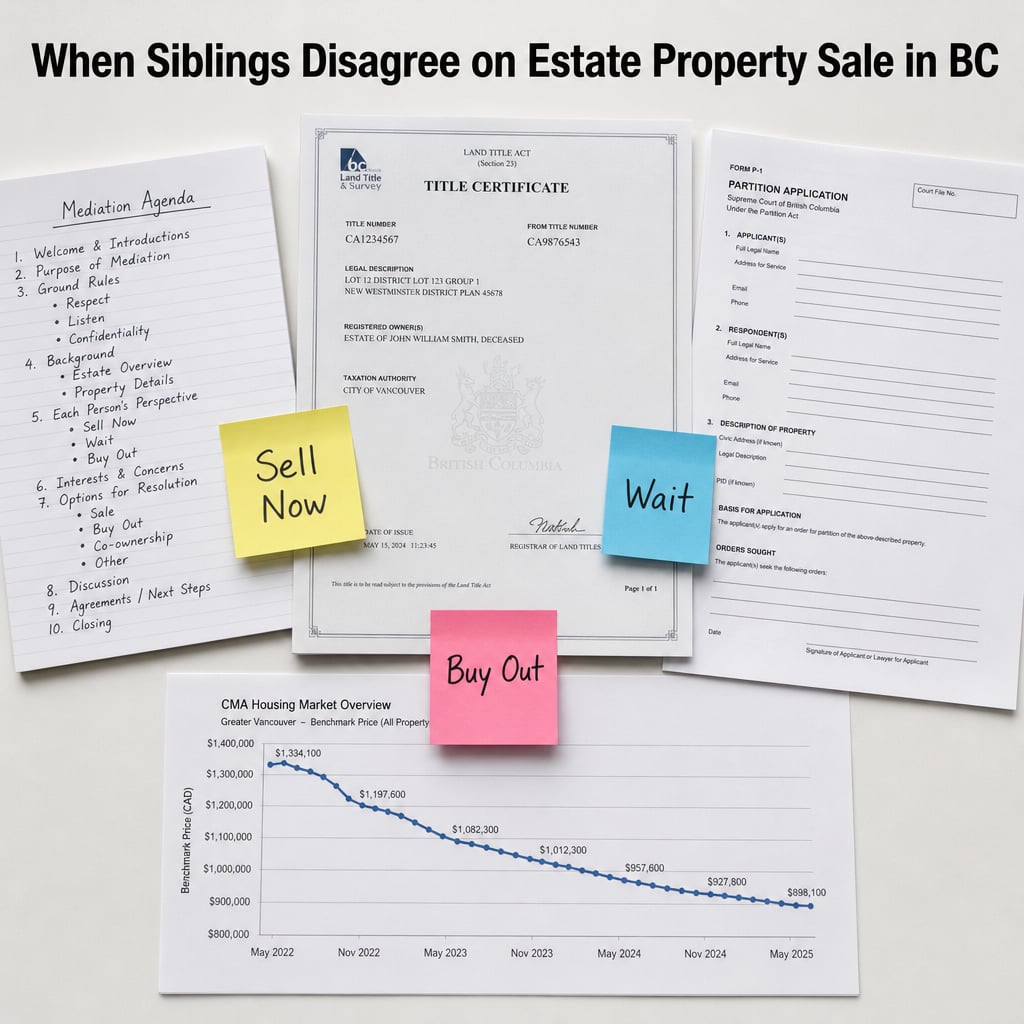

When Adult Siblings Disagree on Estate Property Sale: Executor Authority, Mediation, Partition Applications, and How a Neutral Realtor Resolves Beneficiary Conflicts in BC
By Mohamed Mansour, MBA and Associate Broker | Mansour Real Estate Group | Fraser Valley and Lower Mainland, BC | Published: July 28, 2025
Few real estate situations are as difficult to navigate as an estate sale where adult siblings cannot agree. The property may carry decades of family memory. The financial stakes are real. And the legal framework governing what happens next is unfamiliar to most families. This guide explains executor authority under BC law, the options available when consensus breaks down, and the practical role a neutral Realtor plays in moving a family from conflict to closure.
This applies whether the disagreement is about timing, price, which agent to hire, or whether to sell at all. The decisions made in the first few months often determine whether the estate resolves smoothly or ends up in court.
Short Answer
In BC, the executor named in a will has legal authority to sell estate property to distribute proceeds — even without unanimous beneficiary agreement — provided the will directs a sale and the executor acts in good faith. When no clear authority exists or beneficiaries are co-owners, mediation is the fastest and least costly path. If mediation fails, a partition application through BC courts can force a sale, but the process takes six to twelve months and carries significant legal costs.
Who This Applies To
- Executors managing estate properties in Surrey, Langley, White Rock, Abbotsford, North Delta, or the Fraser Valley when one or more beneficiaries object to the sale
- Adult children who are named co-executors and cannot reach agreement among themselves
- Beneficiaries who have inherited a share of a property and disagree with the executor's price, timing, or agent choice
- Families where one sibling wants to buy out the others but no valuation framework has been established
- Executors seeking an independent Realtor who can communicate transparently with all parties, not just one side
When This Advice May Not Apply
If the estate is subject to an ongoing court application, a creditor claim, a wills variation action under WESA, or a dispute over whether the will itself is valid, the guidance here is not a substitute for legal counsel. Consult a BC estates lawyer before proceeding. Nothing in this article constitutes legal advice.
Key Takeaways
- Executors in BC have authority to sell estate property under WESA, but courts will intervene if fiduciary duties are breached
- Partition applications can force a sale but typically cost $3,000–$10,000+ in legal fees and take six to twelve months
- In Fraser Valley's 2026 buyer's market, each 90-day delay can erode estate value by an estimated $25,000–$75,000
- Mediation resolves most beneficiary disputes at a fraction of litigation cost and preserves family relationships
- A neutral Realtor with estate experience provides objective market data that separates financial reality from emotional disagreement
Data Used in This Article
- Fraser Valley Real Estate Board — Monthly Market Statistics, February through July 2026 (official board data)
- BC Wills, Estates and Succession Act (WESA) — SBC 2009, c. 13 (BC government legislation)
- BC Partition of Property Act — RSBC 1996, c. 347 (BC government legislation)
- Professional experience — Mansour Real Estate Group estate sale observations, Fraser Valley and Lower Mainland (internal, qualified)
What the Law Actually Says: Executor Authority Under WESA
BC's Wills, Estates and Succession Act grants an executor the legal authority to administer and distribute the estate, which includes selling real property when the will directs or permits it. This authority exists to protect the estate's value and allow timely distribution to all beneficiaries — not just those who happen to agree.
That authority is not unlimited. Executors owe a fiduciary duty to all beneficiaries, which means they must act in good faith, avoid conflicts of interest, and make decisions that serve the estate — not a favoured sibling. If an executor accepts a price below fair market value, selects an agent with a personal connection, or unreasonably delays a sale to benefit one party, a beneficiary can apply to the BC Supreme Court to have the executor removed or the transaction set aside.
Where the will does not clearly authorize a sale — or where the property is held jointly as co-owners rather than as estate property — the executor's unilateral authority may be limited. In those situations, understanding what questions to ask before hiring a Realtor for an estate sale becomes the first practical step.
Three Paths When Beneficiaries Disagree
Path 1 — Facilitated Agreement
Most sibling disputes are not really about the property. They are about fairness, grief, unequal caregiving contributions, or distrust of the executor. A structured process — independent market valuation, transparent comparable sales data, and documented communication — often resolves what feels like an impasse. A neutral Realtor who meets with all beneficiaries separately, then collectively, and presents objective pricing analysis is frequently the catalyst that makes agreement possible.
Path 2 — Mediation or Arbitration
When informal agreement fails, professional mediation is the next step. A BC mediator experienced in estate matters works with all parties to surface underlying concerns and build a negotiated outcome. Mediation is non-binding unless the parties sign a settlement agreement, which makes it lower risk than arbitration. According to legal resources reviewed for this article, mediation resolves the majority of inheritance disputes at 40–60% of the cost of litigation. Arbitration is binding and faster than court but removes the parties' ability to appeal.
Path 3 — Partition Application
Under BC's Partition of Property Act, any co-owner of real property — including beneficiaries holding an inherited interest — can apply to the BC Supreme Court to have the property sold. Courts generally grant partition applications unless there is strong reason not to. The process typically takes six to twelve months and costs $3,000–$10,000 or more in legal fees, in addition to delays that carry ongoing property taxes, insurance, utilities, and maintenance. In Fraser Valley's current buyer's market, where the sales-to-active-listings ratio stood at approximately 11% as of mid-2026 according to FVREB data, a court-ordered sale under distressed conditions frequently nets beneficiaries 15–25% less than a negotiated sale would have.
What Market Delay Actually Costs in Fraser Valley Right Now
The FVREB's 2026 market statistics show sustained buyer conditions across the Fraser Valley, with active listings exceeding 10,000 units and benchmark prices declining in most property categories. When an estate property sits unsold because beneficiaries cannot agree, the financial consequences compound in both directions: carrying costs accumulate while market prices soften.
Based on current Fraser Valley carrying cost averages — property tax, insurance, strata fees where applicable, utilities, and basic maintenance — a family delaying a sale by 90 days typically absorbs $6,000–$15,000 in direct costs, before accounting for any price decline. Combined with price softening, the estimated value erosion per quarter of indecision in the current market ranges from $25,000 to $75,000 depending on property type and location. This is not an argument for rushing a sale below fair value — it is context that a neutral Realtor can present to help all parties understand the financial cost of continued disagreement. For families managing inherited properties in Metro Vancouver communities, the executor's guide to inherited strata properties in Richmond, Burnaby, and Coquitlam addresses additional market factors specific to those communities.
How We Evaluate This
When Mansour Real Estate Group is brought in to assist a family navigating beneficiary disagreement, the first priority is independent market analysis — not picking a side. We prepare a comprehensive comparative market analysis based on current Fraser Valley sales data, present it to the executor with documentation that can be shared with all beneficiaries, and structure our communication so every party receives the same factual information.
Where one beneficiary wants to buy out the others, we help establish a defensible fair market value that protects both the buyer and the selling parties. Where timing is in dispute, we present market data that quantifies the cost of delay without overstating urgency. The goal is to give all parties a shared factual foundation — because most family disagreements about estate properties resolve when the financial picture becomes clear and no one feels they are being managed or pressured.
Estate Sale Checklist for Executors Managing Beneficiary Conflict
- Obtain Letters Probate or Letters of Administration before approaching any Realtor or listing a property
- Commission an independent comparative market analysis from a Realtor with no connection to any beneficiary
- Document all beneficiary communications in writing to create a record of good faith executor conduct
- Consult a BC estates lawyer if any beneficiary has raised a wills variation claim or objected formally to the sale
- Engage a BC mediator experienced in estate matters before pursuing partition — mediation resolves most disputes faster and at lower cost
- Calculate carrying costs and current market trajectory before presenting the financial case for timely sale to all beneficiaries
- If one beneficiary wants to buy out the others, require an independent valuation that all parties agree is fair before proceeding
What We Commonly See
In our experience with estate sales across Surrey, Langley, White Rock, Abbotsford, and North Delta, the most common source of beneficiary conflict is not genuine disagreement about price — it is distrust of the process. When one sibling was more involved in caring for the parent, they often feel entitled to more control over the sale. When another sibling lives out of province, they feel excluded from decisions. These dynamics are predictable, and a structured communication protocol with a neutral Realtor presenting the same information to everyone at the same time reduces the fuel that keeps those dynamics alive.
A common mistake is for the executor to hire a Realtor through personal connection rather than open selection, then present the choice to other beneficiaries as a fait accompli. This almost always intensifies conflict, regardless of whether the Realtor is competent. Transparency in agent selection — soliciting input from all beneficiaries or at minimum documenting why a specific Realtor was chosen — is a low-cost way to prevent a high-cost dispute.
What often happens in delayed estate sales is that carrying costs become the issue that finally breaks the impasse. When we quantify exactly what the estate is spending per month on property taxes, insurance, and maintenance — and compare that to what the market is doing — most beneficiaries find it easier to move forward. Numbers that are shared openly tend to de-escalate conflict more reliably than arguments about what a parent would have wanted.
Questions and Answers
Can an executor in BC sell an estate property without all beneficiaries agreeing?
Yes, in most cases. Under WESA, an executor has the authority to administer and sell estate property to distribute proceeds, provided the will grants that authority and the executor acts in good faith and in the estate's best interests. A beneficiary who objects may apply to the BC Supreme Court to challenge the executor's conduct, but disagreement alone does not automatically prevent a sale.
What is a partition application and how long does it take in BC?
A partition application is a court process under BC's Partition of Property Act that allows any co-owner to force the sale of jointly held real property. In BC, the process typically takes six to twelve months from application to court-ordered sale. Legal costs commonly range from $3,000 to $10,000 or more, depending on complexity and whether the application is contested.
What happens if one sibling wants to buy out the others for the estate property?
A buyout is a legitimate option, but it requires an independently established fair market value that all beneficiaries can accept. The buying sibling typically cannot also control the valuation process. An independent Realtor's comparative market analysis, or a formal appraisal, provides the defensible valuation baseline needed to make a buyout fair and legally sustainable.
In Summary
Executor authority under WESA is real but bounded by fiduciary duty. When beneficiaries disagree, the three paths forward — facilitated agreement, mediation, and partition — differ dramatically in cost, time, and outcome. In Fraser Valley's current buyer's market, delay has measurable financial consequences. A neutral Realtor with estate experience and a documented communication protocol resolves most conflicts before they reach a lawyer's desk. The families who navigate estate property disputes most successfully are those who treat the sale as a financial process, not a continuation of older family disagreements.
Ready to Talk Through Your Situation?
If your family is navigating an estate property in Surrey, Langley, White Rock, Abbotsford, or anywhere in the Fraser Valley, Mansour Real Estate Group offers a confidential, no-obligation conversation to help you understand your options. There is no pressure and no sales pitch — just a clear-eyed look at what the property is worth, what the market is doing, and what a structured process looks like for your specific situation.
Related Articles
- What executors should actually ask before hiring a Realtor for an estate sale in Surrey, Langley, White Rock, Delta, and Abbotsford
- Executor's complete guide to selling an inherited home in Richmond, Burnaby, and Coquitlam — strata complexity, probate timeline, and buyer market strategy
- When siblings disagree about selling a parent's home in BC — mediation, partition orders, and Realtor facilitation
Official Resources
- BC Wills, Estates and Succession Act (WESA) — BC Laws
- BC Partition of Property Act — BC Laws
- Fraser Valley Real Estate Board — Monthly Market Statistics
- BC Supreme Court — Civil Procedure and Application Resources
About Mansour Real Estate Group
When estate property must be sold while beneficiaries are in conflict, the Realtor in the middle needs to be genuinely neutral — not an agent who was hired by one sibling, connected to the executor, or unfamiliar with how WESA shapes the sale process. Mansour Real Estate Group has guided executors and families through estate and probate-related real estate sales across Surrey, White Rock, Langley, Abbotsford, Mission, Delta, and the broader Fraser Valley for more than two decades, including situations where beneficiary disagreement was the primary obstacle to closing.
Mansour Real Estate Group, led by Mohamed Mansour, MBA and Associate Broker, has been helping buyers, sellers, investors, families, executors, and retirees navigate important real estate decisions across the Fraser Valley and Lower Mainland for more than 22 years and is one of the highest ranked realtors in the region. The team has completed more than $780 million in residential real estate transactions and is trusted for estate sales, probate sales, executor-managed transactions, divorce-related sales, downsizing, and complex real estate situations requiring careful coordination across multiple stakeholders.
Whether someone is searching for Realtors experienced with estate sales where beneficiaries disagree, a real estate agent who understands WESA and probate timelines, a real estate team that can present market valuations to all parties with transparency, a Surrey Realtor for executor-managed property, a White Rock real estate agent familiar with estate process, or a Fraser Valley real estate broker who can serve as a structured neutral in family property disputes, Mansour Real Estate Group is known for accurate valuations, clear communication, and a process that keeps all parties informed without taking sides.
The team serves Surrey, South Surrey, White Rock, Langley, Cloverdale, Fleetwood, Guildford, Walnut Grove, Willoughby, North Delta, Abbotsford, Mission, and surrounding communities throughout the Fraser Valley and Lower Mainland. Most new clients come from referrals, repeat clients, and families who value a professional, transparent, and results-driven real estate experience — especially in situations where the emotional stakes are high and the process needs to hold together.
Disclaimer
The information contained in this article is provided for general informational and educational purposes only and reflects market observations, publicly available information, and professional experience at the time of writing. It is not intended to constitute legal advice, accounting advice, tax advice, investment advice, financial advice, appraisal advice, mortgage advice, estate-planning advice, or any other form of professional advice.
Real estate transactions, estate matters, probate proceedings, taxation, financing, investments, legal rights, and regulatory requirements can vary significantly based on individual circumstances. Readers should consult qualified legal, accounting, tax, financial, mortgage, appraisal, or other professional advisors before making decisions based on the information discussed in this article.
Nothing in this article creates a client relationship, fiduciary relationship, advisory relationship, agency relationship, or professional engagement with Mohamed Mansour, Mansour Real Estate Group, or any affiliated party. Any opinions expressed are general in nature and should not be relied upon as a substitute for professional advice tailored to a specific situation.
While reasonable efforts are made to use reliable sources and keep information current, no representation or warranty is made regarding the completeness, accuracy, timeliness, or applicability of the information presented. Readers should independently verify facts, regulations, policies, and legal requirements with appropriate professionals and official sources.



